The End Is Always Pending | Dan Leach’s Junah at the End of the World
Forget baseball—doomsday prophecy is our actual national pastime. If the end of the world isn’t bearing down on us, it’s ceaselessly swinging back to take another crack. We’ve survived decades of false apocalypses: from the Jupiter Effect to Planet X, from Harold Camping’s ridiculous rapture forecasts to Pat Robertson’s end-times tantrums, through the anticlimax of Y2K, from the great Mayan calendar miscalculation of 2012 to the latest QAnon cons peddling cheap panic, cheaper merch, and a reminder to smash that Like button before JFK Jr. pilots your ass to Gitmo. For years, we’ve heard from a crank chorus of charlatans that the final curtain could fall at any time. However, that hasn’t happened, so most of our lives are spent in this clickbait purgatory between unending non-endings.
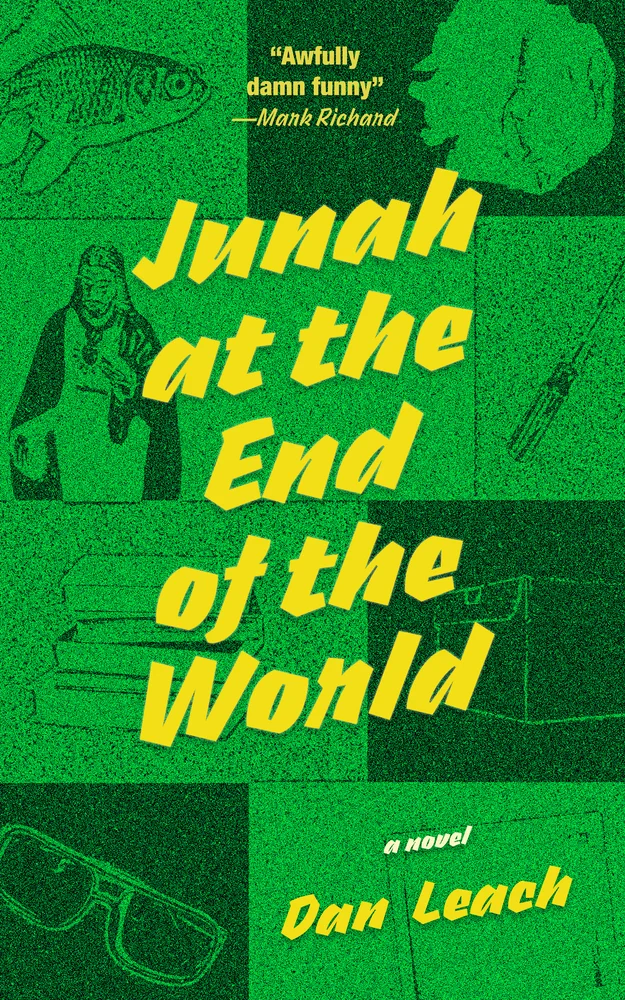
Enter Dan Leach’s eerily prescient and poetically elegiac first novel, Junah at the End of the World. Set in the twilight of 1999, it’s not just a coming-of-age story, but a coming-of-apocalypse tale told through the eyes of a boy who can’t bear to face the day without dark sunglasses. And it’s not because his future’s so bright he’s gotta wear shades, but because tomorrow already seems like a bad bet. Like a lone tenor singing in an abandoned megachurch, Leach’s throwback nineties book hits all the right notes in this foul Year of Our Lord 2025 when it genuinely feels like we’re only a few executive blunders away from the big goodbye.
The luminaries cracked this code long ago: the best kid protagonists aren’t bubble-wrapped in innocence. Why waste words on wide-eyed wonder when you can give them barbwire wit and a working knowledge of adult disappointment? These characters don’t so much come of age as they arrive already halfway grown. Take Judy Blume’s Otherwise Known as Sheila the Great or Padgett Powell’s Edisto. Salinger practically patented this move in his oeuvre. And now Dan Leach steps confidently into this proud lineage of pint-size philosophers, handing his young sage a pair of thrift-shop Wayfarers and a front-row seat to Armageddon.
A child of divorce, the titular Junah Simmons is twelve, an outcast with a speech impediment and no shortage of sharp things to say. “What I love to do is look,” he says early in the book. “Look: the Japanese maple has turned popsicle-orange. Look: there’s a plastic solemn Jesus on my mother’s dusty dashboard.” In a town as static as Greenville, South Carolina, there isn’t much for a middle-schooler to do in the waning days of the empire. You either retreat into your imagination, fall dangerously in love, or find a hobby before boredom swallows you whole. Junah does all three.
When his unconventional teacher, Miss Meechum, assigns the class a time-capsule project meant for the Y2K survivors of some far-flung future, Junah turns the task into a full-time job. His shoebox becomes a kind of black box, packed with the raw data of a life and times in freefall: sentimental objects, scraps of stories, fragments, photographs, and an assortment of mystical middle school musings. In the process, Junah vaults into the pantheon of great literary obsessives, a bona fide renaissance kid, equal parts artist, curator, and end-times archivist, pursuing his doomed project with the kindred conviction of Don Quixote chasing windmills, Ahab hunting his white whale, or Jay Gatsby slinking around in the dark, seduced by the green light at the edge of Daisy’s dock.
The time capsule isn’t just a container; it’s Junah’s last dispatch, his Hail Mary spiral to some future receiver who might one day open it and understand what it felt like to be alive at a certain time and place. One shoebox won’t cut it, either, so Junah occupies his evenings in the Pipe—an abandoned drainage ditch in the woods behind his house—stuffing more boxes like he’s got all the time in the world and none at all. And with each new capsule, the novel takes shape, built from fragments, artifacts, telephone transcripts, and the scattered anecdotes of a life lived on a cursed calendar: September, October, November, and December.
Junah doesn’t wander through the Y2K hole alone. Leach populates the pages with a glorious cast of affable oddballs, each dealing with the last days in their own flawed ways. There’s Miss Meechum, the hippy firebrand whose off-the-wall assignments have the Northwoods Middle administrators breathing down her neck. There’s the sole apocalypse skeptic, Coach Mac, a Vietnam vet who quotes Jack Kerouac in class and blasts Creedence from the school rooftop each afternoon as he pumps iron and knocks back a sixer of Miller. Junah’s mother, an overworked ER nurse and a die-hard Evangelical, white-knuckles her Bible and stockpiles Rapture-ready canned goods. At the same time, Junah’s father, never more than a cool disembodied voice on the phone, cracks jokes and extolls honky-tonk wisdom from the safe distance of another area code. Rusty Riggins, the school bully, handles the end times the old-fashioned way: with his fists, doling out playground beatdowns each recess. And then there’s Sadie Hayes, the scab-eating, punk rock siren from Florida who lights up Junah’s heart like a cigarette cherry flicked into a fireworks factory. Sadie is Junah’s muse, giving him ample “time and music and enough memories to fill a thousand shoeboxes.”
At its core, Junah at the End of the World is a book-length meditation on the elemental forces of love and death. Loss looms large here, sometimes literal, sometimes symbolic: a disemboweled deer on the side of the road, a drowned classmate, the school genius reduced to drooling fool by a freak fall. And yet, love stubbornly persists. Junah cranks Elvis’s “Unchained Melody” and clings to the absurd, almost mythic news story of a man crawling across town on hands and knees to win back his almost-ex-wife. In addition to these classical themes, vision becomes the novel’s central tension. Junah’s mother remains steadfast in her Evangelical inspiration; Sadie sees everything through punk rock optics; and Junah peers out from behind his ever-present sunglasses, both shielding himself and searching for something real. “By the time your eye converts light into form,” Junah muses in science class, “the reality you’re trying to capture has already moved forward in time and space. Maybe it was okay that I couldn’t see God. Maybe no one ever has.” In a novel focused on endings, that feels about right. The present is already gone, and what’s left is anyone’s best guess.
Leach’s prose strikes a brilliant balance throughout. It’s clean as bone and weighted with meaningful poetic freight. Leach—much like Denis Johnson in Jesus’ Son or Mary Robison’s entire catalog—knows how to make every sentence sound like a revelation. The novel itself unfolds like one of Joseph Cornell’s curiosities: a carefully curated collection of scraps, snapshots, transcripts, and fleeting moments that somehow add up to something strange and profoundly human. Like the photographs of William Eggleston, these vignettes render ordinary objects extraordinary, a reminder that the smallest details (the Japanese maple burning popsicle-orange, or a bar matchbook with a nude blonde holding a beer and a gun) carry the full weight of a collapsing order. As with the best coming-of-age novels, Junah at the End of the World is unflinching in its presentation of astonishment and grief.
The apocalypse didn’t arrive as predicted in 2000, but something ended just the same. In retrospect, the turn of the millennium now feels less like a beginning and more like a final curtain falling on the old analog world, amplifying the last gasps of the so-called American century, before the towers fell and when the most remote corners of the republic weren’t wired together with high-speed internet. Junah at the End of the World reminds us that not all finales announce themselves with fiery fury; some pass quietly while we’re busy scanning the wrong horizon for fictional disasters. Just remember: stay calm, refresh the feed. It is, after all, baseball season.
Ryan Ridge is the author of New Bad News (Sarabande Books) and the novella American Homes (University of Michigan Press), among other books. His collaborative collection Climate Strange, written with Mel Bosworth, is forthcoming in 2026 from Astrophil Press, and his YA novel Beyond Human is scheduled for release by Gibbs Smith in 2027. An associate professor at Weber State University, he chairs the Department of English Language and Literature. He lives in Salt Lake City with the writer Ashley Marie Farmer and their greyhound, Doug, and plays bass for the Snarlin’ Yarns, who’ve put out two albums on Dial Back Sound.

More Reviews