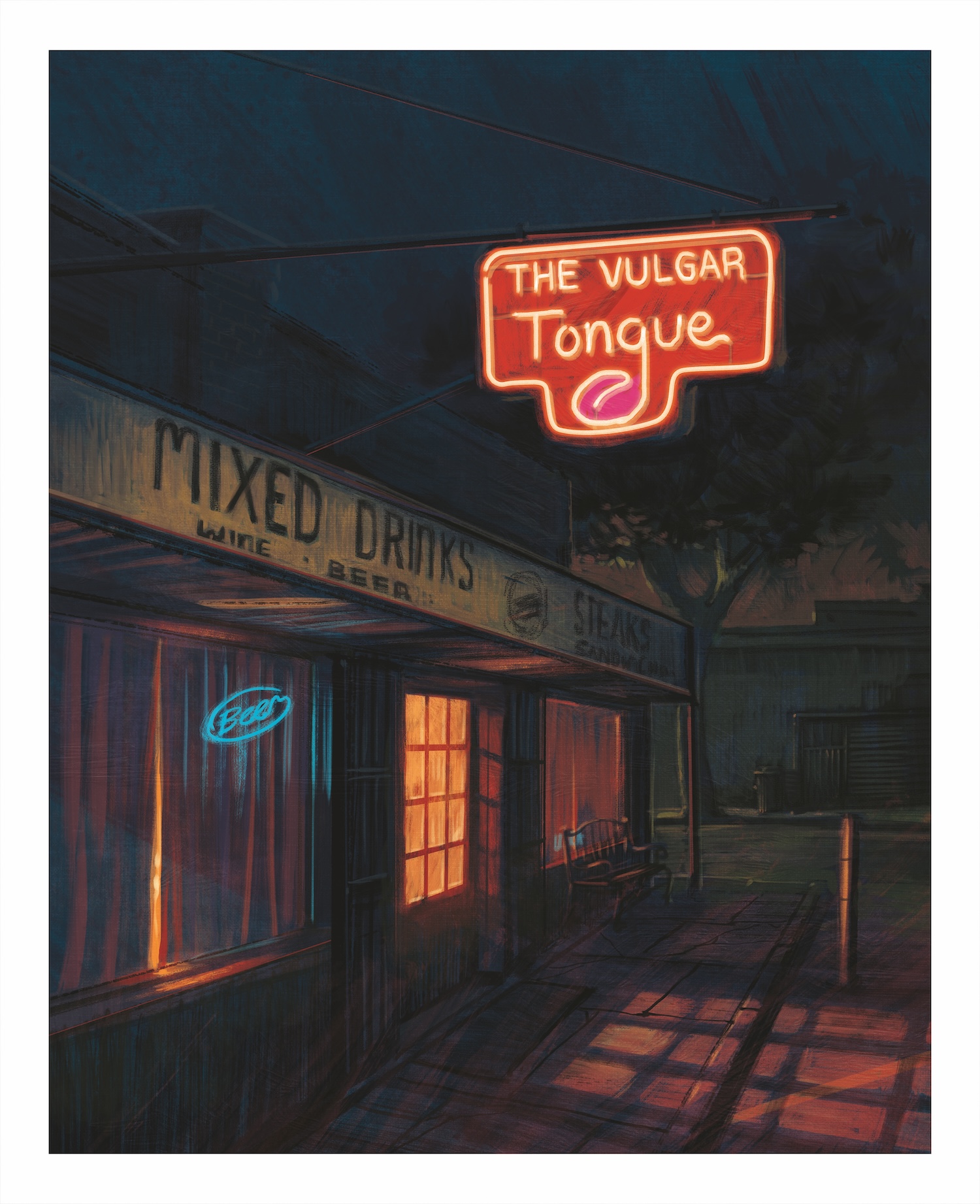
The Vulgar Tongue is a new column about the art of translating slang. The title is lifted from A Classical Dictionary of the Vulgar Tongue (1785), a guide to the slang of back-alley London compiled by the English lexicographer Francis Grose. In this inaugural edition, the translator Lisa Dillman considers one of slang’s baser forms: swearing.
I’m excited to be part of this series on slang, and I’m here to discuss a subset: swearing. It’s often challenging to translate—though most things are, truth be told. The difficulties in translating “bad” language are essentially a microcosm of the challenges of translation writ large, which (in my clearly unbiased view) stem from fascinating reasons.
One issue is that swearing is often particularly located. When someone swears, they’re telling us something about where they’re from. Here’s an example that doesn’t even require changing languages: Americans don’t say “wanker” (sadly), nor do they tend to use bloody as an intensifier (as in, “I should bloody well think so!”). So when I read a character who’s saying those things, I know they’re from the other side of the pond. And in addition to geographical location, cursing colloquialisms are often located in time as well. Twenty years ago, for example, the word actual would not have formed part of the question “What the actual fuck is going on in this country?”
This locatedness poses a problem when translating slang from one language to another—in my case, from Spanish to English. The major question is whether (or how, or where) to locate the English. How do you do justice to the character? How do you avoid overly locating the translation and thereby making the person swearing sound too American (or too Southern, or too New York, etc.), when, likely, in the Spanish-language text they were not? Let’s say Gladys and Pedro are walking down the street in Guadalajara, complaining about their translation professor. What happens if they say, “Total fucking douchebag!” In my view, it does an injustice to Gladys and Pedro, as well as to American English–speaking readers, who are forced into a kind of narcissistic falsehood, led to believe they speak like us (or maybe like my students ten years ago) and denied the chance to see the characters as Mexican. I don’t want to erase the characters’ linguistic (or sociocultural, or regional/national) identity and replace it with an Anglophone one. So, more often than not, I translate expletives in a slightly more generic way. I might be inclined to base their cussing around the word fuck, or another word that doesn’t scream “bro culture,” or some subset of American English, or at least not as loudly.
A second problem with swearing has to do with blasphemy versus obscenity. Most swearing seems to be related either to profaning something sacred (“Holy shit!”) or to saying something “indecent” (“Motherfucker!”). Sometimes both (“Holy motherfucking shit!”). Most translators, I am willing to venture, attempt to recreate as many of the salient characteristics of the original as possible. So if someone uses a colloquial curse that (a) involves cooking, (b) isn’t exceedingly offensive, and (c) is imperative—for example, the Spanish idiom “Go fry asparagus!”—you’d attempt to find an analogue that also does all those things, rather than saying “Fuck off!” even though that’s what is meant by the expression. And if you can’t come up with a cooking expression, you’d still opt for “Go jump in a lake!” over “Go to hell!” to mimic the degree of offensiveness.
Now, back to profanity and obscenity. In college, while studying in Barcelona, I became fascinated by Peninsular Spanish swearing, much of which tended to involve defecating in clearly inappropriate places (the sea or milk, if you were mild mannered; God or host wafers if you were pottier mouthed). Castilian Spanish seemed to revel in excreta. Pep, one of my Catalan roommates back then (and still a good friend) convinced me that this is because Spaniards are at least nominally Catholic, so their invectives involve the church, and because Anglos are more puritanical, our cussing involves more sex. That is, each exploits what’s more taboo to them. It makes sense to me.
Years later, in fairly quick succession, two writers I was translating both told me they’d avoided references to Christianity in their works, which meant the English translations should too. There is also a great article by the mind-bogglingly talented Juan Gabriel López Guix about translating Alice in Wonderland into Spanish (chapter 8 of Bassnett and Bush’s The Translator as Writer). In part of it, he describes avoiding any mention of divinity because he was convinced that’s what Carroll had done. But the most logical translation of “Oh dear! Oh dear!” was “¡Dios mío!” (My God!), so López Guix had a quandary on his hands. Thus, a second difficulty in translating swearing is how not to replace profanity with obscenity, or vice versa. So if the Spanish says, “I shit in the milk!” I’d opt for “No fucking way!” over “Goddammit!” But if the poop is on the host wafer, I’d lean toward “God (fucking) dammit!”
The degree to which I’m guided by this principle is directly related to the final issue: verisimilitude. Spanish has a range of what I’d classify as mild profanities—things you might not say around your abuela but otherwise wouldn’t get most people’s knickers in a twist. A common way to say someone is an asshole, for instance, is to call them a cabrón, or “big goat.” Of course, we rarely think about the literal meanings of expletives; I can guarantee that when I say “asshole,” I am never thinking of someone’s anus, for instance. At any rate, Spanish boasts a plethora of mildly rude (and very located) words: pinche, boludo, carajo, huevón, to name a few. These are somewhat anodyne words that are used regularly, by a range of people. A disaffected teenager, or an angry detective, might call someone a cabrón; less likely would be either of the two using a word like jerk in the same situation in English.
Since big goat, literally, is inoffensive (and neither profane nor obscene), the final problem is matching degree of offensiveness while retaining verisimilitude. The dictionary on my Mac translates pinche as “lousy,” “rotten,” measley,” “crummy.” But at the Tesla Takedown protest I attended yesterday, I saw a sign with a picture of Musk that said pinche ladrón. I’d definitely translate that as “fucking crook.” When faced with an issue of verisimilitude, I am happy to raise the stakes, using a word or phrase that is inherently more offensive if it’s also more accurate in context.
Lisa Dillman has translated thirty-some novels by Spanish and Latin American authors, including Pilar Quintana, Yuri Herrera, Sabina Berman, Alejandra Costamagna, and Graciela Mochkofsky. Her most recent translation, Season of the Swamp, by Yuri Herrera, was a finalist for the Los Angeles Times Book Prize for Fiction. Her work has won the Best Translated Book Award and the Oxford-Weidenfeld Translation Prize and has twice been a finalist for a National Book Award.
Illustration: Sam Hadley
