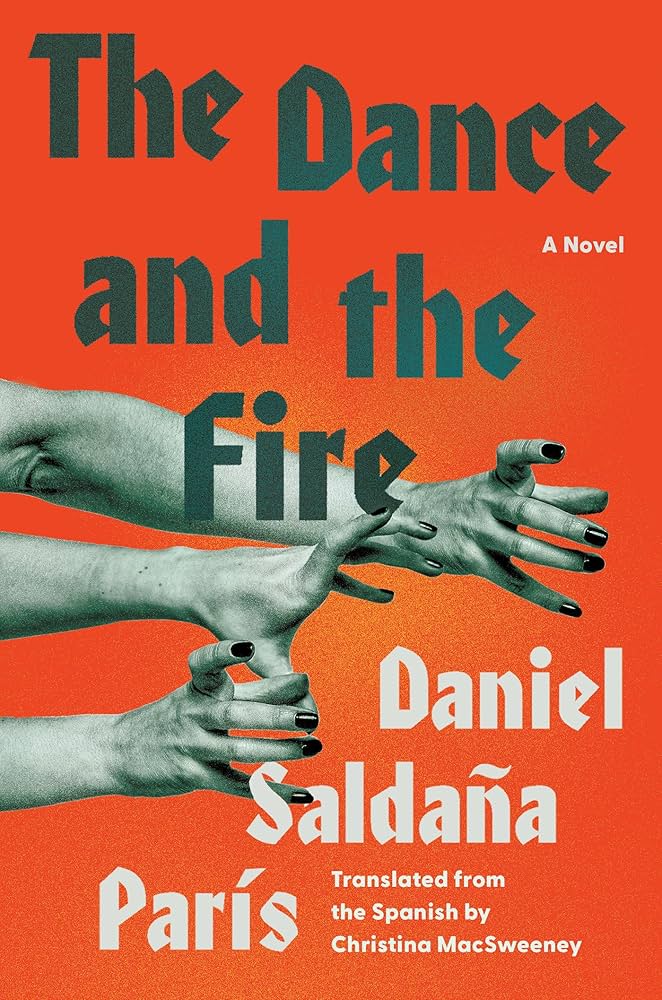
In December 2024, Daniel Saldaña París gave a talk at the Museo de Arte in Zapopan, about 350 miles west of Mexico City. Titled “Puertas, cerraduras, contraseñas: Una charla sobre la ficción” (Doors, locks, passwords: a chat about fiction), the Mexican author used the occasion to illuminate a number of prominent themes that he had explored in his recent writing and also, unbeknownst to him, to confirm my speculation about his enviable—or at least dogged—productivity during the pandemic, when he wrote or rewrote much of the material for not one but two books: the essay collection Aviones sobrevolando un monstruo and the novel El baile y el incendio, which were published in Mexico six months apart in 2021. An English version of the essay collection, titled Planes Flying over a Monster and translated by Christina MacSweeney and Philip K. Zimmerman, came out in the United States in August 2024, and now Anglophones can read the novel as well, thanks once again to a new translation from MacSweeney, titled The Dance and the Fire.
That the two books were nourished and came into the world so close together will not surprise anyone who has read them, as they derive from the same primordial soup of the author’s preoccupations, fascinations, and demons, none more fundamental than his relationship to his hometown of Cuernavaca, where the novel is set. One essay from the collection, “Malcolm Lowry in the Supermarket,” opens with an encapsulation of Saldaña París’s feelings about the city: “A certain sense of despair overcomes me when I write about Cuernavaca. The despair of having mislaid something and being unable to find it anywhere; of having forgotten some fundamental detail of my own story and, without that piece, being incapable of reconstructing the series of events that led to this moment—to this light falling on me from one side as I write in the small, damp room on the roof, at half past five in the afternoon.”
Those sentences offer tremendous insight into Saldaña París’s mindset while he was writing The Dance and the Fire, because the essay didn’t originally begin that way. When it was first published in a Mexican literary journal in March 2016, and again several months later when MacSweeney’s English-language translation ran in BOMB, the essay opened with a general paragraph about cities and their literary roots before going on to lay out the gist of the piece, which is Saldaña París trying to reconnect with the city he grew up in by rereading Malcolm Lowry’s Under the Volcano, which is set in the Cuernavaca of 1938. The attempt at reconnecting doesn’t really work and Saldaña París’s desire lingers, only to be reawakened in 2020 while writing a novel set in his own version of a fictionalized Cuernavaca. In this version, one character has forgotten “fundamental detail[s]” about his lost home, friendships, and identity, all of which still exist, but in iterations so different from what they once were that he cannot reconstruct his past, a failure that leads him to a “certain sense of despair.”
Saldaña París has said that El baile y el incendio was written rather quickly, starting sometime around October 2019 in Buenos Aires, where he had a five-week residency, and finishing roughly a year later in Cuernavaca, where he spent the pandemic—characterized in the Zapopan talk as a time he spent writing a novel about dance even as he had begun dancing daily in his garden. The novel is set in 2018 and so does not deal with the pandemic itself, though its traces can be felt in the story’s general mood of reassessment and despair, as well as in specific imagery, as when “the sounds of ambulances—[hang] in the air like a warning.” The interest in dance while writing the novel, presumably a welcome physical outlet during lockdown restrictions, renewed a passion that Saldaña París had ignored since his early teens when an enthusiastic foray into dance classes was abandoned after his father’s warnings about (again quoting from Zapopan) “los riesgos de la homosexualidad,” the hazards of homosexuality.
Though perhaps apprehensive about embracing queerness when he was younger, Saldaña París has now written about and discussed his relationships with both men and women, relationships that began during those early teenage years. At Zapopan, he credited a santera, or devout mendicant, who read his palm outside a Havana church in February 2017, with revealing three things he had never known or had forgotten about himself: that he will never have children, that he has an inflammatory disease, and that “el secreto de mi carácter”—the secret of his character—was his ambiguous sexuality, something he would need to express through dance. Saldaña París addresses the first two in the essays “Return to Havana” and “A Winter Underground.” The former, originally published in a Mexican literary journal in 2018, includes the meeting with the santera but mentions only her infertility warning; the latter, written for the 2021 collection, documents the opioid addiction that Saldaña París developed the year before his visit to Cuba due to chronic joint pain, which was later diagnosed as rheumatoid arthritis. The Dance and the Fire plumbs all the santera’s revelations even further, using the unfettered freedom of fiction to allot traces of each to the novel’s protagonists.
Natalia, Erre, and Conejo are all thirtysomethings confronting their individual plans for the future and reckoning with the period of their adolescence when they formed an inseparable “holy trinity,” a time coincident with the three years of preparatoria, as high school is called in Mexico. During those years, Erre had physical relationships with both Natalia and Conejo, though his feelings for Natalia were more serious. In their second year of high school, the trio was annealed by what Conejo calls “conflict-proof complicity,” an uncanny closeness that waned with the end of Natalia and Erre’s romance and eventually “faded with time, as does everything.” In the summer of 2018, Erre has left Mexico City in the wake of the divorce that ended his seven-year marriage and moved back into his parents’ house in Cuernavaca. Natalia and Conejo are still there, pretty much right where they were in high school. Natalia left home and now lives with her partner, a celebrated painter more than twenty years her senior, but Conejo still lives with his aging father, whose degenerative blindness has left him dependent on his son.
All three characters refract facets of Saldaña París’s character as highlighted by the Havana santera, though Erre most closely resembles the author himself, or at least that version visible in the nonfiction essays of Planes Flying over a Monster. The name Erre, which is the phonetic pronunciation of a Spanish r, is possibly a nod to Rodrigo, the protagonist of Saldaña París’s debut novel, En medio de extrañas víctimas (2013). That character, who also grew up in Cuernavaca, had only one pet as a child, a rabbit that he treated so badly it attacked him, leaving a rabbit-shaped scar on his arm. Conejo is the Spanish word for “rabbit.” (A Natalia also shows up in that first book, though only for one fleeting, inconsequential scene.)
Each of the protagonists narrates a section of The Dance and the Fire, telling a roughly linear story in which they reconnect as pairs in all possible permutations but are never reunited as a group. All three look at life and the time they have remaining from fundamentally different perspectives. Natalia is, for the most part, fixated on the future. She is over her relationship with Martín Argoitia and sees herself as merely the latest in a “series of replaceable women.” Although she’s not going to wait around for him to replace her with one of his students “ten years younger than” her, she’s also not quite ready to walk out the door. She is, however, willing to use the dance performance she is staging on the evening of the summer solstice to blow up her present circumstances. Argoitia secured the opportunity for her, but Natalia is planning something so extreme that people will “get angry and ask for their money back,” forcing her to “have to look for somewhere else to live.” To wit, she defines her current choreography style as influenced by “the seventeenth-century Swedish witches who danced back-to-back and fucked Satan, who had a very cold penis; the women of the Weimar Republic who suffered crises of nerves, who rocked back and forth and hurled themselves at the walls under Mary Wigman’s compassionate gaze. Bodies that shuffle in some mysterious way. Faces that gesticulate beneath masks.”
Erre is focused on the past, for which he is deeply nostalgic, longing to escape “the long-drawn-out finale in which we now live, plagued by wildfires, shootouts, and thinly veiled totalitarianisms.” His general malaise is heightened by an all-consuming physical pain that migrates throughout his body, “hiding its own point of origin.” The source of Erre’s pain is undiagnosed, and he turns increasingly desperate in his desire to mitigate it, following a course of action that echoes the quest Saldaña París takes in “A Winter Underground.” Specifically, Erre is troubled by the way his pain keeps him focused on his mortality: “I miss all those ways of being myself, of being fully, unquestionably inside myself without pain commandeering me, without the reminder that I’m dying, waning, falling headfirst into nothing, like a picnic left for the ants.”
In addition to the constant reminders of death, he sees defeat and neglect wherever he turns his head: his failed marriage; the frayed connections he once had with Natalia, Conejo, and other friends; even his closeness with his parents, which is not what it once was. He has failed to make it in the arts, as a filmmaker and an actor. His neighborhood is “unrecognizable,” its landmarks replaced by box stores and megachurches. And his city is surrounded by forest fires fueled by a historic drought, the bats, bees, and wasps of his youth replaced by “the nonstop noise of grackles, the smoke from the wildfires, and evangelists.”
Conejo lives almost entirely in the present, partly because so much of his focus is on his father, who is content with the life he has lived and ready to die whenever his time comes. Conejo dreams of being a “popular science author” but would prefer to simply do nothing. He’s a stoner who loves conspiracy theories. He doesn’t like to leave the house, doesn’t like to drive, and doesn’t like confronting his anxieties, including his fear of being kidnapped and disappeared. His twenty-year friendship with Natalia has endured since high school, and she still surprises him. But he’s not sure what he wants from Erre anymore: “There’s something depressing about hanging out with people who’ve known you forever. They always expect you to be the same as you were before, to embody that person preserved in the formaldehyde of the memory, to whom they have an inalienable lifetime right.”
Saldaña París writes about these three characters with a consideration and a confidence that feels far from the relative brashness of his 2013 debut and the more contemplative melancholy of his excellent second novel, El nervio principal (2018). Both these first two novels have been translated to English by MacSweeney, as Among Strange Victims (2017) and Ramifications (2020). The Dance and the Fire also contains an array of evocative imagery and metaphor: Natalia notices Argoitia smells of “poorly metabolized alcohol, something like acrylic paint mixed with repentance.” Erre recalls “that long-past time when the psyche was one, not a heap of pieces scattered on the rug, like a jigsaw puzzle after an attack by a cat.”
MacSweeney’s translation is characteristically beautiful and skilled throughout, though I did find myself occasionally bumping up against the novel’s idiomatic language. Sometimes this interruption was enjoyable, as with the description of a dancer who “springs up and gives a sort of awkward jump, like a draggletail.” That concluding word, which means “slattern,” was entirely new to me, but it’s an immediately evocative and illuminating translation of the original Spanish word, fodongo, a slang term with a negative connotation for someone who is a slovenly, filthy mess.
In contrast, I balked at the moment Natalia explains what she looks for in a man by saying, “Intelligence without self-doubt is about as much use as a chocolate coffee pot.” This whimsical image is cute but sounds like it should be coming from a mincing fussbudget, not someone ready to burn it all down by drawing on her interest in witches who “fucked Satan” and his “very cold penis.” The original reads, “Una inteligencia que no duda de sí no vale tres pitos.” That last word is a true translation challenge, in that pito literally means “whistle” but also is a slang term for, among other things, a penis. I don’t know what considerations went into the final translation; for me, though, Natalia’s character would have been better served with something closer to the original, something like “Intelligence without self-doubt is not worth three pricks,” which also fits with the sexual frustration the character expresses at other points in her narrative.
As the novel draws to a close, Natalia, Erre, and Conejo dance around each other and the various natures of their personalities, culminating in Natalia’s commission, which manifests as an almost mythical and mystical catharsis, an event so tumultuous that it makes Igor Stravinsky’s ballet The Rites of Spring, which caused riots at its Paris premiere in 1913, seem like a Scotch reel danced at a ball in a Jane Austen novel. The evening catalyzes irrevocable changes for all three protagonists in different ways, opening doors through which they can only pass once. All three storylines have resolutions, some more definitive than others, but they vary dramatically in terms of where the characters are left.
A few months into the pandemic, in June 2020, Saldaña París contributed an entry to “Diario de la pandemia,” a special issue of the Universidad de Mexico’s magazine, in which he says he was incapable of writing more than “jirones, esquirlas, párrafos deshilvanados con respiraciones en medio,” shreds, shards, or unruly paragraphs with breaths in between. Perhaps these breaths were spent revising the essays that would be collected in Aviones sobrevolando un monstruo; perhaps they were spent dancing in the garden. However he got there in the end, I hope The Dance and the Fire brought Saldaña París as much insight into the secrets of his character(s) as it brought me into the search so many of us undertake for the fundamental details of our own stories, details that have been simply misplaced or even buried under the ashes of the past.
Cory Oldweiler is an itinerant writer who focuses on literature in translation. In 2022, he served on the long-list committee for the National Book Critics Circle’s inaugural Barrios Book in Translation Prize. His work has appeared in the Boston Globe, Star Tribune, Los Angeles Review of Books, Washington Post, and other publications.
