Difficulty Is Satisfying | Lisa Carver’s Lover of Leaving
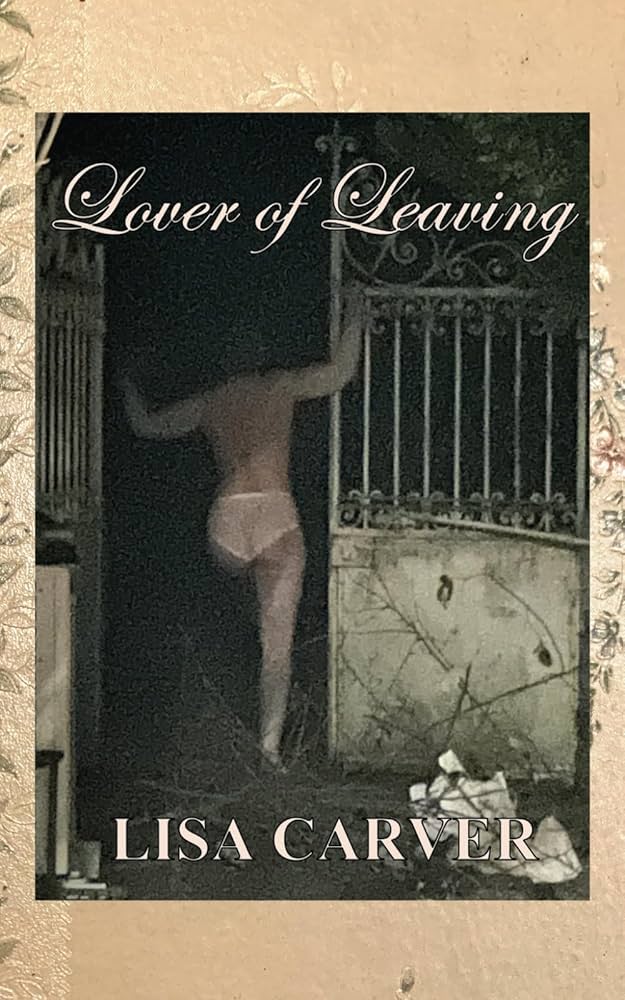
Lover of Leaving (Pig Roast, 2025), the latest book by literary iconoclast and DIY savant Lisa Carver (aka Lisa Suckdog), ends with her friend Frances launching into an interpretive dance in a white nightgown next to a dead rosebush before falling in and letting the thorns rip into her skin. She eats a decaying flower and strips naked, continuing to dance as she moves further into the dark. Carver continues to feel Frances’s spirit even as she grows distant. This is what it’s like to finish reading Lover of Leaving: Carver is naked, bleeding, slowly dancing away from the reader, and we can still feel her presence resonating within us.
Carver’s lengthy oeuvre is evidence that a writer’s life can serve as an endless, fertile source of material without getting redundant or old; a specific event can be told in many different ways from many different angles, especially as the passage of time warps the past. That being said, not many lives are as hectic as Carver’s. Her childhood was spent with an abusive father and a neurotic mother; her father, who was in and out of jail, would prostitute her for money, which she did not remember until later in life. The most productive of her teenage antics involved deranged performance art and zine making, leading to her name becoming known in punk circles, which was also helped by her transgressive noisemaker boyfriends GG Allin and Boyd Rice.
In her many books, Carver has proved that bringing pen to page can be as visceral as when she’d slap or kiss audience members during her performances. In her fervent 2005 memoir Drugs Are Nice, she detailed her mission to achieve “the best blurring of the line between show and reality, between performer and observer.” She and her husband/accomplice, Jean-Louis Costes, were “waging war on perceptions of reality” with their art. In the subtlest, most tender of ways, Lover of Leaving is a continuation of this violence.
The best of autobiographical writing is often the result of the risky act of treating life as an experiment. Think Anaïs Nin’s ecstatic diaries and her dissection of her countless romantic relationships as a way to discover more about not only herself but the entire human condition. Think Audre Lorde’s steamy biomythography Zami and her ability to shed light on history through a cinematic catalog of her lovers. Think Chris Kraus’s autofiction masterpiece I Love Dick and her subversion of gender roles by reducing a man into a muse against his will. Think Marie Calloway’s controversial debut what purpose did i serve in your life and her contemplations on sex that were provocative enough to send the literary world into a tizzy. It’s a hard balance to accomplish—to maintain the sincerity of life while also making it public—but Carver, like the aforementioned authors, is a master of the tricky craft.
Ten pieces that span a couple of decades constitute Lover of Leaving, with half previously published and half brand-new. No topic is too daunting for Carver. Psychedelic drugs taken on a retreat in Peru yield breakthroughs; an unexpected cancer diagnosis ravages her life and gives her a new perspective on pain; experimentation with Judaism shows her the potential for finding comfort in something bigger than herself.
The first essay is stylized like journal entries as she recounts each day of her plant-medicine retreat, where she consumes ayahuasca and San Pedro cactus. She sees geometric shapes floating, she meets her child self, she’s struck by revelations: “But instead of growing up, I made intellectual ribbons and bows out of everything. Now in Peru I can simply untie them, let everything fall.” She makes peace with the harm her father caused and recognizes the way it affected her view of men: “I never thought of men as dying. Starting with my father, I saw men as unchangeable, unkillable, like the devil.. . . And now that I believe men die, I can believe that men live.”
It’s a hell of a way to begin a book—where do you go from there? How can you possibly keep up the momentum from that roller-coaster ride of a story? But this is no problem for Carver. “The 31st Jew of Dover” is just as powerful, as Carver reflects on her attempt to turn to religion in the midst of her mother’s and her son’s simultaneous sicknesses. “Pain, though, seems to be something that can only be experienced, and never understood—not by the sufferer and not by the witness, either,” she writes, a sentiment that becomes even more evocative when she’s diagnosed with cancer later in the book. But in this piece, she illustrates her position as the caretaker, struggling to help two family members of different generations who are relying on her for help she can’t give. A sadomasochistic relationship with a carpenter offers an “evening out in the universe,” she explains. “If I experienced pain, my mom and son must surely be experiencing a moment of relief.” She ultimately backs out of her conversion to Judaism at the last minute but is left enlightened nonetheless, feeling a deeper connection with herself after examining her actions in relation to spirituality. She draws a fascinating throughline between religion and art:
Freedom is hard. It’s unnatural always being responsible for what to think and what to be. We get tired, we want to rest a minute on some external authority, but we have to sneak it in under our own radar. We pick and choose some rules to obey ironically and temporarily. We semi-join a semi-cult or dabble in subculture relationships full of prescriptions. Being Lisa Suckdog or converting to Judaism were both ways to break out of freedom.
The three-page “The Time I Tried to Kill Myself with a Rusty Potato Peeler in Paris” is a transcribed performance skit whose title is self-explanatory. It’s inspired by a moment that’s also described in Drugs Are Nice; some lines are retained—“He’s out doing independent things I don’t know about. French things”—but the format is different and the conclusion is more ingenious, with Carver’s “hole” (her void, her empty feeling that prompted her to cut herself with a potato peeler) becoming a character of its own. When Carver announces that the hole is why she can’t be faithful, the hole replies, “But you are faithful. What is faith but to see what’s not there, to be what has not become? Faith is me, my love.”
To read just one book by Carver is a crime; immersing ourselves in her whole repertoire offers the reward of seeing how one event can be molded into different shapes and stories. And because she blurs the line between life and art, the reader can watch her discoveries and her growth alongside her. It wasn’t until her 2011 untitled book that specific memories of her childhood trauma came to light; that new knowledge retroactively changes her previous works. In Drugs Are Nice, a possible explanation for the allure of performance art arrives while she’s thinking about an Arab stallkeeper who was beat with pipes while onlookers did nothing:
But I feel it’s worse to support such actions than it is to actually do them—because at least once you enter the world of violence, there are repercussions. You could go on to jail, or get hurt yourself. And it’s clear: the victim at least knows you beat him, knows you were wrong. The witness, unlike the perpetrator, risks nothing, but allows everything.
Perhaps this is what Carver’s unhinged performances that incorporate the audience are all about: Teaching them that watching isn’t enough, that the world requires participation from everyone. The same goes for her writing as she unabashedly shares her life to the point where it feels as if, instead of being on a stage and the reader being on the ground, the two are on the same level. The reader can choose what to do with this position as a witness—do we judge her for her continuously morally ambiguous acts, or do we see ourselves in her mayhem?
Maybe the most impactful piece in the book is her cancer diary, in which she reaches inconceivable levels of suffering. “I’d heard other people grunting rhythmically and wailing the first time I was in this ward. I never thought I would be one of them,” she confesses, later declaring: “There is no embarrassment in Pain Land.” She wants to “finish [writing my book] today in case I die tomorrow.” Even in the throes of agony—in a literal hospital bed—she is devoted to her work. She considers that being an artist has prepared her for this condition because she’s used to being alone with her thoughts, yet she’s being humbled by the way “precision is one of those things showing itself to be nothing more than a lace hankie on a clothesline in a dust storm.” The scale of the world comes into focus; sentences are nothing more than grains of sand. Does that stop her? No, it only gives her more to write about.
The amount of epiphanies in Lover of Leaving portrays what writing is to Carver: it is learning the same lessons over and over again; it is having fun making mistakes; it is having the worst time of your life; it is instinctual, like breathing; it is as routine as waking up and falling asleep. Resolution is quickly followed by another problem, but she wouldn’t have it any other way. “Difficulty is satisfying,” she writes. “It makes heroines of us.” Without obstacles, where would the adventure be? How would we be able to feel gratitude if there were no bumps? What would there be to make art about?
Danielle Chelosky is a writer from New York. She is the author of Pregaming Grief and Baby Bruise.

More Reviews