Sick and Tired of Seeing Things as They Are | Michael Bible’s Little Lazarus
The most boring people in the world don’t necessarily live in little boxes made of ticky-tacky or order the same sandwich at the same restaurant with the same sides the same day of every week. They instead look at the recent set lists of some band they’re about to see, making sure they know the songs they’re about to hear or making sure they’re not going to be let down by not hearing the songs they already know. They want to leave nothing to chance, nothing to the will of the artist to whom they’re giving their money.
But a few weeks ago, I felt a twinge of camaraderie with this concertgoing cohort I’ve so long held in bitter contempt. I was headed to see the goth-gospel songwriter Nick Cave play some massive modern theater in Denver alongside his amorphous band of forty years, a dangerous wrecking crew he’s always called the Bad Seeds. The show, I knew, would sometimes feel riotous, the band bending back to its early gnarled songs about violence and death, wickedness and glory in a kind of living retrospective. That’s why, after all, I wanted to be there: to feel flagellated by this roving horde of famous flagellators, who would have made fine outlaws when this sector of the West was still wild.
I also wanted to be held, however, for the Bad Seeds to get so quiet that they’d play a specific song from Ghosteen, a haunted wonder of a record Cave and a variation on his band made in the years after the 2015 death of one of his teenage twins, Arthur. I had once again been thinking about—OK, obsessing over—“Bright Horses,” the album’s second track and, at least as I hear it, a sort of hymn for we nonbelievers who still yearn for everyday magic or casual transcendence, for the sense that there yet may be some grand architecture behind even the most ordinary objects. “And everyone has a heart and it’s calling for something,” Cave begins the second verse, that crucial conjunction giving his distinct speak-singing the desperate urgency of a great traveling preacher. “And we are all so sick and tired of seeing things as they are.”
Amid this year’s avalanche of horrid news, “Bright Horses” had become a kind of existential lamppost for me, the thing to which I held fast as the literal zone of society flooded with proverbial shit. Reading the news, worrying over the news, going for a walk or a run or a climb to escape the news, I would often discover that I was absentmindedly humming it, the low tone in the back of my throat skirting the staccato rhythms of Cave’s words as if I were testing the bounds of reality. When the world looks like hell, it can feel helpful to believe in the possibility of something like heaven or at least more than our pedestrian despair—to believe, in Cave’s parlance, that horses are more than horses, that they are horses of love, their manes full of fire. I wanted to hear the song, to watch Warren Ellis sing that keening introductory part that makes him sound like a sweet, wild animal, begging for a world of mercy.
I had, in truth, also been thinking about “Bright Horses” because of Little Lazarus (Clash, 2025), a little novel of profound wonder, where all the world’s giant tortoises have brains full of dreams. For four weeks, I had been reading—and re-reading and annotating and staring off into the woods while pondering—Little Lazarus, the fourth novel from a North Carolinian in New York, the blessedly named Michael Bible. The 152 small pages of Little Lazarus can consume as little as an afternoon, but they steadily slide open the same trapdoor as Cave and “Bright Horses,” onto vast questions about wisdom that is not human, structures that cannot be seen, science that cannot be understood. Is there something at work in our world (not necessarily “god,” but not necessarily “not god” either) responsible for the stagecraft we interpret as our lives, our free wills? Are we, as Bible posits as a tortoise crash-lands amid the headlights of a teenager’s out-of-control Jeep, “all fated to this place and time”? Or are these just the lies we tell ourselves to take a little responsibility out of living?
The landscape of Little Lazarus was easy for me to love, or at least to recognize as something like my childhood home. It begins in Harmony, a small town at the edge of North Carolina’s ancient mountains. I grew up on the other side of the state, but the exact geography makes little matter. If you have ever lived in a small Southern town where events that may at least seem ordinary enough in a city—a child disappearing, maybe, or a taboo tryst between said depressed child and her therapist—acquire a mythological grandeur, as if they are the most important and interesting things that have ever happened to anyone and not simply the result of hormonal floods and bad impulse control, you have lived in Harmony. Scandals become sacred moments, origin stories.
Harmony is also a place where members of the rural middle class live like vested aristocracy, where little boats on country lakes feel like summertime yachts. And Harmony is a place where, when the aforementioned teenager goes missing, everyone in the town drops their defenses and prejudices and looks for her, as if saving her life were to save the entire world. I remember, when I was six, my mom waking me up long after midnight and depositing my best friend, Brad, in my childhood bedroom so that a worried contingent of local parents could go hunt his missing sister. Saving her was easy—she was found, or at least I was told years later, fucking in the back of a car in a parking lot, having snuck out because her Southern Baptist parents disapproved of her partner’s skin color. She was safe; elsewhere, though, entropy just kept increasing.
Bible is an expert at a kind of scene-setting that is more like world-building. His 2015 debut novel, Sophia, captures so vividly the craziness that is endemic to small towns, where everyone is a character because there can be so little else to be or do. Everyone is a misfit, normalcy a pox. He is also very good at rendering alternate timelines, in setting aside reality to consider what might have happened had a different turn been taken in the garden of forking paths—or to suggest they might be happening in parallel, just off to the side of whatever life it is we think we’re commanding. Particularly in the city-size chess match that frames its coda, Sophia is a monstrous maze of possibilities; his screenplay (cowritten with Al Warren) for 2023’s Dogleg uses a simple mistake—losing a beloved girlfriend’s beloved dog—to remind us of all the chaos an accident can bring, the multiple ways a blip can become the whole picture.
Little Lazarus is a perfect vessel for these skills in tandem, a way for Bible to construct a family, a friendship, and a town that feel real and full and then project them in so many possible directions that discerning fantasy from fact, one fiction from another, is like naming shooting stars. “All I have left is a little bit of truth,” one character tells us. A few pages later, he has a very different confession: “Except none of that’s true either.”
Here is what I can tell you with some certainty. In the late ’90s, or “the weird middle years without a war,” Eleanor and Francois are loosely good kids in Harmony, sharing the sort of adolescent lust-love that means a hand job in the back of a school bus makes Francois, at least, wonder what the rest of their lives together might look like. But while driving home drunk after a small-town, late-night party, they run over a man in a seersucker suit walking with his ancient tortoise—Lazarus, but not Little Lazarus—while jumping over a back-road hill.
The dead man, Thomas, wore seersucker because he was part of a century-old sect of the Seekers called, well, Seersuckers. These men would drift from town to town, slowly ambling alongside Lazarus, a perhaps clairvoyant tortoise who would answer townspeople’s yes-or-no questions by shuffling between boxes labeled in chalk. The tortoise and his keeper learned to move on before what was first seen as a whimsical gimmick for kids curdled into cries of real witchcraft from their angry fathers.
When the seersucker-sporting keeper encountered someone who needed a job and an income more than he did, he would pass the suit along and return to his own life. After Eleanor and Francois accidentally kill Thomas, they bury the body and the murderous Jeep at sea—that is, a small pond on Mulberry Road. Francois puts on the seersucker suit and takes Lazarus. They vanish, separately, Francois hitting the road in the Seersucker tradition until he dies, drunk and distraught, in a New York hotel. Eleanor’s own tortoise, Little Lazarus, sits on her childhood kitchen table, to be forfeited years later by her younger sister to an animal sanctuary. Moments before Eleanor, too, dies (maybe?) after a fire sweeps across a tropical island, Lazarus is gifted to her by a billionaire who is mostly in love with himself and the idea of an eternal life. Lazarus disappears, and Little Lazarus becomes an endling, “the only living thing that matters . . . there on the scorched landscape.”
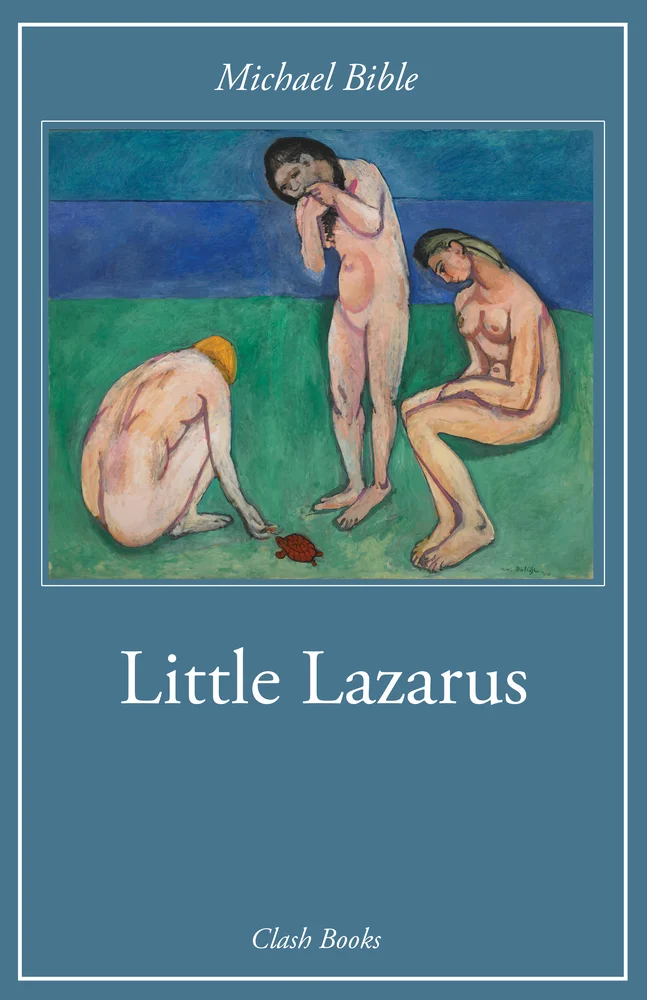
There are at least two dozen more folds inside the story, tucked into a book that feels bigger than its page count—how Lazarus was maybe a passenger on Darwin’s HMS Beagle, how Lazarus goes viral after escaping the billionaire’s lair and taking a walk in Central Park with a heroin addict, how rumors about Eleanor’s abduction, death, seduction, and so on balloon in Harmony after she seems to vaporize. Along the way, too, there are mountain boarding schools, a Southern drunk who starts painting and gives his work to God, a Matisse masterpiece (the one on the cover, Bathers with a Turtle) that becomes a crucial and clever plot device.
It all makes for a compulsive read, a book that opens a little like a trapdoor on a Rube Goldberg contraption that I, at least, wanted to see finish its trick again and again. It’s funny, poignant, and deeply grounded in the realities of the people and places it portrays. But this book’s wide sweep is really in service of a series of central, unanswerable questions: How much of our lives do we control? Are they even our lives, or are we simply living fates designed and implemented by some force we cannot control, whether it’s god or energy or a godlike computer program using an energy source we cannot fathom, let alone find? “I’ll leave fate and free will to the philosophers. Tonight I’ll sleep here in the sand,” Eleanor says near the end of the book, maybe her life. “I’ll dream of finding Francois in New York City still alive.”
But Bible, or at least his characters, seem to fall on the side of fate, concluding that we are all just pawns in a game that is much larger than us, whose bounds we cannot break no matter how much we thrash against them. As Eleanor remembers the night of the crash, for instance, she addresses why she ran away rather than calling the cops or her parents. “What was done was done,” she remembers, summarizing a sentiment that wends through these pages with the certainty of an old Appalachian river. “The events of that night had been set in motion long before we arrived into the world.”
I get it, especially these days, especially amid the crush of a history so heavy no one can seem to push back against it. It is so much easier to see the world as a grand design rather than something we build every day, something where the choices that shape it are actually ours. Isn’t it better to believe that a horse is not a horse and that a turtle is not a turtle but that they are, just like us, all pieces being played by someone or something else? Believe that, and watch responsibility float away, like Eleanor or Francois or unknowable dead children in land we made a battleground.
How many people in Harmony, after all, say, “It’s all part of God’s plan” when Eleanor and Francois disappear, delivering that line to her grieving parents as if giving a sick kid a spoon full of sweetened opium? How many times did I hear that growing up in a town just like it, when a cherished schoolmate got cancer twice or when a favorite aunt, tired after taking me to see Garth Brooks in the same town where Eleanor was supposed to go to college, drove her car off the side of the road and died? If Jesus takes the wheel and kills someone you love, what a friend we have in Jesus, brother.
That is, of course, the potency of Little Lazarus and “Bright Horses.” They allow me of little faith to step into a world where I can submit to some other force (or at least the possibility of it), whether for Nick Cave’s five minutes or Michael Bible’s afternoon of reading. It is a miracle to be able to believe in something more than your own mistakes and faults, fortunes and masteries. But it is also a lie with extreme consequences. Why worry about climate change or genocide or equal rights when we are all exactly where we are supposed to be? What a friend, indeed. In Little Lazarus and “Bright Horses,” investing in that version of reality, one rendered in art, cannot hurt us; close the book or turn off the stereo, and that belief can become both death wish and murder weapon.
By the way, I did not look up the set list, no matter how many times I contemplated it. But after ten often-very-loud songs, Cave and the Bad Seeds quieted down. He began to talk about all the songs he’d ever written and how, just maybe, the next one was the best. Ellis arched his head back and began his series of pained and beautiful ululations, the sound of the whole world wailing through one man. It was “Bright Horses.”
I don’t think, of course, it was fate that Cave played this song at the only show I was seeing on this tour. There can be an inevitability to free will, to being the person we are and doing the things we do. We had arrived in the same place, he with his song and me with my need. But for those five minutes, I believed in some other world, some other paradigm, some other possibility beyond the hardness that is, from time to time, the here and now. It felt so good that, the next day, I read Little Lazarus again, going back to the place where horses and turtles and humans are both less and more than they seem.
Grayson Haver Currin is a longtime music journalist, specializing these days in longform profiles. His work appears regularly in The New York Times, GQ, Mojo, Pitchfork, and many more. A native of small-town North Carolina, he and his wife, Tina, relocated to the high mountains of Colorado in 2023, after completing the 11,000-mile Triple Crown of Hiking. He also writes about backpacking, runs a lot, and buys way too many records. He is starting a Substack called Out & Back, someday.

More Reviews