Death by a Thousand Cuts
In November 1965, Mexican author Salvador Elizondo published his debut work of fiction, the novella Farabeuf, o la crónica de un instante. The title character, named after nineteenth-century French surgeon Louis Hubert Farabeuf, spends the book fixated on the same handful of scenes, including a public execution he photographs in China in 1901 during which the victim is tortured and killed via leng tch’e, also transliterated lingchi, meaning “death by a thousand cuts.” (Shoutout to any Swifties stumbling upon this review.) The photo that so fascinated Elizondo is real, dating from 1905, and is reproduced in early editions of Farabeuf. Needless to say, it is extraordinarily disturbing.
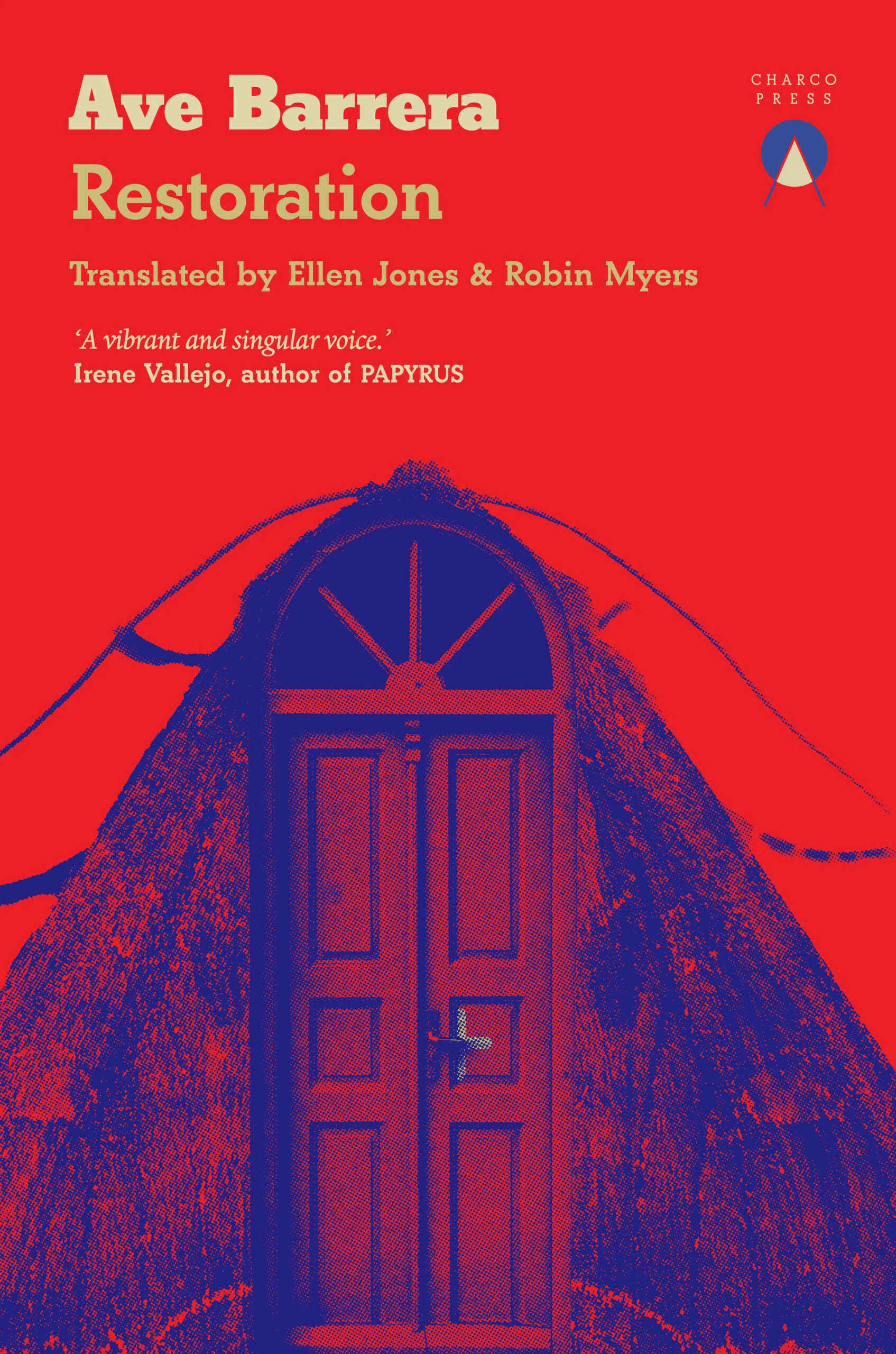
Ave Barrera’s 2019 novel Restauración, newly available in Ellen Jones and Robin Myers’s English-language translation titled Restoration (Charco, 2025), opens with a brief description of that same photograph of “a body being dismembered” but never identifies its provenance. In fact, Restoration only explicitly mentions Farabeuf in its epigraph, which quotes John Incledon’s 2015 English-language translation, though Barrera’s novel refers and responds to Elizondo’s work countless times. Prior to working on this review, I had never heard of Farabeuf, which is something of a cult classic in Spanish (Incledon’s translation was published by the short-lived digital imprint Ox and Pigeon and survives today only as a Kindle ebook). And so despite the graphic imagery at the start of Restoration, I was not anticipating the truly horrifying developments in Barrera’s novel. Reading it a second time, however, I noticed the innumerable warnings she gives, whether the exact moment an enigmatic lover displays previously unseen happiness or a metaphoric remark from a photographer about the importance of learning “to cut with your eyes before cutting with the camera.”
The contrast between the subtle and the brazen is but one facet of this astonishing novel’s brilliance. Among the many things Restoration does is offer perceptive commentary on humanity’s fetishization of and fascination with violence—particularly, sexualized abuse perpetrated by men upon women. There are genuinely beautiful moments of intense physical and emotional desire as well, but most every one proves to be founded on wishful thinking or manipulation. Using a specifically Mexican lens, Barrera captures universally relevant questions about class, ethnicity, and societal misogyny, which is a theme that crops up again and again in literature from Latin America, where such entrenched behavior is often enabled and excused by a virulent form of machismo that is mistaken for manliness. And as hinted at by its title, Restoration explores the eternal give-and-take between old and new, between the urge to hold on to—or the inability to let go of—what has been experienced and our almost compulsive need to replace, relive, and recreate.
Another action that could be added to that trio of impulses is to remember, and remember happens to be the first and last word of Elizondo’s novella and the title of the first section of Barrera’s novel. In both texts, the word is posed as a question (¿recuerdas? and Remember?), though I would argue that, despite its punctuation, it is also a command to the reader, an indication that their engagement will be essential to their understanding. Restoration is not a linguistically challenging novel—in fact, Jones and Myers have written an entrancing translation that frequently had me slack-jawed at its ability to build and release tension—but it is structurally enigmatic, featuring at least two distinct first-person female narrators, neither of whom are identified until well into the novel, as well as chapters told from several third-person perspectives, including those of the two women. There are also spots where I remain uncertain who is talking or whether Barrera even wants readers to have a specific person in mind. Plus those two distinct female narrators might actually be the same person, or aspects of the same person, despite speaking from different decades and, indeed, different centuries.
The novel’s present day takes place in 2015, when Jasmina’s sometime boyfriend, Zuri, hires her to restore his “great uncle” Eligio Vargas’s Mexico City home, which has sat abandoned for thirty years since he moved to Chicago. Interspersed with Jasmina’s work on the house, and recounted almost in concert with the grime she washes away, are decades-earlier recollections from Eligio’s wife, Gertrudis, an Indigenous “village girl” from Metepec and the mother of Eligio’s twin daughters, María and Silvia. The adult Silvia, who is living with Eligio when he dies, charges Zuri with seeing to the Mexico City house so a memorial can be held there in three months. Both Eligio and Zuri are photographers, the latter introduced to the craft at age twelve by the former. Eligio was quite famous in his day, while Zuri is merely devoted, plying his trade for an advertising agency though he harbors grander aspirations. Both men behave monstrously to dramatically different degrees, with Eligio perhaps veering into Jeffery Epstein territory while Zuri starts out closer to an insensitive, selfish man-child. Combining the worst of both of them is Eligio’s writer friend Chava, whose given name is Salvador, the same as the author of Farabeuf. Chava is at best a lewd, aggressive womanizer and at worst a serial killer.
There are little puzzles to grok throughout the novel, starting with Jasmina’s name, which appears only on the book jacket’s blurb, though Barrera leaves clues to it: The character is addressed as Min three times, and, while in a chapter recalling her grandmother’s home, she casually remarks that she was named after the herb jasmine. And there are grand, dark mysteries, such as who is the Vargas’s longtime housekeeper Oralia visiting in La Castañeda Insane Asylum, which is described as “hell on earth,” the same phrase that characterizes Jasmina’s life prior to being assigned the restoration job; and what lies behind the locked door in Eligio’s house, which both Gertrudis and Jasmina are forbidden from entering by the men in their lives. Readers familiar with French author Charles Perrault, whose stories Jasmina finds among Eligio’s possessions, will surely have ideas about what occurs in secret rooms.
There are also numerous echoes across time, whether in the placement of a glass on a counter or the way a character relates to what they are seeing or experiencing. And there are motifs throughout the novel, such as the number six, which is introduced via its Chinese ideogram, liu, which in turn Barrera uses to describe the posture of the men supporting the body being dismembered in the leng tch’e photo. From that point on, the number six acts like a shibboleth to return the mind of a character or reader to the photo. Six is the number of hibiscus blossoms Jasmina cuts, the number of white porcelain jars in Eligio’s pantry, and the number of doors upstairs in his house. A discarded size six shoe lies under a table. Zuri enlists Jasmina’s help to recreate six photographs—“just six shots, nothing too complicated”—of scenes from Farabeuf. The questioner seeking answers from the I Ching, the subject of another series of photos in Restoration (and a throughline in Farabeuf), throws their three coins six times. And the tendrils of liu reach even further: The ideogram, which superficially resembles a capital A comprising four individual strokes, is likened to the starfish used as a prop in one of Zuri’s photos with Jasmina. And in the opera Turandot, which Eligio and Chava go see, there is a slave girl named Liù, though it is unclear if Puccini intended the name to refer to a specific ideogram.
For me, the only recent work of art I would liken to Restoration is Canadian director Pascal Plante’s critically lauded yet lamentably under seen 2023 film Les Chambres rouges, released as Red Rooms in the United States in just fifty theaters in fall 2024. Along with trenchant commentary on the fashion world, celebrity culture, and seamy corners of the internet, Plante’s film tackles similar—and similarly disturbing—themes as Barrera’s novel in its consideration of society’s interest in and tolerance for violence against women. And both the novel and the film defiantly refuse to provide easy answers about what motivates several of their characters. The inscrutableness of the film is thanks in large part to a phenomenal performance from Juliette Gariépy as Kelly-Anne, an edgy fashion model who sleeps on the street in order to be one of the few spectators admitted each day to the weeks-long trial of Ludovic Chevalier, accused of filming and distributing on the dark web videos of himself torturing, abusing, and dismembering three blond-haired, blue-eyed teen girls. Gariépy’s face gives absolutely nothing away, whether staring at Chevalier caged in plexiglass inside the sterile Quebec courtroom or at avatars of her online-poker opponents on her computer screen. Even during one of the most spine-tingling moments I’ve ever seen on film, I would be lying if I said I knew exactly what was motivating her. (A huge assist on the mood of this scene and the entire film goes to Plante’s brother Dominique, who composed the score.)
Both Restoration and Red Rooms memorably portray unequivocal evil, but what makes these works stand out are characters like Zuri and Kelly-Anne who are seemingly teetering between curiosity about and obsession with that evil. By zeroing in on such tendencies and individuals, Barrera and Plante have tapped into an extremely au courant concern. Heinous individuals and acts have always attracted interest, including from those like Elizondo, and even apologists (Charles Manson may not have been the first idolized monster, but he is perhaps the archetype). And yet today the public’s appetite for true crime, fed by an endless supply of streaming series, podcasts, and of course books and films, feels insatiable. The danger in this prevalence is not akin to the PMRC’s fearmongering in 1985 about the perniciousness of music lyrics, but rather the generalized desensitization and eventual normalization that comes with increased familiarity. (See also gun violence and presidential politicking.) For some, their inquisitiveness will draw them still deeper, lead them to fly too close to the sun. Zuri, Kelly-Anne, and the fictional Farabeuf all strap on their wax wings. As readers and viewers, we remain on the ground below, unable to look away, but more worried about how close they will get to being burned than whether we will get crushed when they inevitably fall.
Cory Oldweiler is an itinerant writer who focuses on literature in translation. In 2022, he served on the long-list committee for the National Book Critics Circle’s inaugural Barrios Book in Translation Prize. His work has appeared in the Boston Globe, Star Tribune, Los Angeles Review of Books, Washington Post, and other publications.

More Reviews