No Late Fee at the Library of Love | A Conversation with Courtney Marie Andrews
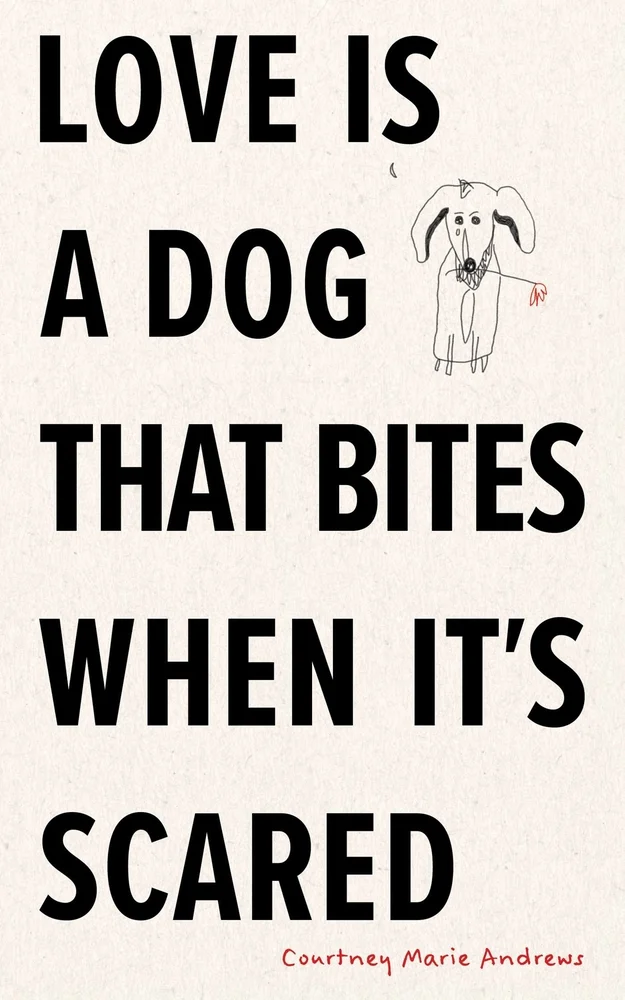
Acclaimed singer-songwriter Courtney Marie Andrews returns to the page with the publication of her second poetry collection, Love Is a Dog That Bites When It’s Scared (Andrews McMeel, 2025). Fans of her tunes will find anchoring treasures on every page: choice phrasings shaped by an ear alive to the dance of syllables. Admirers of her poetry will be grateful for another round of shining wisdoms and effortless oases near which to replenish and rest. Here is a poet unwilling to relinquish her senses to the digitized miasma, eager to help us back to our own; yes, there is “unexpected nectar” in the “subtle nuance of silverware sounds.” Yearning was the pine log burning in the hearth of her pandemic poetry debut. In her follow-up, the poet keeps time by braiding eros’s mane. Though the endless travel down crooked roads is sometimes rocky still, Andrews encounters the “sacred pain of change,” remakes the heart stouter by writing with it, and ultimately challenges her readers to embrace a life and love beyond fear. Fear whose mouth is wide, whose teeth are many, and sharp. Yes, with all our foibles and bad dances and graces and faiths and easy tendencies to hide away. Let us risk this one chance to be. Let us try.
Abraham Smith: Book titles are very hard to drum up or easy or somewhere in between. Care to share a little how this one came to feel like the right clasp or awning or weather for this collection?
 Courtney Marie Andrews: The title was originally a line from a song that was never finished. I loved the line so much, and it kept reappearing in unfinished songs until one day it landed in a finished poem. Though the poem didn’t make it into the collection, the line seemed to perfectly sum up the intention of these words. When deciding this as the title, I remembered the Bukowski collection Love Is a Dog from Hell. This realization nearly swerved me into a new title. However, the more I thought about it, the more I realized the correlation was empowering. This collection is a feminine perspective on love; a conversation and continuation of a silenced lineage.
AS: Dogs! They are Biblical. They round their eyes when they look at us to look more like us. They are biting at you and your beloved’s heels on your last record. Jason Dea West travels with his. But most tune ramblers I know don’t have pets due to their highway ways. Might you muse a little about all things canine as symbol and pal?
CMA: Dogs are our companions, our friends, and most importantly our most private confidants. Dogs know more about our personal lives than our mothers, or best friends. You cannot put on airs around your own dog, in your own home.
AS: Poetry surprises and proffers a mirror toward self-understanding. As you gathered these poems for this book, what were you surprised to see or sense about yourself?
CMA: With every form of writing I’m always surprised to learn about the depths of human nuance. We can be both heartbroken and in love at once. We can feel both hurt and enamored. Understanding human nuance means having compassion. Compassion is love for ourselves and others. Love is understanding, even when it’s so hard to make sense of these complexities. It is a cycle.
AS: You sign off Old Monarch “with longing” and end Love Is a Dog That Bites When It’s Scared “with love.” Could you speak to that shift from one l to another and say a little as well about what feels new to you since book 1?
CMA: Old Monarch was written during a large umbrella time of solitude. I was living alone, pondering the world from afar in the pandemic. I like when bodies of work center a theme so people can bask in whatever feeling is evoked from that particular emotion. During Old Monarch I was longing for everything: past, present, future. During this collection, I was entrenched in the depths of all I had waited for.
AS: Books are walking-stick lanterns. Mind sharing a few of the writers you were reading while composing these poems—and what you gleaned from these authors to help light the way?
CMA: I was reading a lot of Louise Glück. She was my North Star. Her bravery in facing truth and pain strikes me to the core. Her words are simple yet profound. Jack Gilbert always. I feel I understand his view of humanity. Alex Dimitrov is my favorite modern poet. Ocean Vuong, Barbara Kingsolver, and Patti Smith have also been guiding lights.
AS: So much of learning is unlearning or forgetting so we feel free enough to proceed with daring and dexterity. Is there anything you felt you needed to unlearn to write one, many, most of these new poems?
CMA: Knowledge is a cycle. I think it’s important to approach every new piece of work as a student. I unlearned all I knew about love, and learned once again through writing. I am forever a student of love and its many phases. Romantic love, friend love, family love, and self-love. These are always in practice, always failing or flying.
AS: The lineage of love poets is deep, and deeper than crane-bone flutes in the archaeological dirts. You hunt the heart word-go to word-end? Obsession is endless and endlessly prismatic, I know; I wonder, though, if there was a painful pleasure or a different sort of stamina involved in “following the flowers” of this fathomless theme that will outlast us all?
CMA: Love is a large subject to tackle. This I know deeply. If you are an archeologist of love, or a researcher, the library is a place you can never get to the end of. Still, my stamina was born out of necessity. This was the work I needed to make at the time, and I was lucky the subject was not buried in obscurity. In fact, it was all around me. You can’t get a late fee at the library of love.
AS: You paint, you poem, you song. I’d love to hear your cross-pollination thoughts. Do you see clearly which impulse or image requires which medium, or is everything in lively conversation with everything else?
CMA: I like to dedicate my time to each form in chunks of time so I can truly get into the weeds. The stories are always cross-pollinating even when the medium changes. I love to have many ways of telling the same stories, because with every perspective you learn something new.
AS: There’s a sense in the poems that your songwriter self is up for grabs; that people are maybe falling in love with the feelings you help them toward, live from the stage: songster as mood massager. The poems often evoke sheltered times: times beyond the public eye. And the same goes for love: You mull public love versus private love. Could you speak to the agony and joy of bringing your private self to the public ear and eye.
CMA: Both songs and poems straddle the line between public and private, fiction and nonfiction. The worlds are always blurring, and I think it’s more interesting this way as a writer.
AS: Punctuation has an emotional temperature. Your commas possess the weight of the world. Could you speak to their work, that heft?
CMA: I believe in the effect of pause between thoughts. I like to write my poetry like I’m having a conversation with the reader, or some kind of god, and I would never rush to stumble over these weighty privacies. I would say them thoughtfully. Words hold power. Commas are a great way of taking a breath, and collecting our thoughts.
AS: I loved the recurring sediment/sentiment poems, all stamped by place. Beyond the gorgeous rhyme, could you share how those words and their meanings meld and make magic for you?
CMA: These poems are sediment filled because they stick around at the bottom of the glass. These are the memories that are left after a specific place in time. Memory is funny—it can both serve us, and deny us our truth. We can mold and morph memories, and wash their sediment down the drain if they are sour.
AS: Once, some years ago, I visited the amazing poet and barrel racer Shelly Taylor on her fam farm in South Georgia, and I have to say, standing out among the quivery noses and vibrating fleshes of horses pretty much pee-my-pants unnerved me. Since moving to Kentucky, Ada Limón has written so movingly about all things horse. And the equine pops up in a few places in ultrapotent ways in your poems. What about horses electrifies your language and leads you through to wisdom?
CMA: I grew up around horses in Arizona on my grandfather’s ranch. Throughout my life I’ve seemed to end up in places where horses reside. Last month I painted in a barn above two horses. In my twenties I lived below a horse named Freedom who relentlessly broke loose. I seem to attract horse people. In my time spent around them, I’ve noticed their quiet and stubborn nature. They are proud, yet tender. We can learn a lot from other animals. We are them. They are us.
AS: Humor can feel like such a risk. And you risk it to delightful effect in “I Do Not Want to Write About Love.” How did it feel to lend the reader a grin in that one?
CMA: It’s important to remember to laugh at our self-seriousness as poets, and as beings. John Prine has taught me that humor is actually quite tender if used correctly.
AS: One of my favorites pops up on page 67: “The Reduction of Myself.” Mind sharing a little about its qualities?
CMA: I wanted this poem to have a lean quality to maximize the palpable feeling of making oneself smaller.
AS: Through your careful, generous attention to the world and the heart, the poems capture a moment or moments, the pulsation of a feeling, and keep us from the inevitable: The poems seem to sandbag the flood of the inevitable, sometimes in very generous, moving ways. I guess my question is the opposite side of that coinage: In capturing the feeling of impermanence, do you reckon that art is seeking the feeling of permanence?
CMA: That’s a lovely question.
I feel there is an inherent desire in making monuments of our feelings as artists. We think we want to solidify a memory forever. But can we really call that permanence if audiences one hundred years from now could misinterpret the original intention? If this is the case, then I’d be a fool to think my work could last forever as I created it today.
I do, however, believe in creating work that garners a brief glimpse of the reader’s own humanity. Perhaps that’s what I’m after: to reveal to someone themselves in all their ugliness and beauty, even if only for a brief moment, even if tomorrow they forget. I’m in it to help people remember their aliveness now. I cannot expect or predict where the work will end up down the line.
Abraham Smith was raised around Ladysmith, Wisconsin, and lives in Ogden, Utah, where he is associate professor of English and co-director of Creative Writing at Weber State University. His recent poetry collections include Surgencies (Baobab Press, forthcoming 2026), One Warm Morning (Stubborn Mule Press, 2025), Insomniac Sentinel (Baobab Press, 2023), and Dear Weirdo (Propeller Books, 2022). Away from his desk, Smith improvises poems inside songs with the Snarlin’ Yarns: thesnarlinyarnsut.bandcamp.com

More Interviews