I Hear That You and Your Band
Like many British former sixteen-year-olds, I went straight from collecting my GCSE results to Reading Festival. The only drinks I brought were a ten-pack of Capri-Sun. We camped by the toilets. (You eventually stop noticing the smell.) I spent most of it on my own, wearing a hoodie in the summer—the goal being to sweat water out before I needed to pee, thereby retaining my spot close to the front. It worked for the full first day and most of the second, but just after Arctic Monkeys came on, when I was only a couple of rows from the barrier, my glasses got knocked off, and I experienced the rest of the set next to a distant ice cream van. I spent Sunday slightly wounded and poorly sighted.
A few months later, I was interviewed for a piece about the UK’s then-imminent vinyl charts. In it, I outline why I think the vinyl chart sounds interesting—I say that I do not tend to listen to chart music, but that the music I like tends to be more prominent on vinyl, and that I tend to learn about new bands from friends. At the time, music was core to how I defined myself (I was outside a venue), and I started buying records just over a month later. I don’t think it would be unfair to say I thought of myself as “indie.”
It’s worth starting with that label. “Indie” music is, nominally, that which is released on an independent label. Today, that’d be any label not under the umbrella of Warner, Universal, or Sony. But that’s not really what anyone means: Most of Adele’s albums came out through independent label XL, while the Strokes are on Sony subsidiary RCA, with the logo on one of their album covers. Maybe initially indie meant a strain of guitar music influenced by the Velvet Underground, and then, later, Pavement, but now electronic acts like Animal Collective or LCD Soundsystem are canonically crucial. Lists of indie bands tend to include the Strokes, Vampire Weekend, Yeah Yeah Yeahs, and Arcade Fire—a British contingent would include Arctic Monkeys, plus Franz Ferdinand and Bloc Party. Some groupings might include Kanye West, Carly Rae Jepsen, Radiohead, Grimes, or Neutral Milk Hotel—but, equally, those groupings make an another audience raise an eyebrow. No consistent place, no consistent sound, no consistent technical feature, just some vague aspiration to purity—a sound unsullied by commercial concern, independently vetted by record-store clerks and blogs like Pitchfork and BrooklynVegan.
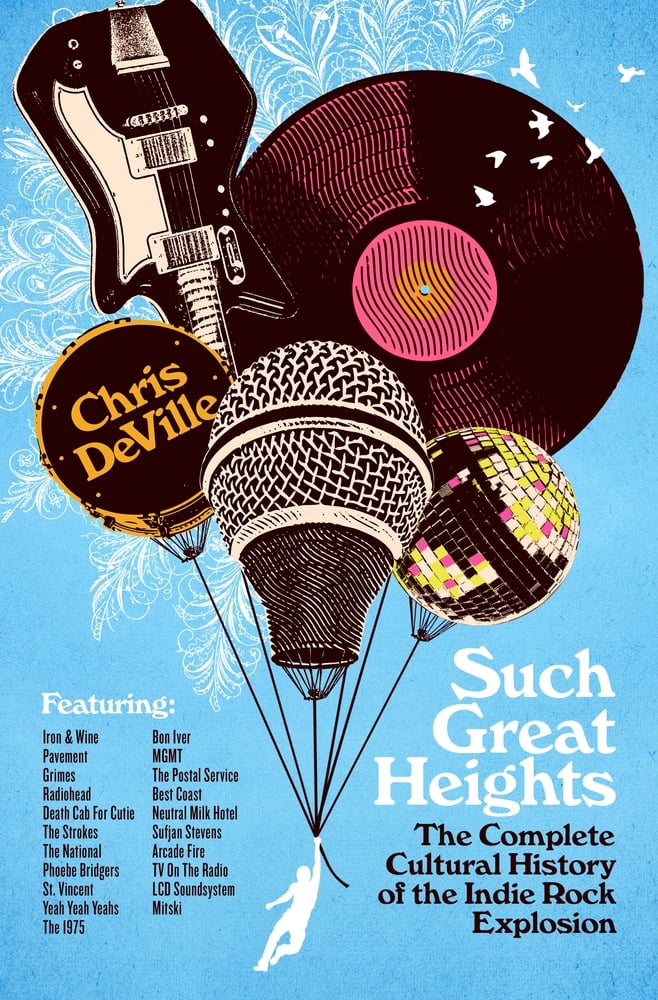
Toward the end of Such Great Heights: The Complete Cultural History of the Indie Rock Explosion (St. Martin’s, 2025), Chris DeVille explains his choice of title. It’s a Postal Service song—prophetic, to him, of indie’s blurring, away from a coherent sound, toward the lubricated and, often, the commercial. But I think I like his second choice better: “Losing My Edge,” a tongue-in-cheek LCD Soundsystem song about being made slowly obsolete by the revolving door of authenticity. “I hear that you and your band have sold your guitars and bought turntables. / I hear that you and your band have sold your turntables and bought guitars.” It’s hard, these days, to “make something real.”
That sense of a just-missed prime underwrites all the music DeVille is talking about, at least in how it’s experienced. For a moment to be remembered as a phenomenon, it needs to be documented so we can look back and venerate it as such—post-2000, it was trivial to do so, and trivial to share it. You don’t mourn missing Woodstock, you mourn the passing of last night’s perfect setlist. That idiosyncratic but up-to-date overlap between dislocated fans, discordant bands, and (at least, allegedly) dissenting blogs is what generated and sustained indie mythology, even as identifiable features got watered down. He documents the now-broader indie sphere as what it has come to be: “a container for a particular audience’s evolving tastes.” This is, “in some ways, […] the story of how hipsters—those urban-dwelling, trend-conscious early adopters often closely linked with indie rock—moved from worshiping Built to Spill to Beyoncé to boygenius.” Hipsters are important here—he cites Mark Greif’s New York magazine essay “What Was the Hipster?,” adapted from an n+1 book, both from 2010. The hipster is useful for thinking about the tendencies that we might now apply to indie as a whole: clever consumption as a path to feeling superior, pride in early adoption, a tension between shameless sincerity and conscious branding.
The book is a loose series of vignettes, heavily annotated anecdotes built around something like a crucial gig, or an album’s recording, or an album’s release. It’s good fun to read, and DeVille—a longtime writer at the music blog Stereogum—manages to appeal to the knowledge of readers who were there without leaving gaps for those who weren’t. These are the years where the internet had amassed the power to influence everyday life, but was still a sphere distinct from everyday life—a band’s fortune might turn on a blog post, or a tweet, or, often, a Pitchfork write-up. DeVille’s account is voicey and bloggy, by which I mean it strikes a difficult but deft balance between sounding knowledgable and avoiding smugness. The book’s style is a reminder that there was also an art to the tastemaking side of things—equally image conscious, though not necessarily insincere.
DeVille’s isn’t quite the first draft of indie history: the journalist Lizzy Goodman went over some of the same territory, quite differently, in 2017’s Meet Me in the Bathroom, a meticulous oral history of New York’s (indie) rock scene from 2001 to 2011. Goodman talked to bands, managers, bloggers, journalists, and plenty more, then arranged those extensive conversations into an immersive, loosely chronological recounting. That’s more the “I was there” portion of James Murphy’s “Losing My Edge” lyrics—the book, as well as its oblique documentary adaptation, are remarkably successful exercises in bottling a feeling of promise. It’s explicitly pegged to New York in a way DeVille’s book isn’t, so you see a lot more of the Strokes. Meet Me in the Bathroom ends in a chapter called “The Last Rock Stars,” around their night at Madison Square Garden. Goodman’s account is eulogistic—it’s going for something more direct. And because it’s fresh, it can, will, and should spoil; a “cultural history” like DeVille’s benefits from accumulated context and distance. The night before the Strokes played MSG, the venue hosted LCD Soundsystem’s farewell. In DeVille’s words, that gig was “a testament to how far this band had come, how far indie music had come,” immortalized in the 2012 documentary Shut Up and Play the Hits (whose directors would go on to adapt Meet Me in the Bathroom). But the band has now been back longer than they were away—longer, even, than they were together the first time around—making it look “pretty goofy.”
Where Goodman’s story is told in large part by the stars, DeVille’s, then, tells it from the other side of the barrier—not about what it was like to write the songs that would define a generation, but about what it was like to be defined by those songs. In DeVille’s familiar yet more distant view, you come away feeling less in awe of geniuses and a since-lost cradle for them, and more in awe of distribution, of the quirks in scale and taste democratization that delivered that music to you. You, like me, might have no memories of MSG, CBGB, or Y2K, but you might remember, as DeVille does, hearing about Death Cab for Cutie on The O.C., or, later, the episode of Girls that ends with Robyn’s “Dancing On my Own.” You might need the legendary gigs to have happened, but a Tiny Desk Concert could hold more personal significance.
DeVille often piercingly relays moments of semi-sellout, where a band might license a hit (and some artistic credibility) to a TV show or for a car ad. It’ll make them money, plus score them publicity (if not in quality, then in quantity). It might piss off the people who were at early gigs, but now they can fill bigger venues, start selling merch online. In 2010, Grizzly Bear licensed “Two Weeks” to a Volkswagen Super Bowl ad—less because they wanted to be associated with cars, more because they needed the money—which would have brought them to more people, but pissed off Trent Reznor, who complained about it to Vulture in 2017, as part of an then-considerable tendency for rock bands to “get in bed with a sponsor.” This goes all the way to top—in Meet Me in the Bathroom, manager Ryan Gentles talks about “getting Strokes T-shirts in[to] Target” after Shia LaBeouf’s character wore their logo in a trailer for the Transformers film. Besides, if these bands won’t do it, a cottage industry of inoffensive-enough bands—akin to what in the UK we called “landfill indie”—will be more than happy to oblige.
I’m writing this while watching coverage of Glastonbury, headlined, on the Friday, by the 1975. They’re one of the last bands written up in the book:
Representing an extremely online generation that harbored none of Gen X’s concerns about selling out, they carried themselves with a stylized glamor that resembled One Direction and none of the self-effacement that once prevented indie bands from embracing their world-conquering destiny.
There’s a tweet I like that goes: “[1975 frontman] matty healy thinks he’s [Arctic Monkeys frontman] alex turner, alex turner thinks he’s [Strokes frontman] julian casablancas, julian casablancas thinks he’s neo from the matrix.” The funny truth in it is that frontman magnetism is always nostalgic pastiche, and therefore always a bit of a lie. Consistent across indie is a belief in authenticity, but how are you supposed to tell the difference between actual artistic integrity and posturing toward one? When is affectation aspirational, and when is it just arrogant?
Healy knows he’s divisive, and came out on stage on Friday adorned with hallmarks of the modern insufferable—split-G Guinness, rollie, black latex glove. If you were to take this at face value, things are pretty simple: Insufferable is as insufferable does. But DeVille disagrees about doing so; the band’s best work, in his view, is “powerful enough to transcend its heavy handedness”; “precious and audacious”—the band does not “obscure their emotions or their ambitions with performative shrugs.”
I, personally, have found the 1975 tiresome for more than a decade. Healy’s all-encompassing performance scans to me as ironic, sure, but on an even-numbered layer, canceling out to sincere self-confidence. That’s by no means a dealbreaker—he would not be the first unlikeably smug frontman—but the music is unremarkable and sterile, like hearing a child say “fuck,” so I’ve never seen any appeal. After pages and pages that didn’t challenge my view of the world in the slightest, then, I was delighted to find this bit. Disagreeing with him so strongly made me feel like I still had some degree of taste—taste being the part of me that indie rock most cultivated. The 1975 are illustrative because they draw out the book’s core concerns—the relationship between credibility, popularity, mythmaking, performance, and money. Healy & Co. have ascended by understanding that the music isn’t that important anymore; indie didn’t scale as a sound, it did not scale as a financial arrangement, but it did scale as an attitude.
DeVille depicts that hollowing-out but doesn’t seem jaded by it. When he comes back to his own love for the genre (if genre is the right word), he traces it to the feeling of individual discovery: “Because feeling like you’re in on the new thing, the secret thing, the special thing can be even more enticing than a generalized sense of belonging.” Indie music was something you had to find, something that would not just be delivered to the incurious. He’s gracious about this—if the music was as special as he felt it was, of course it’d find an audience, given the chance.
In How Music Got Free, Stephen Witt lays out exactly how the music got that chance—the haphazard process by which it became trivial to share music anywhere and everywhere. My favorite foundational nugget from it is that, unlike lossy image compression, which saves space by giving up detail programmatically, MP3 compression throws away sounds humans won’t process—space is saved, but the absence of certain sounds won’t impact our experience of a song. The eventual consequence of all this efficiency is little artistic units, perfectly shareable and consumable. It takes attention and a book to read a book; it takes a couple of hours and a screen to watch a film; it can take years to keep up with a TV show. It does not take long at all to listen to most songs, and the list of available speakers is only getting longer. Like any artwork, they encode whatever taste and ideals you want them to, inserting you into a history of your choice. Where becoming a fan of a band no one’s ever heard of used to involve scouring through vinyl, leafing through magazines, maybe scoping out cheap venues or having the right friends, it now requires only an internet connection. It’s been said before (and DeVille makes it clear), but the effect is that an identity that used to take work to earn can now feel cheap and disposable.
Throughout the book, DeVille returns to hipsters and how “the irony that coursed through 1990s pop culture metastasized,” in large part thanks to the internet. Indie rock bubbled up in New York just as the internet bubbled up everywhere—it was what was cool in New York just as everyone else got access to what was cool in New York. Everyone was suddenly aiming for the same thing; the “process turned a lot of people on to what was happening in major urban locales, which sparked widespread imitation that ultimately had a flattening effect.”
It’s been long enough now to see that that imitation went both ways. If indie rock’s guiding principles are taste and authenticity, defining yourself as somehow more principled and with a better palate than everyone else, those principles ended up assimilated, for most bands, into an inevitable capitulation to financial reality. That chase, and that futility, have come to define any and all aesthetic aspiration online—curated lifestyle, peddling authenticity to one audience and brand viability to another. The best place to be is not at the top, but on the verge of blowing up, quietly undervalued. As long as you can cultivate that underdog sheen, and get that sheen in front of as many eyes as you can, it doesn’t matter so much how you sound.
Blog culture, and later, social media, helped make this the case: Where file sharing and streaming gave you the music, camera phones and up-to-the-minute posts gave you the myth. But that network was also an emblematic casualty of the sphere’s double mainstreaming. The much-discussed shift from disparate forums onto platforms was in some ways equalizing, in that it meant anyone’s “content” could, at least in theory, rise to the top. The problem was that it amalgamated and ate what had previously been countless distinct spheres—now, a blog needed potent, broadly appealing “content” to garner enough clicks to survive. DeVille notes the crucial role of the blog in the indie tastemaking ecosystem but also how, at some point, all those blogs had to compete on the adversarial flatness of a feed. Many did not make it, leaving us with a limp, lowest-common-denominator consensus.
Music taste has been tied to self-image for a long time now, but indie’s tenets make it perfectly suited to modern cadences. There is always something new, something claiming to be raw, something allegedly honest, and there will be something newer next week. It seems like the defining affect of the twenty-first century so far is affectation itself—artifice that recognizes itself as dishonest, shrugs, and moves on. DeVille’s book (like the phenomenon it describes) isn’t about granular descriptions of guitar tones, or about the songwriting process, or even about if certain songs or albums were any good. It’s about how it felt, and what it meant—to him, to you, to Pitchfork, to me.
DeVille flirts with a few factors driving the change, but the result is clear: that aforementioned flattening, an overall devaluing of music into “less an end unto itself and more a backdrop for scrolling timelines and zoning out.” He returns to Mark Greif’s idea of the hipster as duplicitous, a hypocrite— rebel for clout, conformist for comfort. I personally think Jack Antonoff often produces very good songs—the core (reasonable) gripe in Mitch Therieau’s Drift essay seems to be that he has abstracted the process of making them away from alchemy and into a reliable recipe—“a mechanism for delivering a concentrated shot of big feelings”; “a catharsis machine.” Those songs do well, much like what DeVille calls the “scalable middlebrow versions of indie rock.” It could be an outlier single like “Kids” by MGMT; inflections into chart pop, like recent Taylor Swift albums; or just bands whose credibility gets killed by their ubiquity—my school’s gig nights had to limit the number of Arctic Monkeys songs played to one per band.
If I’m not more cynical than when I got into these bands, I like to think I’m more consistent in how I apply my cynicism. Maybe younger fans are too—you see them obsess not just over an hour of new music, but over the material conditions of promotion, of splitting royalties, of publicity rollouts, streaming charts, album-cover signifying, Target-exclusive vinyl. If you’re inclined to turn your nose up at the commodification of things (and I am), DeVille plainly unpicks and assembles the fact that that level of coordination or commercial thought isn’t so new—what felt ephemeral about indie rock was, quite often, manufactured. Maybe now we just know that better.
Samir Chadha is a writer from London. His work has appeared in the European Review of Books, the Cleveland Review of Books, and The White Review.

More Reviews