Adrián arrived by donkey at our house in Mexico. We had the biggest, nicest house of the neighborhood, and barefoot and dirty children always crowded nearby to get a glimpse of my mother’s pristine garden, of the pool in our yard (an alien concept to most of our neighbors), licking their lips longingly to get a taste of those niceties, those creature comforts. That morning, they all gathered to see the strange animal posted outside our door like a circus attraction. I remember the figure of Adrián, dark as old wood, standing proud and erect. His donkey had a nosebleed it nursed with its dry tongue. I was the first to answer his call—his deep, rugged voice announcing, “Ya llegué, señor.”
My mother woke up after me and ordered me to go see what all the noise was outside. My mother never wanted to busy herself with much and was only used to sleeping and being told everything that happened after the fact. Although my father had been expecting Adrián, she acted as if he were a nuisance, as she did with most things. My mother was White—another quality that fascinated the neighborhood kids, for they were also so unused to seeing such a fair-skinned person, getting only glimpses of her here and there in her yard as she stared at her flowers (though all the gardening activities were reserved for the servants), like she was a strange creature of mythology. I know they also probably longed to run a hand through the softness of her hair, just as I did now and then, for I had my father’s hair, which was coarser, not pillowy and thin like hers.
So, I went to greet Adrián as my mother told me.

The donkey astonished me. It was the color of dirt, and its big, bleeding snout made me feel itchy, repulsed yet fascinated. Adrián, towering over me, lowered his gaze and met my eyes, and I instantly felt a hotness and youthful hardness between my legs, which I almost covered with my hands instinctively out of shame.
“Buenos días,” he greeted me with pure warmth, smiling with the whitest teeth I’d ever seen, all neat and perfect, in contrast with the sweating, dark skin, and muscle that enveloped him. His hair was long and black, grown a bit past his shoulders, and he wore a loose cotton shirt that revealed more thick, dark hair that covered his chest. “Dile a tu papá que ya llegué,” he ordered me, and I thought nothing odd of following this stranger’s orders. Instead, I rushed to meet his request, yelling “Apá!” as I scurried back inside, the flock of children dispersing at the sound of my father being summoned (for they knew my parents were no strangers to telling all those dirty children to go back to their dirty houses).
I noted nothing else strange about that first meeting, only that when my father stumbled out of the house half asleep, buckling his belt, the donkey was gone. My father never saw the creature, so he made no inquiries, and Adrián gave me a knowing look and smiled lightly as he and my father got to talking their business. As a child, I just figured the donkey went away and left it at that.
My father and Adrián talked of my father’s business, which was to cross people to the United States, where our other house was—one quainter, more suburban, nearly indistinguishable from the other rows of houses around the neighborhood. Here in Mexico, our status was marked, and our image was recognized as the “rich family”; but in the United States, we blended seamlessly and unannounced, which my father much preferred, for his was a business where quiet was valued. I could tell that my mother, however, enjoyed the status that Mexico gave her—a status she never tasted back home, where more women looked like her. I never knew the specifics of what my father and Adrián agreed upon, only that my father came back inside with a bundle of cash (bundles of cash were so usual a sight in his hands) and the announcement that Adrián would be moving in with us in the United States, would sleep in a makeshift bedroom in the toolshed in the backyard, for his set of skills had amazed my father such that he could not pass the opportunity to employ him as our newest servant (or help, or custodian, or whatever title he had been promised—my mother knew them all as servants).
My mother had no room to protest or say anything else, and she simply wondered out loud if Adrián would turn out to be trustworthy, to which my father said nothing. He only counted his cash and made some phone calls to have it all arranged, as he always did. Sometimes my father smuggled people in trunks of cars, or right under the noses of authority with fake documents, but it always ran so smoothly, and sometimes my father would get people like Adrián—people willing to give all their life’s savings just to taste the hard, cheap labor of the other side of the border. We would so often see the faces shift in our house in the United States, people coming and going depending on whether they were still useful to my father or not, but he seemed enamored at once with Adrián, and thus, his stay with us would be prolonged.
Adrián immediately showed a strong dislike for my mother that he could barely contain in his glances. He was always polite and subservient, but I could note a grimace forming at the corners of his face whenever he was met with the sight of her—akin, I’d say, to being presented with food that has just started going bad. My mother, however, fell in love at once with Adrián, for he kept everything neat and running around the house, never made much noise, and accepted miserly wages with gusto, as if a couple of dollars were a fortune to him. My father never explained much about how they’d crossed paths or where Adrián came from but spoke endlessly of our good fortune at having found such a hardworking Mexican as him.
My father was also Mexican, was almost as dark as Adrián, but American citizenship and US dollars had turned his once-Mexican nature into a taste much more like my mother’s. He spoke of Mexicans as if they were others, much like my mother did, and though my skin and my hair were dark like his, he never seemed to identify his family with the masses of bodies he hurled across and up and down the border, never seemed to think we had a kinship with “these people” past the money and transactions. Perhaps it was the nature of his job, of seeing people reduced to a bounty, to cumbersome bodies one had to hide well—things like that seem to warp what constitutes a “person.” Even with Adrián, sometimes the orders they gave him seemed the same as quips and commands one gives to a dog; but Adrián never complained, not even about my mother, whom he seemed to detest so.
With my father, however, Adrián seemed madly in love, and he even seemed to work extra hard and strain himself just for the sake of my father’s adoration. The two laughed heartily and joked like college kids, and my father made constant mention of Adrian’s musculature, of his dexterity with his hands, of the proudly earned sweat that marked his brow, and Adrián (to my own, secret arousal) seemed always to gaze down in boyish shyness at these comments, as if they were the coos of a lover. I noted, on more than one occasion, how Adrián would place his hand on my father’s forearm—a friendly gesture, it seemed, but I noted, as hyperaware as I was about the movements of men, that his fingers lingered there a second too long, like tasting just that one bit of my father too irresistible for him.
But with me, it seemed Adrián did not know how to make up his mind. I noted at times the same hidden scowl as with my mother; other times, when I played out in the yard or arrived home from school, he would give me more than one glance as he fixed the plumbing or trimmed the mesquite trees out front. Curiosity is maybe the best word for his contemplation of me, a hidden fascination, not as intense as with my father, but still, it seemed that in his mind, in those hidden recesses he would never make known (and how could he, for his words and opinions were never asked, and he was virtually voiceless most of the time), he seemed to be weighing options, wondering what to make of me.
On a hot afternoon, when Adrián had been tasked with sweeping all the yellowed mesquite beans from our yard, I arrived from school, and instantly he ceased his sweeping and fixed his gaze on me. I was shy and secretly aroused at once, for it was my own private little secret to sometimes watch him do his yard work: Adrián extending his arms, arching his brawny back, crouching with his thighs in full display—sights I could only enjoy in brief passing, for I was always afraid he would catch me. I never imagined, however, that I would get his full attention like that afternoon, when he dropped his rake to his side and signaled to me and said, “Ven.”
I hesitated only for a moment, and next thing I knew, I was moving toward him as if hypnotized. I was curious to know what he would have to say to me after so much silence, and part of me even wished that curiosity would be fulfilled by something morbid, something incredible. He had the same curious look in his eyes, not fully hiding a certain morsel of disdain, but with a softness to his eyes and mouth that still reassured me his intentions were good, or at least not evil.
That’s when he said, “Mira mi mano,” and held out his left hand for me to contemplate.
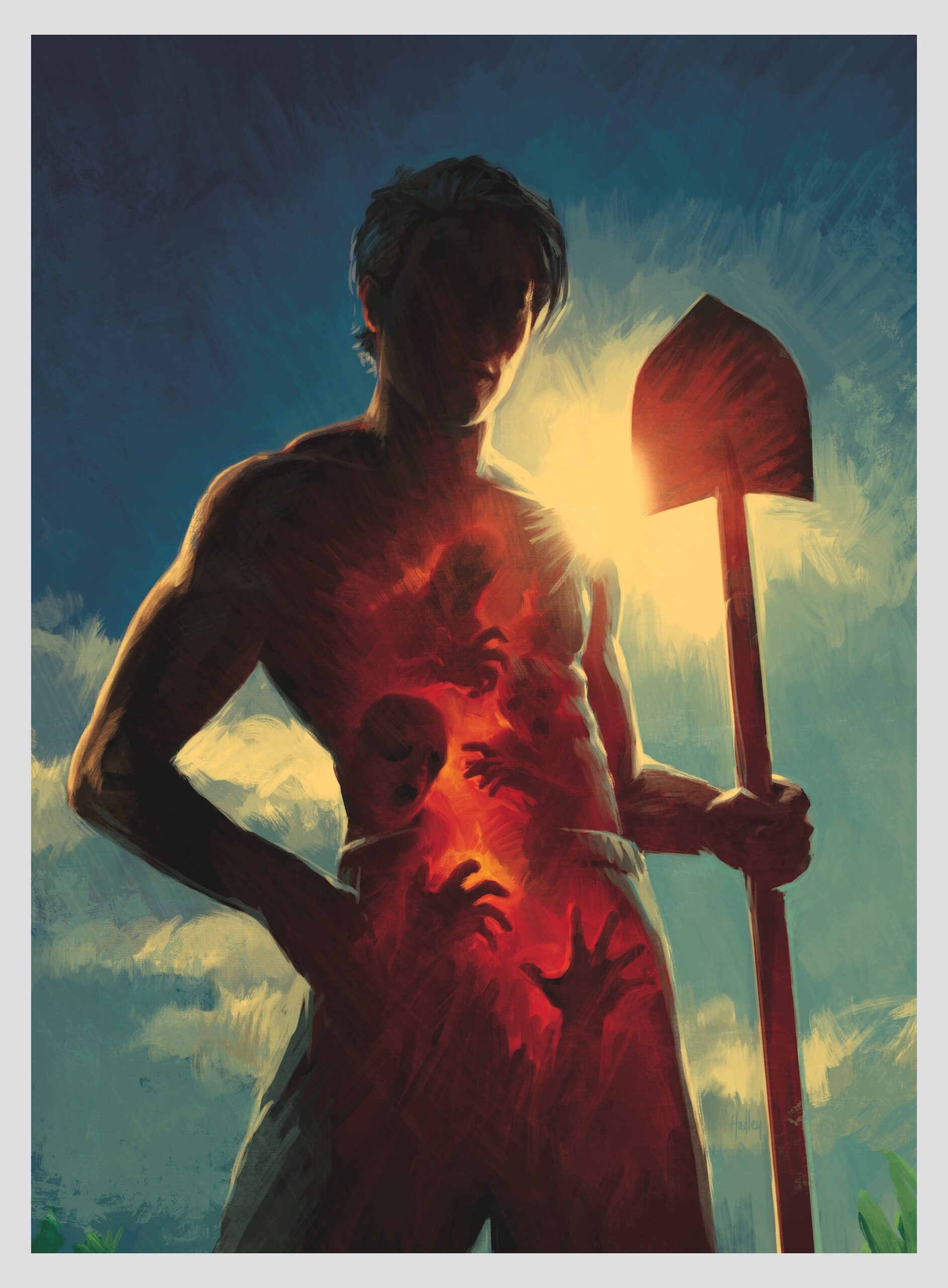
There, on the palm, I saw what at first seemed to be the movement of small insects beneath his skin. Dozens of impressions that seemed to kick and contort about. They were small, human faces, human limbs, all crawling with monotone expressions, pushing outward, like trying to breathe through a curtain, like trying to make more space where there was none. Then, out of these miniature silhouettes, I could also make out the faint passing of four-legged beasts, nonhuman snouts breaking through the human faces, cavorting around in the same playground of flesh and muscle, nearly indistinguishable unless one squinted. I could make out perhaps a robust pig, a muscular horse, the saddened trudging of a flesh-colored donkey—
Then, Adrián moved his hand away and studied my reaction.
I could not contain myself as I reached for his hand again, wanting to see again, drawn now to this man by some unknown force, thirsting, hungering for his touch.
Adrián did not offer his hand again. I felt a coldness stretch between us. It felt terrible, so terrible.
“Es nuestra piel,” he offered as a final remark, then returned to his work.
At that point, what I felt most was a deep jealousy for my father, who experienced the constant pulsing of his skin, the constant blessing of his touch, whereas now I felt starved, alone, and extremely aroused—aroused in my youthful way, confused and ashamed, but wanting more of that touch I was deprived of. Still, I think—still, still, he offered me that touch.
For some reason, he offered me his touch.
From that day I could think of nothing but Adrián, his hands, the wonders beneath. My father, too, seemed stupefied by the same spell, refusing to work for weeks, and my mother’s concerns about the family’s income went unnoticed. I watched my father’s every move, not out of concern for him, but with a deep envy at how he and Adrián grew closer with each passing day. Their talks grew more secretive; their embellishments through words evolved into an almost private affair; and the touching—it maddened me. To see my father press at Adrián’s bicep, to see him caress an elbow, smack a cheek playfully—it filled me with an immature rage, like a toy had been taken from me. I never knew if my father had seen the same things in Adrián that I had been allowed to see, and thus I consoled myself in thinking that I’d been chosen, that maybe I was special for having laid eyes on such a horrid yet subtle thing.
My mother was pushed to the margins of the household even more so than she’d been before. Adrián always avoided her, and whenever she issued a command, he’d give a brief nod and escape to his tasks. It dawned on me that it was due to my mother that Adrián showed a certain apprehension toward me, as if allergic to something in her lineage, something in her flesh that did not agree with his taste. My skin, a bit lighter than my father’s, held something desirable but perhaps tainted, perhaps not fully what Adrian’s appetite sought.
Oh, but in my father, I could sense that he had found his sight most delicious, and day after day, the two grew closer in their hushed bond. Many times, during those days, I pleasured myself in absent-minded thought, dreaming it was my arm that Adrián caressed, my touch that he craved.
One night, I could not contain my sweaty passion any longer. I snuck from my bed in the deep hours of night, haunted, as was now custom. Tiptoeing, I made my way out through the backdoor, approaching the toolshed where Adrián was resting. Passing through the rustling grass, underneath the mesquite tree, I found a nook of shadows that allowed me to observe through the makeshift window (only a hole sawed out of the metal wall of the shed) and peer inside.
Instantly, I perceived I was being watched, though no eyes were visible. Not even a silhouette could be made out in the darkness inside Adrián’s room, but the sensation stayed fixed on me. Then, it was like I could see many bodies moving at once—like the impressions in Adrián’s hands, only now they filled the hidden corners of the room, pressing all about, making no noise.
I made my way back to my room as silently as I could, defeated, for I had hoped to catch a glimpse of the man—the man, perhaps in full nudity, lying down on his bed after a hard day’s work, his skin crawling head to toe with wondrous energy, with unknown magic.
In the night, I half snoozed, half stayed pondering the body of Adrián, as I would every night from thereon.
The last night I spent in that house, I was awakened by a loud crash that reverberated through all the walls. A high shriek for the brevity of a second, then rumblings from my parents’ room. I was at once on my feet, following the sound. My father’s business had always been one of risk, of a criminality that, even in my youth, I knew could brew into vengeance, or a robbery, given my father’s preference for bundles of cash. Still, something told me this was not the cause of the commotion.
The bedroom door was ajar, just a slight crack so that a thin sliver of light fell onto the hallway. I opened it, and it was blood that instantly assaulted me, blood under my toes in the now-mushy carpet, caught in wine-red stains all about, pooling right by the bed. All coming from my mother, who lay on the ground by the window, rib cage flowered open in one giant wound, the corners of her fair skin wrinkling around the gash like torn gift wrapping, her insides festooned over the bedside table and all about the floor. In her eyes, just blackened death.
At the other side of the bed was Adrián, who held my naked father in his arms. Adrián was naked as well, but this did not seem apparent, for across his body flowered the many miniature bodies of strange creatures and homunculi. He was covered in small arms, covered in small legs and torsos that stretched and arched in dramatic poses, like from a religious painting. Only the light from a small lamp on the bedside table, partially covered in my mother’s guts, revealed this grotesque shape of Adrián to me, though some details remained in shadows. His only recognizable features were his head crowned in that long, black hair and his arms that now cradled my father like a child.
“Ella no es de nuestra piel,” came the soft, calm voice of Adrián, who gestured with those dark-brown eyes at my dead mother. I was frozen in place, my mind losing the last bits of sanity it could retain at seeing the remains gushing more and more blood.
But it was then that my father began to unstitch. First, his skin lifted from his form, revealing the bloody muscles beneath, fetal and glistening in blood, as all that skin, all that brown skin entered through one of the gaping faces where Adrián’s chest should have been. Like thin smoke entering through a mouth, so evanescent had my father’s skin become. Slowly, so slowly, the muscles followed, and then the bone, in a procession that was noiseless, brief. From one second to another, it was as if my father had never been there at all.
“Ya está en su casa,” continued Adrián, “a donde pertenece su piel.”
From one blink to the next, Adrián was just Adrián, nude, hairy and firm chest, rugged limbs, gaze fixed on me, his nostrils flaring as if smelling me, looking for something in me, then turning to the rest of my mother apprehensively, then back to me. He stood there in indecision, and I longed for nothing more than to feel a wakening spasm to shake me out of this trance. My eyes grew droopy, tired, and Adrián approached slowly, holding out his hand—that hand I had so longed for.
But I could not take it, drunken as I was with delirium.
I remember just then sleeping, maybe, and I do not remember much else.
And today, I am drunk every waking hour, scratching my eyes, my ears, for these glimpses from my childhood keep repeating themselves in my mind. Last night was the scene in the toolshed, and this night, awakened as soon as the troubled sleep brought on by whiskey wore out, I could have sworn I was back there, in my parents’ bedroom, watching Adrián unravel my father greedily into his center, the contorted faces and bodies all about him turning at me, not knowing if I also belonged to that mass, not knowing if my own skin was worthy of being consumed—
Oh—here I throw the half-empty bottle of whiskey at the wall of my decrepit studio, and it smashes in a high-pitched sound that reminds me of the shrill, final scream of my mother. I scratch and scratch at my scalp, irritating, drawing blood, my half-eaten nails lodging on the soft skin—the light-brown skin, the skin of my father and my mother, not apt, it seems, for the appetite that Adrián satiated with my father.
Adrián, Adrián, will you come and consume me? Where have you gone? When the police found my mother, they assumed my father was guilty of a crime of passion, after which he vanished. But I and only I know and believe that you took him because you came from somewhere where that skin belongs, all that skin, all that bronze skin like the one my father half imparted to adorn my bones.
Don’t you want this skin, too, Adrián? I still feel the lurch of a broken heart escalating somewhere in my esophagus, the drowning, empty pain of being alone. For how could I long for anything else other than to feel you take me, as my father felt?
Adrián, Adrián, won’t you take my skin, too? Won’t you deem it worthy, too? 
Juan Valencia is an author born and raised in Mexicali, Baja California, México who currently resides in the border region of Southern California. Alongside being a writer, he also has an immense passion for cultural preservation and community advocacy and dedicates his time to uplifting native voices and culture in his home region.
Illustration: Sam Hadley
