Her son got into bed with her, tore open her blouse, took her nipple in his mouth. He squeezed her breast like nobody had in years.
They’re dry, Josefa said. I’m an old woman.
The boy sucked and sucked until he choked, spat out dirt.
She held him.
This dream, unlike many others, was a good dream—a happy dream.
That same morning, two hours after waking, she found the mayor playing with excrement. He was dressed in a shirt and Charvet tie, standing there, facing his bedroom wall. He wasn’t wearing pants or underwear and was using his shit to draw triangles on the wallpaper.
Señor, Josefa said.
She touched the nape of his neck—clammy from sweat—but he didn’t turn around, didn’t seem at all bothered by the interruption.
I’m going to go see my mother, he said.
Stop, Josefa said, plugging her nose against the smell. Either his medication wasn’t working anymore or he hadn’t taken it that day. The responsibility of the new nurse—who’d been hired when the previous one quit after the mayor (in one of his lapses in lucidity) went into her room and offered her a thousand dollars for a hand job.
Come, Josefa said, and guided him to the bathroom. It would take them hours to make the room habitable again. She felt for Juana and the other cleaning girls, imagined them wearing surgical masks, scrubbing the wall.
She makes me drink a juice that smells like lavender, the mayor said.
What? Josefa said, entering the bathroom, seeing the shower curtain was also covered with shit but without the triangles he’d been drawing in the bedroom.
My mother, he said. She says I have to drink it to loosen my teeth.
She removed his tie and shirt and got him into the shower. She’d seen it a thousand times but was always surprised by the scar on his chest, the mark left when they operated on his heart after decades of rigorous addiction to tobacco and power.
She turned the handle and the water fell in a stampede; she got his hair wet and splashed his forehead and shoulders. She covered his chest and arms with soap and bent down to do the same with his thighs and buttocks—covered in shit—and when she stood up, she looked at his face: his eyes were closed, and that suffused her with a kind of calm, as if she were dreaming of frozen lakes or a very soft rain.
All my mother’s lovers are dead, hence the glow that surrounds her head, he said.
Josefa couldn’t help but laugh.
They medicated him for the civic ceremony. He occupied a seat at the long table they set out in the main square. He was surrounded by city council members. One of them—Josefa didn’t remember his name; she mixed them up—was speaking about improvements to the transportation system and about how much would be invested that year to solve Santa Cruz de la Sierra’s traffic issues and help it attain a privileged place among the great Latin American cities.
The mayor smiled, avoided looking at the cameras, interlaced his fingers, unable to keep his hands still. Josefa watched him on the TV in the kitchen. She never missed his public appearances, more infrequent all the time, decreasing exponentially since his diagnosis. They put on that circus every week, inviting dancers and singers and parading out the public authorities as if they were celebrities, but they brought him up onstage only when they had a special announcement. They doubled his dose and begged him not to open his mouth during the four-hour ceremony. He’d become a totem, what some—the most conservative, the majority of voters—considered the epitome of cruceñidad, of Santa Cruzian identity. Seeing the inexpressiveness on his face, Josefa caught a glimpse of the man he’d been before he entered politics. She saw him on TV but also in La Esplendorosa when he was thirty-two years old, just after he’d married Señora Mercedes, riding those wild colts he brought from Beni.
He was dashing, Josefa surprised herself saying, and felt embarrassed that someone in the house might’ve heard her.
The nurses, bodyguards, and service personnel had to sign confidentiality agreements: if the mayor’s condition got out, their lives would be ruined. Josefa was the only one without a contract. They didn’t ask her to sign anything, because she’d been working for him longer than anybody and was the closest thing he had to family.
They slept together when they were young. She was nine years younger than him, having just turned twenty-three. Delfín, her husband, was working as a laborer on a fencing project in a remote area far away from La Esplendorosa. It happened when he was drunk, during the days of cattle branding when Señora Mercedes had stayed behind in the city. He would slip into her bed without a word and she would let him, softly squeezing the nape of his neck before he came. She would whisper things in his ear she’d never said to her husband.
Sometimes the noise woke her son, who slept in a cradle beside the bed, but he was too little to understand. The mayor—before he was mayor, when he was a young rancher—would leave without a word and the next day treated her as if nothing had happened. He deployed the same jokes with her—his cook—that made him someone everybody liked and missed when he didn’t attend parties.
and I told my mother that one of my teeth had fallen out she wanted to look at my mouth but I didn’t want to show her they all have to fall out so you can go down she said she examined his gum dug into the hollow with her fingernail blood and drool at the end of the third week it appeared in my elbow grew like a wart without cavities all beautiful and white, the tooth
Josefa couldn’t sleep. She was watching a movie on cable and heard a burst of laughter that ended in a moan and a cough, coming back in an explosion: his bronchioles, worn out from years of tobacco, were a broken-down V-8.
When she went into his bedroom, she saw him pissing in the sunflower pot. It was the idea of the nurse who quit, scandalized when the mayor had gone into her room and propositioned her.
Gold, he said. I piss gold. I want you to collect the little pieces. Put them in a marmalade jar and take them to the bank.
She took him by the arm and led him back to the bed. He’d gotten fat in recent months, due to the medication.
Rest, she said.
Hurry.
It’s late. Tomorrow’s going to be a long day.
Hurry, Josefa. The bank is going to close.
It’s nighttime—the bank is already closed. You’re going to have to be patient. I’ll take care of it.
What time is it?
It’s two. You should be asleep. Look, she said, and pointed out one of the windows at the night.
The mayor seemed disoriented, eyes red, two smoldering embers.
They’re not going to disappear, Josefa said. Relax—when you fall asleep, I’ll do as you say. I’ll collect the little pieces of gold and put them in a marmalade jar.
Where are you going to hide them?
In the freezer.
No, dummy. Someone will take them. Any one of these presumptuous shitheads might open the freezer and take them.
Josefa laughed. He was serious, an accumulation of preoccupations.
Where do you want me to put them?
He scratched his chin, anxious, and, after a coughing fit, leaned back against the headboard.
He said:
Nobody checks what an old woman keeps under her bed.
He rested his head on Josefa’s shoulder. They looked like a married couple who’d put up with each other for over thirty years and attained some degree of fulfillment and resignation.
That’s where I’ll put them, then, Josefa said. Relax.
Lie down beside me.
I can’t.
Don’t give me that, the mayor said. I’m in charge here. Lie down for a little while.
Josefa did as she was told. He held one of her hands and the two of them stayed there in silence, looking up at the glass spider that’d cost a fortune and that hung from the ceiling, giving off a greenish light. The nurse said that color would help calm him when he had one of his crises. They never turned it off, so the room was always cast in that tenuous light that gave it the feel of a karaoke bar.
These are not my eyes, the mayor said. My mother came a few nights ago and took them. She put these in their place. Instead of nerves, they have cables. That’s the only way I’ll be able to see her when I bury myself in the ground.
What did you say?
They belonged to one of her lovers. I see the last thing he saw.
What do you see? Josefa said, going with the flow.
The mayor squeezed her hand.
He said:
I see horses in the snow, all that fog billowing from their nostrils.
That was the last thing he said before he fell asleep. Josefa stayed with him almost until sunrise. She thought about snow, about all that whiteness she would never see.
One of the bodyguards opened a trash bag and showed her a cat with its throat slit.
Where’d you find it? Josefa said.
In the garden, under that mango tree, by the swimming pool. I thought I should show you first.
He didn’t do it, Josefa said.
Who else could it have been?
How should I know?
The bodyguard shrugged and looked at the mayor, sitting in a lounge chair by the pool: the mayor was shirtless, his scar shining in the light, the keloid acquiring a rosy hue. He was dressed in shorts and sandals. The sun made him drowsy; he was nodding off but not entirely asleep. He hadn’t said a word for two hours.
He’s not violent, Josefa said.
What do I do with this?
Throw it in the trash and don’t say anything to anyone. Let me investigate.
The bodyguard took the bag, walked down the hall, and left the house.
teeth grew in my intestines and I found three in my shit I wanted to tell my mother but she hasn’t come back since she swapped out my eyes she won’t come again until it’s time to dig the pit teeth in my rectum in my colon my whole digestive system transformed into a mouth
Delfín was walking along a dirt path in La Esplendorosa; he was the man he’d been when he married Josefa thirty years before. He was barefoot. She was coming behind him, watching his small back; over one shoulder he was carrying a welding tool. His body was compact yet strong. Since going bald, he’d gotten a reputation for belligerence. He had neither humor nor patience, losing his cool at the least provocation.
Are you still mad at me? Josefa said.
He didn’t even turn to look at her. In the distance, one of the dams and some orange trees. The glare made the water look like melted aluminum. Hundreds of cows grazed nearby.
This light is from 1982, Delfín said. It’s still new here—light doesn’t age.
He paused on the hillside and she stopped beside him: they looked out at the fields, all that green, the light made the leaves and underbrush glow. She wanted to touch his face but couldn’t move, her fingers frozen.
Will you ever forgive me? Josefa said.
She woke up and it was already day, the light streaming into her room the same as in her dream. She sat on the edge of the bed and it took her a few seconds to realize she was crying.
After the heart attack he suffered at the beginning of the year—when they gave him the pacemaker—the mayor stopped speaking. They thought he’d lost the ability. He withdrew to La Esplendorosa to rest and recover. They kept the media away from him: his inner circle speculated about the obituaries that would appear in the papers, how they would portray his life, what emphasis would be put on the scandals, the sordid details, the confrontations with reporters, the innumerable cases of extortion, the hundreds of women he paid for sex—models, TV hosts, beauty queens. The list was littered with famous names.
Josefa called Señora Mercedes, who hadn’t spoken to the mayor in twenty-two years, since they signed the divorce. She traveled to La Esplendorosa and spent a week with him. Josefa saw them play at the domestic life they’d once lived, with the difference that he was now a mute old man and she was no longer the beautiful and haughty woman she’d been in the ’80s. They ate lunch together and took short walks at sunset. She read detective novels in the shade of a cypress tree that was over a hundred years old, reading fragments aloud that got no reaction from the mayor. She helped Josefa bathe him and pick out his clothes. She was strict and demanding—the world revolved around her.
As she was leaving to go back to the city—the driver already waiting in the Land Rover—the mayor said:
Forgive me for everything.
It was the first thing he’d said since the operation. Josefa couldn’t remember if Señora Mercedes replied, if she touched his face and nodded, or if she embraced him and spoke words of reconciliation that burned away years of resentment, of consciously inflicted pain.
They never saw each other again.
Upon returning to the city, he resumed his duties. It was his fourth term. Two months later, one of the assistants walked in on him in a storage room: he was naked and setting a construction contract on fire. The woman ran out screaming, and it was a while before she could explain to his advisors what she’d seen. When they told Josefa about it, she said not to have him committed, that she would take care of him.
This time it was Magdalena who found it: a ball of fur floating in the swimming pool. She pulled it to the edge with a leaf rake. It was a little lead-colored cat with its throat slit. On that November night, the blood stained the water, giving it a brown tint, like a shitstorm had hit.
Someone is throwing dead cats in from the street, Josefa said.
What do we do? Magdalena said.
Josefa looked at the walls surrounding that fifteen-hundred-square-meter garden. The mayor was taking a nap and the bodyguards and service personnel were busy.
Get a trash bag, Josefa said. I’ll tell everyone to be more vigilant.
Should we tell Juan to check the security cameras? They must’ve captured something.
Get the bag—I’ll tell him.
And what do we do with pool water?
We have to refill it, she said, and she walked over to the edge, catching a glimpse of her reflection in the water: in recent years her hair had turned white, so she wore it down, falling to the middle of her back. On her upper lip, the hook-shaped scar, and keloid scrawls across her right cheek and forehead.
Hours and hours of the same angle of that one stretch of street, parents with children, couples, a group of students smoking marijuana. The tonality of light changed, but no one suspicious, nobody throwing dead cats into the garden.
In the kitchen, the mayor wobbled, clutching his belly with both hands.
Feeling okay? Josefa said.
He vomited up a green mess. When he smiled, his teeth were the same color. Strings of grass in the bolus.
Juana, Josefa said. Come quickly, we’ve got to clean up.
And to the mayor:
Why are you eating grass?
She took him to the bathroom to rinse out his mouth. She sat him on the toilet, forced him to drink water.
Don’t swallow, spit it out, she said.
After he spat out the water, she said:
You’re going to wreck your stomach if you keep doing this.
When she digs the pit, my mother is going to give me children, the mayor said.
What’re you talking about?
You’ll be there when they’re born, you’ll look them in the eyes, you’ll feel their first breath, he said.
Drink and spit, and cut the bullshit. If your mother were alive and she heard the stuff you say, she would die all over again of shame.
Josefa brushed his teeth, took him back to his bedroom, and couldn’t stop thinking about that woman who’d become both legend and taboo. Why now, at this stage of his illness, did he mention her so often? Josefa would ask the neurologist who visited every month. On his last visit, he’d said that within two years the mayor would lose his memory.
You don’t know anything about some dead cats, do you? she said.
The mayor scratched his head.
He said:
The president once told me how he saw a man burned alive. He was just a kid and was forced to watch it. It was an act of justice—the community was executing one of its members, and he had to witness it.
She looked out the window at the two employees cleaning the pool. They’d just finished filtering the water.
Can you imagine, Josefa? the mayor said. A man consumed by flames. He’d raped his stepdaughter. He ran around like a chicken with its head cut off, here and there, waving his arms, until he went stiff. The Indian wept when he told me the story.
When was that? Josefa said.
He made a brusque movement with one of his hands and twisted his mouth in an expression of disapproval, as if Josefa’s question were ridiculous.
Has anything that fucked up ever happened to you?
I lost my son, she wanted to say. They took him from me when he was only sixteen. The police, your police, she wanted to say, but the words didn’t take shape in her mouth, didn’t ignite, as anemic as her rage.
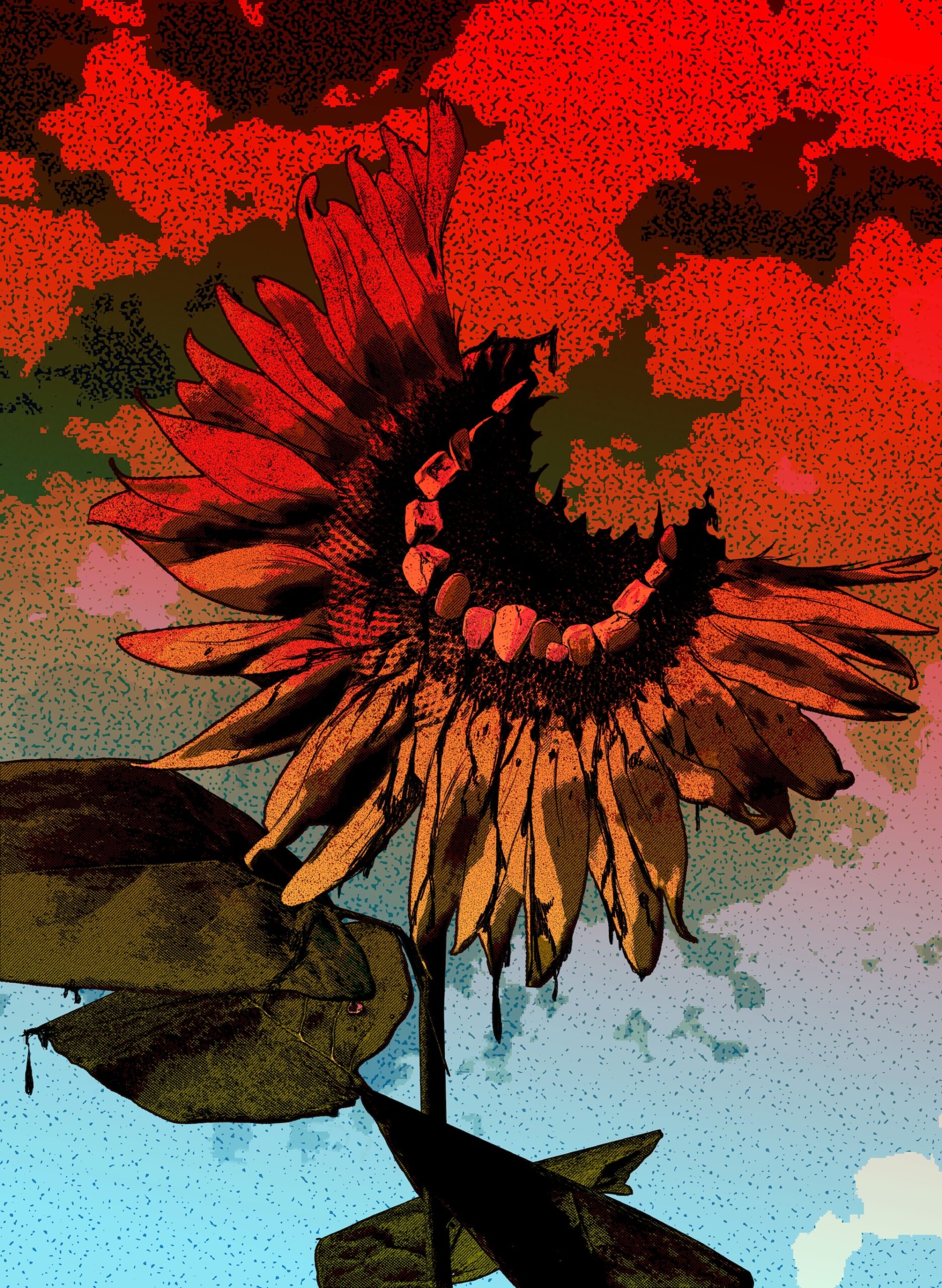
She went over to one of the windows and opened it to let in the air and the light. She heard the voices of the employees cleaning the pool. She sat down in a chair in front of the bed and looked at him. Was this one of his moments of sanity? Had that conversation with the president taken place? After a minute of silence, the mayor walked over to the pot. He brought the sunflower to his mouth—it was massive, the biggest and most beautiful flower Josefa had ever seen—and ripped off a chunk with his teeth. He swallowed. She didn’t try to stop him. She stayed still, watching how he took a second and third and even a fourth bite, until he ate the whole thing.
They killed her son after he held up a gas station and took off in a car with three other juvenile delinquents. They shot him in a house in Plan 3000 where the four of them were hiding out. The shoot-out lasted less than fifteen minutes—none of the boys survived. Josefa went to the morgue to identify him. He was lying on a steel gurney, his face clean, no signs of violence. He appeared to be sleeping. A scraggly beard grew messily across his neck and chin. It didn’t take more than twenty seconds. She didn’t say a word, didn’t complain. She nodded and left that little room that reeked of formaldehyde. It was neat and clean and foul-smelling—that, she remembered.
A few meters away, sitting on a bench by the medical examiner’s office, the mother of another of the boys was weeping, waiting her turn to identify her son. A man, maybe her husband, was comforting her. Josefa didn’t cry then or on any other occasion. In her throat, something hot and viscous, like phlegm, she feels it even now: the origin of rage.
Delfín was working as a welder in an oil-company encampment a hundred and fifty kilometers from the city. He was incommunicado and learned of their son’s death two days after the burial. He went to La Esplendorosa, where Josefa had gone to recover, and gave her a beating in front of the entire staff. He split her lips, cracked her nose, almost killed her. Nobody intervened. They made a circle and watched him beat her.
Delfín blamed her, accusing her of spoiling their son. She was responsible for raising him while he was away, working in the highlands for long stretches. Josefa turned a blind eye when the boy got into trouble, and she was the one who opposed sending him to a military academy in Sucre after he got expelled from high school, accused of attempting to rape one of the girls in his class.
When the mayor—it was his first term, he’d only been in office for a year—found out what’d happened, he asked her if she wanted to him to retaliate. Josefa repeated the same thing she’d told the social worker at the hospital:
Don’t do anything, it’s not his fault.
two teeth emerged from my forehead centimeters from my right eye they looked like pimples I squeezed them but they didn’t pop they stayed there with that little red rim around them hard to the touch
Late in the afternoon, Josefa went into the mayor’s study. Dozens of photographs where he was posing with politicians from different periods. There was one where he was with Paz Estenssoro, already an old man then; sitting in the shade of a tree, the old Tarijeño was holding a glass of wine. They were laughing. Among the photographs, a small one, in black and white. It was the one she was looking for. A twenty-year-old woman, before she married a rancher who owned properties in Beni and in northern Santa Cruz, before she became the mayor’s mother. The photograph was from the mid-thirties. She left her husband when her son was ten. People didn’t get divorced back then. She ran away with a French geologist who was working in Chiquitania. Some people speculated that they left for Paris, others that the mayor’s father had them killed and buried at La Esplendorosa.
In the photograph, the woman is smiling, grabbing her hat with her right hand to keep it from blowing away in the wind. She was sitting on a bench in the main square. In the background, Calle 24 de Septiembre, a mud pit.
She woke up in the mayor’s bed. He wasn’t there. She called to him but got no response. She went into the bathroom and found him standing there, naked. He had an erection.
Señor, Josefa said. Come to bed.
The mayor didn’t answer, just stood there silently, looking at himself.
Josefa put on his pajamas. She brought him back to bed and had him lie down on the side where she’d been sleeping.
Rest. Big day tomorrow.
My body is no longer my body, the mayor said.
Josefa didn’t know what to say, so she just stayed still beside him, staring at the empty pot. The mayor pulled down his pajamas—he still had an erection. It made him uncomfortable, looked like a prosthetic. He masturbated. She closed her eyes, tried to recreate the dream but could only recall random details: old picture windows, destroyed lamps, a urine stain on the rug. She heard his ragged breathing and knew he was about to come.
At the public event, a city councilwoman delivered a preliminary report on a paving project underway in some neighborhoods of Octavo Anillo. She spoke pompously, gesticulating and walking around the stage they’d improvised in the main square. Josefa watched it on the TV in the kitchen.
There was a shot of the mayor looking confused. He stuck a thumb and two fingers into his mouth, closed his eyes. In the background, the voice of the councilwoman, employing the standard party rhetoric. A bodyguard tried to usher him away, but he resisted.
He pulled, extracting a molar. A thread of blood ran down the left corner of his mouth. Two assistants took him by the arms and led him into the building. The councilwoman fell silent. Everyone watched as they went down the hall and into an office. The reporters asked questions that none of the authorities answered. Josefa turned off the television and for the first time in months felt relieved.
She woke up confused. In her dream everything had been red and she’d been hearing the same laughter that’d come from the television when the lie was unmasked and the mayor’s illness made public. The staff was gone now, and the silence made the house feel even bigger. It was the second week since the mayor’s resignation and there were no assistants there to check on him, no bodyguards or cleaning girls either. The TV reporters weren’t stalking him anymore. He’d become old news.
Unable to fall back asleep, she went to the kitchen and filled a glass with water. She sat down at the table where they ate breakfast and drank it slowly, savoring that glacial silence. She’d spoken with Señora Mercedes the day before, who’d wanted to know how he was, and Josefa told her that things were the same as ever.
Why do you stay? she said.
Where would I go?
Anywhere you want. He must have given you some money. Why don’t you go live your life?
My life is here.
Before hanging up, Señora Mercedes told her to call if she needed anything, but it was pure formality, because Señora Mercedes knew—they both did—she never would.
She left the glass in the sink and went to the mayor’s room. She didn’t find him in bed or in the bathroom. She went to the billiard room, the study, the guest rooms. When she went out into the garden, she saw him sitting in a chair. He was under the shed where they stored a Mercedes that was at the mechanic. The lights were all out except for the underwater spotlights from the pool, which gave off a greenish glow. All she saw was his silhouette, unable to make out his features. He was stroking something. It appeared to be a cat.
Señor, Josefa said. What are you doing out here? Are you trying to give me a heart attack?
. . .
Where’d you get that cat?
It’s my son, the mayor said, his voice strange.
What’re you talking about . . .
My mother is waiting for me, he said. There—and he pointed to a corner of the pool where there was a mango tree.
Give me the cat, Josefa said.
She didn’t dare get any closer. She was paralyzed, like in certain dreams that her son or her ex-husband appeared in.
Over there, the mayor said. Do you hear her? Do you hear her screams? In the pit.
What pit are you talking about?
She looked where he was pointing, but it was so dark, she couldn’t make out anything, just the shadow of the enormous tree.
The mayor said:
She’s giving birth to the second child and doesn’t want me to watch. She says if I do, I’ll go blind.
You should go back inside—it’s late. You need to sleep.
Once she’s given birth, I’ll go with her. We’ll descend into the earth, bury ourselves and our children.
Your place is here, with me. You don’t have to go anywhere, Josefa said. Stop saying these things. You’re scaring me.
She went over to the electric gate and turned on the shed lights: he’d ripped out all his teeth. They were scattered across the ground beside his bare feet, along with the pliers he’d used. Molars, canines, incisors. Blood on his neck and chest, covering the scar. His arms and legs caked in dirt, his hair damp with sweat. A shovel was leaning against the chair.
Blood continued spilling from his mouth.
My God, what’d you do? Josefa said.
The cold made her chest swell, closed her throat: her own voice sounded unfamiliar. She’d never felt such desolation, not even seeing her son on the steel gurney in that silent room where she’d spent less than twenty seconds.
He’s been born, the mayor said.
Josefa heard the crying of a baby but couldn’t tell if the sound was of the world or just in her head. It was so high-pitched it stabbed her ears, as if it had consciousness and intent and its only objective was to rend her eardrums.
The mayor stood up and walked away holding the cat, disappearing into the darkness that surrounded the tree. 
A writer and university professor, Maximiliano Barrientos (Santa Cruz de la Sierra, Bolivia, 1979) has developed a highly personal body of work with novels and books of stories published in Spain, Bolivia, Argentina, and Mexico. His debut collection Diario (Premio Nacional de Literatura de Santa Cruz, 2009) blends weird fiction with pulp-inspired horror and his essays on literature, film, and music have been published in numerous magazines and cultural supplements.
Will Vanderhyden has translated more than ten books of fiction from Spanish. His translation of The Invented Part by Rodrigo Fresán won the 2018 Best Translated Book Award. Vanderhyden’s work has appeared such journals as Granta, The Paris Review, Two Lines, Future Tense, and Southwest Review, and he has received translation fellowships from the NEA.
Illustration: Zach Hazard Vaupen
