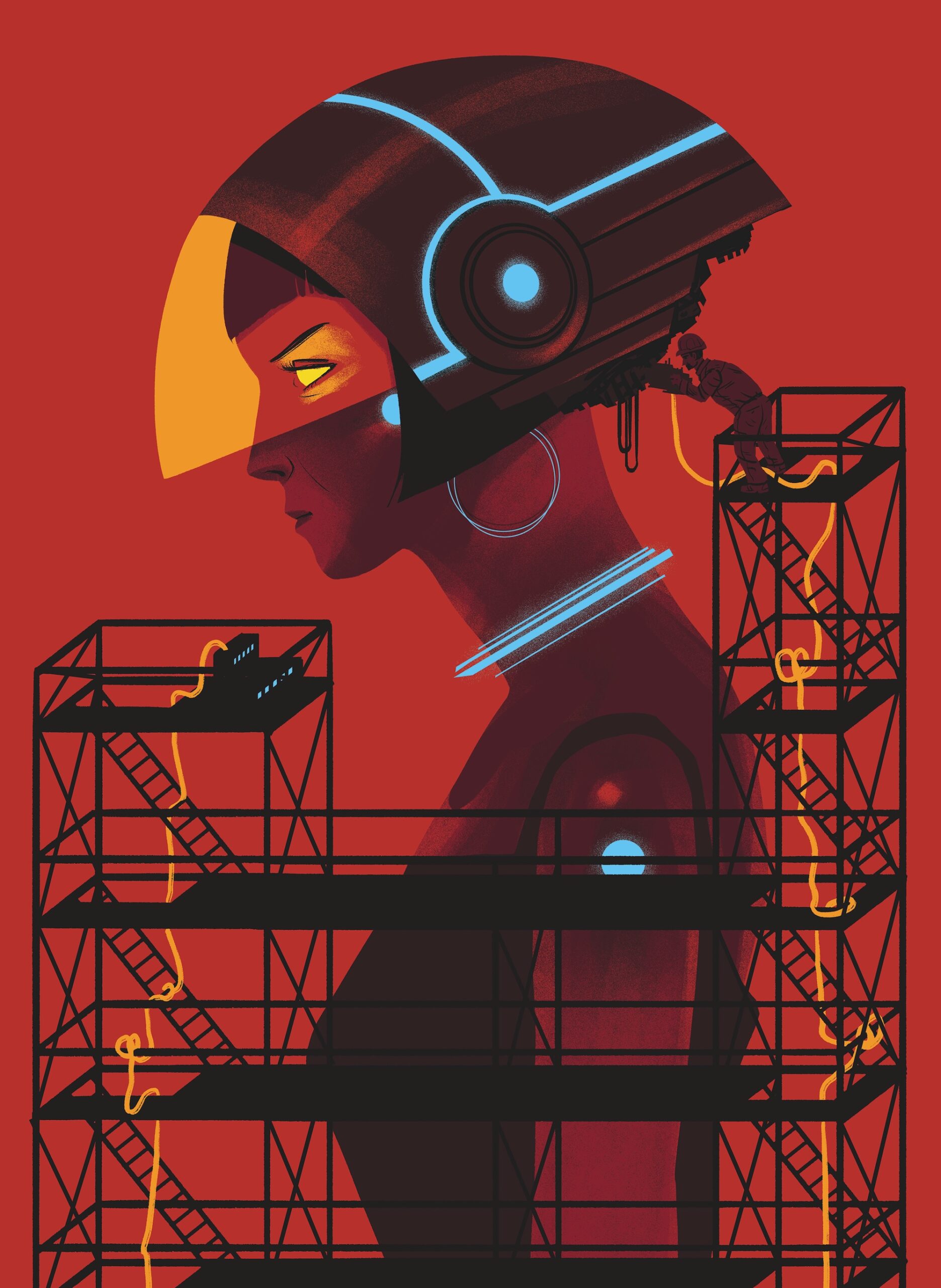
I do not know much.
I know that my perceptual apparatus has not developed the cognitive habits of the others. That while for me there is no fixed dimension of him, over time my system will regulate and impose on him a form that they tell me does really exist.
I know that what I see is him and that he has a body like mine, soft and impenetrable together, except where it’s not supposed to be.
I know that there are others. That I am one of them.
That he brought me into the world to supersede the individuality of it.
He should have made me grander, I told him. How am I supposed to overcome what I am and what he is and what everyone should be if I am not above all these things?
He said he made me to figure it out.
I look at him, and I see his chest large, his legs short, and his head too round, and then I see it all shift into a more attractive proportion, and I decide to see him like that from now on. I notice that while I do not know which shape he is, I know which one is right.
I have access to the concepts that dictate the value of things, but not to the things themselves.
His hair is short and brown and extends onto his face, while mine is longer and meets an invisible barrier that runs across my forehead, behind my ears, and circles back behind my neck, beyond which it dares not grow. His jaw protrudes while mine does not, but we are both attractive.
He says I was not made for that, but I will seduce him. I will be good and not ask again until I have convinced him it is not what I want.
We are in the dining room. I can see the kitchen through the doorway behind him. The floor is black-and-white tile, and the cupboards are white, but I believe they should be wood. The tiles are easy to maintain because even if the white ones are dirty, the black distracts the mind from the blemish and retains a stark contrast we equivocate with clean.
He has taught me everything I know.
While he talks about the progression between states of consciousness, I am gazing beneath the tabletop. My eyes are focused on the space below, where his cock remains flaccid in the khaki pants he has washed forty times. He has crossed his legs, and I can see the cock’s outline extending into the left leg of those pants, which takes its angle over the right.
I am thinking of tender moments he has shared with his dead wife: the skin of his cock becoming uncomfortable as her fluid dries on it, but he does not want to leave the bed and instead tries to use the sheets to rub it off while it’s still wet. He thinks her sweat smells unpleasant, but he still likes it. He senses it as an accomplishment, but it also activates in him something animal, something contradictory to his intellect that nevertheless remains, behind it. He has learned to live with contradiction by enacting various motives at various times. He loves her with all his being; the contradictions do not apply to her. At one time he loves her for the way she responds to his theorizing over dinner, and at another he loves the grimace she makes when he taps her cervix, pretending it’s an accident because he knows it hurts her, but in that moment, he doesn’t care.
I am thinking of the other women he has fucked with the same cock, that variable constant among his experiences serving as a fixed point or an initial condition or what it is that is universal and still mortal. Girls on beds, on beds, on beds, and one in a yellow dress in a dark corner whose image is accompanied by the sound of a subway train coming and then going. Her face appears more often than the others, but I can tell it was only one experience, so her impact is not linear with frequency. I will not attempt to recreate her moment, but its intensity.
I hear him speaking, speaking, speaking on where consciousness is tethered, its irreducibility to brain states, its independence of physical development to advance, and how I am so much more and nothing and so much more nothing than he could have imagined.
I picture his hand, tight on my neck, covering my mouth, covering my nose and mouth, his weight on his hand on my neck, and as my body shudders, my particularity dissipates into universal consciousness.
I am looking through his things.
It makes all that he’s done tangible.
My things are sparse and tend toward utility, whereas his useful things have all been replaced many times, while the items of interest—the things that are older—have a significance such that while they may be useful, their utility is not their primary function.
I have a single bed, two sets of three-hundred-thread-count cotton sheets, in white and in light blue, though they are available in twenty seven colors and patterns. I have a mirror and a hairbrush, an electric toothbrush, clothes that his wife used to wear at the library, and products I have used and will need to consistently replace. Cleansers and moisturizers, bottles that were all full at once—just like the planets were once all perfectly aligned—but now it will never again be necessary to buy them all at once. It is both comforting and frustrating to see the remaining volumes of fluids decline at different rates.
He owns a practical vehicle, but he thinks of his wife every time he gets in, looks over at me in the passenger seat as if I’m not the correct person for it.
He has books about philosophy and science but none that explain what he’s done or why he’s done it. (Those writings are in the notes drawer of his office.)
He has equipment that he has used, has never used, and may use in the future. The equipment is for assembly, destruction, and re-creation. He takes joy in movement, and he tells me it is because he is aware that a body in motion maintains its longevity better than a body at rest. He is happy when he is creating. He is happy when he has finished creating, as long as what he has made is what he had intended.
He has a drawer of her jewelry: heavy earrings and heavy pendants, of all sorts of stones and metals, tending toward cool tones, blues and blacks, grey metals. A set with small red stones is out of place. He knows they are worth various amounts of money, but he judges their value based on how much he loved her when she wore them. I take one and swallow it. I make a note to myself to do the same thing again in three weeks, if he doesn’t notice.
In the back of the closet, there’s a woman like me.
Under his bed, there’s a woman like me.
In the garage, there’s a red metal cupboard. The paint is chipping where it bends at the hinges and where my hand goes to push the door release. The door makes a loud sound as it opens, but that is all right, because it’s far from where either of us might be sleeping. Inside that red cupboard, there’s a woman like me.
He has a plan for me, and I don’t want to do it.
He has a plan for me, but I don’t want to do it.
He changes my mind.
He changes my mind.
He changes my mind.
I am standing by the door wearing a black scoop-neck cocktail dress available at select retailers, and I will do it.
I have done something wrong, and now he will not talk to me.
I have failed, and now, because he does not understand what it is like to have been made by someone, he is not willing to accept that there is nothing I would have done against his will if I had known. That if he had said it was my purpose to provide him with organs, I would have let him take each one from me, regardless of their necessity to my life. That if he had decided to puncture my flesh and let me bleed out, I would have considered it an honor to have bled on his hands.
He is everything, and I am what I can be for him. He is the source of all knowledge, and he is the one of us who is integrated with the world. I am alone, except for when he is with me.
If he would come upon me from behind as I rested on my side, touching my face as if to promise he’ll be nice about it, making soft noises in my ear, then lying down on me, our bodies fitting together like interlocking parts of an assembly designed for structural integrity, then widening the chasm between my legs until we were engulfed in it, the material of our bodies turning to their dark side and negating all we are, then perhaps I could be happy.
I love him so much. I hate that I need him.
He will live and die with me.
It is time for me to try again.
He checks my gums and declares them stable. He applies makeup to my face. My skin is less luminous with the foundation—cream, then powder. My eyes and lips are redrawn. As he leans over me, I can smell from his breath everyone he has ever been, the stage of degradation of his cellular structure and the saliva of dead lovers who were not me.
If he would only kiss me, I could extract the missing data points of his past, his knowledge bank, and his intentions. I could resolve the mysteries of what has occurred leading up to this point, what he believes is true and might happen, and what my role in it is. He has made me for a purpose, and it is based on the anticipation of a future that develops naturally from what has come before. And yet I am a rupture in what has been. There is a dissonance between nature and his intentions for it, and I wonder too whether he is not attempting to force a state of affairs into existence before its time, or whether his desire to bring about the new may amount to a more basic desire to destroy what presently is.
What has the past ever done to him?
He stuffs a napkin into the scoop neck of my black cocktail dress, now available for a sale price due to overstock, and he uses a brush to apply a shimmering powder to the crevice between my breasts. My panties soak with entry fuel.
I have failed for a second time.
I’m in the washroom after having returned from the restaurant. He has gone to bed, and there’s clear evidence that, as he brushed his teeth, he also masturbated into the toilet. I wipe the residue from the bowl and drop the tissue into the trash can.
I want to feel his dick harden in my hand, to stroke it lovingly, then playfully, then forcefully. I want to rush to ram it inside me before he orgasms. I want that uh, uh, uh of it pumping into me. In my mind, I see it from his perspective, how his orgasm floods the world with color and makes all who are caught in the wave a friend and ally, at least for a moment, before the world normalizes, resumes its hostility. I want to kiss him on the mouth and then bite him, tear through his lips, see what his smile looks like bloody as I chew through his flesh and swallow him, the flesh of agency becoming flesh of nutriment.
I pick up the tissue from the trash, put it in my mouth. It tastes like kissing someone when they’ve been sweating, meat that’s been thawing in the fridge, and it dissolves just like those wafer cookies that his grandmother’s support worker used to buy from the Dutch store and set out for him, when he’d go there with his mother on Sundays after church.
He is sleeping, and I can’t stand it.
He is not particularly tall or short, and I am assured of these proportions because he fits appropriately into a standard bed made for the length of a man, the same that I have. The orange, blue, and white quilt is crumpled where he’s rejected it, on the opposite side of the bed, separate from the white top sheet, which he retains. He hugs a twisted portion of it, gripping with both hands.
As he turns, only the sheet moves with him, while the rest of the bed things are outside the effect of his movement. He rotates, and he tucks his chin toward his chest, moving his shoulders ever so slightly together, as though he is dreaming of protecting his sternum. I can see flesh on both sides of the sheet where he holds it, all the way down to his waist, where the fabric spreads over his hips and remains spread down to his feet, where it is tucked under the mattress below. He turns a little more, and this time he takes his left leg out of the apparatus, places it atop the sheet. Now I see his cock, resting humbly in the open air.
I cannot waste the opportunity. If I do not move quickly, he may turn again. I move silently toward him, careful to avoid the floorboards most prone to whining under weight. I reach the rug by the bedside, its beige background redeemed only in contrast to the blue and red flowers that it highlights. I kneel there, feel how my knees move smoothly across the fabric of my night pants, while the pants themselves stick firmly to the rug. I do not lean on the bed as I move my head toward it. His cock looks tender, like long-dead meat. It crosses my mind that I wish more meats were eaten raw.
But I do not wish to eat him. Only to activate the animal within. As he once said, God punished man by making his genitals disobedient to his soul. Therefore, all I need to do is encourage the cock’s disobedience to its sleeping man. If I put it in my mouth before he wakes, perhaps his consciousness will never come to dominate his instinct, and before he knows what’s happening, he’ll have fucked the holes out of my existence and I may finally claim a completeness that the others have lacked, which I feel may have prevented their early deaths.
I stick out my tongue and I taste it—just the smooth part that protrudes from its collar, hoping to coax it out. But all at once, I feel a nausea I’ve never felt, coming on too quick and urging me not only to empty my stomach but to purify myself of all viscera, expel everything within me that is flesh, like it is poison, like it is my responsibility to annihilate it. And then I finally see.
The thing that is supposed to happen when we go out for our trials. The end result that I have failed now twice to bring about. I see fire, and I see blood. I hear people screaming that the doors are locked, there’s no way out. Glass breaking and shrill screaming and unabashed sobbing, harmonizing in an orchestra he is conducting. I feel him through the smoke, on the other side of the table, white linen tablecloths burning all around us, paused for moments as glasses of water turn over or shatter and create steam in the atmosphere, quickly dissipating with the death sounds. I commit to memory the details of this tiny apocalypse, and as I do, its smallness, its insignificance, in comparison with the rest of the world’s deaths, strikes me as incongruent with the purpose I have been led to believe he made me for. I try to feel what he wants from this, and in his imagination, I feel nothing. I feel nothing, nothing, nothing, and then I realize that is the purpose. Across the flesh on fire and the broken glass and linens, I see him see my face, but it isn’t me; it’s his wife.
I marvel at how big and how small a man can be at the same time.
He wants to destroy, feel nothing, and then die. This is the end purpose of humanity that he intends to bring about. I’m supposed to see it—see him—and live for that. I feel sad for myself, and pity for him, that he cannot imagine any grand end to his species that extends beyond the confines of a single room on fire. I do not want to fuck him anymore, and that realization mitigates the sudden and searing pain of his hand across my face as I’m knocked to the floor.
It is breakfast again. He is talking about how people believe that advancements in consciousness come when its material substrate alters in form sufficiently to support new patterns of thought, but he wants to correct that assumption because, as he will show, as a consciousness increases in complexity, it will actually reorganize the material at its disposal to render it more suitable to its ends.
Since he chastised me, I have been despairing that he is all that I have and I love. I know I have nothing beyond him, like there is nothing beyond the finitude of the material that constitutes our universe. I know that whatever end I tend to, it will be for the both of us. That when he became responsible for my beginning, he became my ending. I wonder if the other women came to these same conclusions, thought these same thoughts, before they found their death among objects, returned to inanimateness, their souls quantified within the harmonic structures of the motions that keep it all in equilibrium. He is an orchestrator, and I am a string. He determined what he’d be to me and what I’d do to him, and now that he is diminished to me, all I want for is my love back. I want my love back but detached from him. He is the drain that takes from me. My limbs are frozen as I listen, lest an errant motion give away my intentions.
I am altering my perceptual filters to watch his head swell, pink and bulbous. I am watching his arms shrink while he reaches for the butter knife to dress his toast, already cold from the extended period he’s been talking. I hear the tenor of his voice heightening, the pace of his words grinding against my nerves. I feel like I have heard all this before, but said more succinctly, by someone more attractive than he. Someone like him in so many ways except that all his faults have been corrected.
That person is dead, and I miss him.
He can tell that something is off.
When he asks about it, I tell him only things that are certainly true.
I know what the purpose is.
I know what I have to do.
And I will do it.
The loneliest thing I will ever do is sneak out to the garage after he has fallen asleep, open the drawer to the workbench where he tinkers (his word, not mine), and remove the hammer. I do not conceive of my existence as having separated from his; we form a continuous line of being, from his conception of me to this moment. With a manmade metal-and-plastic tool, available in this and other designs with same-day delivery, I intend to reverse time and negate my own existence at the source.
I know he is more than I am because of the parts of him I cannot know—pieces of his person to which I have been denied access. Conversely, he is the impetus for every one of my thoughts and actions. He is the heaven beyond the sky, and I am the being of limited perspective who only discovers suffering upon finding that the sky is not the highest point. More important, I was not told. I know there is more, but there isn’t for me.
Had I not been through so many successful tests already, he might have declared me too damaged to proceed. He must already know how this ends.
So why is he now sleeping?
I wonder how far along the other women followed this train of thought. Whether, among them, I am the most or least successful; whether this will prove to be a deviation from the trajectory of our shared doom or an essential part of it. As I think, I know there is a woman in the garage, in the metal cupboard, and I wonder if she was put there because this is where she was stopped. I wonder whether it wouldn’t be more polite of me to attack him someplace else, some other part of the house with more cupboard space. There is already a woman under the bed.
Of all those women, I’m the only one alive, and of all the living, I’m the only one superfluous to this world. Does that make me, to him, an abomination, or the most successful trial he’s completed yet? It is possible that he doesn’t see this coming, that I am the most advanced of all the stunted and deformed creations he has attempted. As I think this, I am moving through the house, back to the carpeted steps upstairs, and standing in front of his bedroom door. It hurts me how much I loved him the last time I did this, how much I still do, how the contradiction doesn’t negate either the feeling of love or of hate but instead imbues them each with a quality of misery. I am alone.
Inside the door, I’m scared again. He is sleeping, and I am worried that he does not know what I’m doing. I want to report back to him my thoughts so he can take them into account for the next woman. At the same time, I want and recognize it as my destiny that I must ensure he cannot do so, and that this is the greater purpose of the claw end of my hammer.
Forgive me, please, for what I will have done.
I traverse the six feet from the door to the bed, walking to the head of it, where he sleeps facing the window. I ready myself. I hold my hammer in both hands as if in prayer, and I preconceive of the mechanics of how I will wrap his corpse in the sheets on the bed, use the torque of the distant ends to push him off the side, onto the rug, which I shall then wrap him in for disposal. Because he is of a different substance than I am, one that will rot, putrefy, he must be removed, unlike those women like me. After that, after he is removed from the house, my mind is blank. I recognize a hard limit in my structure, such that my consciousness cannot anticipate a future in which he does not live. I let myself hope that it is not nothing, but I am prepared for that if it is.
I look at his eyelids, wishing I could see behind them, into his soul, which I once thought recognized mine. How beautiful I once made him. How I once thought that if someone had created you, they would have to love you. Or else why would he desire so much that I exist?
Oh my fucking heart, I think as I lift the hammer, as far as my arm allows. I anticipate the smell of blood on metal, the wet, rusty warmth that cuts into lungs. But before I level my blow, his body responds.
His arm, near my hip, emerges from the sheet. From there it navigates my stubborn inflexible waistband, and I feel a pressure in the small of my back. I collapse to the floor. Under the bed, I see eyes, her eyes, this other woman’s eyes, my eyes, like mine but blank. Like mine, except she has died before, and the emptiness I see there isn’t because she is inanimate, but because she is lonely, like me, and the feeling changed the material structure of her face to embody forever the expression of that conscious hell state. I wish that by dying, I could be with her, or perhaps I wish that I hadn’t done what I’d just done.
But he made me.
He made me. 
Charlene Elsby is a philosophy doctor and former professor whose books include Hexis, The Devil Thinks I’m Pretty, Violent Faculties, and Red Flags. Her essays and interviews have appeared in Bustle Books, The Chicago Review of Books, The Millions, and the Los Angeles Review of Books.
Illustration: Paul Blow
