I Wake Up Streaming | October 2025

In this edition of “I Wake Up Streaming,” novelist William Boyle rounds up his top streaming picks for the month of October. The column’s name is a play on the 1941 film I Wake Up Screaming, starring Betty Grable, Victor Mature, and Carole Landis. While the film’s title hits a pleasing note of terror and despair, changing that one letter speaks to the joy of discovering new films and rediscovering old favorites, as well as the panic that comes with being overwhelmed by options.
Ghost Tropic (Kanopy)
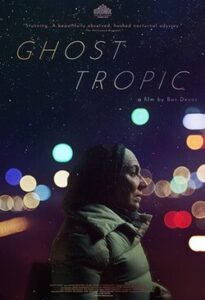 Bas Devos’s Ghost Tropic had been on my radar and watchlist for a while, but I’d never managed to see it and had drifted away from thinking about it. It came to my attention recently that it’s on Kanopy, so I finally watched it. An absolute stunner. Gave me hope on a day I needed hope. My favorite film discovery of the year. Goes right to the top of a bunch of lists—easily one of my favorite films of the decade (released in 2020 in the U.S.) and I would probably put it in my top ten of the twenty-first century so far. Hit me that hard. Saadia Bentaïeb plays Khadija, a 58-year-old Maghrebi immigrant in Brussels who falls asleep on the metro heading home from her job as a corporate cleaner and wakes up at the end of the line. It’s the middle of the night. Her son’s not answering his phone, and she has no money. She heads home on foot. On her journey, she encounters various night people, some of them tragic and most of them helpful. It’s not frenzied and full of wild detours—it’s slow, melancholic, pulsing with humanity. You can feel the loss she’s surrounded by. You can feel age and time. Bentaïeb gives a performance I won’t soon forget. The score by Ameel Brecht is sublime. So is the cinematography by Grimm Vandekerckhove. I’ve never seen Devos’s other films, but I’m going to correct that soon. I’m also curious if there’s any connection here to my hero Jason Molina’s great album Ghost Tropic (recorded under his Songs: Ohia moniker)—I can’t find anything, but they have the same sense of aching and longing.
Dr. T and the Women (The Criterion Channel)
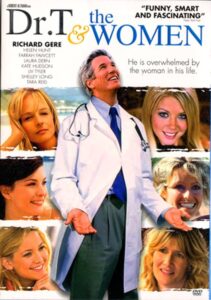 The Robert Altman collection that got added to the Criterion Channel last month is incredible. First time rewatching 2000’s Dr. T and the Women since it came out—I remember liking it back then but didn’t have much of an impression beyond that. I almost certainly appreciated it as an Altman picture—no one captures chaos and crowded rooms like him—but I don’t think I appreciated it as a screwball comedy, which is what it is. It’s deeply funny once you get on its wavelength and stop trying to see it as a romantic drama or something else. That ending had me howling. Like so many Altman productions, it features an absolutely unreal (and sometimes surreal) cast: Richard Gere, Shelley Long, Laura Dern, Helen Hunt, Farrah Fawcett, Lee Grant, Kate Hudson, Liv Tyler, Tara Reid, and Andy Richter. Worth noting that it’s a terrific Dallas movie. I met Anne Rapp once and talked to her a little about the other Altman movie she wrote, Cookie’s Fortune, and what it was like to work as script supervisor on Tender Mercies (check out her filmography as script supervisor beyond that—insane), but I wish I could go back to that night and ask some questions about Dr. T and the Women (and also about Deep in the Heart, aka Handgun, my favorite first-time watch of last year, which she was script supervisor on). Excited to keep going through everything in the Altman collection. Most I’ve seen many times and love a lot, but others—like this and The Company—I hadn’t seen since they came out.
Everybody Wins (Prime Video, Tubi)
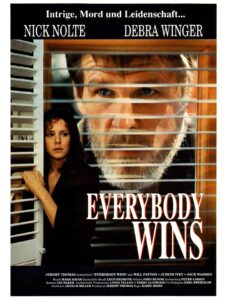 Such a weird, fascinating film. Arthur Miller’s first original screenplay since The Misfits. Director Karel Reisz’s last picture. Came out in 1990 and wasn’t well-received. Pauline Kael, as far as I can tell, was about the only critic who championed the film, praising its “idiosyncratic hallucinatory quality and wonderful performances.” Kael called Debra Winger’s Angela Crispini “something new in thrillers: a schizophrenic femme fatale,” going on to say that “Winger throws herself into the role and makes Angela’s irrationality passionately real.” Nick Nolte is terrific as shaggy private investigator Tom O’Toole, a lapsed Catholic with, as Kael observed, bangs “like a Richard Burton priest.” One of the strangest and most distracting haircuts I’ve ever seen in a movie. Winger is astonishing—her Angela Crispini feels cut from the same cloth as Marilyn Monroe’s Roslyn in The Misfits but also Sheryl Lee’s Laura Palmer in Twin Peaks (I’m thinking particularly of Twin Peaks: Fire Walk with Me). There are other elements that put me in mind of Twin Peaks, as well—Will Patton’s Jerry and his biker gang and the weird church he’s building, the thermos factory, the murder house, the sense that evil has taken root in the town, and Jack Warden’s performance (reminiscent of both Ray Wise’s Leland Palmer and Robert Loggia’s Mr. Eddy). In a New York Times piece from ’89 by Kirk Johnson, Reisz said that the film is “a comedy-melodrama with film noir tensions,” which explains why it also feels a lot like something Alan Rudolph might’ve made (Nolte’s presence amplifies that). I’d argue that it has a lot in common with Kubrick’s Eyes Wide Shut, which bookends the decade, though I’m not currently prepared to go too deep on that. One thing Miller’s script recognizes is that the rot runs deep in this world. Anyhow, I can’t stop saying the name “Angela Crispini” over and over in my mind.
Below the Belt (Tubi)
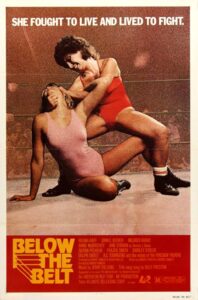 I was on a Shirley Stoler kick a couple of years back and was trying to track this down. At the time, it was available on YouTube, but the quality was terrible—I gave it a shot but couldn’t stick with it. Recently, I posted about a first-time watch of Kansas City Bomber and Daniel Kraus suggested I check this out, which reminded me that it got a Blu-ray from Kino Lorber in 2024. Also turns out it’s currently on Tubi. Man, I love this movie. The editing (by future writer/director Steven Zaillian, crazy) is a little rough, and the upbeat music is wacky and runs counter to the broken-down tone, but those are minor complaints. Completed in 1974 but not released until 1980, it feels like some lost artifact from the heart of ’70s cinema. The movie is “suggested by” Rosalyn Drexler’s 1972 novel To Smithereens, which was reissued in May of this year (I picked it up and read it after watching—it’s excellent). Drexler was a fascinating figure, who—by chance—passed away in early September at the age of ninety-eight. She was a Bronx-born visual artist, playwright, novelist, screenwriter, and former professional wrestler (To Smithereens is based on her experiences in the ring) who also wrote the novelization of Rocky under her pen name Julia Sorel. Back to the movie: Regina Baff is terrific as Rosa and the supporting cast is so memorable—Stoler and the great K.C. Townsend especially. If Below the Belt had a more appropriate soundtrack (’70s Tom Waits would be ideal) and leaned more fully into the downbeat vibe à la Fat City or even Kansas City Bomber, it’d be a perfect gem. There’s so much good footage and material that gets brushed over in those hasty montages. Still, it was a revelatory first-time watch for me.
Come Early Morning (Tubi)
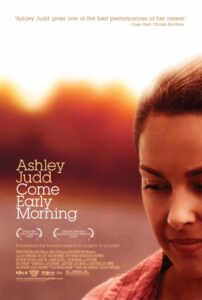 An understated and underrated mid-aughts gem written and directed by Joey Lauren Adams. A heart-rending lead performance by Ashley Judd as an Arkansas woman trying to climb out of the wreckage of the life she’s fallen into. Judd never got her due—this is up there with her best performances (Ruby in Paradise and Normal Life are my favorites, and she’s great in Heat, Smoke, Bug, and Twin Peaks: The Return, of course). A stellar supporting cast that includes Diane Ladd, Scott Wilson (who says almost nothing at all and tells the whole story of his character with vacant stares), Tim Blake Nelson, Ray McKinnon (his preacher character in this almost feels like a contemporary riff on his preacher character in Deadwood), Stacey Keach, Laura Prepon, Jeffrey Donovan, and more. Terrific score and soundtrack. Would’ve probably fit in better and been more well-received in the nineties but got kind of lost in the swampy aughts.
William Boyle is the author of the novels Gravesend, The Lonely Witness, A Friend Is a Gift You Give Yourself, City of Margins, Shoot the Moonlight Out, and Saint of the Narrows Street. His novella Everything Is Broken was published in Southwest Review Volume 104, numbers 1–4, and he co-edited (with Claudia Piñeiro and Frances Riddle) the noir issue (Volume 108, number 3).
Illustration: Jess Rotter
