At the Edge of the Known
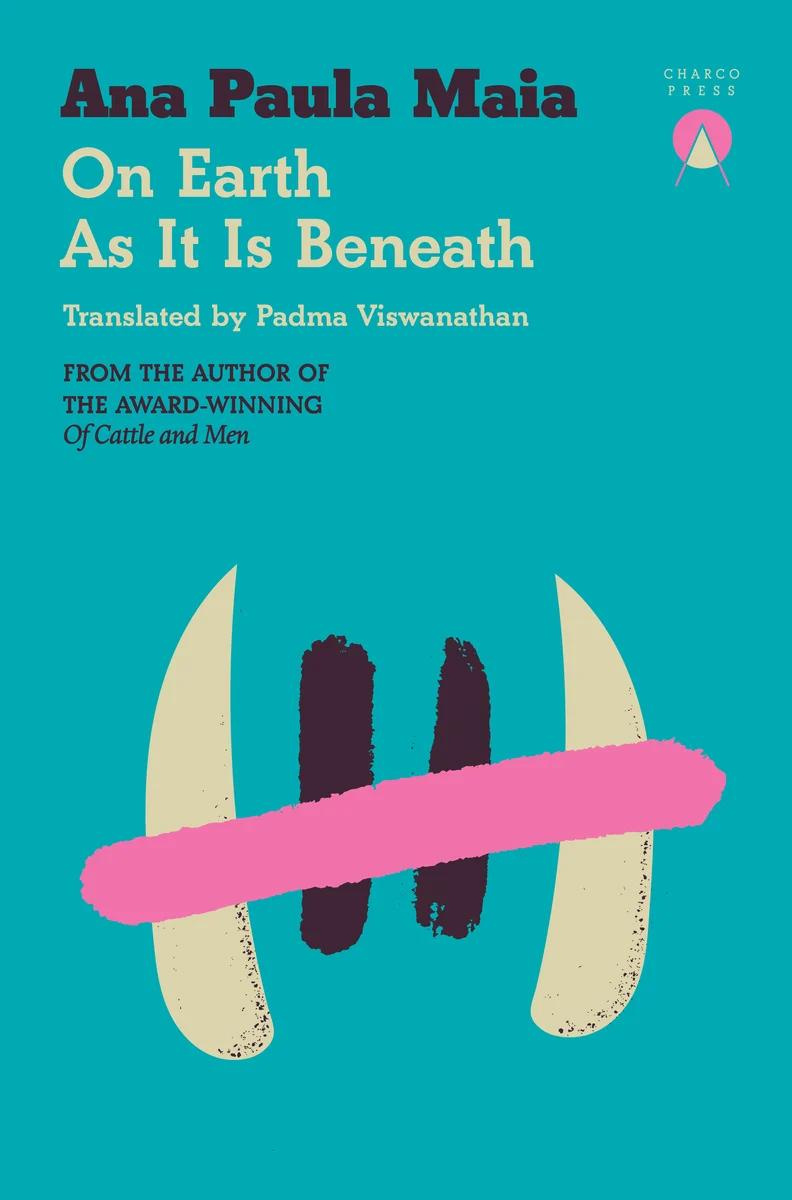
Ana Paula Maia’s slim, newly translated novel, On Earth as It Is Beneath (trans. Padma Viswanathan, Charco Press, 2025), set inside a failed Brazilian penal colony at the edge of the known, is a saga of nihilistic minimalism with the rarest of qualities: a spare tenderness and a sorrowful heart.
Take the following passage, fairly late in the novel, when the closest thing it possesses to a protagonist—the avowed multiple murderer and taciturn giant, Bronco Gil—recounts the slaughter of the colony’s horse population by its crazed, bloodthirsty administrator, Melquíades: “The first shot,” Maia writes, “made [Bronco Gil’s] whole body shake, and the impact of the horse on the floor muffled his terrified gasp. The horses started to panic, crashing into the stable walls, trying to get out, eyes rolling. One by one, they fell to the ground. Bronco Gil’s favorite fell with its head near his feet. Its large, lively eyes closed gradually in time with its slowing heartbeat. The bulging veins on its neck started to deflate, and a few minutes later, there was just him and five dead horses, illuminated by the beams of light coming in through the cracks in the old stable walls.”
Maia’s deft juxtaposition here between “Bronco Gil’s favorite [horse’s]” “large, lively eyes [closing] gradually in time with its slowing heartbreak,” “the bulging veins on its neck [deflating],” and the mad stampeding of the horses in the stall, the gunshots and the “rolling” eyes, is a characteristic one in On Earth as It Is Beneath, which numbs the reader with appalling violence and cruelty for pages on end, only to prick them with sorrow and tenderness.
Or, take this subsequent moment, in which the tower guard Taborda, Melquíades’s second-in-command (much like the characters of Thomas Bernhard or Brian Evenson, many of Maia’s tend to go by an enigmatic single name), who takes a break from confessing the atrocities that have transpired in the penal colony over the course of the last several years to reflect on a memory from childhood: “Taborda lets himself be lulled by the warm, gentle breeze touching his face. He listens to the delicate sound of the wind blowing across the plains, reminding him of his childhood home, the trees swaying just outside his bedroom window, lulling him to sleep with the rustling of the leaves.” The wistfulness of Taborda’s recollections is no accident. Nor will it perhaps be surprising to hear that only a few pages later we find him still, “beneath the almond tree,” like the innocent child he can no longer be, dead from a self-inflicted gunshot.
These delicately rendered emotional pivots aside, the plot of On Earth as It Is Beneath is unvarnished and straightforward. Along a more or less linear timeline, the novel tracks the fate of Bronco Gil, its one-eyed titan of a protagonist (the penal colony’s reigning authority figures tend to address him derogatorily as “Indian!”), who at the beginning of the book finds himself serving out an indeterminate, lengthy sentence behind the colony’s fortress-like walls, along with a dwindling host of co-inmates: Pablo, Valdênio, Julio, and so on. In spite of the fact that Bronco Gil and the other inmates can move freely within the boundaries of the colony itself (Maia wryly suggests its Angola-like, agrarian inner workings as rehabilitative, if not restorative, in concept), they are also outfitted with what they refer to as “tags” on their ankles that the inmates, at least, are told will explode the moment they venture beyond the walls.
To make matters even slightly worse, the land on which the colony is constructed is believed to be cursed. “More than a hundred years before,” Maia writes, “enslaved people . . . were mostly tortured and killed” there; its future occupants will fare no better. “Once more, the place was deserted and unproductive,” Maia continues.
That is, until the decision was taken to build a penal colony to serve as a model to the rest of the country, and from where not a single prisoner would ever escape. Building the walls took five years. On inauguration, there was a party with music and drinking. Afterward, everyone seemed to forget about the place. It was never mentioned and those who commanded it from a distance avoided the subject.
But the true reason for the penal colony’s dwindling inmate population is far more horrid than simple neglect or mismanagement. Its psychopathic warden, Melquíades, “two days” following his slaughter of the colony’s horses, has “started hunting the men like they were animals,” removing the explosive tags from their ankles in the dead of night at the edge of the wilderness in which the colony sits and, with his prized “long-range made-in-Czechoslovakia CZ.22 rifle” and a stopwatch to give them a running start, commutes their sentences with bullets. Buffeted by the heightening winds of Melquíades’s insanity, the primary objective of the inmates left alive gradually shifts from endurance to escape. And finally whatever it takes to survive.
Ana Paula Maia, in the course of her relatively short yet impressive career, has been hailed as South America’s answer to Cormac McCarthy. (On Earth as It Is Beneath implies itself as a prequel of sorts to Maia’s McCarthyesque 2013 novel, De gados e homens., translated by Zoë Perry as Of Cattle and Men, 2023.) And while in many ways the parallel is apt—Maia, like McCarthy, follows even her central characters with a cold, observational remove, and seems equally unafraid of ending their nasty, brutish lives without warning—it also feels hollow, a bit superficial. Maia’s prose, for one thing, is much leaner and more self-consciously oblong than that of America’s maestro of bloody grandiloquence. Not to mention the fact that Maia seems actually to care a great deal more about the blood-soaked, disreputable lives that she toys with, implying a certain degree of appealing contemporaneous sincerity: hope amid a hopeless world. And where McCarthy seems happy to point out (for instance, in his masterpiece, Blood Meridian) that the mythopoetics of the American West were written in someone else’s blood, Maia here endeavors an incrementally more thoughtful investigation into the poisonous legacy of the Brazilian slave trade and the hypocrisies of the carceral state. On Earth manages as well to chillingly presage the rise of Jair Bolsonaro and Brazil’s own flirtation with fascism in 2019. More Kafka finally than McCarthy (the reference to the prison as a “penal colony” seems far from accidental), with the allegorical incisiveness of Yuri Herrera’s Signs Preceding the End of the World or J. M. Coetzee’s Waiting for the Barbarians, Maia’s novel is a thinking person’s sociological thriller that is also somehow a sort of fable, as tough to endure as it is to put down.
In leaving so much up to the reader’s inference by merely suggesting the walled-off inner-compound of the penal colony itself, Maia allows plenty of room for the political and the emotional imagination to take hold. The book’s ending—not happy, but not disemboweling—leaves that reader in gentle and gratified awe. Though one may have escaped Maia’s prison for now, one’s heart still mourns behind its walls.
Adrian Van Young is the author of three books of fiction: the story collection The Man Who Noticed Everything (Black Lawrence Press), the novel Shadows in Summerland (Open Road Media), and the collection Midnight Self (Black Lawrence Press). His fiction, nonfiction, and criticism have been published or are forthcoming in Electric Literature’s Recommended Reading, Black Warrior Review, Conjunctions, Guernica, Slate, BOMB, Granta, McSweeney’s, and The New Yorker online, among others.

More Reviews