The Good Kind of Bafflement
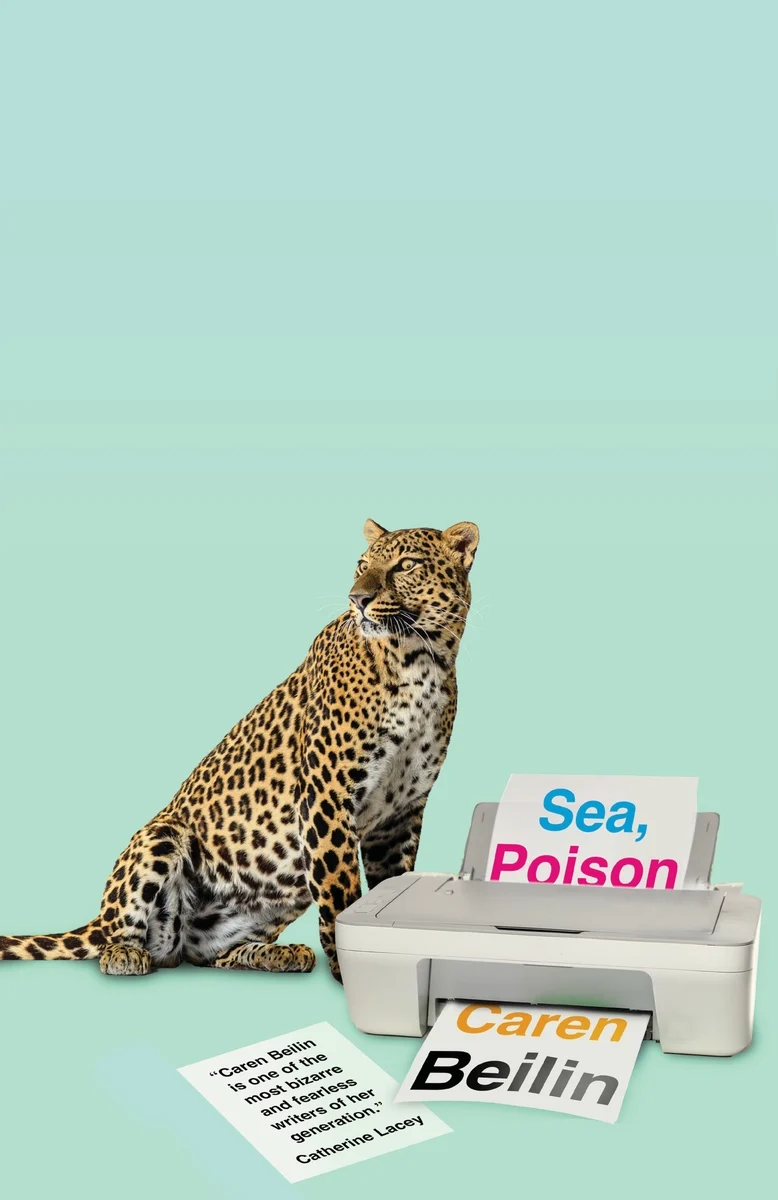
Upon finishing Caren Beilin’s new novel, Sea, Poison (New Directions, 2025), I immediately went back to page 1 and dove back in. Not because I like to reread books, but because I was in a state of bafflement. This is not an uncommon feeling when reading books by this incendiary and very funny Philadelphia writer.
Let me be clear: There is the good kind of bafflement and the bad kind. Sometimes the seesaw of engagement teeters on the brink of feeling overwhelmed—it could be a fun ride up and down, or you could slide off and fall in the wood chips. All of Beilin’s books are overwhelmingly good bafflements, even the earnestness of her body (bawdy?) horror medical gaslighting diatribe, Blackfishing the IUD (Wolfman Books, 2019).
Sea, Poison could be seen as Beilin’s most challenging book yet, partly because of the range of subjects it tackles in just over a hundred pages (polyamory, laser surgery, writer’s block, language, literature, desire, Shūsaku Endō, copycatting, Oulipian writing . . .) as well as the abruptness with which it moves between them.
The hilariously named protagonist, Cumin Baleen (functioning, arguably, as the author’s surrogate here), finds herself thrown into turmoil after she believes that a laser eye surgery has singed her brain.
I began having some cognitive problems. The best way to describe them is something between aphasia and writer’s block. I could speak, and write, but I had become very spare somehow, unable to elaborate or more importantly to me, to use language—namely, sentences—elaborately, I mean with multiple clauses, which had always meant so much to me, to do that, to keep going.
Stuck in a medical kind of limbo in “this city of hospitals,” Cumin (Cu for short) has a lot happen to her in the span of a few early pages: Her boyfriend, Mari, breaks up with her after falling in love with their landlord; she goes to live in the closet of a polyamorous theater professional named Maron, where she quietly listens to a rotation of lovers, and then her ex-landlord calls her to say things have ended between her and Mari after one month. By this time, though, she has emerged from the closet and is spending time with Alix, a hospital hottie who who was previously fooling around with Maron (whose closet Cumin inhabited).
Turns out that Alix works at the Moody Eye Clinic, where Cumin had her bad surgery. So they go there at 2 a.m. and have a restless and circuitous conversation in a black box theater in the basement, where they discuss Alix’s never-fail script to get patients to poop in a bedpan (this involves the show Seinfeld being played on the room’s TV), medical scams, and stories of women being raped on the OB/GYN table.
You might think from my descriptions so far that this book is hard to follow. And you’d be right. But that’s also part of the pleasure—a sort of mystery or labyrinth of unpredictable scenes that often transform into a new narrative, like when Cumin is at a café having a long conversation with a stranger about a writing residency they took with a Sex and the City writer. As the stranger (who somehow knows Cumin’s name) goes on about writing mentors, Carrie Bradshaw possibly being an incest survivor, the Coen brothers, Daniel Day-Lewis, Dirty Dancing, and the “fuck chair genre” of movies (which apparently includes Claire Denis’s High Life and the Coen brothers’ Burn After Reading), the café fills up around them and Cumin becomes stuck there as an MFA thesis reading for a creative writing student begins.
The next chapter, “A Manager”—a clever spin on a chapter in Endō’s novel The Sea and Poison—is the “long short story” that the MFA student reads at the café. A sort of vertigo effect happens here: There’s nothing to indicate to the reader that the narrator has shifted and that we’re reading this student’s writing, until an aside where Cumin shows the stranger sitting with her that the student is closely echoing part of Endō’s novel. The stranger, in turn, responds to Cumin by pointing out that Endō himself was mimicking part of Flaubert’s Madame Bovary.
Sea, Poison is populated by these funny moments of characters being well read and into literary history. A hospital assistant discusses a Teju Cole novel with Cumin; Alix talks about the feud between Camille Paglia and Susan Sontag; Maurice Blanchot is mentioned; we learn about the plagiarism feud between Camille Laurens and Marie Darrieussecq; the boyfriend-stealing landlord debates Cumin on Endō’s best work and is also a tenured expert on experimental French literature at a university. Even the grocery store that Cumin works at is called Sea & Poison, after Endō’s novel.
At times, when these references (or the many movie and music references) happen, it reminds me of the scene from the Charlie Kaufman movie (based on the Iain Reid novel) I’m Thinking of Ending Things, where Lucy, played by the amazing Jessie Buckley, delivers a monologue where she performs the Pauline Kael review of the John Cassavetes movie A Woman Under the Influence. Buckley basically transforms herself in this scene into the famous critic, mimicking Kael’s posh diction and ruthlessly attacking the film. Transforming (or digressing) is something that Beilin’s characters do often as well, spouting unexpected, memorable lines like “An enema is for, I don’t even know, Obama” and “You think Condom Kingdom sells madeleine cookie butt plugs à la Proust?” Sometimes they sound like they’re quoting from a thesis study, like when Cumin’s ex, Mari, says, “I could link polyamory with a vivification of gay and/or Sapphic forms of lust, or inclinations anyway against old controlling customs—this appraisal, this poor study of toxic masculinity—of owning, of holding back, or dominating anybody, but I think it’s just, Cu, it’s our disposability only, it’s a dark night of subjugation.” (All that being said, I would campaign for Jessie Buckley to star in Sea, Poison–or play any character, really–if it ever becomes a movie. Charlie Kaufman, are you reading this?)
Sea, Poison is defiant and ironic in its presentation. Though Cumin Baleen struggles to regain her clause-loving writing style, Caren Beilin is able to frame this predicament with a smorgasbord of commas and dashes:
I told Janine over tea about what happened with the laser at Moody, how it had gone in too hard, and clipped me, bit or burnt me, something, in the brain. How after it happened I had stopped writing. And how when I tried to write again, like in a journal, low stakes on the metal stairs that led up to my studio—my own private entrance, very nice, and lately all for free—only very stuck, plain sentences came out.
“I am here.”
“I see a dog.”
“I can see the sky.”
“I have a knee.”
It turns out that Cumin’s laser accident was not an accident after all. While talking with Mari about their breakup, the ex-boyfriend reveals to Cumin that their landlord was not a fan of Cumin’s novel, Naked Grapes.
“Medical OuLiPo?”
“Yeah.”
“What?”
“How’s it going? Are you writing shorter sentences at all? I guess she was gonna take a shot at that veritable wasp’s nest of commas—clauses—in your head.”
“Mari, I need those.”
Taking a stab at her own kind of medical OuLiPo toward the end of the book, Cumin attempts to write a chunk of text without the letters that form the word uterus, in tribute to Georges Perec, the French writer who famously published a novel (La Disparition, 1969, translated by Gilbert Adair as A Void, 1995) without using the letter e.
Cumin’s novella-length battle is a combination of medical gaslighting, literary ambition, low-income malaise, and unrequited, horny heartbreak (“Polyamory is running amok in South Philly!”), and it has led her to this point, on the verge of losing herself entirely, her u, t, e, r, and s. But this exercise in language brings something back to her in the nick of time. And if she thinks she’s finally figured something out, maybe it’s a happy ending? I’m not so sure, but you could always do like I did, and go back to page 1 to experience it all over again.
Kevin Sampsell is a writer, publisher (Future Tense Books), collage artist, and bookseller living in Portland, Oregon. His latest releases are Sean the Stick, a collaboration with Emma Jon-Michael Frank, and a new zine, The 24 Days of Xmas. His novel Baby in the Night is due out in 2026 from Impeller Press.

More Reviews