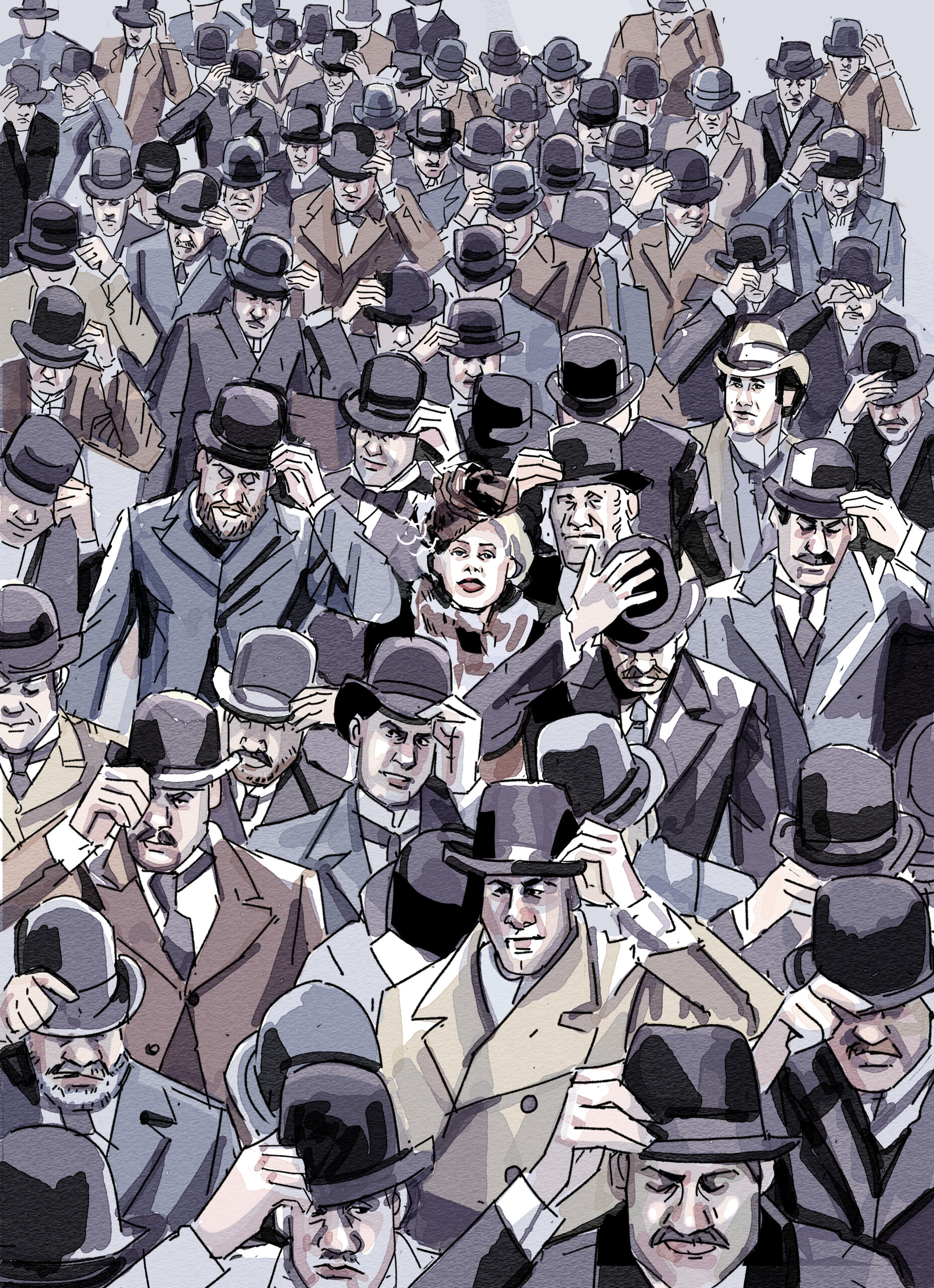
Needle Drops is a column that asks writers about—you guessed it—their all-time favorite needle drops. In this edition, Megan Abbott offers a view of Enya’s version of “Marble Halls,” featured in Martin Scorcese’s Age of Innocence.
Martin Scorsese is one of the greatest needle droppers in cinematic history. One could argue that he invented them with his unforgettable use of the Ronettes’ “Be My Baby” in the opening moments of Mean Streets (and, later in the same movie, with the Rolling Stones’ “Jumpin’ Jack Flash” accompanying the introduction of Robert De Niro’s troublemaking Johnny Boy). But the Scorsese needle drop that looms the largest for me is a quieter, more idiosyncratic choice, in one of his quieter, arguably more idiosyncratic films: his 1993 adaptation of Edith Wharton’s 1920 novel, The Age of Innocence.
Set primarily in 1870s New York, it’s the story of an ill-fated (and unconsummated) affair between Newland Archer (Daniel Day-Lewis), from one of the city’s old-money families, and Ellen Olenska (Michelle Pfeiffer), whose social stature has suffered following a scandalous divorce. At the time, the film was considered an anomaly in Scorsese’s oeuvre: a period piece focused on high society, on the conflict between social expectation and the force of desire. But, to me, it felt—feels—a quintessential Scorsese story from a director forever wrestling with duty and passion, with the damage we do to ourselves. As he told Charlie Rose, it’s one of his most violent works—an “emotional and psychological violence.” It’s also a story of suffering, a theme in Scorsese’s Catholic-haunted work from the beginning.
I first saw the film the day it came out, which is what we did back then. It was during my sole semester of journalism school in Illinois, smack in the Corn Belt, swathed by miles of the kind of picture-perfect farmland I knew only from The Wizard of Oz, Field of Dreams, Days of Heaven, Children of the Corn. I was desperately unhappy at the time, in the wrong place, the wrong program. Movies were a balm; a new release by my favorite director even more so. For its 139-minute run time, I could escape everything and savor the torment of his characters.
Elmer Bernstein’s sweeping, achingly romantic score dominates The Age of Innocence. Midway through the film, however, we hear a plaintive song. It occurs just after Newland and Ellen have shared an anguished conversation on a sunlit hotel veranda facing the water, their hands touching briefly as the song begins, and then extends through the next scene. The screen dissolves from the doomed couple to the same veranda, now empty and filled with melancholy. Then, in the movie’s most memorable image, we watch in slow motion as a mass of suited men move down New York City’s bustling 23rd Street, bisected by the Flatiron Building. They move nearly as one, a rippling swarm of sameness. The wind kicks up and they all clasp their near-identical bowler hats against the bluster, a few birds flying among them.
The song that accompanies this wrenching sequence is a nineteenth-century standard of piercing longing and nostalgia: “I Dreamt I Dwelt in Marble Halls,” an aria from The Bohemian Girl, an 1843 opera by Michael Balfe with lyrics by Alfred Bunn. Arline, a count’s daughter, recalls her lost childhood before being kidnapped from her noble home at age six: “I dreamt I dwelt in marble halls / With vassals and serfs at my side . . . I had riches all too great to count / And a high ancestral name.” These are not memories, precisely, but a fantasy reverie of a time for which she has only the faintest (and thus most romanticized) recollection.
The aria appears in many works by artists from Booth Tarkington to Willa Cather to Laurel and Hardy, who adapted the opera in 1936. In The Dubliners, James Joyce mentions it in two stories: In “Eveline,” a young woman attends the opera with the handsome seaman with whom she intends to run away. More significant, in “Clay” a middle-aged woman who has never married sings “Marble Halls” in a “tiny, quavering voice,” moving another character to tears.
The part of the aria Scorsese uses is its most romantic, the thrice-repeated refrain: “I also dreamt which charmed me most / That you loved me still the same.” But rather than a traditional rendition, Scorsese uses a recording by the Irish singer and composer Enya from her Grammy-winning Shepherd Moons (1991).
In Wharton’s novel, each Pompeian vestibule or gilt vitrine is a signifier of social status or lack thereof. Likewise, in Scorsese’s adaptation, the narrator highlights the “roses from Henderson’s, the Roman punch and the menus on gilt-edged cards” that are meant to accompany a formal dinner. This is why it’s jarring to hear Enya’s distinctively modern arrangement. According to Enya, Scorsese requested she record the song with a “more traditional feel to it,” but she refused. Scorsese relented and used her arrangement. The result is both anachronistic and deeply resonant, as if the characters were extending their arms from the screen itself and assuring us that these conflicts, feelings, desires are not trapped in amber from more than a century ago. They are our own too.
Soon after seeing the movie, I bought the soundtrack, and I still remember my surprise—even embarrassment—that the singer whose voice so moved me was Enya, who was decidedly “uncool” to my Gen X sensibility. I associated her music with department stores, doctors’ offices. In the privacy of my dorm room, I listened to “Marble Halls” again and again, inexplicably stirred every time. Can one be moved in spite of one’s own taste? Of course. Maybe even especially so. I’ve come to believe this disconnect is in fact a necessity for a full experience of art. The feeling must supersede the shabby limits of intellect, one’s haughty ideas about oneself. And, too, like Wharton’s characters, my irony-infused taste as a twenty-one-year-old snob who loved Joan Didion and Sonic Youth was, in its own small way, as rigid as Newland Archer’s hopeless conventionality, his distaste for new money, or, more to the point, his lethal conformity, like all those sad men holding onto their identical hats.
I can tell you this: Every time I walk along 23rd Street on a windy day, I think of those men and that song. Scorsese has said the inspiration came to him from a 1903 film called At the Foot of the Flatiron that showed “all those people bunched up on the sidewalk” in a time before skyscrapers, when the “wind could blow right across the island.” We find ourselves looking for Newland in the scene. He never appears among the masses. Or perhaps he’s there and we miss him, those clasped bowlers hiding him from us. Today, skyscrapers have come and gone and new ones have sprung up. And yet the wind still whips, my eyes stinging from it.
Megan Abbott is the Edgar-winning author of twelve novels, most recently El Dorado Drive and Beware the Woman. Her stories have appeared in multiple collections, including The Best American Mystery Stories 2014 and 2016.
Illustration: Rachel Merrill
