Night came crashing down on Byron Andrés in his last year of high school. The days grew dense, opaque; he could almost reach out and touch them with his sticky fingers. After his abuela Alba died, strangeness spread throughout the house. Death released a viscous liquid that permeated everything, a patina of fear that made each movement heavy and plodding. As if Abuela Alba’s body had emitted a hot, desert wind. There was a reason she was born in Villavieja, Huila, people said, where there was nothing but dust and heat.
Byron felt prickly with fear and rage. Then came the whiplash of guilt. He always thought that when Alba died, what he’d feel would be sorrow and tears and all the nice things. The kind of haze you see in movies when people recall love. An explosion of nostalgia that would render grief tolerable, sweet, beautiful in its own way. But he couldn’t cry. Instead what seeped from his bones was fear: cold, hard fear. His muscles tensed, his tendons grew stiff, he began to constantly grind his teeth. Byron slept very little and was awoken regularly by the sense that he was burning up, as if his bed were on fire.
Doña Alba died at midnight one Sunday, so they didn’t realize she was gone until Monday morning. It was raining out, hailing. The metallic pings on the tin roof were louder than his mother’s cries and the nosy neighbors’ murmuring. Byron knew his grandmother was dead just by looking at her, there in her little bed, all balled up in the covers, lopsided. One chicken leg, covered with tiny moles, sticking out. Her arms tangled up in the sheets, and her face. That face. Byron knew Doña Alba had fought the bed, and without thinking he said, “Ay, Albita, even in death you got no peace.” His mother whipped around like a cat and gave him a smack. The neighbors rushed over to restrain her or embrace her; it wasn’t clear which. Byron didn’t cry. His mother’s hysterical choked sobs were enough for them both.
Doña Estela arrived at the morgue alone, at dusk. Byron brought her a milky coffee and a few strawberry sandwich cookies. She stood in silence for a time, gazing at the milk water, bits of pink frosting floating in it. Byron was touched by the pathetic way she was hunched, like an overgrown girl, and for a few minutes, against his will, he forgave her everything. Out of nowhere, she blurted: “The funeral’s going to cost two million pesos, papito.” And burst into horrifically genuine tears, unlike the soap opera version she’d cried that morning. No. Now she was crying for real, like a little orphan. Byron couldn’t breathe. These tears came from the depths of her childhood, and felt like a left hook to his stomach. It was as if his heart and his liver and his pancreas were being removed. But still he got up, went to hunt through his grandmother’s closet, and brought out her metal Christmas cookie tin. Without looking his mother in the eye, he handed her all the money Albita had been saving to buy his military booklet, releasing him from compulsory service.
Byron’s mother stopped talking about the formal graduation photo she was going to order, the cap and gown to be rented, the arroz con pollo she’d serve guests and all the relatives she’d invite, stopped asking Sonia to lend her enough to buy three cases of beer. Doña Estela took refuge in the light of the TV. She wept periodically, her face shiny and sticky. Byron didn’t know if she was crying about Abuela or the TV show, but it didn’t matter since he didn’t know what to say either way. He sat beside her, watching novelas day after day without seeing them. Staring at a luminous void. Smelling the neighbors’ sancocho. Hearing cars brake their way down the steep streets. Byron was sure that his mother, too, felt the absence, the emptiness, the unreality taking over the house, but they never spoke about it. They spoke only the bare minimum in the months following Abuela’s death, as though afraid they might rouse the hordes that were watching them.
It was about that time that two posh kids came to his school. They looked like they were from another planet, or had walked out of one of his mother’s soap operas. Both of them had tiny pores and smooth skin, wore spotless polos, and smelled like shampoo. It was as if they’d been mass-produced at the same factory, with slight variations. The entire class fell into silence. A silence heavy with scorn, mockery, fear. Rich kids didn’t just tend to turn up like that, in the middle of the day, with their doe-like eyes, didn’t tend to stand at the chalkboard in front of a bunch of high schoolers who were dying to laugh or cause pain. These two were an apparition. Miss Juliana, the teacher, said that these college boys had come to give them a vocational talk. Byron felt watched, exposed, and looked down to stare at his shoe. One of the la-di-das asked, in a game-show-host voice: “So, guys, what do you want to do when you graduate from high school?”
“Have a car and a girl with big tits and drink fancy booze, like you,” said González, who never missed a chance to show other people that he could see right through them. And that he was never, ever afraid. Or that he was only ever afraid.
The class erupted in laughter. The boy gave Miss Juliana an imploring look and, in bewilderment and resignation, she came to his defense. A few kids kept tittering, until Soraya, four months pregnant, shouted, “Oh, grow up! Or are you never going to do anything with your sad little lives?” Byron got a lump in his throat, his windpipe constricted, and he felt the urge to cry. He saw Soraya in two years’ time, with some other asshole boyfriend and another kid, and then another, and so on. He pictured her trembling, in bed, a child on either side of her, praying the guy wouldn’t come home. Byron Andrés was enraged; he shook off his vision and thought that the future had long been a thing invented by the movies, or by rich kids in polo shirts. The future was rigged, a racket, a teacher’s fantasy.
Students began raising their hands to respond. One by one, they said more or less the same thing, though upping the ante: “I want to join the National Police force.” “I want to be a professional soldier.” “I want to be a sergeant major in the army.” “I want to be a forensic examiner.” “I want to be a detective in the technical investigation unit.” “I want to be a brigadier in the air force.” “I want to be an agent in the GAULA anti-kidnapping forces.” Byron Andrés had no idea where all this terminology was coming from, all this technical cop-speak. Suddenly, John Pajoy said, “I want to be a patrol officer.” And Byron saw, with great precision, the way this sparked a cruel laughter, full of shiny teeth. “Just go sign up at the substation,” Bemúdez shouted. González was next: “Dream big, John, say, ‘I want to be a major general, motherfuckers!’” The laughter didn’t die down. And Byron knew that John’s nickname had just been changed, that for the rest of the year he’d be the General. He saw John at recess, attempting to walk with his head held high, ignoring the taunts, making a face that resembled a smile. Again Byron felt the urge to cry, but held it in by staring at his shoes.
Byron began to feel the air of unreality, bursting in like a dry wind that advanced across the room. His classmates resembled clay figurines, floating stiffly in gray space. He saw chunks of exposed muscle oozing blood and a yellowy liquid. He saw calluses on hands and feet. He saw a seven-year-old boy, bowed under the weight of a 6mm rifle that looked as though it were caressing his cheek. A toothless old lady choking back sobs over a casket as rancheras played softly among the fake flowers. He saw grimy faces, dirty sex. He saw fissured sphincters and an ATM displaying a balance in red, flickering incessantly. A buzzing swept over the school and rumbled the whole neighborhood. Byron thought he was going to faint and caught a glimpse of his abuelita, there in the classroom, dancing a sanjuanero between the desks and stroking Soraya’s belly. He held fast to the table, closed his eyes, and inhaled deeply, filling his lungs all the way.
They were given handouts that had a series of ridiculous questions:
I dream of: _____.
My life’s desire is to: _____.
What I want most is to: _____.
Byron simply wrote: I want to stop feeling so strange.
Then he balled up the paper, stuffed it in his pocket, and felt terribly sad for everyone in the room. Terribly sad for the collective shipwreck of good intentions, which collided with one another and slowly sank. He allowed himself to be dragged under by the red-hot currents of silence. Let his body be taken by a sorrow that was ancient, a sorrow older than his abuelita. A fermented sorrow that made his arms heavy and his fingertips touch the sandy, gray depths of nothing. His lips pressed tight, Byron felt sure he didn’t take a single breath until he got home.
He found his mother watching a soap opera about the war. Her gaze was fixed and languid. A square-faced sergeant major in the army was kissing a longhaired woman in a tightfitting outfit. They were celebrating the success of some counterguerilla operation by getting it on. Byron felt a stab of rage, and his nose filled with the sweetish scent of his dead grandmother. He rushed to the kitchen and, as he stared at a plate of rice and greasy plantains, was attacked by a rabid thought that bit his leg. The thought was that it would have been easier to bury her in the yard, beside Motas, Canela, and Zeus. He pictured his grandmother’s bony hand stroking their ghost fur through the black rubble. Byron closed his eyes and for several minutes was surrounded by the roaring silence of the earth. He knew that he was bad, the worst. Perhaps he deserved all the darkness surrounding him.
The day the army had come for recruitment, Byron’s mother had clung to his grandmother’s rosary and turned off the television. She told him to tell them he had bad teeth, said to show them how his feet twisted inward. The soldiers stripped him, auscultated him, weighed him, measured him, felt his testicles, and examined his mouth. Having no documentation to certify his negligible physical abnormalities, he was deemed fit. Byron Andrés would be a private, like the majority of his classmates. No anti-kidnapping officers, no sergeants, no forensics specialists, no detectives. Just a handful of teenaged privates scattered through the country’s jungles. Like tossing gold nuggets into the air for them to land in the depths of a well.
Byron was assigned to the 30th Jungle Battalion, in Mitú. No sooner had he stepped off the small plane than he was hit by the humidity of the Vaupés River: It seized his lungs and forced him to turn his face. On the pavement, under his boots, he felt a heat dense with the sun of many days. The ground beneath him pulsed like an old dog’s heart. Byron felt the weight of his entire uniform at his knees, which were sweating profusely at the fold. A sickly sweet rotten stench assaulted him in waves. A smell very like the one his grandmother’s death had left in the house but stronger, riper, more penetrating.
That’s when the sergeant began to shout. Orders and more orders. His words seemed to get shorter and sharper. Speech had lost its soft curves. Military language was truncated, terse, impatient. A hard language: this, or that. Period. The sergeant had to shout to be heard over the shrill sound of the birds, which shrieked as if to warn them of some timeless, invisible horror. And of the cicadas that disrupted the hot air, sounding like the crackle of an enormous inferno as it swallowed up the jungle.
The first days weren’t so terrible, or were less terrible than what Byron expected. Sleepy as they were, the boys behaved as if they were on a field trip. The novelty of sleeping over, this one’s girlfriend, that one’s cell phone games, the exchanging of musical preferences, partying, messing around, joking, competing. All of it a pillow for their anguish. Byron liked listening to their accents, liked the way they made a varied music. He thought of a handful of jungle birds, their colors and their plumage. All of them proud, on their two feet, squawking in the trees. And the birds took on the faces of the soldiers, and the soldiers sprouted little wings. Sad, scrawny wings. Short little stumps that pressed against their sweaty uniforms, smelling permanently of wet rag and warm testosterone.
But then quickly things became tense. The soldier-squabs soon grew testy. They realized within a matter of weeks that it was crush or be crushed. Their lives depended on ingratiating themselves to the commanders and the commanders’ cruelty, and, in turn, to exerting pressure on the youngest fledglings, those most fragile, most likely to cry. And then there was the tedium, which blended with the furtive howling of monkeys, the ever-present roar of motorcycles, the soporific steam rising off the river, the moldy damp at their armpits. The unbelievable urge to tear off their scorching boots and hurl them into the water and run away.
Their nicknames increased in caliber, hitting where it hurt the most. The boys were merciless with García, because the fear on his face was always so easy to read, and he had no cell phone and spent every afternoon begging to make a call. Byron didn’t like to look at him; the naked distress was too upsetting. One night, dazed by the heat, silence befell the barracks. García had managed to borrow a phone. Those who were awake could plainly hear him using his voice in an attempt to comfort his newborn. To console the tiny feverish body with hasty, muffled words. The bunks got even hotter; time slowed down. When García hung up, in total darkness, a single grubby melted chocolate was passed through the dorm from hand to hand until it reached him. An anonymous peace offering. A solidarity that was unidentified, and thus had impunity. Byron stiffened to keep from crying, turned over in his sweaty sheets, and felt a body sit down on his bed. He opened his eyes to find his abuela Alba, sewing a ragdoll and stitching on little black eyes. The cicadas made a silence so huge that it was a chasm, and the bunks sank a few millimeters into the tiles. Nobody could truly sleep. And a fiery restlessness mixed with the smell of piss creeping out from the latrines.
Byron was assigned guard duty in town, which was simply another way to sweat and feel bored and sweat and feel sorrow, watching the boys wait like vultures for the girls to be dismissed from school. To distract himself, he occasionally left his post and walked, looking at faces, gardens, bougainvillea, shops, old ladies in rocking chairs, and kids in flipflops. He liked to slip away and buy cigarettes too. On one of those trips, he bumped straight into a very old woman with very long and very black hair, jet black. Not a strand of gray but millions of wrinkles. Skin so rough, it was like a mountain range. The woman stared directly at him and, apropos of nothing, said, “For years now, life has been unbearable.” Without awaiting a response, she shook her hands as if shaking off sand and then kept walking, her face wooden.
Byron was afraid to close his eyes. Every time he blinked, he saw the black-haired old woman’s horrible face. What was truly unbearable was having her strange presence stuck to his retinas. And then, in his fear and unease, Byron realized that his back tooth hurt. In the beginning, the pain blanketed his whole mouth but was mild. Bearable. Then, as the night wore on and the sounds of the jungle grew sharper, the pain grew more and more acute, persistent. Past midnight, it turned brutal, and fire shot up the whole left-side nerve of his jaw. Byron, who had made an effort to suffer in silence, began to bellow. At this point he was seeing the black-haired old lady’s face without even closing his eyes. She stared down at him from the planks of the upper bunk. By the time the roosters began to crow and the jungle birds kicked up a fuss, he was shivering so violently that his legs spasmed like reeled-in fish. And something so hot shot through his insides that, at some point, it numbed him. He was surprised by how quickly the cavity advanced, for in a matter of hours it seemed to be eating away at his bone and digging into his brain. Then he fainted.
It took several hours for anyone to realize he wasn’t there. No one noted his absence in the showers, or at cleaning, or at breakfast. It was only at muster that anyone realized he was absent. They found him face down, unconscious, delirious with fever. They put him on a wobbly stretcher, rank with decades of accumulated soldier sweat, in the battalion’s infirmary. He spent all day there without anyone coming to examine him, fading in and out of thick nightmares. At times, Byron succumbed and let his mind churn in that boiling stew. He said to himself, Okay, I guess this is how I die. But almost immediately he was gripped by a panic that clenched his throat and bore down, as if grabbing hold of his body. “Fuck no, not in this piece of shit battalion, not like this.” In the afternoon, when on top of the delirium there were also the mosquitoes, a nurse appeared and gave him ibuprofen and a few drops of water. She stroked his head for a short while and then disappeared.
When his fever broke, midmorning the following day, Byron struggled from the cot and walked, one hand on the wall for support. Outside the infirmary he found a cadet listening to the radio and picking meat from his teeth with a toothpick. Seeing Byron didn’t seem to shock him. He told him to lie down, that it was going to be a long ride because the one dentist they’d had in town was dead. He gave Byron a box of ibuprofen and some tepid broth with soda crackers. Byron said nothing in reply. The pain, now an entity unto itself, had settled in the middle of his body and taken him entirely. Time became solid pain that advanced in a straight line, a bulldozer of the flesh. Byron slept. A prick of suffering awoke him in the depths of night. Trembling, he rolled from the cot onto the cold floor and crawled across the room to a bucket. He vomited continuously, until he saw his tooth fall into the bile. His molar like some gray pearl, all rotted, illuminating the night.
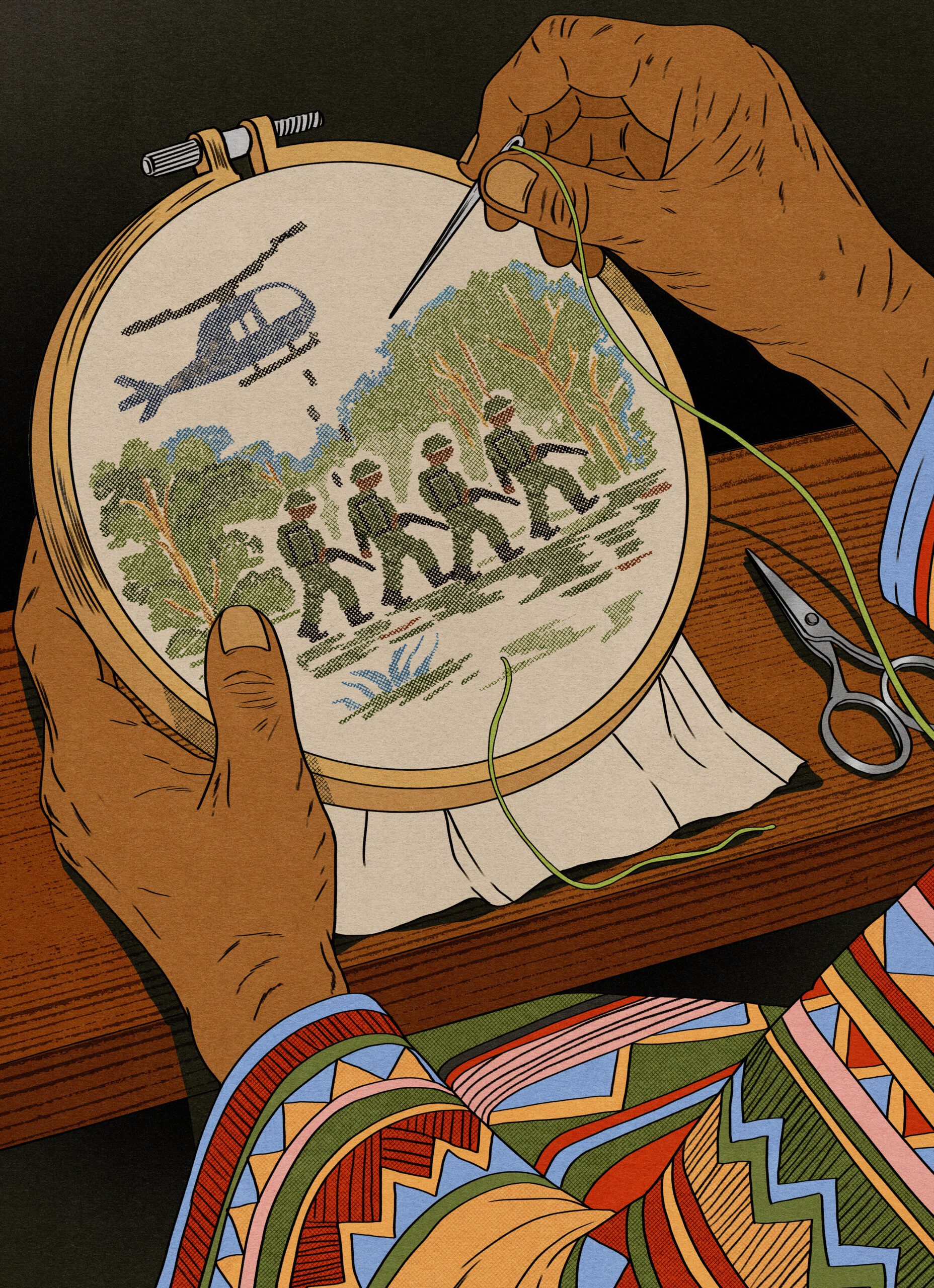
During a fitful sleep, he felt a touch that was identical to Alba’s liver-spotted hand on his forehead. He felt her there, tending his fever, just as she did when he was a boy and had frequent bouts of tonsilitis. Byron recalled the endless afternoons when she taught him to do cross-stitch, to sew by hand and by machine. The murmur of the radio always on in the background, her never-ending stories about relatives in Huila weaving an endless and gnarled family tree. And more than anything, he remembered what she said, over and over: “Don’t worry, mijo, I know my Lord has great things in store for you. A devoted boy like you, just look at the way you embroider.”
He awoke no longer delirious, no longer trembling, the pain diminished. The nurse helped him change his uniform, but his underpants, rank with fear, she left on. The fever was not abating. That’s when they began to worry. A few soldiers and a couple of sergeants came to see him. They told him to open his mouth, listened to his chest, inserted a thermometer into his rectum, while Byron listened to the chanting and violent trotting of soldiers out on the field. The nurse became more attentive, gave him several injections. But Byron struggled to come to, and each time reason and strength seemed within reach, a wave of fever dragged him down by the feet once more. “He’s not well, but he’s not in danger,” the nurse said. So they did little aside from look at him every once in a while, most of the time forgetting he was there, like a piece of junk in the corner, like a three-legged chair.
During his time in the infirmary, every now and then they’d bring in a tray with food and give him a few injections. Slowly, Byron adapted to his permanent state of fever, though he felt his brain was no longer entirely solid. He could sense it creating waves inside his head. Mostly he stared at the door: Time had become waiting. The shadow of a sergeant entered, rushed over to him, and stuck his face down close to Byron’s. Then he opened his mouth and said, “Hello, son. I’m Soldier Cepeda, and I want you to hear me out. I got injured, killed by a mine and a grenade, and since then I can hardly sleep.” Byron was more frightened of this than he had been by days of nightmares. He let out a high-pitched scream, but, unsurprising by now, no one came to his rescue. He twisted his head away and clenched his teeth and squeezed his eyes shut. There was no way anyone was there; the infirmary had only one cot. When he opened his eyes, the man was still there, mouth open wide. Byron tried to speak but his voice came out raspy, his words senseless. The same thing happened to the man. The two of them carried on that way for a time, shouting incomprehensibly into each other’s face. Until soldier Cepeda closed his mouth with a sound like a soft clap. And turned and walked out.
The hours passed, liquid, and Byron lost all notion of time. He sensed another man’s presence, but this time the silhouette was not crisp; the man was larger and seemed to be watching Byron from a face without eyes. Each time Byron made the slightest move, the shadow did the same, stalking him. He told the nurse when she came to give him his injection. She spoke as if Byron weren’t there: “This kid’s losing his marbles.” The nurse tossed the used syringe into the garbage and walked out. Byron tried not to move so as not to disturb the shadow, clenching his stomach to hold his breath. He fought off exhaustion; there was no way he wanted to close his eyes in front of this guy. He lay there with his gaze fixed on the man for a long time. The silhouette became thicker, darker. Byron realized that the color black could turn blacker, so much blacker that the body became an abyss. Outside, a horse whinnied in fear and the shadow body split into four. Four pieces of fat man and at the same time four separate people.
All four pounced on Byron and began shouting at once, in a panicked chorus: “I had a child, have you seen him?” “Those motherfuckers were dying to rob my house.” “I don’t know why I stuck my fingers into the wound, maybe to see how deep the bullet had gone. And I died like that, with my fingers in one butt cheek.” “It was like a burning sensation. And at that moment, I hated the fact that I was a healthcare worker because I couldn’t react like a normal human being; instead I thought: laparotomy, peritonitis, pierced intestine; I pictured everything I’d seen in patients with this type of injury.” “They told me maybe I should try social services, check the hospitals. But I don’t know if I lost him or he lost me.” “They weren’t good for shit. Thirty hectares they had, all of it abandoned, nothing but weeds. Those sons of bitches were bad, but the others were worse, snuck in at night, list in hand. Killed the officer just over there. Right there.” “And it’s such a pain because if I need to defecate, as they say, my hand ends up covered in crap.” “I was trying to stop the bleeding with my hands, and I told the soldier, ‘They shot me, they shot me.’”
Byron sat up and pressed himself to the infirmary window. As the four men moaned and prattled on interminably, the fat old shadow laughed nonstop. It became an indistinguishable clamor, the sound of the men who refused to shut up and the shadow laughing uproariously. Insults and laughter and fear.
Byron covered his head and buried his ears in his shoulders. He turned and saw his abuela Alba, half her body sticking out of a hole in the ground. It was pouring. He ran out, in part to escape the yakking horror and in part so he could cling to his abuela. When he got outside the building, what Byron found was a ditch, filling up with rainwater. No Alba, just a little brown pool of fucking water. He felt nauseous, knelt on the wet ground, and vomited everything in his stomach as the rain drenched him. Byron heard voices behind him. It was those four, on the rampage, accosting him. They droned on with their endless, overlapping lamentation: “I told them not to trust those men, but they didn’t say a word. And, see, I was right. They kicked half the people off the land and sent the other half to the grave. Just so they could get their hands on that whole mess of lots where supposedly some African palm thrives.” “Was it a boy or a girl, do you know? They told me the baby had a birthmark on its genitals. But who looks at a baby’s private parts? Not me, I assure you. I never looked.” “And when I want to eat, that’s a whole different problem, given that I can only use one hand, and it’s very unhygienic, not to mention awkward. Because the hand that got spared was my right hand but I’m a leftie for everything except shooting a gun.” “I had to have the surgery without anesthesia; since there were no drugs at the little clinic, they just poured one glug of moonshine into the wound and another one into my mouth. And I had to give the nurse instructions the whole time so she’d know what to do. Really shitty luck, I tell you, having to lead your own surgery.”
Byron was overcome by another violent bout of vomiting, bile streaming from his mouth as he endured the onslaught of voices. When there was nothing left to puke up, he felt an impulse to get rid of the voices by repeating their words into the earth. He latched on to one monologue and repeated it, recited the whole damn thing into the pit of dirty water. The four men were slowly soothed and even seemed to be awaiting their turn for Byron to release their litanies into the ground. It was in the midst of this delirious speech that four soldiers ran up, restrained him, tied him up in a blanket, and threw him into a cell. The sergeant major said he’d lost his mind and it was too dangerous to have a madman on the loose in a place with so many weapons.
The news spread quickly through the barracks. His fellow soldiers, who’d almost forgotten about Byron, suddenly remembered him and felt shocked. García was the one most disturbed, since he’d always believed Byron had been the one to send him the chocolate that night. Almost no one slept. In Byron’s fate they prophesied their own insanity, because sometimes the relentless cicadas and their boots and the sweat made them feel they were teetering on the edge of what was sane.
García was the first to visit him, in part out of solidarity and in part selfishness. Byron’s legend had grown, spreading through the battalion, and people said he could talk to ghosts, and García had something big weighing on him, something heavy as a ton of bricks.
He found Byron in his cell, curled up in bed. Byron looked like a frightened bird, face gaunt, eyes open wide, body cocooned in a sheet. García approached the bars and greeted him warmly, using a quiet voice so as not to frighten him. Byron seemed to wake from a dream he’d been dreaming with open eyes; he stood and went to the bars. They shook hands through the grate like two men at a business meeting. An awkward greeting, odd and tender. García handed him a box of cigarettes and a lighter, an old book, and six chocolates. Byron cradled the gifts in his hands and swallowed the urge to cry. For a while, they talked of Mitú and the heat and told soldiers’ gossip, until García dared to reveal the reason he was there:
“Listen, Byron, I believe you, that you’re seeing ghosts. I don’t believe what they’re saying about you going crazy. That’s why I came. I’ve got something on my conscience, something really bad, see, ’cause I used to drink a lot. My mother died of cancer while I was supposed to be taking care of her, but instead of taking care of her, I just drank. One day I was plastered, and I fell asleep at her feet. When I woke up, she was stiff and cold and purple. Who knows how long the old lady had been gone, her dead and me just passed out snoring. And now Yésica thinks that’s why the baby is sick. She says it’s my fault, that I let the old lady die and now she wants our baby to die.”
Byron stared at him in silence for a time. His lower lip trembled and his eyes looked glassy, as if he were about to cry or the fever had never broken. And he realized that, yes, everyone bore the weight a whole series of wrongs that grew like an avalanche, and would bury them all. He sensed that no matter how far they ran, this violence, which had been part of the world for so long, would catch up to them sooner or later. He saw García standing there, so sad, and opened his mouth to console him, wanting to say it wasn’t his fault. But what came out of his mouth was a different voice, a raspy voice, that said:
“What happened is that your mother got stuck to that empty liquor bottle. And what you need to do is empty a bottle into the ground and bury it. Don’t worry, mijo, I know your son will be saved.”
García looked skeptical, but that night he did as Byron said. He felt sorrow and also relief, as though finally emerging from a hangover that had lasted years. The next day, Yésica told him the baby was being coming home. And that was the first miracle, that fast. García told Rodríguez, and Rodríguez told half the battalion. One by one, other soldiers began sneaking off to go consult Byron. The same process was repeated: They’d tell him about some dead relative, or something truly awful they’d done, and he’d open his mouth and end up saying things he hadn’t intended to say. The base was filled with odd burials; it was not unusual to see three or four soldiers in the fields burying all manner of things: underpants, scapularies, letters, shoelaces, plates, and even a debit card. Byron’s cell was filled with offerings: tallow candles, religious cards, flowers, stuffed toys in the form of Mickey Mouse, Winnie the Pooh, and Spider-Man.
When the situation got back to the sergeant major, he wanted to put the boy’s powers to the test, in person. His confession was the longest and most sordid. He told Byron, chapter and verse, about how they’d shot twenty-four campesinos in the shed out back of the barracks and then buried them in a trench behind the administrative building. When he was done, he tried to justify himself:
“I swear I thought they were damn guerillas, and we were under so much pressure. Every fucking day we had to report casualties to the general. Just a messed-up competition, you know what I mean? They killed us, we killed them. The hardest part was getting all that lime and then throwing it onto the pile of bodies with our bare hands. I don’t know what burned most, my hands, my nose, or my eyes. And I’m not making this up: One of them opened his eyes, the kid must have been twenty years old, and he looked at me. The corpse, he looked at me. Stared right into my eyes, and he had this look . . . I can’t explain it. There’s no words to express what I saw in those eyes. Then the others came with the paperwork and made me sign a bunch of forms and said, ‘Okay, that’s it,’ and it was all legal. But I can’t forget that look. It’s like a stain on my body, and it never goes away, no matter how much bleach I use.”
Byron was terrified, and for the first time, remained silent. The sergeant grew impatient, moving his hands and feet a lot. He put his face up to the cell bars and said:
“What, not going to say anything, you son of a bitch? I thought you were supposed to be some kind of witch doctor, you little shit. Say something, you son of a bitch, say something!”
Byron froze; not a single fiber in his body responded. The sergeant opened the cell and punched Byron so hard, his nose shattered. He ordered Byron to be locked in solitary, no food and no light. In total darkness, with his nose bleeding and a metallic taste in his mouth, Byron knew they would kill him at daybreak, toss his body into that same ditch. But he couldn’t muster the strength to cry for himself, felt no pity for the end of his life, so short and so gray. He didn’t even think of his mother. Nor did he feel rage at the idea of dying in the goddamn army. The only sorrow he felt was for his abuela Alba, who always used to say, “No, mijo, you can’t go into the service, it would kill you.” His grandmother was right, but it didn’t do any good. He spent hours with his ears pricked up, skin taut, awaiting the bullet.
But nobody came. Then at midnight there was an uproar. The alarm went off and boots could be heard charging down corridors. There was also, quite clearly, the sound of howling, of wailing. People shouting invectives against the troops. Byron thought maybe it was an attack, that the guerillas had stormed in and were going to kill them all. He took refuge under his cot and cocked his ears. It was odd: Despite all the commotion, there were no shots fired, no explosions. There was shouting, voices, feet stomping, running, the piercing alarm. Several minutes went by, during which adrenaline overtook every organ in Byron’s body and surged through his veins, bracing him. He was more alert than he’d ever been; colors became overly bright and the outlines of everything unbearably crisp. Hyperreality. Abuela Alba appeared, walking very calmly, and with no effort and using only one hand, she opened the holding cell the same way she used to open Byron’s bedroom door to say good morning, just like that, no effort whatsoever. She smiled at him. Byron heard Hello, mijo in his head, and then she was gone.
He leapt up like a frightened cat and took off, ran down the hall without being seen, the alarm in his body deafening him. On reaching the field, Byron saw a throng of people. The sergeant shouting orders, the soldiers running, the spirit campesinos chasing them and shrieking. The ghosts created a torrent, a nonstop lamentation; they latched on to one man’s ears and then another with their interminable wailing. Some of the men covered their ears, others tried to hit them, others simply ran. The spirits went on and on, bawling mercilessly. An infernal lament, louder even than the alarm. Suddenly, Major Medina arrived with group of men with machine guns and assault rifles, a megaphone in his hand. He began to order the troops at the top of his lungs: “Quiet, you sons of bitches! All of you, to the field behind the administrative block!” The soldiers ran hurry-scurry behind Major Medina, as if searching for a parent’s wing. They gathered around the invisible grave and received the order to fire and keep firing. Nonstop gunfire pounded the earth for over twenty minutes. Ammunition hit the ground, sending chunks of grass and dirt flying. So deafening was the sound that the spirits fell silent, or at least they could no longer be heard. Finally, someone turned off the alarm and the early glimmers of day broke through. Byron followed this all from a distance, not entirely sure that he was truly seeing what he was seeing.
Exhausted, the soldiers sat on the mass grave and threw down their weapons. Sweaty and trembling. They looked around, incredulous, and didn’t dare speak. They looked especially at Major Medina, as if in search of explanation. But the major was disconcerted as well, his breathing ragged and loud. Byron watched as the spirits began to rebel once more, rising up in body and in voice, their cries surrounding the soldiers who lay there on the ground. More and more spirits, multiplying. Literally shooting up from the grass. Like seedlings that sprouted in an instant. A vertical moaning, everywhere sending up shoots. A thicket of corpses that wove itself around the soldiers’ bodies like passionflower vines. An evergreen forest of jungle and army camouflage. And the monkeys barked, and the cows grunted, and the birds whinnied, and the air was a quiet glimmer. Byron walked directly to the thicket, guided by something vast, something bigger than conviction. He walked into that jungle sprouting with corpses and soldiers. The bodies of the living and the voices of the dead parted to make way for him. The jungle opened and Byron stood in the clearing at its center.
The air filled with air, as if they had all stopped their growing and their sorrow to breathe. Byron sat cross-legged. He looked down and began to sob. Weeping, with none of the sound but all of the water. The flora and the fauna and the soldiers and the dead and the voices and the light and the jungle all watched him. The dead formed a long, long line, meters and meters and meters long, behind Byron’s emaciated body. They looked to be waiting their turn and growing impatient. Shifting their weight from one leg to the other, coughing, tapping their feet. And with each tap it got worse, because their feet shook the earth, waking older ghosts who then also came and got in line.
The entire battalion gaped. So many useless soldiers, all those privates, sergeants, lieutenants, and second lieutenants. The captain and the major were worse, unable to shake off their fear and astonishment. Unable to shut their traps. Their entire battalion, totally worthless, just waiting for the damn corpses to devour what was left of Byron’s body and put an end to this ordeal. The soldiers were on edge too, because the day was heating up and they hadn’t slept at all. They had now realized that the whole corpse problem hadn’t been solved by bullets and felt that with each passing minute spent before Byron’s scrawny body, reality was becoming more fractured, and in deeper and sicker ways. To see what they now couldn’t stop seeing was a kind of torment that took their bodies. Every passing minute of the spectacle led them farther from the possibility of returning to themselves. But the whole mess dragged on and the kid wasn’t moving.
The townsfolk began to arrive, and nobody did a thing. The living began to stare at Byron, and the dead who came behind them lined up in an infinite queue. The old woman with jet-black hair and a very wrinkled face was the first to approach. She placed before him a calabash gourd filled with chicha and touched his head affectionately. Behind her came more old ladies, with offerings of spikenard, dried meat, religious cards, tallow candles, fruit, vessels of water. The last one hung a necklace of carved yaré beads around his neck. The sun was by this time macerating the heads of all present, and the soldiers feared that the sobbing was going to start back up. The priest appeared and placed his purple stole around Byron’s shoulders. Behind him, twenty dead nuns rushed to the distant back of the line. One held a child in her arms that resembled García’s baby.
Byron resembled a New Year’s doll, or better yet, a withered apocalyptic priest, enduring the sun and the pressure. The pressure of the heat, of the noise, of his own heart. The pressure of the battalion, of the cicadas, and the old ladies. He looked like a futurist shaman, the sole survivor of six wars. All he knew to do was to sit quietly, resisting, as if his body were what was keeping the chaos in check, the chaos of the dead uniting with the living and forming an avalanche. He wanted to die; his nostrils filled with rage. He wanted to die so as not to have to be this wall, so as not to have all eyes on him.
Byron leapt back. He thought that perhaps, if he ran fast enough, he could grab some unsuspecting soldier’s weapon and shoot himself in the head. But Byron knew he couldn’t run fast, he couldn’t even run. With his eyes cast heavenward, he took a break from all their staring. He closed his eyes and saw, clearly, the image of Abuela Alba, stitching a corpse.
“Papito, my sweet, it’s very simple: These people need be buried.”
He attempted to sit back down and could not. Three old women helped him. In a reedy voice he said, “I know what I’m going to say.”
Someone took the megaphone from Major Medina and it was passed down, from hand to hand. It was held frantically before his mouth. And Byron spoke:
“Bring all the fabric you can find; we have to make a doll for each of the dead.”
People moved quickly; they snatched up tablecloths, sheets, pillowcases, kitchen rags, and shower curtains. Not a single piece of cloth in all of Mitú went unseized. They brought all the needles from all the sewing baskets, along with four sewing machines that several people helped carry. Those with cattle brought a truckful of hay to be used as stuffing. Without grumbling, without protest, without a word, every living soul began to make a doll.
And each of the dead chose one of the living to sew for them. The line grew shorter and shorter, and finally Byron collapsed. Each of the dead sat before their maker and began to tell the story of their lives. They all began the same: My name is so-and-so, and this is the place I was killed. From there, the accounts diverged. The range was endless. Their deaths came from every geological strata, every possible violence, imaginable and unimaginable. People listened and sewed dolls ceaselessly. Their words hung from the thread and were woven into flowered fabric. Childhoods, traumas, quests, the deaths of millions cleaving the seas of yarn. And an intense smell of spikenard and a day that felt eternal, a standstill. The most moving thing was the sight of so many soldiers embroidering. Their tongues poked out in concentration, and it was as though they’d regained the fierce tenderness of childhood.
The voices of the dead slowly settled into the gentle hum of hummingbirds, the trickling of water in a gently flowing stream, the cold swishing of an eel, a wind that does not lash. Their voices dwindled into fabric, drained into hands, settled in the cochlea of a compatriot. Languorously, silence descended as the day began to wane. The major ordered the boys to begin digging graves. Hundreds of uniforms, tinged with pink and orange rays of light, shoveled until nightfall, as Byron fast asleep in the aftermath of his dream.
When Byron awoke, silence reigned. The kind that falls over the jungle for a moment when the creatures of the day have stilled and those of the night have yet to begin. The kind that falls over the battalion when the dead finally dissolve into silence. He saw an enormous funeral that twinkled in the glow of candles and flashlights. The dolls were deposited carefully into holes, and some actually hugged and kissed the rag body before gently laying it like a silent egg in its grave. They helped one another shovel dirt over each of the graves and passed water bottles and handkerchiefs and very salty yucca. Byron began to sense that he was engulfed in beauty, that it was everywhere, as if all had been forgiven, now and forever. From his body came a golden fluttering of wings, and he felt he was levitating. But looking up he saw that the buzz was instead coming from a Black Hawk helicopter that was already opening fire above their heads. It was the army, coming in to save the battalion that hadn’t responded all day.
And Byron thought that it was true, what Alba used to say: “The darkness always outlives the night.” 
Laura Ortiz Gómez is the author of the short story collection Sofoco, which won the Elisa Mújica National Narrative Prize in 2020; it is forthcoming in English from Charco Press. She has also written the nonfiction books Somos abrecaminos and Diario de aterrizaje. In 2024 she published her first novel, Indócil.
Lisa Dillman has translated thirty-some novels by Spanish and Latin American authors, including Sabina Berman, Alejandra Costamagna, Yuri Herrera, Graciela Mochkofsky, and Pilar Quintana, Her most recent translation, Season of the Swamp, by Yuri Herrera, was a finalist for the Los Angeles Times Book Prize for Fiction.
Illustration: Maria Jesus Contreras
