Camero Vistas: Phoenix in the ’70s
Arizona (aka the Grand Canyon State or the Copper State) was the last continental territory to join the Union, finally becoming a star on Old Glory in 1912. This—along with the too-common observation that the northern part of the Sonoran Desert is maybe not the most hospitable place to settle millions of people—might explain why a kind of frontier mentality has lingered there. The state for a long time had a reputation as a kind of freakish backwater. As someone who grew up there in the 1970s and ’80s, this was in many ways well deserved. Aside from its quite stunning natural beauty (the one thing pretty much everyone can agree on), Arizona didn’t have a lot to offer. For the first seventy or eighty years of statehood, it attracted a curious mix of people. This was not a fashionable place to live, and truly ambitious people tended to go elsewhere. You did not move up in the world by settling in Arizona in, say, 1940. For the most part, those who didn’t have ancient roots in the region came here to escape the humidity and pollution of Eastern and Midwestern US cities. (Including some of my ancestors.)
By the dawn of the Sun Belt era, Phoenix had become a sprawling, car-centric, boom-and-bust town that mostly thrived on real estate sales—whether legit, speculative, or fraudulent. The Chicago mob infiltrated deep into state government in the ’70s and subsequently carried out a number of local assassinations, like that of the Arizona Republic reporter Don Bolles. Architecture was decidedly of the postwar variety: heavy on parking lots, big box stores, air conditioning, desert landscaping. In short, the patterns and evidence of human settlement were generally expedient, engineered for profit and convenience, and often tacky. (In fairness, this was often a realistic adaptation to the climate.)
Growing up there at the time, the feeling of regional isolation was as real as anything else. For about half the year, scorching, burning days gave way to nights of thankful relief. But outside your home and school, places to hang out unsupervised were scarce. You smoked cigarettes or got high behind convenience stores. You found places to drink beer where you hoped the police would leave you alone. Mountains with names like Camelback, Squaw Peak, Papago Park, and South Mountain defined your world but didn’t confine it. The desert that surrounded the city made you feel like America was galaxies away—and maybe you were OK with that.
I certainly felt that way sometimes. I remember watching the evening news in, maybe, February some year in the early ’80s and seeing images of blizzards shutting down whole cities in other parts of the country (this was for years how I pictured the abstraction that was “Ohio”). Outside my window it was 70 degrees. I wondered why anyone would want to live anywhere else.
The region could also drive you to trouble, or worse. I remember a guy I grew up with who once drank a gallon of wine and drove his mother’s suburban to Flagstaff, wrecked the car on the way, and abandoned it in the desert. He walked to a Denny’s on the other side of the highway, found some paroled convicts, and hitched a ride back home to Phoenix. Incomprehensible as it was, this was the sort of thing that happened.
The music made in Arizona at that time evoked a world that felt foreign to what was happening in the rest of the country. Local heroes loomed larger in our imaginations than distant artists whose albums we were lucky to hear (Minor Threat, Black Flag, the Cure, etc.) We loved our hometown misfits because they were ours, but also because they could not have come from anywhere else. Many embodied the wild freedom we saw as our birthright and hoped would be our future. And they did so using a musical language that reflected the sun-scorched, brain-melted world around us.
Especially Meat Puppets. They were ours.
Not Your Father’s Garden
For most of America in the late ’70s, the secondary or tertiary waves of punk rock barely registered—disco and arena rock made sure of that. Where it did register, it was embraced by a small, enthusiastic, often willful and bullheaded minority.
In Phoenix—again, about as far away from the American cultural mainstream as it was possible to be in the lower 48 then—punk manifested in particularly curious ways. Tony Beram, aka Tony Victor, co-owner of Placebo Records, the most significant punk label in Phoenix, recalled how musically diverse things were at the time: “Other cities were mostly moving along a kind of more typical punk rock sound. Not Phoenix. We were all over the place.” A glance at the names on Amuck, an early Placebo Records compilation, perhaps underscores this. The Brains, Killer Pussy, the Feederz, JFA, Sun City Girls, Mighty Sphincter, and others confirm Beram’s observation that “bands [in Phoenix] were not just plentiful but they were all very different from one another.”
Another thing they all shared—despite varying widely in quality, skill, and longevity— was a fierce, funny, and almost innocent commitment to their vision, no matter how eccentric. No one expected recognition or fame, so no one bothered to tailor what they did to anyone’s expectations. “It could be sun damage from over exposure to the heat,” Beran mused. “I’m sure the sarcastic nature that seemed to be one of the only things that kinda ran through most of the bands’ lyrics may have been from all of us being exposed daily to Wallace and Ladmo.” (No one raised outside of Phoenix will get that reference. No one who grew up there will fail to.)
In addition to running Placebo Records, Beram booked the primary punk rock venue in the city—a wrestling rink called Mad Garden. (Named, sorta, after Madison Square Garden in New York City.) It’s where a lot of the local musical drama of the first half of the ’80s would unfold.
Let the Secret Out
On New Year’s Eve 1980, in Tempe, someone threw a secret party featuring bands of some local repute, like Killer Pussy (featuring Lucy LaMode) and the Jr. Chemists (featuring Michael “Chickenbutt” Cornelius, later the bass player of JFA). Most of the city’s then existing punks were in attendance.
The third band of the night consisted of two semiferal-looking brothers on guitar and bass, and a slightly more conventional-looking young man behind the kit. Once drummer Derrick Bostrom clicked his sticks three times, there was, according to my cousin, who happened to be there, “the most beautiful cacophony I have ever witnessed.”
“They were running and bouncing around all over the place, yet never once collided,” he said. “Their songs were super short. But they all began and ended the songs with precision. It seemed like they played two hundred songs. . . . [They] changed my life and are still the best band ever.”
Forgive my cousin’s hyperbole, but it’s deserved. This was an early performance by the band called Meat Puppets, a group of misfits that would soon delight, bewilder, and inspire a generation of seekers, artists, and music enthusiasts. Listen to “Melons Rising,” off the band’s self-titled debut, released later that year, to get an idea of what it was surely like to experience. The Tasmanian Devil gone hardcore, recklessly ignoring coherence or even comprehensibility. There really hadn’t been anything like this before.
Though the world at large wouldn’t really get to know the Kirkwood brothers—older brother Curt on guitar and lead vocals, younger brother Cris on bass and sometimes vocals—and Bostrom until the mid-’90s, when Nirvana covered three songs for their MTV Unplugged swan song, their impact on, first, the local Phoenix scene, and later on every place that had some kind of post-punk scene, would be unlike anything else that came from our state, before or since.
Anthem of (Up on) the Sun
The Kirkwood brothers and Bostrom are all Arizona natives, the former two products of a Catholic education. Curt and Cris are grandsons of the millionaire inventor of Tip Top products. The elder Kirkwood, as part of a senior prank, tried to ride a motorized dirt bike through the main hall of the Jesuit school he (and later I) attended, but was apparently tackled by a priest.
The band’s early recordings on SST Records (then one of the most important punk labels in America) quickly established their reputation as exotic, freewheeling acidheads who would play anything from blazing punk to country to quiet folk music, sometimes all within the same three-minute span. And just as their more decidedly punk SST labelmates were growing in popularity (think Hüsker Dü, Black Flag, the Minutemen), the Kirkwoods and Bostrom were getting bored with the whole thing; on hardcore bills they would often play Fleetwood Mac or Linda Ronstadt covers.
Many of the stylistic innovations of their landmark 1984 album, Meat Puppets II, have been absorbed into the rock mainstream, so it might be difficult to understand how startling it was when it first appeared. From the opener, the 180-mph barnstormer “Split Myself in Two,” to the closer, the Neil Young–ish country three-step swing “The Whistling Song,” the album is a hallucinatory, hilarious, incredible, and indelible journey that is as much a psychedelic exploration of the spiritual interior as it is of the external mesas on the horizon. Generally regarded as a classic of the time, it set the stage and themes that the band would explore for much of their career.
And, importantly, the music strongly evokes a particular vision of the Southwest. No doubt the “exotic” Arizona-ness of the music—and of the onstage appearance of these unpredictable, shaggy LSD enthusiasts—boosted their notoriety. The unmistakable country flavor in their music was neither ironic nor an affectation: Phoenix’s main country music station, KNIX, was also one of the best-regarded country music radio stations in the country (or so the station told us). Waylon Jennings and Glen Campbell ultimately settled there; Lee Hazlewood was a local DJ for a spell. In our remote state, many of these artists loomed large.
But even still, the dramatic turn Bostrom and the Kirkwood brothers would take for their 1985 album Up on the Sun could hardly have been more out-of-the-blue. While some elements from their prior records remain—wobbly-at-best vocals, relentlessly exploratory guitar, propulsive drumming with minimal fills, a general sense that everything in front of you is at least half a mirage—it’s as radical a shift as any of their peers ever attempted.
The occasional comparison of Curt Kirkwood’s guitar playing to Jerry Garcia’s is not as accurate as it seems at first. Whatever your opinions on Garcia, you get the sense that he would start playing without any sense of where he was going or concern with how long it would take him to get there. While you would never call Kirkwood’s guitar playing “tight” (at least, not then), one unmistakable feature of the band early in their career was the projection of a common mission. The listener might not understand exactly where the band was going, and the band’s trajectory might only intersect occasionally with reality as most of us experience it, but they clearly had no doubt about the necessity of their journey. And thus even on the relatively mellow Up on the Sun, an intense urgency is there for anyone willing to hear it.
In contrast to everything the band did up to this point, the music on Up on the Sun is bright, unfolds gently and sweetly even when it revs up the intensity, and from the first note sets an unmistakable vibe that continues with slight but meaningful variations for the duration of the record. Startling in part because it’s so easygoing—at least on the surface—the album boosted the band’s profile, especially on college radio, and has since been recognized as an inimitable document of Arizona, and of American music. In many ways, it’s also the band’s masterpiece.
Where It Never Rains or Snows
One thing the record does is stretch your adjectives. Jangle and chime are familiar ways to describe guitars, but could apply to the Byrds, the Beatles, Television, REM, others. There’s only one guitarist, but you’d be forgiven for thinking otherwise. Curt and bassist brother Cris played, as described by a friend of mine who saw them live around this time, like they were practicing telepathy.
Now, forty years after its release, Up on the Sun endures and is undeniably worth nudging into the American music canon. (Pitchfork ranked it at 72 among the “Best Albums of the 1980s,” in case that sort of thing matters.) Not only does the album sound like nothing else before or since, it falls into one of the rarest categories of great albums: You never hear other artists cover its songs. Its achievement is so singular, its emotional and artistic pitch so perfectly realized, that trying to capture and repurpose its inspiration is pointless. The world that the Kirkwood brothers, Bostrom, and producer Spot captured (or created, if you prefer) is as vivid, tactile, and inviting as it is inscrutable—even decades later. You may never truly understand it, but they are welcoming you to wander around and find a little place in this paradise under the sun.
The title track and centerpiece, “Up on the Sun,” instantly grabs your ear with one of the unforgettable guitar riffs of the decade. Riff doesn’t quite summarize what feels like a stone skipping across a pond—hypnotic, calm, totally new yet weirdly familiar. In the song, a man meets his daughter, hoping they’ll have something to talk about. No one who hears this once ever forgets it, and it sets the context perfectly for the music that follows.
And what follows is a guided tour of a world you won’t find at a theme park. We meet creatures “that dance / On invisible air” in an “Animal Kingdom” that exists only after the sun goes down. We’re offered a one-note guitar solo that rocks like a baby’s crib mobile in the wordless but whistling “Maiden’s Milk.” (See the Feelies and Neil Young for other examples of one-note solos. Dear guitarists: More of these, please.)
We’re also introduced to the not-often-observed erotic energy emanating from the Sonoran. In the song “Hot Pink” (which may or not be about procreation), we’re told:
hot pink apple with the sweet golden dimple
has stuck its claim in me
hot pink rubber it comes in every color
and every style you please
This is where chime and jangle are accurate, inevitable adjectives, and where the fully impressionistic lyrics become secondary to the general atmosphere. If you, the listener, haven’t yet grokked the warm, dry groove, this is surely where you surrender.
But up to this point, it’s still all been a little vague and, sorry-not-sorry, heavily acid-tinged. It’s fair if you haven’t figured out exactly where you are on this ride. Which leads us to the end of side 1, where it turns out you were in a “Swimming Ground” all along. Our little patch of paradise, this watering hole isn’t “close to any town,” but we’d rather be here than anywhere else, particularly on those July days when the mercury pushes above 100.
On “Enchanted Pork Fist,” all three players sound possessed, like they, and we, may fly off the dirt road. The spasmodic, speedy, slashing first half does eventually settle down a little bit into a meditation on pistachios (no joke), but the groove and melody, moving into the delay-drenched guitar solo, offer something like an emotional epiphany. It’s hard to shake off the song’s spell, and impossible to understand it.
“Seal Whales,” despite the title, doesn’t take us near the ocean or discuss aquatic life. But it does make you feel like you’re floating in an inner tube on a river. (The Colorado, probably.) The second, and final, wordless song on the record, it seems impossible that only one guitar is carrying this loping groove that makes you feel like you could glide downriver forever.
Speaking of rivers, near Phoenix there are two, the Salt and the Gila, that merge southwest of the city. They are dry much of the year; nevertheless, the city could not exist without them. The penultimate song, “Two Rivers,” reminds us (in the unlikely event that we’d forgotten) of the landscape and geography being evoked. This song, perhaps the loveliest on the record, quietly recognizes that man’s first God-given power in the world—the power to name things—really doesn’t matter to nature at all. (And it’s enough to make you forget that riverbeds, after a storm, are actually dangerous.)
The final song is more explicit in its mystical bent, and, subtly, a little disturbing. “Creator” muses about its subject, seems to hem and haw about the existence of said entity, without Kirkwood ever explicitly letting on what he believes or doesn’t. Considering the almost uniformly friendly vibe of most of the record, it’s a peculiar way to end this trip (yes, “trip”). Kirkwood’s Creator turns “loose the butterfly that ate the alligator,” and his followers “moved out to the tower to look down on me and you.” Everyone appears to be “walking clouds on caves of emptiness / That fall around their minds / To flirt openly with vapor and the trail it leaves behind.” This ambivalence and somewhat suspicious tone—in contrast to the exuberance of the rest of the music—is carried by the most unsettling chord progression on the record. The song as a whole suggests that Eden might not always be so welcoming.
Finding, and Killing, the Buddha in South Phoenix
I first saw Meat Puppets on my seventeenth birthday, in October 1988, a time of year when Phoenicians start to feel OK about spending extended periods of time outdoors. The band was at the tail end of supporting the recent album Huevos, playing at a now-long-defunct outdoor venue in a pretty bad part of South Phoenix called Crash. (Sun City Girls, augmented by a horn section that was both tuneless and self-assured, opened the night in an unforgettable fashion.) The late summer heat had broken, and the crowd assembled was every bit the motley mix that was common at Phoenix shows at the time.
I admit I didn’t know what to expect. But like my cousin seven years earlier, I left that night a convert. Their intensity, sheer joy, wild rock ’n’ roll energy, manic-but-warm humor, and complete artistic fearlessness if not recklessness was an absolute revelation, even if I can recall only maybe three or four specific songs. (Note: I was completely sober.) At the time, it felt to me like a road map for living—how single-mindedness and an utter lack of concern for any compass other than your own could be made into an actual life. One thing hadn’t changed in the years since the band was playing Mad Garden: The Kirkwoods and Bostrom could wander around randomly, without colliding, and still come together in unison. Practicing telepathy.
Some in our high school gang of malcontents, many who were at this gig, had a thrashy, arrogant, sometimes offensive punk band (yours truly was one of the guitarists), which gained some local notoriety mostly because we had little fear of looking foolish. One song, the band’s fastest and tightest, was called “I Hate the Meat Puppets.” (I wrote the music but not the words, and to this day I still don’t know them.) Somehow, after the police shut down the gig during the band’s second encore (noise complaints in South Phoenix? What the hell?), which included covers of Metallica and “The Battle of New Orleans,” some of us found ourselves “backstage.” (It was a little outdoor space with no security. A perfectly informal, DIY kinda vibe.)
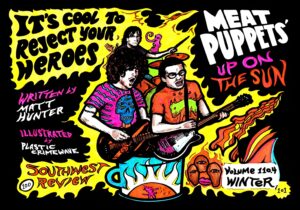
We were out of place among the small throng of much-older people there, who were passing around joints and talking among themselves with an impenetrable seriousness. Someone—an older acquaintance of one of my bandmates—noticed us and mentioned to the Kirkwood brothers: “Hey, those guys are that band with the song ‘I Hate the Meat Puppets.’” One Kirkwood brother, drawing deep on what was to this day still the biggest joint I have ever seen, replied, to no one in particular: “That’s OK, man, it’s cool to reject your heroes.”
Welcome to Your Second Century, Phoenix
The last verse in “Creator” feels, today, enigmatic and unresolved. As the final verse anxiously crescendos (“Making love to open windows / And the vapor trails refrain”), the band lands gently but finally on a high G major. After everything that has preceded this moment, the tone and the tenor feel like the shock of sunlight on your face when stepping outside a dark room. Or the unbearable blast of heat when you open your car door, having forgotten to put the shade up over your windshield, perhaps finding your favorite cassette melted on your dashboard.
But that last chord also feels, in 2025, like a kind of finality. This provincial identity that we took for granted would change when the city, and the Sun Belt in general, became more and more central to American cultural and civic life. From 1970 to 2000, Phoenix’s population more than doubled, with the greater metropolitan area seeing a 46% increase from 1990 to 2000. By the turn of the century, Maricopa County—today 9,224 square miles, containing twenty-four incorporated cities, including Phoenix, Tempe, Scottsdale, and Mesa, with approximately four and a half million people—had moved from the American cultural fringe to, if not exactly the center of the national consciousness, at least somewhere far more accessible to outsiders.
The evolution of the city’s later cultural output reflects that. No offense to Jimmy Eat World or even the Gin Blossoms, but if someone from Phoenix today told you they were from Los Angeles or Austin or Nashville or even New Jersey, you wouldn’t be surprised. What once was distinctive about the place has, no doubt, diminished. But in 1985, Phoenix still had the savings and loan crisis, scandal-plagued governors, mass snowbird migration, and NFL and MLB teams in its future. The millions of our fellow Americans fleeing the decaying and de-industrializing cities of the Northeast and the Midwest for the promise of the then–relatively cheap, low-tax Sun Belt wasn’t quite yet overwhelming.
Up on the Sun appeared just as the weird exoticism of the state was starting to disappear, as Arizona became more and more recognizably “American.” It now sounds like the last document of a unique cultural moment. Even our heroes, after this record, started inching bit by bit toward what they thought was the mainstream, though of course (apologies to Willie Nelson) in their own peculiar way. Their following three records—Out My Way, Mirage, and Huevos—all have great stuff, but you can feel the band sanding down some of their sharper edges.
Which is not to say that this unique cultural identity is lost forever, or that a musical or artistic renaissance couldn’t still blossom in the northern Sonoran. As Beram observed: “I do think it could happen again. Sometimes the conditions are just right with the right people at the right time for neat things to happen. When they do, enjoy them because they are always fleeting. All great scenes come to an end.” 
Matthew Hunter is a writer and musician. He was a founder of New Radiant Storm King, and has played or recorded with Silver Jews, J Mascis & the Fog, King Missile, SAVAK, and the Wharton Tiers Ensemble. He is currently a member of the Whimbrels and his own group, Matt Hunter & the Dusty Fates.
Illustration: Steve Krakow
