Let Us Now Praise Giant Men | The Exceptions
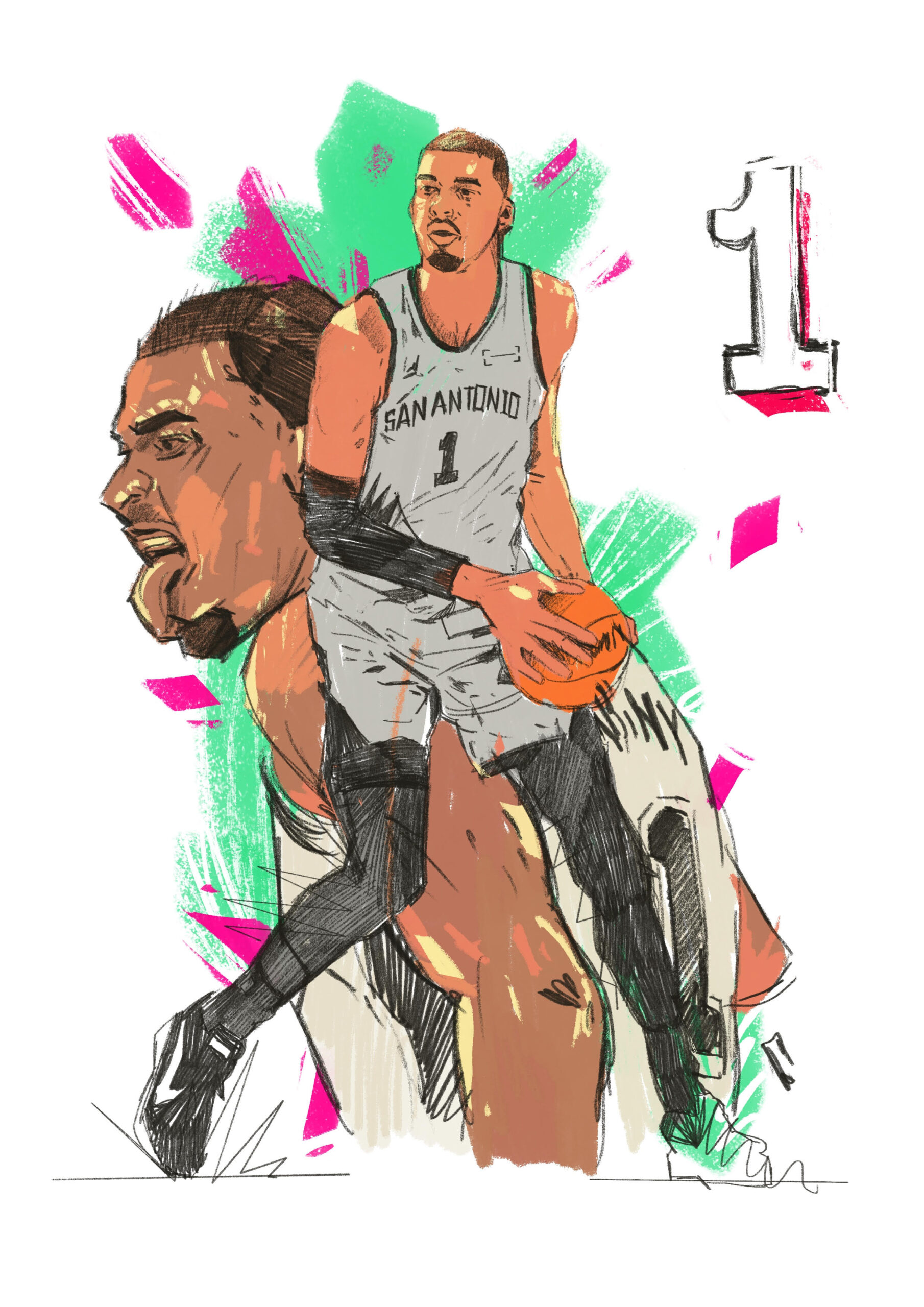
Let Us Now Praise Giant Men is a regular column about NBA basketball. This edition is about a reluctant contortionist, overcategorization, forgotten books, and Victor Wembanyama.
I once went to a freak show where none of the performers looked any more or less freakish than a barista, which most of them probably also were. The strongman hanging weights from his gauged ears wore a beanie, and the barker kept his backpack on, which was the kind of modern bindle favored by Arizona Iced Tea enthusiasts where it’s just a sack with two strings attached. It was a weekday, and I was one of no more than ten people in attendance, and one of few of those willing to pay an extra two dollars to see the secret boneless position the tracksuit-wearing contortionist had folded herself into to avoid the swords thrust into the sword box. I lined up with the other suckers and we approached single file, like it was a casket.
Inside, the contortionist’s supposedly impossible posture was nothing more than a loose fetal position curled around the dull, sparsely arrayed blades. The barker rattled off insinuating patter about our collective imagination, which made the utter lack of sexuality of it all seem even more lecherous, like all of us filing past were getting off on the idea that two bucks a look was a real bargain to realign something no more erotic than a bus ride into a collective perversion that we wished to be mocked for.
It turned out that we were the freaks all along.
So that was the best freak show I’ve ever seen.

This year, my son has gotten really into basketball. For the time being, he’s not too into its metaphysics or the artistry of movement or the characterizations or storylines. He’s seven. He likes it when his team (the Knicks, despite my warnings) wins, and he likes shooting at our local courts or, since it’s gotten cold, on the plastic hoop on his closet door, low enough that he can almost dunk. I’ve introduced him to some of the game’s finer things, like what “Ball don’t lie” means and D’Angelo Russell’s “ice in my veins” celebration (not sure if I’ll get in trouble for that one), and he picked up Steph Curry’s “night-night” on his own. But mostly, he likes the numbers—scores and wins and losses. He likes to look at the results of the previous night’s games in the morning and recite them to me. Sometimes he reads me the standings. Sometimes he rattles off each team’s record. It’s not the most stimulating conversation, but I get it. The numbers are great. They accumulate. There’s something remarkable about how they always go up.
I’m pretty sure I recognize how his mind works. One time, I asked him if he understood the obtuse way they’re teaching arithmetic in second grade, and he said he did, but that he used it only when they made him at school. When I asked how he figures out the fairly complex calculations he does in his head on his own, he said he just thinks about the numbers “and then they change.” I knew exactly what he was talking about. I used to watch them change, too. It’s hard to explain precisely, but it happened somewhere that was both part of my brain and a journey outside it, a place where “eight” (for example) was the name of a number but also a description of a concept of eight-ness, a concept that was immutable and butter-soft, obvious and hopelessly inscrutable, as solid as your body and as gauzy as your reflection. Now I think of where the numbers are as the “Numbers Place,” but I didn’t have a name for it when my vision of it was clearer. Naming it means I can almost still see this place if I try, but sometimes I wonder if all I’m seeing now is the name itself.
When I was a kid and my dad (also possibly ASD) brought a computer home, he warned me that computers trained users to think only with a specific kind of “boxes-in-boxes” logic. He thought this would be a big problem if it led people to follow that method of thinking outside computing itself, partly because it would inevitably lead to mislabeling and miscategorizing, but also because it would make it hard to recognize when something contains contradictory multitudes. In real life, he told me, things can be both on and off, both ones and zeros. They can exist beyond the burrow of folders and subfolders in which they’re stored.
Are you an introvert? A Sagittarius? An “Xennial”? A democratic socialist? What’s your attachment style? What are your “icks”? Are you in a fandom? What was your listening age on last year’s Spotify Wrapped? As it turns out, my dad was right: The future has thrived on labeling all the strange, contradictory aspects of selfhood and then analyzing those labels as if they were actually the same as the states of being that they describe. It’s the Numbers Place as dystopia, taken over by soulless quantification junkies who figured out a way to profit from tawdry collective vanity, a commodified, flattening overcategorization that obscures the uncategorizable until it’s easier to just pretend that it doesn’t exist at all.
A strange side effect of the NBA’s almost uniform adoption of what used to be called “Moreyball”—no midrange shots, only layups and threes—is that the athletic marvels who might have taken over earlier eras are now, for the most part, role players. Lots of the newer stars—Brunson, Dončić, Shai, Jokić, Cade, etc.—aren’t necessarily in the upper percentile in any measurable skill but have embraced what’s different about their games to find their way through the cracks of rigid arithmetical ideology. Now that the game-theory-sanctioned correct way to play has been codified, it’s the players who play wrong who succeed at it. They’re the exceptions. This year, I’ve really liked watching Portland’s Deni Avdija, who looks like fan art of Phenomenon-era John Travolta and seems to use black magic to control the viscosity of the glass when he slips the ball against it from an analytically unsound fifteen feet out.
And then there’s Victor Wembanyama, an exception to the exceptions, a stereotypical Hanna-Barbera cartoon of a basketball-playing villain and a grotesque sideshow attraction who makes everyone else on the court with him look normal. Before he entered the league, the hype about Wembanyama seemed to be based in the absurd and joyous carnival barking that encircles every very tall player like a halo. And it’s true, he is the tallest player in the NBA, but it’s the NBA. All the big dudes are tall. Height ain’t nothing but a number. But Wembanyama’s height seems to go beyond measurement—for lack of a better description, it’s a vibe. One of the strange and tragic joys of this season has been watching ball handlers panic upon realizing who looms before them, seeing their (comparatively tiny) synapses short-circuit, as thousands of hours of muscle memory telling them what action they should take next is overridden by the extraordinary monster proving that very action’s absurdity. They become visibly wrought, exactly as you or I would. No one reacts with this sort of vicariously palpable physiological repulsion to Zach Edey.
The thing about freak shows is that any time a performer is in front of an audience, it kind of is one. A stage frames what’s on it as something so far from the everyday that the very act of watching turns you into a gawping mark. There are aspects of professional basketball that fit this mold more directly than others—it’s fairly easy to picture, say, Chet Holmgren crudely depicted on an antique leaflet inviting you to see the famous Skeleton Man. But part of the thrill of what even normally sized and proportioned NBA players do isn’t that you could never, it’s that your observation frames even the banal as something extraordinary. T. J. McConnell throwing a bounce pass: freak. Bones Hyland missing a foul shot: freak. Mike Conley sitting on the bench with a towel over his head: total freak. So watching fear mutate these freaks back into comparatively ordinary men turns Wembanyama’s lane into a secret, smaller stage that has somehow materialized within a larger one, one where categorizations break down, a place where something can be both itself and its opposite simultaneously.
When opposing players do work up the courage to challenge him, Wembanyama’s body contorts into Lovecraftian angles as he blocks their shot. Instead of sending the ball into the stands or back the way it came, he often knocks it straight down, or even snatches it out of midair. He seems to barely leave his feet on defense, and when he does jump, he frequently makes contact with the ball on his ascent rather than at the height of his leap. He runs the court like a fawn and when he’s camped out in the lane, his multiplying, elongating limbs make him look like a spider who became a tree who became a man, and it all gives his movements a mythic quality, not in any aggrandizing moralistic sense but in tune with a rawer function of myth that’s harder to pin down: a distorted amplification revealing something that can’t be shown any other way. Certainly not with numbers, or at least not by using them to do math.
Last month, I found myself (as one does) with a couple of free hours in Schenectady, New York, and chanced upon my favorite type of bookstore, the kind that seems to exist out of time and out of bounds of any remotely viable business plan, the kind where you feel like you’re walking through an eccentric octogenarian intellectual’s shaggy mind—barely passable aisles blocked by unbrowsable piles of books, titles oozing between genre borders futilely marked by ancient handwritten labels Scotch-taped to metal shelves. I eavesdropped on one insane conversation between the owner and a local tweaker, and I bought four books (for less than ten bucks!)—an unread copy of the recent-ish Shirley Jackson biography, a Richard Hughes novel I’d never heard of before, an ’80s Virago Modern Classics reprint of a novel called The Squire by someone named Enid Bagnold (which turned out to be great), and something called A History of Messianic Speculation in Israel, described on the back cover as “seventeen centuries of dreams and pretenders among the Jewish people,” which I’m hoping helps me to get at what’s going on with Deni Avdija.
I’m not bringing this up to brag about my idiosyncratic reading habits—first of all, lots of people have way wider ranges than I do, and second, I have no illusions that reading stuff no one else does is a better or worse literary diet than that of my friends who almost exclusively read what they call “front-table fiction.” But the space I enter into with books like these is somewhere I can’t go otherwise. It’s quiet, guided by serendipity and undefined by the usual overpowering cultural currents. It’s not part of a larger conversation but is instead the sum of a private one, often containing only two voices: mine and the now infrequently heard one of the (usually dead) author’s, which lets me sit with the conflicts that inevitably arise from any merging of minds without trying to resolve anything. Nothing has to be named, no sides need to be taken. And this feels like I’m getting access to some kind of secret knowledge, even if that knowledge doesn’t seem to have any objective relevance to anything that’s happening now. It feels like I’m learning spells. It feels like I’m neither a mark nor a freak, but something different. I’m an exception, too.
The hoop in the yard at my son’s elementary school is only maybe eight feet high, so sometimes when we go there on the weekends, it’s being used by thirteen-year-olds. A short hoop is a rare treasure, and more so for a thirteen-year-old, who can still hold out hope that it’s a leap forward in time rather than mere fantasy indulgence.
This one time, my son and his friend played the standard game of all little kids when they’re waiting for big kids to vacate a court, pretending something else was a hoop and shooting the ball at it instead—in this case, a sign mounted to the chain-link fence surrounding the schoolyard. It’s a game I remember playing. It’s not that fun. I sat down on a bench and kept an eye on my kid and his friend plus the court they wanted to use. Even for thirteen-year-olds, the thirteen-year-olds weren’t very good, their games clearly addled by YouTube tutorials, filled with missed step-backs and pointless crossovers that they bobbled like apprentice jugglers.
But then, one of them airballed a baseline jumper, and another, sneaking through the crowded lane, grabbed the errant shot from midair and in one motion mashed a monster one-handed jam right on his buddy’s head. It didn’t matter that the rim was only eight feet; you could tell this was the first time any of them had done anything like this from the tremendous upswell of nonverbal vocalizations and how all the kids, on both teams, even the one who got dunked on, immediately scattered like ants from a flooded anthill. They shouted and leapt. The ball rolled away. The game was over. How could they even keep score anymore?
Once in a great while, I’ve felt like I’m perceiving the world in real time but am also somehow conscious that I’m also looking back on it as a memory. It feels sort of like a complementary version of déjà vu, only instead of feeling the eerie presence of another self adjacent to your own, you feel like you’re inhabiting that second self and your own at the same time. I’ve never felt like that during bad stuff, only in moments of joy so unambiguous and fleeting that they almost seem to be gone while they’re happening. This was the first time I was sure I saw someone else experience it. It made the kid who dunked look like he was still untethered by gravity, overflowing with energy as he skipped across the playground. And I was there, too, and maybe it’s only vanity, but I think that by witnessing this moment I solidified it, and made it real, turning it from something blunt and binary into something else, something open ended and full of untold possibility.
Then my son and his friend grabbed their ball and took the now-empty court. They counted their makes. My son was going to the Numbers Place, I could tell. He has to go to the Numbers Place first to someday make real the things he can’t name.
Liam Baranauskas is a writer from Philadelphia.
Illustration: Arunas Kacinskas.

More Columns