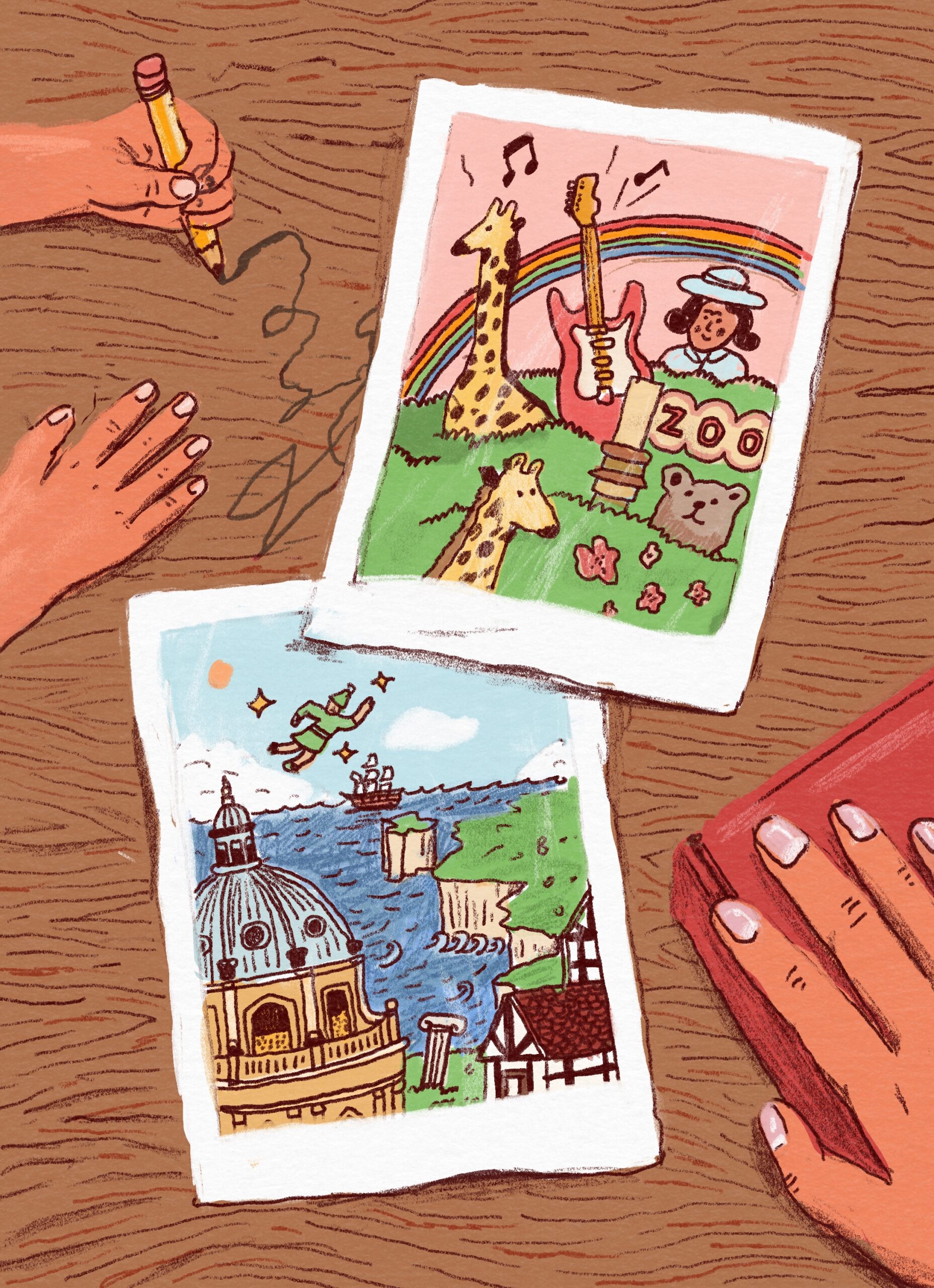
In England I have a palace made of ice.
My four-year-old son has a parallel, imaginary life in England. He’s never been to the United Kingdom, and he doesn’t understand the difference between England and Great Britain, but if you ask him his nationality, he’ll tell you that he’s Mexican (like me), Chilean (like his father), and also “Englandish.” This has been going on for several months now, long enough that I can’t quite remember the first time he said it. I’m certain his Anglophilia has something to do with a comic book on the history of the Beatles, as well as a favorite book of his, Paco y el rock, the story of a dog who travels to London and forms a rock band there. He hasn’t seen pictures or videos of Great Britain, and he knows fairly little about the country, but almost every day he drops a phrase or two that give shape, little by little, to his own British utopia.
You know what I do in England? I have a little stand where I make cookies that don’t have sugar and they taste like they have sugar and they’re shaped like little animals.
I fear, though, that—alongside the books and the Beatles—I’m also somewhat to blame for this idealization. I must have somehow passed on my love affair with that place, which my feet have traveled so few days, yet my mind so many. For years, that’s what Great Britain was for me: a space in my mind. When I was a teenager, long before my first trip to London, I read, devoured, obsessed over a whole string of books set in the United Kingdom, and through those readings, it slowly took shape in my imagination. Its geography was the wuthering heights of Emily Brontë, the fields and meadows of George Eliot, the frigid seas of Coleridge and the gloomy villages of Sherlock Holmes. London was a mixture of Virginia Woolf’s thoroughfares and Dickens’s shops, Angela Carter’s toy stores and the theaters and pubs of T. S. Eliot’s cats. I spent a good deal of my adolescence in this Great Britain of books, where I took refuge from fights between friends, romantic letdowns, my parents’ divorce, my grandmother’s dementia, and bodily angst.
—In England there used to be warriors. There was lots of fights in England.
—And who won?
—England.
I long believed in the false etymology which says that England means “Land of Angels.” It actually means “The Land of the Angles,” but throughout my childhood and teenage years, the word bore that halo of divinity and supernatural beings.
In England we all got vaccinated already.
Many a literary island has been imagined from the United Kingdom. For example:
• Thomas More’s Utopia
• Treasure Island, which Stevenson drew before writing
• J. K. Rowling’s island-prison, Azkaban
• Francis Bacon’s New Atlantis
• Agatha Christie’s Indian Island
• the one Robinson Crusoe named the Island of Despair
• the unnamed island in the dystopia The Lord of the Flies
• Tol Eressëa, J. R. R. Tolkien’s wandering island
• Jonathan Swift’s islands, Lilliput and Blefuscu
• J. M. Barrie’s Neverland
Borges said that Novalis said that every Englishman is an island.
—Is England north or south of us?
—It’s north of us.
—I have to go north, then, since I’m English.
When I was fifteen, I read A Short History of England by G. K. Chesterton. I remember none of it except the beginning, which I’m rereading now: “The land on which we live once had the highly poetic privilege of being the end of the world. Its extremity was ultima Thule, the other end of nowhere. When these islands, lost in a night of northern seas, were lit up at last by the long searchlights of Rome, it was felt that the remotest reaches of the earth had been touched; and more for pride than possession.” On Roman and medieval maps, the British Isles always appear in a corner, the furthest reaches of the known world.
In England there’s a huge jungle full of tigers.
My own British utopia also came to me through its music, from the Spice Girls and the Beatles when I was a child, and later on from Bowie, the Smiths, and Radiohead. From the cemetery Morrisey sang about to PJ Harvey’s white chalk hills, the landscape of the United Kingdom, for me, is also a soundscape. I could easily make a map of it, a musical book with buttons like Poppy and Rock & Roll.
You don’t have to pay to go to the zoo in England, and there’s lots of giraffes.
Much of Great Britain and Europe once formed a single island. During and after the last ice age, in the southern part of the North Sea, there was an immense landmass—a giant bridge—which geologists call Doggerland. Later on, the water level rose and Great Britain became one island as well as many. In my view, it has that charm, unique to islands, of being an enclosed universe in miniature.
The word islomania refers to a fascination with islands. Lawrence Durrell describes it in this way:
A rare but by no means unknown affliction of spirit. There are people . . . who find islands somehow irresistible. The mere knowledge that they are on an island, a little world surrounded by the sea, fills them with an indescribable intoxication. These born “islomanes” are the direct descendants of the Atlanteans.
I like imagining that moment in time when Great Britain was a cradle of majestic forests and its inhabitants were unaware that they lived on an island. Because, in reality, islands come from our cartography, since an island is no different from a tiny continent, the same way a continent is a giant island.
—In England I have a girlfriend.
—What’s her name?
—I’m not going to tell you.
—Is she English?
—No, she’s Mexican, but she lives over there.
When I was a child, my aunt lived in London, and once a year she’d return to Mexico with a suitcase full of dolls, postcards of cats, Spice Girls posters, and butter cookies. To me, the United Kingdom was this cornucopia. It was also where grown-up women went to study, because that’s what my aunt was doing there: She was a student. Over there were the Oxfords and the Cambridges, temples of sorts, where studying was sacred since many centuries back.
Mom, is England pretty?
Why do you want to study English literature? they asked me during my university admissions interview. Because of Oscar Wilde, I replied. I want to better understand Oscar Wilde.
Hey Mom, you know what? In England, the pandemic is already over.
My son does this a lot: uses England as a counterexample. He tends to do it when joining adult conversations, especially those he might find troubling. He’ll speak with utter confidence, flaunting his knowledge as if he were citing a statistic from a recent article in The Guardian. For him, England is the country where nobody eats eggs for breakfast and no one ever gets sick, where the museums, parks, and zoos are bigger and better. Whatever happens, in his England everything is all right; this is how he comforts himself.
In England, they have a tradition where they set up a bunch of balloons and gymnasts have to go through them without popping them.
For a long time, I resisted my Anglophilia. It was an aspect of myself that I found embarrassing. Growing up, I went to a school that refused to teach English, since English was the language of empire. For my parents, too, and later for my teenage friends, English represented the interventionism of the United States. It was the language made lingua franca by force, which threatened to corrupt and even wipe out our culture and our language. Spanish had its own history of colonialism, but we talked about that less often, and we almost never talked about the many languages in danger of extinction in Mexico. If there were linguistic justice in our country—and in the world—I’d speak the Mayan of my great-grandparents and the Nahuatl of the city I live in. But when I was a child, the important thing was to resist English; to celebrate the Day of the Dead, not Halloween; the Reyes Magos, never Santa Claus. There was no value in speaking English; it represented falling into the system’s trap. Sometimes it was inevitable, of course, but it was nothing to aspire to.
At my house in England, there’s always a bit of sunshine. It’s the only part of England where it never gets cold.
Thomas More situated his utopia (a word he coined meaning “no place”), his ideal society, on an island. Utopia measured 320 kilometers across. The United Kingdom is just slightly wider, at 500 kilometers. Set far away in the Americas, Utopia was an inverted mirror reflecting back at the England of the time an image of the chaos being wrought by large-scale livestock farming, with thousands of peasants displaced, hungry, and terrorized, and an increasingly idle, decadent, and punitive wealthy class.
There’s a museum in England where everything is always straight ahead.
I still have my acceptance letter from the master’s program at the University of Oxford. I didn’t even consider the possibility of gathering the money I would have needed for the stratospheric tuition fees. There wasn’t a scholarship or family contribution or lottery ticket that could have paid for it. But I often fantasized about going there, of shutting myself away in its libraries, wearing those togas and little hats, biking on the cobblestone streets whose stones have seen it all.
My house in England keeps getting bigger and bigger and more and more people can fit in it.
First seen by sailors in antiquity, Thule appears throughout history as “the northernmost place,” “beyond known boundaries.” Later, in the Middle Ages, Thule was Iceland or Greenland, and now it could be the island of Smøla, in Norway, or Saaremaa, in Estonia, or an asteroid in the asteroid belt of our solar system. But in antiquity, ultima Thule was Britain.
The Greek explorer Pytheas claimed to have reached Thule by crossing Britain on foot. He encountered there a region where land, sea, and air blended together into a gelatin of sorts which was impossible to traverse. It was thought that there was no night in the summer or daylight during the winter.
In England the airport is called Beatles Airport, and they give you a device with music you can listen to.
When I was twenty years old, I traveled to Great Britain. The “real” one. The really expensive one, where the famous tea and scones cost forty-five pounds. The one with Charles Dickens’s commode chair. The one with outer boroughs, where a woman told me she wanted to be a painter but it didn’t make money and that was why she’d been working full time at a Carolina Herrera shop for years. The one with the punks that I searched for but never found. The one with the round church and that living room furnished with paintings of flowers by a female Victorian botanist. The one with cattle at sunset. Where I cried on buses, kissed in cemeteries, and slept on tiny mattresses on nasty floors in tiny apartments. Where we begged the waiter to let us in and he said, “Come back tomorrow,” and we said, “But we’re leaving tomorrow,” and he said, “I wish it was me who was leaving tomorrow.”
—Mom, have you been to my house in England?
—Of course I have.
—What’s there?
The memories of my travels are also unreal, of course. They’re hardly possible—likely distorted, invented, idealized to an unknown degree.
The United Kingdom, for me, is a combination now of three imaginary places: the one I constructed from books, the one my memory “literaturized,” and the one my son invents every day.
When I’m done being a kid, I’ll stop telling you the history of England.
My son says this, and I ask him: When do we stop being kids? But he changes the subject and doesn’t respond. So I answer myself: quickly and never. “To be born is to be shipwrecked on an island,” wrote J. M. Barrie, the Scotsman writing from England who imagined an island where children never grow up.
Mom, all that stuff about me living in England isn’t true. I’m just making it up. 
Jazmina Barrera is an author from Mexico City whose writing has appeared in The Paris Review, El País, and The New York Times. Her book Linea Nigra was a finalist for the Gregg Barrios Book in Translation Prize and the National Book Critics Circle Award for Autobiography. She is the cofounder of Ediciones Antílope.
Illustration: David Huang
