The first time I saw him, it was nine in the evening. We’d been to a dinner party and were going home on a 2 Train, traveling south down the East Side of Manhattan to then cross to Brooklyn, where we had to change to the Q route.
(To say “home” is something of an exaggeration: We were living temporarily in a borrowed apartment before moving to another borrowed apartment, as we did that whole winter. We spent two weeks caring for the bonsai collection of a woman who was on vacation in Puerto Rico; we pet-sat a one-eyed cat in Astoria and, a little later, a deaf cat in Crown Heights; a famous novelist hired us to organize his library while he was giving classes in Paris. It was Elián who found all those places; he’d been living in New York for a decade and seemed to know everyone. He has tall, charming, smiled a lot, used black eyeliner that accentuated his dark eyes, and there was something indefinable about him that made people who hardly knew him hand over the keys to their house. I was—am—much less remarkable, the boyfriend whose name nobody remembers, but my attention to detail, my meticulous habits—Elián used the adjective neurotic—and green thumb made us the ideal couple for house-sitting.)
The subway car was neither very full nor totally empty. I think it was a Thursday, and the man was sitting almost opposite us. He looked to be around 60, was slightly overweight, had long, graying hair that showed below his Santa hat. He was wearing jeans, a rather worn overcoat, and was warily clutching the backpack on his knees. Beside him, a woman in her mid-20s, makeup, heels, was listening to him with a cordial but strained smile, her eyes sending out signals for help to the other passengers.
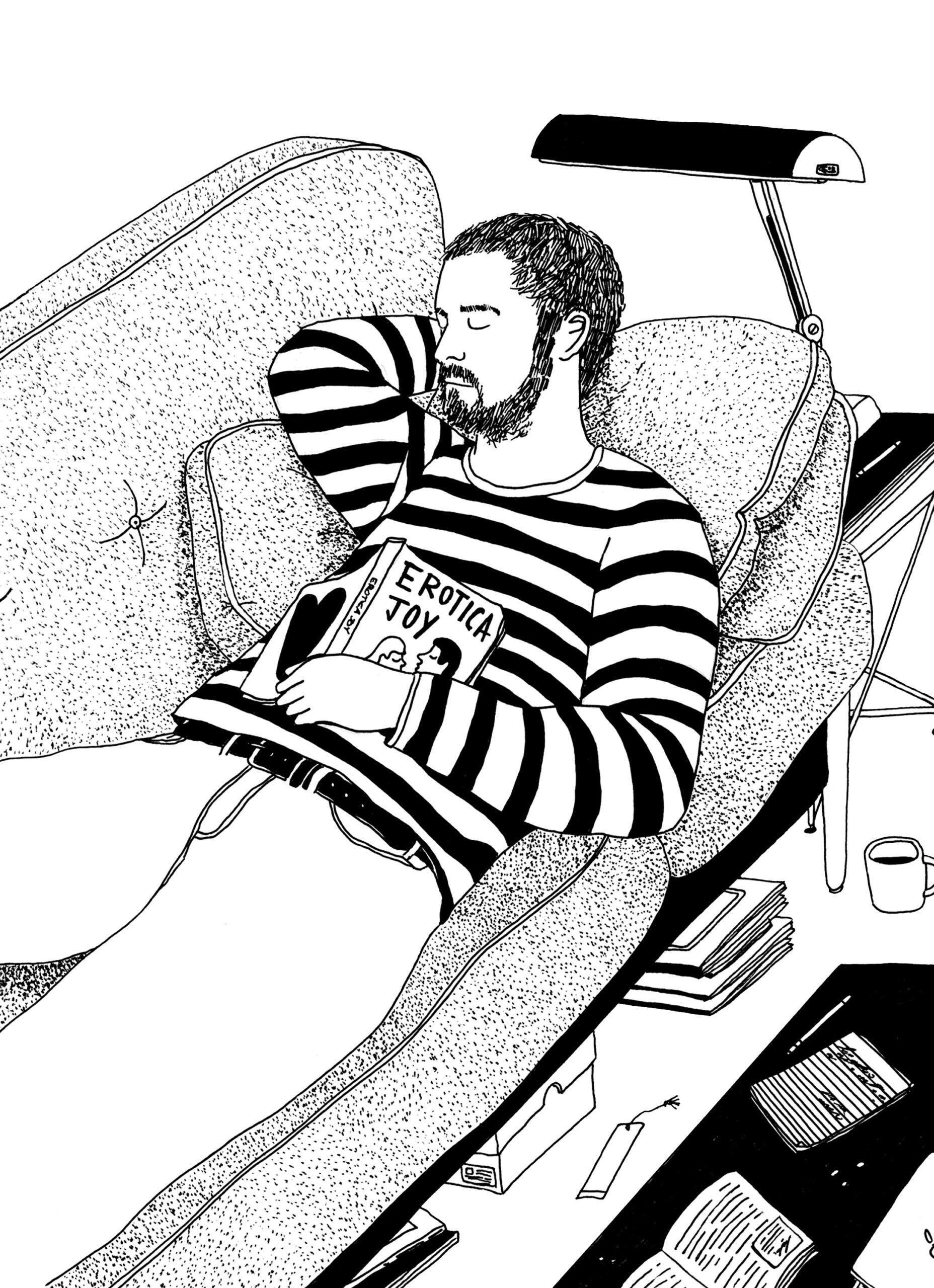
Elián was reading an erotic novel, one of those pulp literature products sold in airports and supermarkets. He liked reading them in the subway because, he said, nobody starts talking to you if you’re holding an erotic novel, although, in fact, I think he got caught up in the plots, the more ridiculous the better, and had come up with that excuse so he could go on reading them without feeling guilty: Nobody ever talks to me on the subway and I’m hardly ever reading anything. What I’m getting at is that I was the one to see him first, not Elián, and though his English is better than mine, it was me who paid attention to what the man was saying (that torrent of information and opinions he poured over the woman in heels): “In order to understand the present, you have to go back to the Nixon presidency, that was when everything really started to go downhill,” he said with a pedagogic air.
I listened to him expounding heatedly on the details of the Watergate scandal, the Cuban missile crisis, September 11, and Russian interference in the 2016 presidential elections. When the train stopped at 42nd Street, the woman stood up, muttered something inaudible, and was out of the car like a shot the moment the doors opened. The man in the Santa hat raised a hand to say goodbye to her and shouted, “Think over what I said about Zionism.” Then he was left alone. A little lost, he looked around, as if searching for his next victim, but all the passengers were traveling in groups, wearing headphones, or had a menacing air. I remember thinking that I’d never seen anyone so alone in the middle of a big city; I was tempted to invite him to our loan apartment and listen to his soliloquy while I was watering the bonsai trees. But when our eyes met, I discerned a disturbing voracity in his, so I looked down, stroked Elián’s wrist, and rested my head on his shoulder, feigning sleep.
A short while afterward, Elián and I moved to a tiny loft on the Upper East Side, which was where our problems began. First off, he was cagey about telling me who the studio apartment belonged to, and it seemed odd to me that we had no assigned task: There were no plants to water, cats to feed, or books to rearrange. Sifting through the mail, I discovered that the owner was a North American actor who had appeared in two or three independent movies. I googled him and instantly felt uneasy: I know Elián well enough to realize that the actor was exactly his type. I confronted my boyfriend and he played innocent. He told me he’d met the actor at a party and that, out of sheer charity, the guy had lent him the loft while he was on tour (he’d mounted a production based on the murder of Pasolini that was playing in various Midwest cities). I gave Elián a skeptical look but let the issue drop because I believe we all need a secret every now and again, an area in the shadows that the other has no access to, where we can go to breathe easy when everyday life gets too much for us. What did it matter that he’d had sex with the pseudo Pasolini? Elián was with me. We’d been living together for two years, first in that insalubrious basement in the ass end of Inwood and then, since early winter, in that series of loan apartments I took pains to call home. Of course, my secrets were of a different nature: sometimes, when Elián was taking a siesta, sleeping off a hangover after a night on the tiles, I’d take out my sketchpad and draw him. I had fifteen or sixteen sketches of Elián sleeping in different positions, sometimes undressed, sometimes just his head, at others his whole body, or a detail: a foot hanging over the edge of the couch, the curve of his back, the trail of drool running down his chin.
The second time I saw him, it was later, maybe one or two in the morning. We were returning to Pseudo Pasolini’s loft from a Chelsea gallery, where we’d attended an opening with free wine. Elián was very excited because he’d spent the whole night talking to an art patron and collector who had a house in the Hamptons and who, so he’d said, traveled a lot on business to Western Europe, the former Soviet bloc countries, and China. There was still no concrete offer, but Elián thought that if we met him again, at another opening, he could manage to get a loan of the house for at least three weeks. While listening to him outline his strategy, I caught sight of the guy in the Santa hat, dressed exactly the same as on the previous occasion, talking nonstop to a man his own age, who was furiously disagreeing with him. I stopped listening to Elián and focused in on what they were saying. Santa Hat was proposing that socialism was at the root of everything that was wrong in the world. In a tone meant to imply moderation, he was explaining to the other that Obama was born in some African country, not the United States, and was in fact a pawn of the Chinese. Without the least transition, he then jumped to defending Israel’s right to defend its borders from Islamic terrorism, while his interlocutor desperately gesticulated his defense of the two-state solution.
Elián realized I wasn’t listening to him and, following my gaze, turned to look at the two men who were arguing. “Do you remember the one in the Santa hat?” I asked. “We saw him on another train a few days ago. He was talking politics with a stranger then too, a poor young woman who finally fled the car at a run. The funny thing is that the first time he was on the left and now he’s backing the right.” But Elián seemed to find the man less interesting than I did. He shrugged and donned an expression I’d often seen that said, “That’s New York for you. Those things used to surprise me too, at first, but you get accustomed.”
Only, I didn’t want to get accustomed, I wanted to go on drawing Elián when he was asleep and I wanted to go on being surprised and eavesdropping on other people’s conversations as long as I could, and perhaps the only thing I’d have changed in my life at that moment was the situation of our accommodation because although I liked plant-sitting, I didn’t want Elián owing Pseudo Pasolini any favors; who knows how he’d repay them.
Two days after that, Elián told me he was going to be out of the city for a while. A job had come up in Chicago, something about a party where he was going to entertain people, and although I felt that couldn’t, strictly speaking, be anybody’s job, I told him it was OK because sometimes that shadowy zone of the person you love needs to expand, like a haunted house whose rooms swell or shrink according to the mood of the person in them, and I truly do understand and respect the need for that shadow, it seems to me healthy to feed it with secrets, allow it space to breathe, because a restricted shadow is a cancer capable of eating away at love from within and, at that moment, my love of Elián, his siestas on the couch, the sun pouring in on his weary-cherub face, were my home, the only place to return to on the subway, at night.
With Elián out of town, I felt a little adrift. Pseudo Pasolini’s loft made me think of the shadow zone, of my lover’s inaccessible room where, at that very instant, the unthinkable was happening.
An arctic wind blew in over the city, making it impossible to walk the streets, and since I didn’t have money to spare on museums or restaurants either, I decided to spend as much time as possible on the subway, traveling from one end of Manhattan to the other, exploring the lines that reached into the depths of Queens, or those that terminated at Coney Island. My meals consisted of whatever was sold on the platforms. I crossed the city’s bridges, looking out the window, trying to catch a little sun before the train entered another tunnel.
The third time I saw him was almost at the end of the E Line, as we were approaching Jamaica Station. I’d dozed off at some point and, when I woke, felt disoriented, with that kind of sadness that siestas sometimes bring about and that has its roots in early childhood. I patted my coat to check nothing had been stolen—not that I had anything to steal—and looked toward the rear of the car, which was almost empty. The man in the Santa hat was standing in front of a woman with Asian features, who was sitting, reading a newspaper with what looked like Chinese characters, and ignoring him. He didn’t seem to mind; he was speaking with the same decisiveness he had used to address his two previous victims. “The important thing,” he said, “is to allow the market’s own inertia to expand democratic values. So that when developing nations embrace the principles of economic freedom, they reach maturity as a republic, with only limited intervention from the state.” The woman didn’t even look at him; he could have given his speech to a fire extinguisher or a pony and gotten the same result. I was surprised by his absolute lack of reserve, and that in itself confirmed what I had suspected from our first encounter: He was among the many passengers to be found on the New York subway who had mental disorders, were drug addicts, chronic loners, or almost fatal victims of a predatory for-profit health system. Just before our train entered the station, Santa Hat turned in my direction and, when he saw that I’d woken, was alone and unsure where I was, he started to advance toward me.
Panic set in. I stood up and walked to the other end of the car, away from him. It was like a very slow pursuit. Just as he was about to reach me, the doors opened and I left the train. His eyes—weirdly deep-set in a pale face—remained watching me through the now closed door as the train pulled out. It was 2:35 in the afternoon. That night, back in Pseudo Pasolini’s loft, I tried to call Elián on my cellphone, but he didn’t answer. I took out my sketchpad and spent a short time looking at the portraits of Elián sleeping. They weren’t so bad, but they lacked something. I lacked something too. And I guess that Elián lacked something, and that is why he was aways searching for it.
I emptied the metal wastepaper basket Pseudo Pasolini kept under his desk. Then I tore out the drawings of Elián from my spiral-bound pad, crumpled them one by one, methodically, without a trace of anger. I put all the pages into the metal basket and threw in a lighted match. After a few seconds, dense smoke began to issue from the wastepaper basket and then incredible flames. The fire alarm on the ceiling sounded, very loudly. I attempted to switch it off with a broom handle, but it wouldn’t reach, and even standing on Pseudo Pasolini’s desk, I couldn’t get it to stop. So I grabbed my backpack, put in the few things I had scattered on the bed, and left. As I closed the door behind me, a bifurcated tongue of fire leaped from the basket to the drapes.
The fourth time I saw Santa Hat was a few hours later. I’d traveled Manhattan from north to south, and when I changed at Canal Street, I saw him walking along one of the passageways. I decided to follow him. To my surprise, he didn’t head for another platform but exited into the street, and I exited after him. I tailed him at a prudent distance for a couple of blocks, through Chinatown. The arctic wind pierced the seams of my jacket, the eyelets of my trainers, and the fibers of my cap, freezing my whole body. I thought about Elián’s shadow zone, and then about mine. I thought that maybe the fire trucks had arrived in time to extinguish the flames in Pseudo Pasolini’s loft. But the fire had probably spread to the adjoining building, or the whole block, the arctic wind feeding the flames.
Santa Hat entered a building. I didn’t dare follow him and stayed on the sidewalk, not knowing what to do with my life. I noted that, in addition to feeling cold, I was hungry. I wished I had a home that wasn’t a metaphor. I tried to count, one by one, the places where I’d lived before meeting Elián but couldn’t remember them all. When I was about to leave, to go back to the subway, to Pseudo Pasolini’s loft, or to my own country, I heard a very loud dull thud a few yards behind me.
The fifth time I saw him, the man in the Santa hat wasn’t wearing a Santa hat: He was a mass of flesh, tendons, and bone on the sidewalk. Blood was pouring from his head. One leg was lying at an impossible angle and both his wrists were turned inward. But he wasn’t dead. A constant whimper was issuing from his lips: He seemed to be singing. 
Daniel Saldaña París is a Mexican writer based in New York and Mexico City. He is the author of the essay collection Planes Flying over a Monster and the novels Among Strange Victims and Ramifications. In 2017, he was named to the Bógota39 list of best Latin American writers under 40.
Christina MacSweeney is an award-winning translator. She has translated works by such authors as Valeria Luiselli, Daniel Saldaña París, Julián Herbert, and Jazmina Barrera. She has also contributed to anthologies of Latin American literature and published shorter translations, articles, interviews, and collaborations on a wide variety of platforms.
Illustration: Keiji Ishida
