Nightmares of the Voiceless
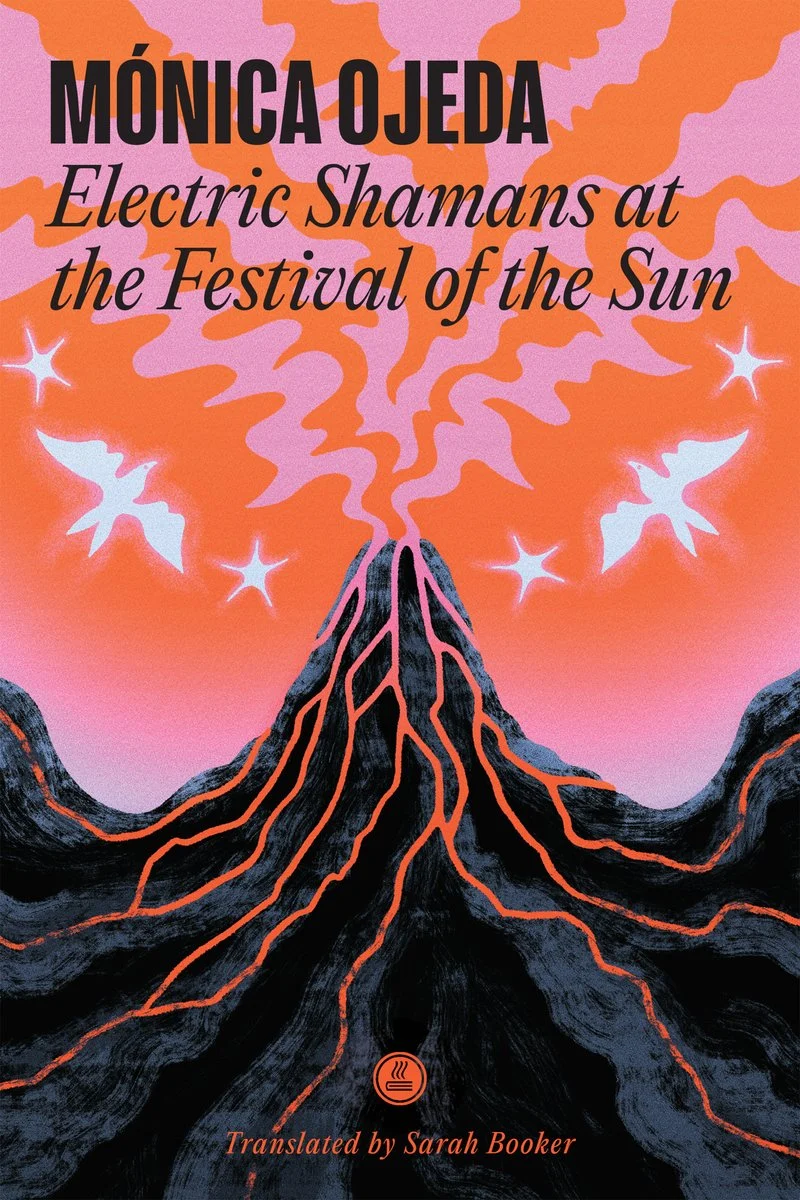
Mónica Ojeda writes like the sentences are escaping from the fractured earth after disaster, as if her narrative is informed by an intertwined set of truths in logical relation that selectively burst forth into consciousness, as if the fragile surface of humanity’s veneer has ruptured, bringing to light insights that have always been as necessary to our functioning in the world as they have been obscured, or buried in the mud along with all that’s dead. Her work doesn’t so much integrate the primeval and the supernatural as it reveals that they have always been inseparable. Sarah Booker has previously translated Ojeda’s Nefando and Jawbone from the original Spanish, her intimate familiarity with Ojeda’s work abundantly evident in this gorgeous new translation, Electric Shamans at the Festival of the Sun.
The profundity of Ojeda’s novel demands we interweave the minutiae of the human psyche with nature’s capacity to engage in its own sublime destruction and that we find beauty in both. Told through a number of perspectives of people attending the Solar Noise Festival, Electric Shamans is still very much focused on one character. Noa is attending the festival with her friend, Nicole. Noa is the character whose backwards sleepwalking disturbs us as much as the deaths that occur due to an earthquake that causes a stampede, but we never gain access to Noa’s perspective. Instead, the text shifts from narrator to narrator, along with our framework for understanding the events Ojeda relates and their timeline. The facility with which Ojeda switches back and forth between individuals—their thoughts, actions, and priorities, and the universal truths and tricks that seem farther from but are perhaps more fundamental to their being—emphasizes how humanity is not at all separate from the earth that undergirds and supports its existence. That the interweaving of humanity and its world is as closely knit as the compendium of incidents and ideologies that constitute for us a character, as integrated as the multiplicity of perspectives that represent all of friends, family, strangers, and the people we fuck—soul, society, and nature separable only insofar as we choose to abstract them, but never in reality, and not in this book.
There is an extent to which every story is told in obliquo. The stories of others, including those that are written, are always approached from the side. We have no direct experience of what the author is telling us, and there is no way for us to confirm whether what the author is telling us actually happened, even within the world of the book. Part of what makes Electric Shamans so powerful is that we never even get a glimpse of what the story could look like from its main character’s point of view. Nevertheless, we empathize with Noa, and the effect of approaching her story from the vantage points of those around her allows us a paradoxically more intimate revelation of her psyche, her origin, and her world. We have the secondhand accounts of things that Noa has said to other characters, which feel like the fragments of the ancient Greek philosophers’ texts that have been preserved only as quotations in other texts. There is the question of reliability—whether the reports reflect accurately what the source intended for us to understand. But also telling are the reactions of those individuals who choose to preserve that particular bit of thought for posterity, or in this book, why the characters have preserved those particular observations in their memory and choose to relate them as part of their own stories of what happens at the festival. What imprints on the other characters about Noa and how they relate those anecdotes within their own worldviews gives us a supplemental insight we would not have if the story were related to us directly through first-person narration or an omniscient bystander.
Beyond the multiple attendees of the festival (whose unique voices all give us a perspective on Noa’s present existence) are the parts of the book told from the perspective of her father. Noa’s father anticipates and then suffers through a visit from his daughter, whom he hasn’t seen in ten years. Nicole describes how Noa is anticipating the visit. Time is bent, and these chapters are reported from ten years in the past, according to the chapter descriptions. But the timelines are united by Noa’s blue hair, which Nicole says was dyed for the festival, and Noa’s father remarks on it upon her arrival. In this strange visit, Noa’s father describes how Noa takes on the clothes, the characteristics, and the belongings of his dead mother (Noa’s grandmother), how Diablumas circle his house at night; and he describes how he had to leave Noa when she was a child and how it was because he didn’t love her enough to stay. These parts of the book, where Noa’s father recalls the circumstances and his thought process in leaving his family, are the most emotionally affective. It’s not a book about blame but rather reconciliation with the entirety of self, including that part that demands we behave badly to those with whom we’re closest. It’s hard to gauge whether Noa’s strange behavior is a result of trauma or if she is truly possessed by the spirit of her grandmother or by some third natural or unnatural force that also causes earthquakes, stampedes, torrential downpours, and death—death overall, all the destructive forces of nature culminating in one terminus, the all-pervasive death that Ojeda also describes through Noa’s father’s reminiscences of the bodies lining the streets of Ecuador.
The image of the mare pervades the novel, and is immediately associated with fear. Mario, one of the points of view to which Ojeda gives us access, refers to Noa as “the mare’s voice.” In the opening chapter, Nicole recounts how Noa “grabbed my hair and explained that the English word nightmare has the word mare inside it.” Reading this, we’re forced into recognizing the immensity of the image because of the physical force Ojeda puts into its telling. Noa grabs Nicole’s hair to make a point; she acts physically to impart some bit of intellect. In the next one-sentence paragraph, Nicole tells us: “A mare is a female horse, she said, but it’s also what they call the evil spirit that suffocates people when they sleep.” We gather that this image of the mare is personal. Within Pedro’s narrative, Noa recounts a story of how her father threw himself down on a mare with a bullet in its neck that he and Noa stumbled upon in the forest when she was a child. The scene is reminiscent of something from Nietzsche’s life, where he is supposed to have broken down at the sight of a horse being whipped. According to legend, Nietzsche’s empathy for the horse caused his mental breakdown, after which he remained roughly comatose for the last ten years of his life.
In Noa’s version of the mare story, she and her father stumble across the body in the woods, and she wants to leave, frightened by the change in her father as he weeps over it. She thinks she sees the body move under him, but what she is most certain of is that there is another man in her father’s body, a man who is suffering. When, later in the book, her father tells the story, the mare has been dead for hours, shot and showing signs of other previous abuse. He throws his arms around the mare, reminded of the horse that killed his own father, the cruelty of men, and his own agony. In that moment, he spontaneously imagines a plan to leave his daughter lost in the forest, pretend it was an accident—and then makes a real plan to leave her, soon, having come to the realization that he “wasn’t a father or a husband, just a man whose love was insufficient.”
Through this retelling, we imagine how Noa’s character developed out of this man’s begrudging care and abandonment, and we feel more closely aligned with her, having seen into the soul of the man who at one time decided for her the symbolic significance of so much of the world. And it’s devastating.
At many points in this novel, I felt my soul being crushed by Ojeda. The novel serves as a sort of grounding, a catapult from the abstract back to Earth. There is no way to read this book except to feel along with Noa the weight of the sky falling, the lost child seeking solace among corpses and the terror of having no say in any of it. Her voice does not exist except as an echo. And the man who condemned her to voicelessness is just as lost. Electric Shamans at the Festival of the Sun is a beautiful and disturbing text—turning humanity’s insides outside—and a cure for the numbness of contemporary routine.
Charlene Elsby is a philosophy doctor and former professor whose books include Hexis, The Devil Thinks I’m Pretty, Violent Faculties, and Red Flags. Her essays and interviews have appeared in Bustle Books, Chicago Review of Books, The Millions, and the Los Angeles Review of Books.

More Reviews