The Indiscreet Charm of a Royal Dunce
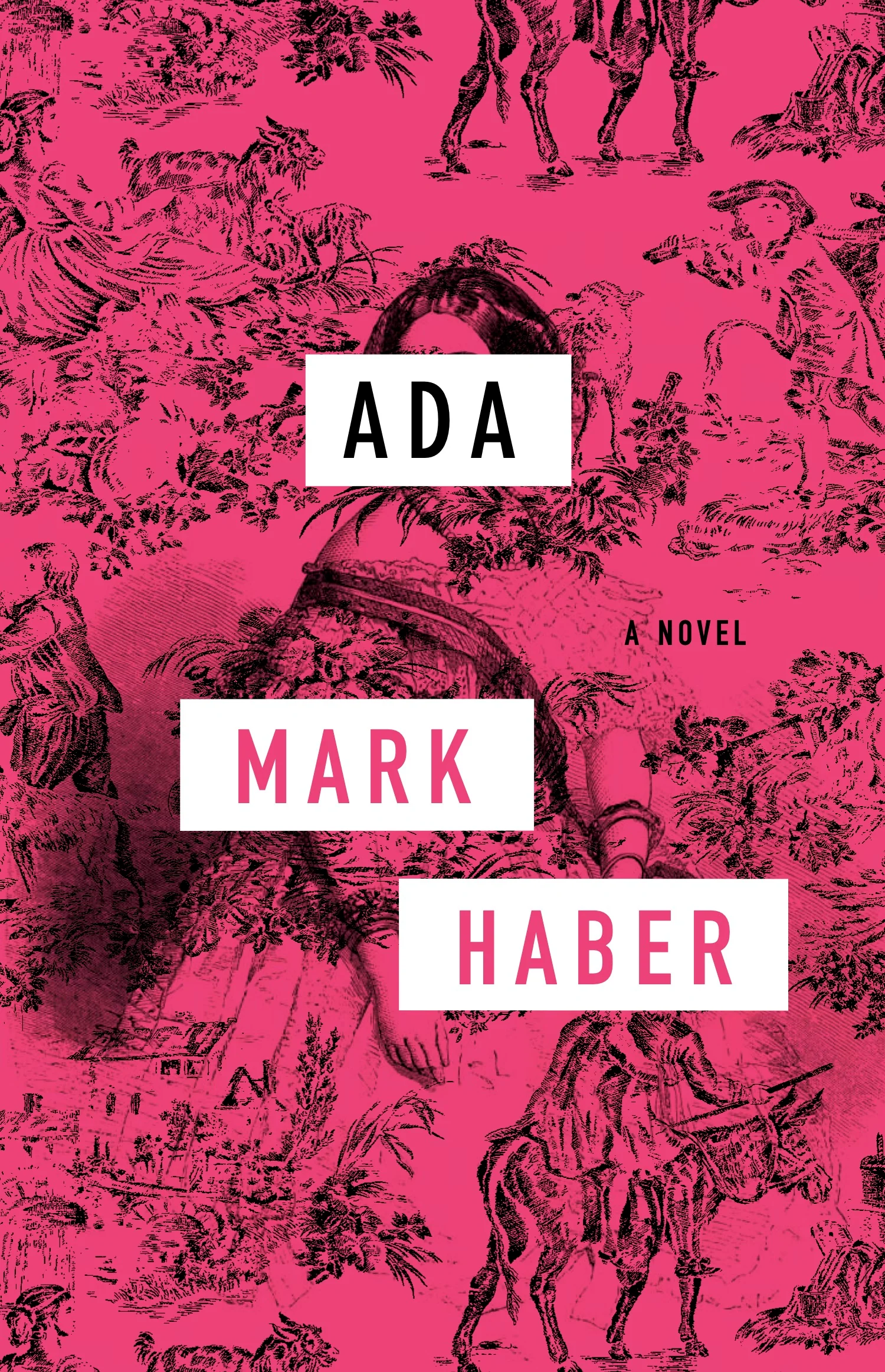
What happens when a writer finally loses their mind and decides to write a book anyway? While I doubt Mark Haber has lost his mind, or that he has held back when writing his previous books (he clearly hasn’t: lunacy galore), it seems to me he at least pretended go bananas while writing his new novel Ada. And he’s hilarious at it.
The book is a portrait of Gerard Desacroux IV, a rich, devious royal who reigns over the Berchtesgaden region, which is either Saxony or Bavaria (we are never sure—a “lesser country” or land given to his father by the French Crown). From page 1, Desacroux is waiting. He paces impatiently in his great room anticipating the arrival of Ada, a woman he met four or five years prior, while living in Paris, back when he would enjoy lascivious days drinking and possessing every human body he could find (an ass is an ass is an ass, he believes). He spent only one day with her and has not seen her since, but through his correspondence knows she is married to a man named Ehrhart. Both are visiting Berchtesgaden at Desacroux’s invitation.
Haber’s boy-meets-girl story is a basic prompt turned total absurdity. Desacroux IV met Ada on the street, along the Boulevards des Maréchaux: an elegant woman carrying her body weight in boxes and satchels. Ever the dandy, he brought her to his room and seduced her. They spent a day in bed together, pretzeling in sweat, an experience so intense that the sexual encounter rewired his brain. The “virulent fornicator” suddenly turned monogamous. Under the covers, he promised himself to her but confessed he is bound to the Berchtesgaden: his father, Desacroux III, has called him back from Paris, fearing that his days are numbered because the peasants might soon try to murder him. Ada in turn confessed she is not a royal like him, but a servant caught shopping for her mistress. The revelation makes absolutely no difference. Desacroux is in love.
Thus begins the obsession.
After years of not seeing her but writing the most pornographic letters to her, he learns that she is married to Ehrhart, a man who, like him, sits atop the social order, albeit in his own way, not by lineage but by new money coming from the invention of the paisley textile pattern. The former Dionysian invites them both to his castle in Berchtesgaden to amend his indiscretion, to apologize for the “painstaking depictions of lovemaking to Ada.” Or so he wants Ehrhart to believe. But as male bravado and privilege would dictate, his plan as soon as they arrive is to disclose his romantic intentions with Ada and challenge Ehrhart to a duel. So, we are waiting and pacing and rambling with him in the great room as we read on.
Slowly, even with the ever-present Ada, Haber’s satire turns from a story about sexual desire or love or infatuation to a tale about the ridiculousness of male grandiosity, a parable of insecurity in men then and now. What men want and take—like children. The great room can be read as a metaphor of the main character’s mind. There’s even a closet to unleash his lust, but you’ll have to read the novel to know why. The wait in the great room, the main hall and setting for the whole book, feels like we’re holding an orgasm with Desacroux. For over ninety pages.
Luckily, the author alleviates the tension with hysterical interactions between Desacroux and his butler, Hans, a man he abuses both verbally and physically, a man he deems “dense, lazy, and incredibly stupid.” Hans’s job is to stay on the tower and to let him know when Ada arrives from the foothills of the Watzmann, even though Hans keeps interrupting Desacroux’s pacing with mere trivialities. Sheltered in his great room—where he keeps books, not because he reads them but for appearances—Desacroux is just another idiot (man) with a last name and an inheritance. It’s a timeless tale of childish masculinity.
Ada is also a book about the delusion of power and the absurdity of hierarchy and how people (again, men, mostly) are given control over people, resources, and land, their entitlement no matter how idiotic they might be. In the wait for Ada, Desacroux’s mind starts to unravel, exposing his cruelty and rancor as he narrates his father’s misfortunes and the consequences of his own “indignation at the world, his inclination for ceaseless authority and wrath.” Through the father we learn about the son. The younger mistreats butlers, maids, indeed every servant who happens to appear in front of him, even if only to clean up his mess. He is paranoid, afraid—no, terrified—of the people living in his land, since they already killed his father and might come for him (a rebellion is always lurking). Desacroux also waits for the Romans to come seize his land. This sense of despair lasts until the very end.
But Ada shouldn’t be read as historical fiction, because really it’s a broader depiction of the men running the world. Brutes supported by their status, whether it comes from a last name, old money, corrupt money, tech money, or fake money (bitcoin). Haber simply imagines a moment in history to serve his purpose and add to his already insane and erudite (the same thing?) fictional universe. And with Ada, he is saber rattling. Here we find his emblematic mile-long blistering sentences but sharper, funnier, reinforced by the pedantic language spoken by his characters, perhaps a mockery of the literary kind. For those of us who have read his previous books, Ada is another room in his byzantine castle, a space at the end of a twisting hallway, behind a jib door. For first-time readers, Ada is the perfect foyer, the short, impeccable entryway that will draw them into a delightful and delirious new world.
Efrén Ordóñez Garza is a writer from Monterrey, Mexico, living in Washington, DC. He is the author of the novel Humo (NitroPress, 2017), the short story collection Gris infierno (Editorial An.alfa.beta, 2014), and the novel Productos desechables (Textofilia, 2025), all written and published in Spanish. He founded the literary translation press Argonáutica (2017-2022) for which he translated Mark Haber’s short story collection Melville’s Beard / Las barbas de Melville.

More Reviews