A Mystery of Murder and Memory
For nearly a decade after World War II, Jorge Luis Borges spent summers at his mother’s quinta, or country home, in Adrogué, a suburb south of Buenos Aires. During those years, his eyesight was steadily worsening from the same degenerative disease that had afflicted his father, and his mother had begun to assist him in much the same way she had helped her late husband. After his mother sold the property in 1953, Borges commemorated the quinta in an autobiographical poem titled “Adrogué,” which was included in his collection El hacedor. By the time the slim volume was published in 1960, Borges had been blind for several years, and the first of the poem’s dozen quatrains assures readers that even in “la noche indescifrable,” the incomprehensible night, he would never lose his way among the quinta’s familiar rooms and pathways preserved in his mind. Borges concludes the poem on an uneasy note, however, with a couplet about “esta suerte de cuarta dimensión,” that fourth-dimensional fate, that is memory: “Y no comprendo cómo el tiempo pasa, / Yo, que soy tiempo y sangre y agonía.”
The cast of Claudia Piñeiro’s 2020 novel, Catedrales, is similarly confounded by the passage of time, by the endlessly widening chasm between an achingly tangible past and the urgency of the present day, between the memory of who they were and the reality of who they’ve somehow become, individuals who have aged and suffered at the mercy of time and blood and agony. These characters are all specifically haunted by the night three decades earlier when the body of seventeen-year-old Ana Sardá—sister, daughter, and friend—was found burned and dismembered in a vacant lot near the church of San Gabriel in Adrogué, about thirty minutes away from that quinta memorialized by Borges.
Perhaps no one in Piñeiro’s novel has suffered more during those intervening thirty years than Marcela, whose memory of Ana’s death is singular. Marcela remembers cradling her best friend’s head in her lap, laying the girl’s lifeless body gently on the church pew where they were seated, rushing to get help from Father Manuel, and having her jacket sleeve snag on the support bracket of a large marble statue, which subsequently toppled onto her and knocked her out. When she came to an hour later, Ana’s body was gone and Marcela had anterograde amnesia, meaning she could no longer form new memories. (Think: Christopher Nolan’s Memento.) For Marcela, the death of her best friend would always be the last thing she could remember. In a lovely Easter egg late in the novel, we learn that Marcela’s surname is Funes, but unlike Borges’s memorious Uruguayan, who retreats to a darkened room due to the overwhelming profusion of his limitless memory, Marcela can’t escape the confines of a single moment, the most painful one of her life.
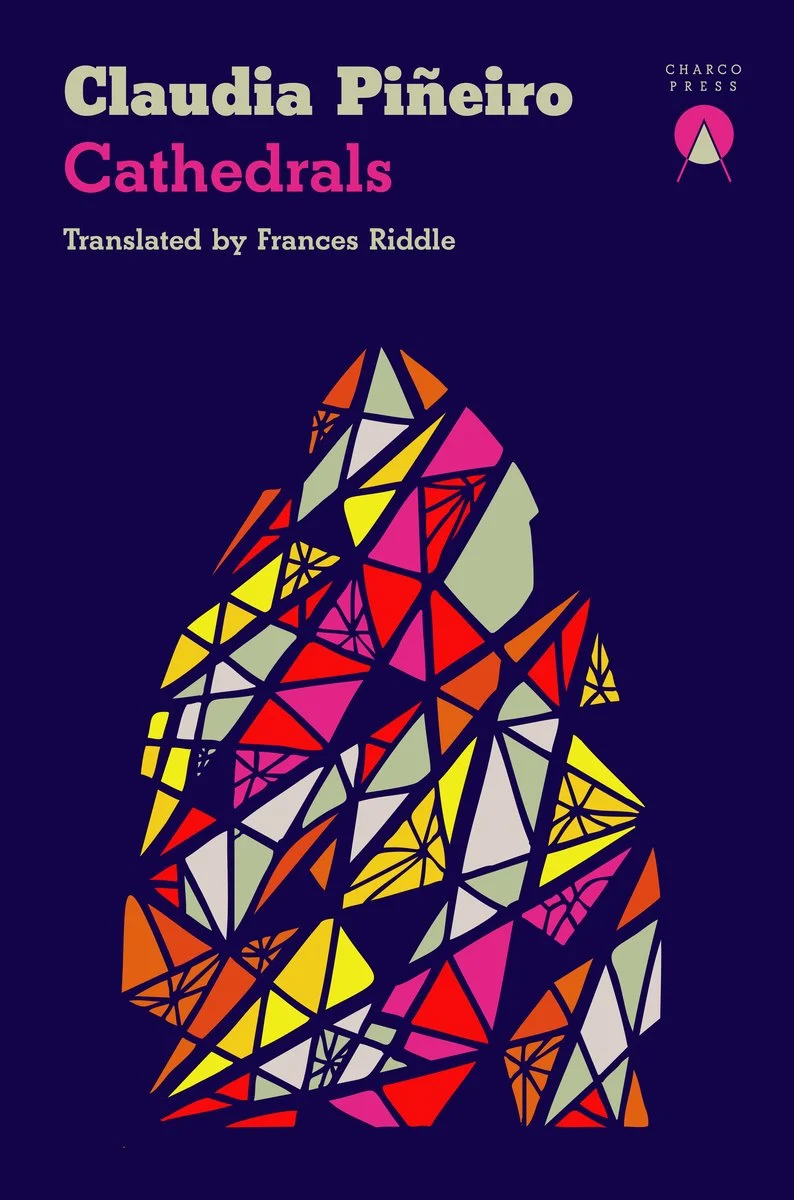
Because of her trauma, no one believes Marcela, and so Cathedrals, as Piñeiro’s novel is titled in Frances Riddle’s new English-language translation, is nominally concerned with reconciling the discrepancy between Marcela’s recollection and the apparent facts of the case. But as with all Piñeiro’s books, the mystery is almost a MacGuffin, a means to discuss the sociological themes that have recurred throughout her more than twenty-year career: free will versus fate, which many equate to the hand of God; the ways that parents, particularly mothers, seek to control their children; and the Catholic Church’s insistence on using its righteous authority to impose its doctrine on the lives and bodies of women and girls. The result is an affecting examination of devotion, both virtuous and misguided, as well as a withering critique of religious zealotry and pious hypocrisy.
Cathedrals is a polyphonic novel, with Piñeiro segueing between seven sequential narrators who draw incrementally closer to the truth about how and why Ana died. The girl’s older sisters, Lía and Carmen, bookend the story itself, which is capped by a brief epilogue from their father, Alfredo. Other chapters are related by Carmen’s husband, Julián, who was a twenty-two-year-old seminarian when Ana died; Carmen and Julián’s son, Mateo, a twenty-three-year-old repudiating his parents’s Catholic “fanaticism”; and an independent forensic detective named Elmer, who was a police rookie when he worked on Ana’s case. Lía opens the novel by relating the events on the night that her younger sister died, but the circumstances that led to that moment and what happened afterward are revealed only as the story goes on. It’s difficult to substantively discuss Cathedrals without mentioning the immediate cause of Ana’s death, which is revealed about a hundred pages into the novel, but I won’t delve into specifics or any subsequent disclosures because Piñeiro does such an excellent job ratcheting up the narrative tension. Her novels are generally classified as crime fiction, but none of them are really whodunits; Cathedrals is as close as she’s gotten to one.
Lía, who was nineteen when Ana died, has remained consumed by her sister’s death and her own need to know “who burned her, who sawed off her legs, her head, who discarded my sister’s body parts in the vacant lot where the neighbors dumped their trash.” In the middle of Ana’s funeral, Lía had declared herself an atheist. Two years later, she left home, telling her family that she wanted no contact with them unless they were calling to tell her who killed Ana. She moved to northwestern Spain and opened a bookshop in Santiago de Compostela, the final stop on the Camino de Santiago, one of the three main pilgrimages of Christianity. Eventually, Lía begans exchanging letters with her father about the incidental details of their daily lives, making an exception for him because he “was the only member of my family who seemed to want to know who had killed my sister and why. My mother and Carmen did nothing but pray to accept ‘God’s will.’”
Carmen, four years older than Lía, relies on her faith to the exclusion of all else: “I believe in God. I am a thorough, total, passionate believer. Brutal if necessary.” Her entire life, Carmen has seen herself as the victim, even within her family, where growing up she viewed sisterhood as “a battlefield.” Outside the home, she attracts allies for whatever cause she takes up by deploying a charm that could beguile most anyone she comes into contact with, a guise that Ana always saw right through, knowing that “all her sister cared about was controlling the world, by whatever means necessary.” Like many women in Piñeiro’s fiction, Carmen wants children above all else, seeing it as one way to make the world a better place. “Why should a woman have to have other goals above being a mother, starting a family, educating her children in the Catholic faith so that they can become good Christians?” But motherhood is not guaranteed. And when women in Piñeiro’s novels can’t have the children they want, the result is often damaged women; when they can, the result is often damaged mothers. After Mateo was born, Carmen learned that she could not bear more children, a disappointment she rationalized as acceptable because God “wanted it that way.”
God’s role in a person’s fate is a long-running consideration of Piñeiro’s work, which repeatedly explores how her characters react to the obstacles life has placed in their path. In Las viudas de los jueves (2005), translated by Miranda France as Thursday Night Widows (2009), Ronie’s life is saved simply by leaving a party early, but it’s not until the end of the novel that his family dares to leave Cascade Heights and embrace the second chance they’ve been given. In Una suerte pequeña (2015), translated by Riddle as A Little Luck (2023), Mary explicitly questions how much free will she had in the series of events that resulted in her being blamed for the death of her son’s friend: “In which precise moment did it become inevitable?” She subsequently decided to abandon her son, Federico, and the novel is equally concerned with how he dealt with the fate his mother dictated for him. And finally, in Tuya (2006), translated by France as All Yours (2012), Inés convinces herself that things will be okay after watching her husband kill someone: “It was Fate that decreed the woman should die that way. Or God. Actually I do believe in these things. And I respect them. And I look for the message.”
While Inés does invoke God, she doesn’t find absolution in her faith in the way that Carmen does. In fact, Carmen’s closest analogue is Rita in Elena sabe (2007), translated by Riddle as Elena Knows (2021), a woman so certain of God’s will,— as it has been conveyed to her by the Catholic Church—that she intercepts a stranger who is about to get a clandestine abortion. Twenty years later, that woman still detests Rita for upending her life and condemning her to unwanted motherhood, telling Elena, Rita’s mother, “There hasn’t been a single day in my life that I haven’t wished to some god, some sorcerer, some star, that your daughter would die.”
Cathedrals shares a lot of thematic DNA with Elena Knows, and narratively it also allows for a stylistic similarity—in Elena’s Parkinson’s and Marcela’s amnesia—that provides Piñeiro a textual means of repeating things over and over, allowing the novels to hammer home ideas the author presumably wants to get across to her readers. While Cathedrals doesn’t give Riddle the unique opportunity to distinguish herself that is provided by Elena’s digressive, almost stream-of-consciousness narration, this latest translation, Riddle’s fourth of Piñeiro’s work, stands out for the way it so clearly individualizes its seven different narrators. There are also countless memorable passages throughout the novel, starting with Lía’s description of her early religious education that left Biblical passages “branded on [her] skin” and “carved into [her] mind.” The text can also be darkly humorous, as when Marcela reports, “They explained away my ravings, blaming the [statue of the] Archangel Gabriel,” the irony being that Gabriel only ever conveyed the will of God. But the single most beautiful moment in Cathedrals is one that exists solely because of Riddle’s judgment, experience, and feel for what constitutes a good translation. A couple of days before Ana dies, she spends the night at Marcela’s house, in a scene that Riddle translates as follows: “She said: ‘I love you, amiga.’ And, with our arms around each other, we fell asleep.” As best I can recall, it’s the only time in the entire novel that Riddle retains a Spanish word from Piñeiro’s original, and it carries the impact of a freight train.

When Carmen and Julián show up at Lía’s bookshop, the event that kicks off the present-day timeline of Cathedrals, the sisters haven’t spoken for thirty years. Even still, this is no tearful reunion. Carmen says that her son, Mateo—the nephew Lía that didn’t even know she had—is in Europe but has stopped responding to his parents’ messages. They’ve tracked him to Lía’s store via credit card purchases and need to find him, Carmen explains with overpowering sanctimony: “He’s confused. He’ll get over it. I trust in the way we raised him, but, most of all, I trust in the power of Faith.” Her contrasting apathy toward her sister is demonstrated chillingly when she places a box on Lía’s desk on her way out the door, mentioning almost as an aside that it contains half their father’s ashes—unbeknownst to Lía, he died two months earlier from brain cancer.
Mateo’s parents are unaware that he has renounced his faith, which he calls “the darkness that my parents represented,” changing his major from architecture to psychology due to Freud’s “idea of religion as collective delirium.” They also don’t know that the young man’s European trip was planned with help from his late grandfather in order to introduce himself to his aunt Lía and bring her a message from her father. Mateo sees through his mother’s façade just like Ana did, calling Carmen “the most hostile person I know,” a manipulator, “all fake.” While Alfredo and Mateo were plotting the boy’s escape, the old man was also meeting with Marcela, convinced that the only hope for solving the mystery of his youngest child’s death lay in the reason the girls were at the San GabrielChurch the night Ana died.
And Marcela does hold part of the truth in her memories. She swore to never reveal that Ana was waiting for her “secret crush” that night, someone whose identity Ana never divulged, telling her friend only that his Catholicism prevented them from being together: “He loves me but he can’t love me.” Marcela also remembers that Ana was pregnant, and that the day before Ana died, Marcela accompanied her to get an illegal abortion. All of which is only part of the twisted and twisty story that Piñeiro teases out. When Alfredo learns of the abortion (a revelation that does not come from Marcela, who indeed never breaks her promise to her friend), he takes responsibility for his shortcoming as a parent in a way that no other adult in the novel does: “With my silence, I sanctioned their mother’s outrage whenever the word [abortion] was mentioned.”
Like most girls in Piñeiro’s novels, and in Argentina itself prior to 2020, Ana and Marcela have no reproductive rights, no real resources, and no one trustworthy to turn to for help. Thinking back, Marcela recalls that even the word abortion was “shocking” and “scary” to them, “a dirty word” that she had never seen “written in any book, in any magazine.” She’s still distraught that her friend had “moved so quickly from the novelty of sex to the horror of pregnancy,” and remembers praying for “God to protect her” during the procedure. Abortion is a frequent narrative thread in Piñeiro’s work, appearing not only in Cathedrals and Elena Knows, but in All Yours, when the teenage Lali, who is effectively abandoned by her parents once they become consumed with their crumbling marriage (her mother, Inés, is trying to save it, her father, Ernesto, is decidedly not), turns to a man she met at a bus station for help getting an abortion. And Ana may have actually been better served seeking help from a stranger, too, because those who do help her are motivated, like Rita in Elena Knows, by unapologetically righteous selfishness.
Ana’s abortion scene is harrowing, and the events that follow it are somehow even worse. and it’s not the first time that Piñeiro has dispassionately yet compassionately documented the dangers associated with illegal abortions. The first time was in “Basura para las gallinas,” a short story that dates back to at least April 2010, when it appeared in the literary journal Hispamérica. “Scraps for Hens,” as the story will be titled when it anchors a forthcoming English-language collection of Piñeiro’s short fiction, is almost unbearably sad, powerful, and infuriating, elucidating in barely a thousand words a legacy of horrifying desperation passed down through three generations of women living in a country where they have no reproductive rights.
While it’s impossible to know what role, if any, “Basura para las gallinas” played in Argentina’s successful Green Wave movement, which helped legalize abortion in late 2020, the story can be found on countless blogs and in various audio recordings all over the internet. In 2018, Piñeiro parried a question about abortion in her fiction by simply saying, “Es parte de la vida, lo que le puede pasar a una mujer.” Abortion is a part of life for many women, something that remains true whether or not the procedure is conducted safely or in a way that is legally permissible by the state. In the United States prior to Roe v. Wade, fiction played a vital role in publicizing these realities and destigmatizing the choice to have an abortion. In a post-Dobbs environment, US authors regrettably have an opportunity to take up these issues again; for now, US readers would do well to pick up Piñeiro’s essential novels.
Cory Oldweiler is an itinerant writer who focuses on literature in translation. In 2022, he served on the long-list committee for the National Book Critics Circle’s inaugural Barrios Book in Translation Prize. His work has appeared in the Boston Globe, Star Tribune, Los Angeles Review of Books, Washington Post, and other publications.

More Reviews