1.
Night had fallen. I must have been six, and even back then it was hard for me to get to sleep. At our place we slept with the television on; the glow it gave off was the extension of another world. What I saw that night left me with the feeling of having glimpsed a hidden, illicit reality: the cabin of a spaceship in which a man grew old in a matter of seconds, a looming monolith, a star fetus floating in the uterus of space.
The next morning, in the deceptive safety of daylight, I had no words to describe that nocturnal transgression. I carried those images within me like a secret, a burning question, a reminder that the flimsy fabric of normality can be torn apart at any moment. It was only years later, as an adolescent, that I discovered the name of that event. Since then I have watched 2001: A Space Odyssey over and over again.
2.
An uncle came to stay with my parents while he recovered from surgery. He spent his time at our place telling me stories about his past lives and covering the doors of the bedrooms with symbols to ward off malevolent forces. One day I came home from school and was sad to find that he’d gone. But he’d left a number of books: a pair of gnostic gospels that he’d written himself, esoteric treatises explaining the relations between extraterrestrials and Andean cultures, and a very strange text that languished on my shelves for several years, until one day I decided to read it. This was the 1888 edition of La lengua de Adán (Adam’s tongue), almost impossible to find at the time, except perhaps at a secondhand-book stall. The author, Emeterio Villamil de Rada, was an eccentric scholar from La Paz who spent his life embarking on various ill-fated business ventures around the world: copper mining in Bolivia, the extraction of quinine in Peru, hunting for gold in California, advertising in Mexico. In 1876, crushed by poverty, he committed suicide in Brazil by throwing himself into the sea. La lengua de Adán, the only one of his books that made it into print, attempted to prove that Aymara was the perfect language—the original tongue of humanity, no less, from which all the others descended. Villamil de Rada reached this conclusion after mastering twenty-two languages and acquiring a working knowledge of another ten. Drawing on archeological studies, he also argued that Eden was situated where the small Andean town of Sorata is today, a vindication of Indigenous Andean culture that was explosive at the time. The theories set out in La lengua de Adán, as well as Villamil de Rada’s adventures, nourished my interest in nineteenth-century Bolivia. I now regret not having kept the books about collaboration between Indigenous civilizations and extraterrestrials.
3.
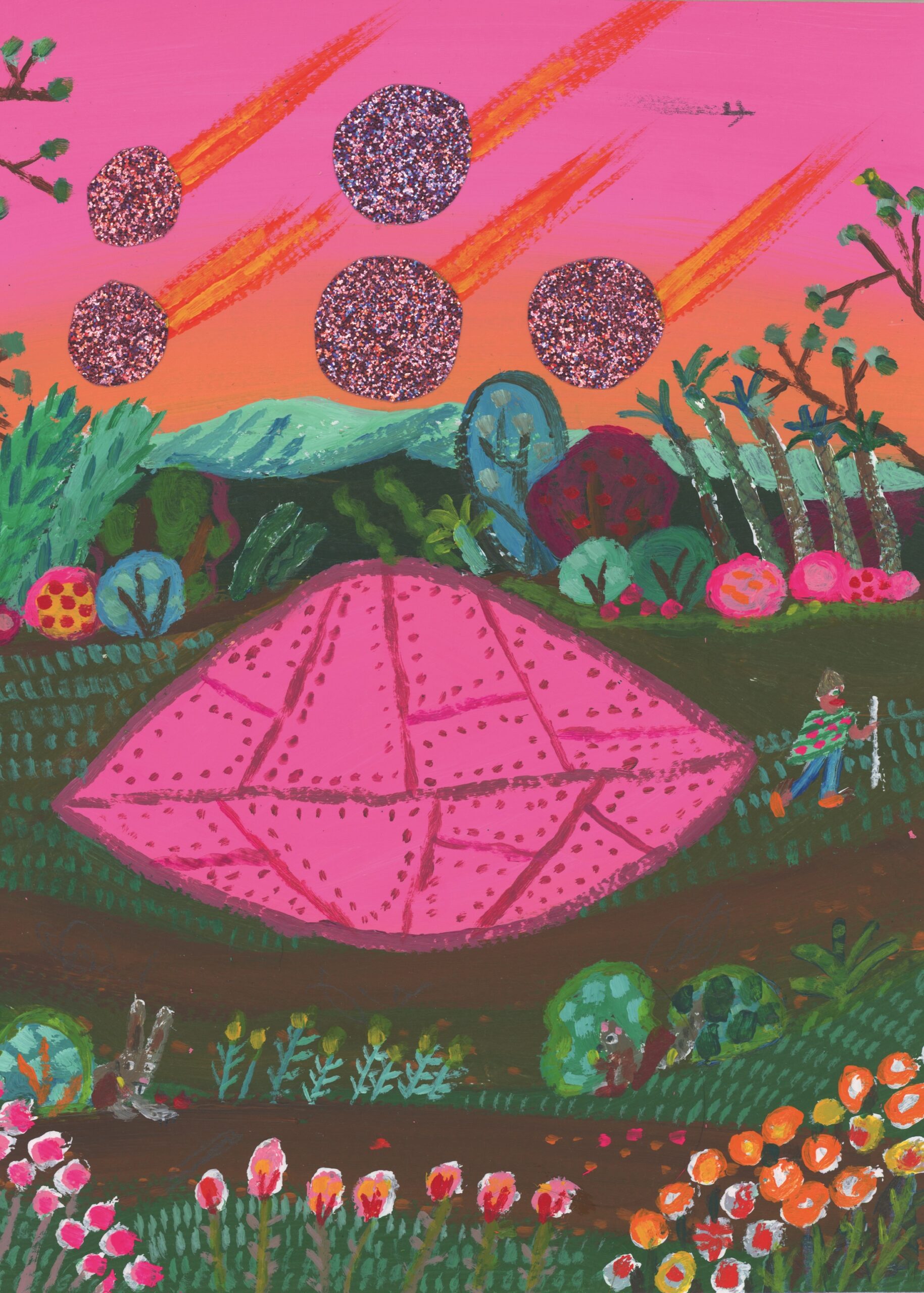
In H. P. Lovecraft’s “The Colour out of Space,” a meteorite that has fallen near a farm begins to produce extraordinary effects on the natural environment: Squirrels and rabbits develop malformations that frighten the local people; the vegetation grows out of season, luxuriantly, exhibiting garish colors; the countryside glows suspiciously at night; and the trees sway in the darkness, although there is no breeze. Soon the farmer’s family members get sick and go mad, and the whole area takes on a grayish hue and becomes a blighted wasteland. Back in 1927, Lovecraft found a way to narrate the alien while avoiding the cliché of the extraterrestrial as a being with human characteristics; he conceived of the invasive force as a substance whose color is indescribable.
Art has usually represented extraterrestrials in one of two ways: as little green men with oval-shape heads and long fingers, or as tentacular creatures, like octopuses or squids. Both formulas betray our inability to imagine the truly alien: We cannot know what is beyond the grasp of our senses, and every representation of a Martian is simply a projection. We can only describe an alien in our terms; its own categories elude us.
Perhaps the novel that best reflects the impossibility of contact with an extraterrestrial being is Solaris (1961) by the Polish writer Stanisław Lem, in which a psychologist travels to a distant planet to study a life form discovered there. The planet’s ocean responds to x-ray bombardment by confronting the human intruders with images drawn from their most traumatic memories while revealing nothing about itself. The alien in Solaris is so radically different that every attempt at communication fails, leaving the humans to contemplate themselves in an infinite regress.
4.
My mother and my uncle maintain that once, in Riberalta, they saw a spaceship come down and hover over the river, bathing them in a strange light. The circumstances of the sighting are a source of disagreement: My uncle says it took place when they were children; my mother claims she was already married at the time and that it happened when various relatives were returning from a funeral. But it’s impossible to corroborate either version because all the other witnesses are now dead. According to my uncle, the extraterrestrials abducted him and modified his organism to prepare him for a mission. According to my mother, the UFO simply hung in the air above them for a while before disappearing into the trees as mysteriously as it had appeared.
In 2019 I traveled to Riberalta with my mother. That afternoon, we went to visit Cachuela Esperanza, which was the epicenter of the brutal latex boom at the end of the nineteenth century and has since become a ghost town, dotted with old mansions that once belonged to the rubber magnate Nicolás Suárez and are now being swallowed by the jungle. In his day, Suárez was the richest man in Bolivia. Someone told us that one of his descendants still lived in the area and spent his time fishing from a small canoe.
Before setting off, my mother wanted to go to a restaurant beside the river that served caiman-tail ceviche. There was a live caiman drowsing on the bank. As we were walking down toward the river, my mother pointed to a spot in the jungle.
“That’s where we saw the UFO,” she said.
5.
In the sci-fi story “The Cosmonaut” by the Cuban author Ángel Arango, three extraterrestrials covered with tentacles and pincers see an astronaut landing on their planet in a spaceship. These beings use their pincers to lop off each other’s tentacles, and each time they do this, offspring emerge from the severed extremities. The lascivious creatures beg each other: “Bite me!” and “More, more . . .” as they liberate their tentacular progeny.
The astronaut encounters them in the middle of their reproductive frenzy. When he approaches, the three aliens look at him with innocent curiosity and cut off one of his arms, causing his death. “What will his children be like?” wonders one of the creatures, waiting for the astronaut to reproduce himself from the wound. From a human point of view, it’s a violent, hostile act; for the creatures, it’s a way to see how the visitor reproduces. There’s a failure of translation between the two cultures.
As the critic Lu Han has pointed out, “The Cosmonaut,” like many fictions about aliens, is a parody of colonial encounters. The astronaut comes to the planet convinced that he will be able to establish contact with its inhabitants, moved by supreme self-confidence and the implicit assumption of technological superiority. The bodies of the planet’s inhabitants are monstrous and hypersexual, like those of Indigenous people as described in colonial chronicles. They destroy the visitor in their sexual excess, but without any ill will. The story inverts the logic of exploration narratives: The human visitor, who in colonial accounts usually occupies the place of the rational observer, becomes an object of curiosity and experimentation. The violence of the encounter springs not from an aggressive intention but from the impossibility of translating the practices of one culture into the terms of another.
Cajamarca, 1532: The friar Vicente de Valverde presents a Bible to the Inca emporer Atahualpa and explains that it contains the Word of God. Atahualpa examines the book and holds it to his ear, hoping the foreign god will speak to him. But the object is silent; it says nothing. Frustrated or annoyed, Atahualpa throws the Bible to the ground. The Spanish interpreted this gesture as a grievous offence, a blasphemy, and used it as a pretext for capturing Atahualpa and murdering his people. The Peruvian critic Antonio Cornejo Polar reads the moment as a collision between oral and written cultures. And there is a song about this episode by the Argentine artist Victor Heredia: “Encuentro en Cajamarca” (Meeting in Cajamarca).
6.
In the 1960s, there was a Bolivian rock group called the UFOs of Huanuni (Los Ovnis de Huanuni) that started out in a mining town. In those years of political repression and military governments, many mining areas had their own rock groups; the local radio stations mixed political and community announcements with soap operas, protest songs, rock, and Andean music. Although the UFOs of Huanuni were relegated to “purgatory” for many years, “Minero” (The miner) and “Gente pobre” (Poor people) are classics of Bolivian rock. The UFOs were also the first Bolivian rock band with female members.
In 2024 I listened to a talk by the geographer and visual artist Trevor Paglen about mass-surveillance systems, hallucinations generated by artificial intelligence, photos of UFOs, and politics. Paglen cited Richard Doty of the US Air Force, who confessed to having spread lies about UFO sightings in order to cover up secret operations. So whenever we see the government recirculating images of supposed flying saucers, we can assume that there is some military activity or intelligence operation underway that has to be concealed from the public. Doty said it was easier to get people to extend their deep-rooted false beliefs than to implant a completely new lie.
7.
Some years ago, Selva Almada took me to see the UFO museum in Victoria, in the province of Entre Ríos, Argentina. Many things in Victoria seem to come from contrasting times and realities, as if they’d been sucked into a black hole and crushed together: There’s a Laguna del Pescado famous for its UFO sightings, a Benedictine abbey where the monks make their own brand of liqueurs and beer, an opulent all-night casino, and a hill called Cerro de la Matanza, where the army murdered Indigenous people of the Chaná, Minuan, and Charrúa nations in 1750. We were met by Silvia, the founder and director of the museum, a woman with dyed-blond hair, wearing a red jumpsuit. She showed us flasks full of a dark, viscous liquid, in which the fetuses of unidentifiable animals were floating—mutant creatures produced by the experiments that aliens had carried out in the area. It was common to find cattle drained of blood, for some mysterious purpose, by those chupacabras from space.
Silvia had been married to an engineer who worked for the oil industry in Patagonia. One day a mothership came down over her house and released five flying saucers. Years later she read in the newspaper that UFOs visited Victoria in Entre Ríos, so she decided to move there with her mother, her three children, and even her daughter’s boyfriend, aiming to make contact with the entities from space. At first the family of ufologists lived in tents beside the Laguna del Pescado; eventually the city granted them the land where the museum now stands. As well as specimens of mutants, the museum houses press cuttings relating to sightings, a television that shows witness accounts of encounters with UFOs in Victoria, and a life-size reproduction of the Roswell aliens.
I noticed a hunk of iron kept in a glass case. It looked like an everyday piece of scrap, with rough edges. “It’s part of a spaceship that crashed near here,” Silvia explained, adding that the metal had special, unearthly properties. The iron was literally indestructible: Locals had tried to cut it, but they couldn’t even scratch the surface, even with an angle grinder. “Why do you keep it in a glass case?” I asked. I was imagining that this unbreakable, fantastic extraterrestrial material would have been widely coveted. “Is it to stop people stealing it?” Silvia shook her head. “One day a little girl stepped on it, and it broke in half,” she said. “That’s why it’s protected now.” 
Liliana Colanzi has published the short story collections Permanent Vacations, Our Dead World, and You Glow in the Dark. Among her awards are Spain’s Ribera del Duero Short Story Prize for You Glow in the Dark, in 2022, and Denmark’s Zinklar Short Story Prize, in 2025. She lives in Ithaca, New York.
Chris Andrews lives on Gadigal-Wangal land in Australia. He translates prose and writes poems. His recent translations include Ágota Kristóf’s I Don’t Care and Liliana Colanzi’s You Glow in the Dark.
Illustration: Esther Pearl Watson
