Sure, I could no longer see the title of my novel or the incredibly handsome cover art by Sylvie Burke that displayed a pier jutting into the placid waters of Kyoto’s Lake Biwa (a prolonged, calamitous, but ultimately successful conversation between the book designer and the artist, the artist and the jacket designer, and then, eventually, the editor, agent, and myself, the author), but what matter, since it served the larger purpose of one evening, fifteen months later, attending the Carnegie Gala of Literary Prestige in New Haven, Connecticut, celebrating the most venerated books of the year, of which mine was the most renowned? The cover of my book had been bestowed to me like a vision years before when the novel was merely the germ of an idea, a jellyfish or amoeba swimming desperately in the lunar waters of my brain; back then I’d already considered the cover of my novel as a concrete fact, indisputable, and the book itself had merely to follow the outlines of the image cultivated in my mind, written in order to justify the book cover’s existence, because why would a writer be blessed with a vision of something so pure and sublime, so wholly novel (no pun intended), and not have this selfsame vision supported by the architecture required—that is, the novel itself? This was the question I routinely asked myself while writing the book, mainly as I brooded and sulked, neglected family and friends, ignored disasters both public and private (namely, the work of a writer) to finally finish Dusk, Oblivion, the follow-up to my first novel, Heart’s Renaissance.
I chased this vision like a higher destiny, like a fortune whispered in my ear from the toothsome lips of a perfumed huntress, to find myself, years later, seated at the most revered and triumphant table of the gala, the ballroom organized by importance: the judges, editors, journalists, agents, and publishers seated in the peripheral rows closest to the exits and moving inward—that is, toward the central ring of author tables, approaching the illustrious table where I now sat, each row populated by highly successful and highly praised writers, just a little less successful and praised than me, seated in the center, where I commanded a view of the festivities.

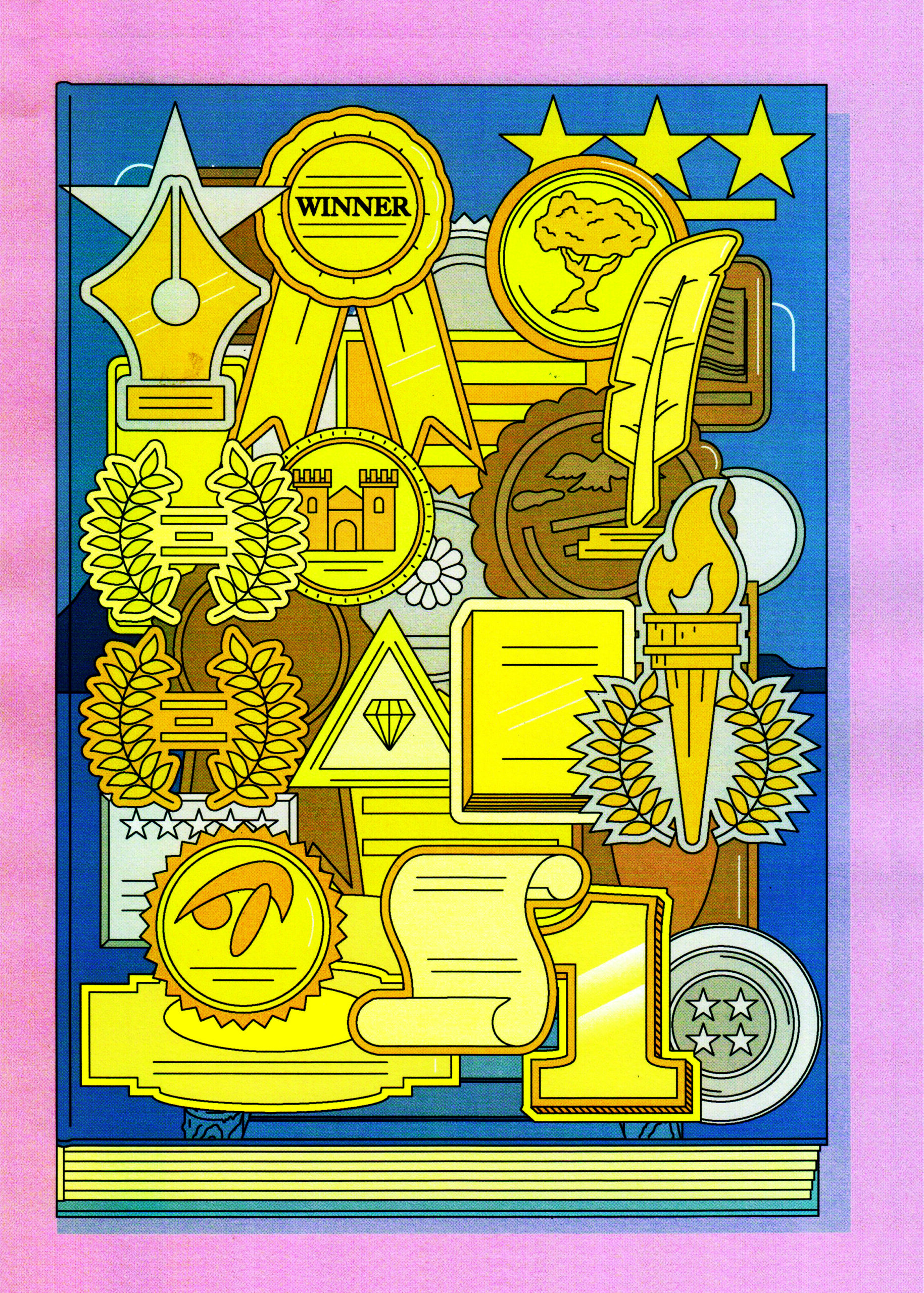
It’s true, the cover art of my book had been completely obscured, but replaced with proof positive I’d written the greatest, most triumphant book of the year. The title and my name, as well as the aforementioned cover by Sylvie Campbell, who’d died, sadly, hang gliding over the Cape of Good Hope (may she rest in peace) were now thoroughly hidden by the prodigious array of prize stickers affixed upon my book. Month after month, award after award, Dusk, Oblivion became more acclaimed and more important and thus, ultimately, more cloaked by stickers. Each time a new prize was awarded, a new sticker was thrust upon the book’s jacket, going from partially obscured to half obscured to now, finally, fully obscured, and a sense of sublime joy warmed my bones as I watched Sylvie’s stunning artwork become increasingly concealed by a glorious array of stickers and emblems illustrating the multitude of praise and prizes my book had won: in bronze, silver, yellow gold, white gold, even rose gold; glowing with radiance, shimmering with prestige, each sticker pleading for attention, each sticker begging the reader, shopper, perhaps the harried passenger passing the airport’s bookstore window, to consider not only the amount of praise heaped upon my second novel, Dusk, Oblivion, but the well-grounded argument that a book so highly praised and prized couldn’t be anything but miraculous.
For these prizes to be awarded, of course, the books first had to be read rigorously by a panel of judges (of various sundry awards) to one day be announced as a nominee, then a finalist and finally, the winner: me marching bravely through the perilous minefield of awards season: longlist, shortlist, finalist, because winning an award and getting the sticker is no small feat: Firstly, the book has to be written, then accepted for publication, and then, often much later, published. And during awards season I had ensconced myself in the mountains of Vermont to avoid social media, the press, and all the other frivolous fanfare designed to beguile and entrap the triumphant artist, as well as train for awards season itself, with hours of calisthenics in the barn adjoining the rented house, including the medicine ball, treadmill, and elliptical; I also did jumping jacks and pull-ups, and employed an array of different weights and pulleys while simultaneously waiting to hear if I’d won another award, thus another sticker, such that when awards season arrived and my book (hope upon hope) was listed among the myriad categories for which it was nominated, I would look dapper and svelte in my jet-black tuxedo, handsome and lithe, thriving and agile, looking like an author whose book deserved to be inundated by a litany of stickers of which the most recent, Book Design of the Year, completely buried Sylvie’s gorgeous cover art of lake, dock, and the distant cityscape of Kyoto, and with this a flash of grief stabbed my heart, poor Sylvie, who, months earlier, met her fate by smacking face-first into an outcrop of ancient boulders despite the fervent protestations of her hang gliding cohorts, who had urged her to avoid the Cape of Good Hope: It’s begging for death, they’d said, Avoid Table Mountain altogether, they’d barked, and Sylvie didn’t listen, she never listened, and with a hint of anguish I glanced at her vacant seat at the far end of the ballroom abutting the exit.
As Dusk, Oblivion continued winning awards, I’d receive calls from fellow writers wishing me congratulations, and graciously I told them how humbled and grateful I was, when what I really felt was a sort of pity and disgust, because I quickly realized a book without prize stickers was akin to a book with bad or middling reviews or, even worse, a book met with indifference, like a body with stumps for appendages, and I’d read essays and interviews with these same writers claiming their books were not written with awards in mind, that longlists and shortlists and nominations meant nothing or next to nothing and I laughed to myself because those were either outright lies or the words of losers and defeatists, of trivial dreamers, writers who realized their book had no possibility of ever achieving glory, meaning a starred review or a luminous sticker and, consequently, likely weren’t very good in the first place and sure, a self-righteous person might think the difference between a book with a prize sticker and a book without a prize sticker is trifling and nebulous, and, to be sure, in some sense, this is true: No comma was removed or added upon the award, no edits when the prize had won; sure, the same writing, the same story, the same exact book. However, I’d argue, the award and hence the sticker altered the book, because with each award, meaning a new sticker, my book was refined, enhanced, and ultimately improved, until the book was nothing close to what it was when I’d written it or when it was first published. In fact, if I deigned to glance at the original and unadorned cover of Dusk, Oblivion before winning its first award (the PEN/Borges), I’d see an innocent fawn, a newborn deer with legs trembling, attempting to stand upright, unsure of its very survival. Thus with each additional sticker a new and complex importance for the book grew in my mind, forcing me to notice things I hadn’t suspected were there. Did winning the Peabody Humanitarian Prize make me suddenly see the humanitarian thread running through Dusk, Oblivion? Did winning the feverishly competitive Council of Librarians for Dusk, Oblivion make me realize I’d always liked libraries? Was I placed on the cover of Lit Commerce in smoking jacket and pince-nez for an article regarding how many starred reviews my book had garnered (eight), to suddenly see Dusk, Oblivion as a symbol of redemption not only for myself but for literature entire? The answer to these questions was a clear and unambiguous yes.
At the table I was flanked between Eliott Goldbaum and Natalia Álvarez, both highly respected authors whose books had won various prizes, as the amount of stickers adhered to their books testified; however, I could still make out the titles of their books with relative ease, as well as their terrible covers: Goldbaum’s derivative of an old jazz album, a sort of Blue Note rip-off, and Álvarez’s, whose sticker for the Platinum Wreath Prize barely concealed a banal landscape and which, pitifully, resembled thousands of other literary books, not a bad cover per se, but rustic and beige, monotonous and self-serious, pleading to be blanketed with a surplus of awards for which she’d been nominated but ultimately I had won. And the reptilian part of my brain wanted to take them both aside and furiously whisper: I’m not a fucking nominee, am I? I’m no runner-up, no finalist, but, quite clearly, the best. In short, I’d say, teeth clenched, restraining a guffaw, a book with a sticker is clearly superior to a book without a sticker—stating the obvious, pointing out what clearly didn’t need pointing out. This would bring, of course, a dark and unnecessary cloud to the evening because, following coffee and dessert, each judge was to stand at the podium and give a speech celebrating the beauty and originality of this year’s books, of which mine possessed the most beauty and originality.
Eliott’s and Natalia’s spouses were also at the table and though I’d wanted to bring my wife she’d filed for divorce during the final stretch of completing Dusk, Oblivion, a dark period when I’d paced the house at all hours, barking one-syllable responses to her stupid and mean-spirited questions, like when was the last time I’d showered or why hadn’t I turned off the oven, and she’d shown an efficiency never exhibited during our marriage when, minutes after the divorce was finalized, she’d packed her shit, decamped, and vanished completely, leaving no trace, the house utterly vacant besides our cat, Chorizo, a slim Persian and the object of my deepest affection, whose framed photo I’d brought with me to the gala and placed lovingly in front of my plate, and, after murmuring sweet nothings to the photo, calling Chorizo “my little sausage link” and “Lord Dumpling,” I gazed upon the tables of the other, less celebrated writers, authors of books with a sticker or two and nothing more and, of course, these writers were probably good, but where were their stickers, I wondered, because following the plethora of prizes won by Dusk, Oblivion, the other winning (but less winning) books looked anemic and frail: longlist, runner-up, or nominee, but no winner. And yes, I’d been forewarned, the winner’s table was illustrious and prestigious and a whole litany of words that simply meant “amazing” but also, at the same time, it was incredibly lonely, looking out upon the assemblage of round tables populated by other, lesser acclaimed writers with fewer accolades, thus fewer stickers; the titles of their books clearly visible because, alas, they hadn’t been nominated or hadn’t won as often as me. Meanwhile I complimented Eliott Goldbaum and his novel with its three measly stickers: one, a silver thing shaped, ridiculously, like an ascot, another like a fountain pen; and, furthermore, I thought, one of his stickers was only a longlist sticker and, why, I’d thought, sampling the tiramisu, why even put a sticker on your book if you haven’t made the shortlist or won? A longlist sticker is advertising to the world that you hadn’t made the shortlist and hadn’t won; a longlist sticker is exclaiming from the highest rooftop that there were other, superior books. Tell your publisher, I’d thought, tell your agent and publicist to simply back the fuck off. Show some pride. Show some backbone and moral integrity. But sure, I admit, in my more generous moments I felt a sense of empathy for Goldbaum and Álvarez and their feeble brethren, the less stickered writers, because I’d been there before with my first published book and no sticker for Heart’s Renaissance, no prizes or awards or longlists for Heart’s Renaissance either, only a single nomination from a second-rate award given by some regional college I’d never heard of. I don’t want the fucking sticker, I’d hollered at my agent through the phone, poor Chorizo sensing my agitation and leaping off my lap. Yes, I’d been on the other side: no nominations or stickers or even a single starred review, simply tossed in the gutter and disregarded in favor of the books with stickers and stars, because it was a well-known fact that the winningest book, the most awarded and successful book, would no doubt furnish the rest of a writer’s career not only with high sales, but likely positive reviews and more awards, meaning, of course, more stickers, because it was only natural for the judge or the critic (or the public) to consider the success of previous books when reading and reviewing current books.
Yes, I continued to think, perusing the tables of less successful writers through my pince-nez, sipping coffee, finishing off the tiramisu, because, to quote a highly successful author, though one not quite as successful as me: “One sticker begets another.” Indeed. With the array of stickers affixed to Dusk, Oblivion, was there any doubt my path had been made? Because the world of writers is divided between those who’ve won awards and prizes, thus stickers, and those who haven’t. And the winner of the prize is clearly superior to the runner-up or finalist because, stating a fact so obvious that it’s almost repugnant, it had won! And as I passed the photo of my precious cat around the table, the lights dimmed and the first speech began and for the briefest moment I considered how lucky I was to have Chorizo, a creature who loved me without question, tender and doting, who supported me during the psychic turmoil of writing Dusk, Oblivion, as the dishes collected in the sink and the electric got turned off, as my wife’s frenzy over my commitment to literature reached outlandish levels of hysteria, she throwing cups and plates and eventually cutlery, compelling me to sleep in the garage just to find a moment’s peace, and, lest I forget, dear Sylvie (rest her soul), who hang glided to her demise, not alive to witness the evening’s gala and see her beautiful cover of Dusk, Oblivion wholly eradicated by my genius. 
Mark Haber’s debut novel, Reinhardt’s Garden, was longlisted for the PEN/Hemingway Award. His subsequent novels, Saint Sebastian’s Abyss and Lesser Ruins, were both named a best book of the year by the New York Public Library. Haber’s fourth novel, Ada, will be published in 2026.
Illustration: George Wylesol
