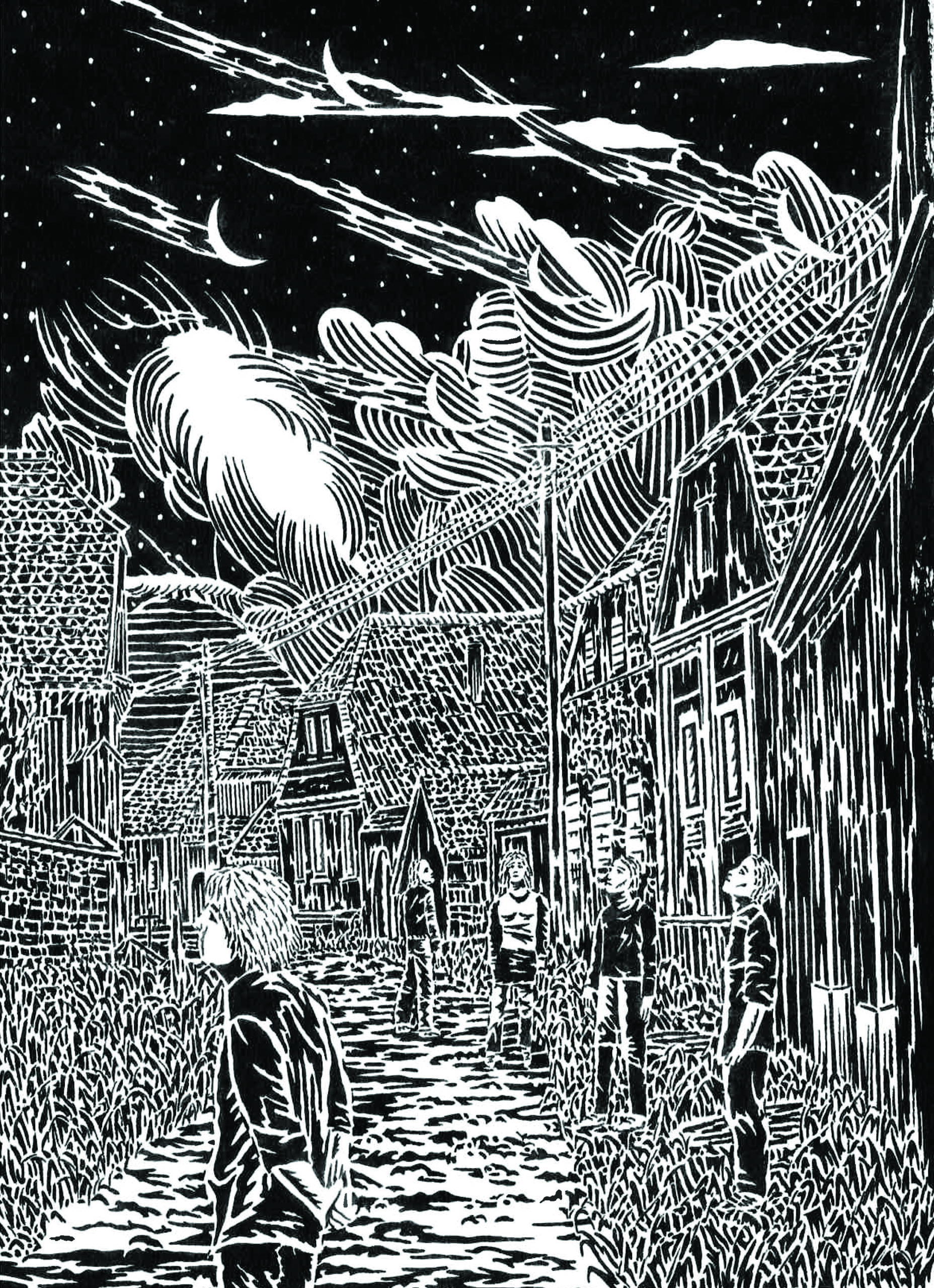
And the war was a fire somewhere on your street that everyone smelled but never saw. And the girl you loved had crooked hair and tough questions. Like, “That’s a lot of smoke—you think something’s happened?” And you knew something had happened, and you knew it was the war, but your voice was still a cat that couldn’t get home, so everything you offered felt impossibly wrong. Like when you said, “It’s just Mr. McGregor burning his trash.” Like when you pointed at the approaching plane and swore it was the moon.
And after the first moon flew over, there were other moons too. And your parents came out of the house and looked like children as they watched all the new moons filling up the sky. And they sounded like children as they said, “We should go inside.” And once you got inside, you realized your parents looked and sounded like children because the war had turned them into children. Your mother crawled on the carpet by the television and tried to slip a dime into her mouth before you scooped her up and carried her on your hip. Your father pulled himself up using the coffee table but lost his balance and cracked his head on the corner. Blood poured out of his squirming face, and he was crying, and this made your mother cry too, and neither of them calmed down until you had bandaged the cut, and fed them bottles of warm milk, and rocked them to sleep in the chair by the window. With a thousand moons spilling light through the blinds, you kissed your parents on their tiny heads and said, “A little smoke never killed anyone.”
And come morning, you woke to find your father had crawled out of your arms and slipped through the dog door. You spotted him in the front yard, wrestling with a coyote. It scared you badly, even worse than the smoke, seeing your father box the coyote’s face with his doughy fists and seeing the coyote snap its teeth at his tiny ears. And you ran upstairs, and you got the gun that belonged to your father back when he was still your father, and you shot the coyote in the side of its head, and it slumped down in the grass at the base of a plum tree, and this saddened your father, who had understood the animal to be a friend. But by the time you buried the carcass under the plum tree and put your father in a swing by the window, everything was calm again. He watched the smoke rub against the houses, and he watched the moons fly across the sky, and everything was perfect until the phone rang. And it was the girl with crooked hair, and she asked about your parents, and you told her they were babies. And you asked about her parents, and she said, “My parents turned into coyotes. My mother is here with me now, but I’m starting to get worried about my father. I let him out earlier this morning and he still hasn’t come back.”
And so much did not come back. And the moons multiplied. And the smoke got stronger and saturated everything, even the plums you picked and turned into jam so that, in the evenings, you could have something to spread on the toast you ate with the girl who had crooked hair. And one night, as her mother slept curled on the floor beside your parents’ cribs, the two of you looked out the window and saw a battalion of soldiers marching down your street. She said, “Are those moons too?” And for a moment you were struck dumb by the audacity of gear—so many masks and so many shields and so many weapons. But eventually you said, “Those are migratory birds. Black-chested nightjars, if I’m not mistaken.” And you held her hand as their masks twisted into beaks and their shields bubbled into gray breasts. And you pulled her close when they flapped their weapons like restless wings. And these changes did and did not make the war less difficult to witness. And she said, “But what are black-chested nightjars doing here?” And you said, “Don’t worry. They’ll be gone come spring. No one can live long in a city made of smoke.”
And spring came and went. And the nightjars remained. And you tried to use the phones, but the phones no longer worked, and all you heard was an automated recording that said, “The Devil himself started this fire. Cooperate with the nightjars as they work to keep you safe.” And you tried to watch television, but the televisions no longer worked, and all you saw was an emergency ticker that read The Devil isn’t real. Foreigners are behind this. Cooperate with the nightjars as they work to keep you safe. And you went to the store to buy a paper, but the newsstand had been turned into a gun rack with a sign that read Free to a Good Home. And you were told to stay inside. And, except in the evenings when the girl with crooked hair would walk around the neighborhood and search for her father, you learned the quiet art of cooperation.
And one morning you looked outside and realized the smoke had become so thick that you could no longer see anything at all. Not the nightjars, who had tripled in number and nested into barricades at the end of every street. Not the thousands of moons, which now swarmed the sky like flies on a fresh wound. Not even the plum tree or the unmarked grave at its base. And you told the girl with crooked hair, “I never thought I’d say this, but we can no longer live here.” And she agreed on one condition—that you help her find her father.
And for seven days and seven nights, you tied a rope to your waist and fixed the other end to the plum tree, and you wandered out into the neighborhood to scream her father’s name into the smoke. And at midnight on the seventh night, you came home and found the girl with crooked hair standing over the carcass of a coyote. She said, “I have good news and bad news—which do you want first?” And you said what you always say in response to this choice. You said, “Give me the bad news.” And she gestured towards the dead coyote at her feet and said, “I had to kill my mother.” You said, “What’s the good news?” She gestured towards the pair of empty cribs and said, “It was revenge for her eating your folks.” And when she asked if you were crying, you said, “I got smoke in my eyes is all.”
And you left that night in the car that used to belong to your parents back when they were still your parents. And the smoke was worse than ever, but you aimed the vehicle in what you believed was the direction of east, and except for occasionally bumping into a flock of nightjars, you drove steadily on the road that led out of town. And as you arrived at the city’s edge, visibility improved, and you were able to see the sign that read Now Leaving White Pine, and right beneath it you saw the fire that started it all, and you saw that people were gathered around it. And the girl with crooked hair begged you not to drive any closer. And you knew she was right, that it didn’t matter what ruined a place you would never return to, but you also knew she was wrong, and that you could not live your life without knowing what kind of people want war to go on for forever. And so you pulled up to the fire, and you saw that it wasn’t the Devil himself, and neither was it foreigners. You saw that it was families, and that they were gathered around the fire for warmth. Some were dancing, and some were drinking. Everyone was smiling. Their tranquil faces appeared soft-lit and flickering, and their hands, which hovered inches from the flames, might as well, from that distance, have been outstretched in prayer. And then you understood. 
Dan Leach has published work in The Southern Review, Copper Nickel, and The Sun. Junah at the End of the World, his debut novel, was released by Hub City in 2025. He lives in the low country of South Carolina and teaches writing at Charleston Southern University.
Illustration: Miroslav Weissmuller
