Needle Drops | Kiss’s “Rock and Roll All Nite”
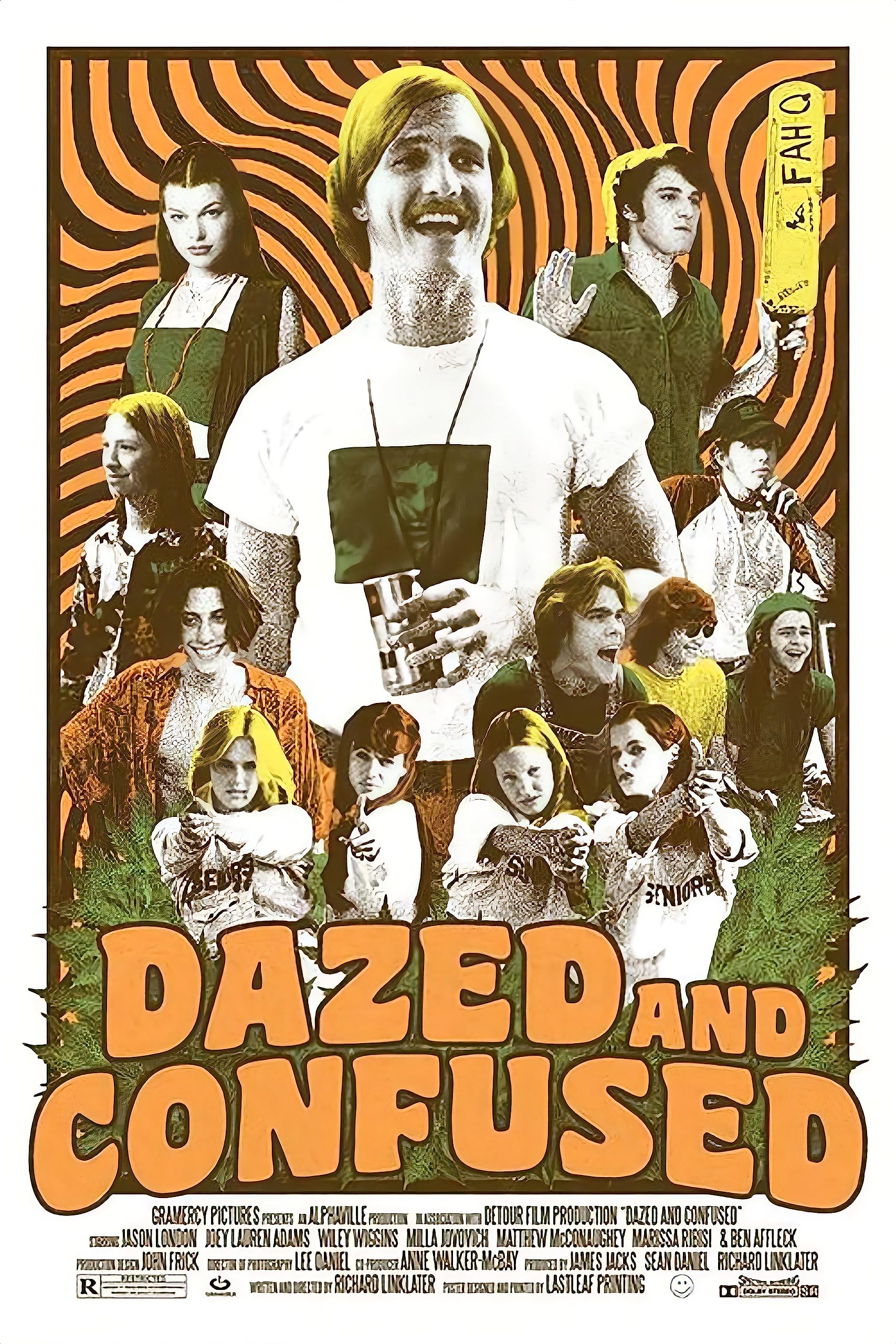
Needle Drops is a column that asks writers about—you guessed it—their all-time favorite needle drops. In this edition, Elizabeth Nelson explores the Kiss classic “Rock and Roll All Nite” from Richard Linklater’s Dazed and Confused (1993).
Cue the iconic opening drumbeat, the insistent riff, the unsubtle amuse-bouche before the orgiastic beggars banquet of Kiss’s “Rock and Roll All Nite” from their world-historic Alive!
“You show us everything you got / And baby, baby, that’s quite a lot”
It is a lot. You can tell by the stammered repetition of “baby.”
Then the second verse: the deal memo, as it were. Should be given a once-over by everyone’s legal representation but feels like a rational exchange of goods for services.
“You drive us wild / We’ll drive you crazy”
Nowadays, in this time of deceptions and obfuscations, you’d call that a pretty straight deal. Nothing too complicated. Not the Yalta Conference anyway, or any single terms-of-service contract I sign 10 times a day in the heedless forward rush to give every last atom of my being to the techno-feudal man. In the 1970s, work was catch-as-catch-can, and the members of Kiss were reasonable men. They understand the virtue of give-and-take. Wildness for insanity. They were proposition men, always. Consider “Calling Dr. Love” from 1976’s judiciously titled Rock and Roll Over. This is Gene singing in his strained, sweating, never-going-to-be-a-loverman way that is by some cosmic irony his most appealing mode. Who knows what they were thinking with “Calling Dr. Love?” A burlesque pastiche, something on the order of “Dear Doctor” from Beggars Banquet? Was Gene dabbling with medical school? I’m not going to break my brain over it. It doesn’t matter. The important thing is that “Calling Dr. Love” landed on a truly populist, if semipornographic, message.
“Enter please / Get on your knees / There are no bills / There are no fees”
It’s not unbeautiful, in its way. The Affordable Care Act as authored by Charles Bukowski.
Kiss were held in contempt by most important critics of the day. In the 1983 version of the Rolling Stone Record Guide, co-editor Dave Marsh’s evaluation of their catalog is less a career overview and more of a crime scene. He gives the first three records one star out of five. He yields and gives their masterpiece, Destroyer, four stars, while broadly insinuating that producer Bob Ezrin was largely responsible for the upgrade in material and sonics. And maybe Bob Ezrin was, but it doesn’t matter because Dave Marsh was asking all of the wrong questions.
Marsh, much of whose work I genuinely admire, is always on some quixotic search for what he called “authenticity” in rock music, which he tends to identify in Bruce Springsteen and Bob Seger, both heroes of mine as well. But it was a needless parochialism that caused him to set apart rock from disco—a profound category error, really—when both were simply extensions of First Testament edicts. The Stones understood this intuitively, trend-chasing Mick leading the charge as always. Some Girls doesn’t bother to draw a distinction between Donna Summer and the New York Dolls because, done correctly, there is no distinction. Talking about authenticity in rock is like talking to the piano player in the whorehouse. From the machinations of Colonel Tom to the sweet payola days of Alan Freed, this “authentic” business has never been remotely aboveboard. That’s where Kiss comes in. No great band has ever been more below board. As one of their alleged heroes once put it: “Nothing is real.”
Richard Linklater’s Dazed and Confused deployment of Kiss’s “Rock and Roll All Nite” happens a little more than an hour in, and kicks off the third act of the film, where they have the party at the Moontower. It’s such an exhilarating moment, and says something about the sheer, ridiculous fun machine that Kiss was in the early days. There’s an old music-business legend about Leonard Cohen trying to convince CBS Records President Walter Yetnikoff to release his lugubrious but brilliant 1984 LP Various Positions, the one that contained the initial version of “Hallelujah.” Yetnikoff, who loved Cohen but was in the position of watching the label’s bottom line, notoriously responded: “Leonard, we know you’re great. The question is if you are any good.”
Greatness did not enter into the Kiss conversation. They were never great, but they were almost always good. And there is something about the discernment of the teenage mind that could parse this dichotomy in a way that older heads had come to guard themselves against. If you have seen the film Dazed and Confused, you know what the plot point of the party at the Moontower is. But on the other hand, if you haven’t seen Dazed and Confused, you can still pretty much figure out what happens at the party at the Moontower, which makes “Rock and Roll All Nite” the ingenious, universal text it is. If you were at any point an American man or woman, or a Soviet dissident or anyone who ever had a heart, you know on some level what is happening. Of course, Dazed and Confused exists in our collective consciousness as much a fetishized soundtrack as a brilliantly rendered anthropological film. The kids, in their innocence, had no opinion on any of this but voted with their tendencies. From Aerosmith’s “Sweet Emotion” to Ted Nugent’s Detroit City “Stranglehold,” the emphasis is always the pure anarchy of youth, and what is gained and lost in its taming.
Later-years Kiss. Sometimes they put on makeup, and sometimes they took it off. It’s hard to know what it means to be authentic at a time when the mask reveals as much as the unmasking. People thought it was strange when Gene Simmons collaborated with Bob Dylan on a song for the recent, widely unseen Reagan biopic Reagan. People thought Dylan was strange for agreeing to appear on the objectively low-rent garbage television classic Pawn Stars or the strange, middlebrow ’90s comedy Dharma & Greg. But Dylan was always selling his wares, and so was Gene. Making strange choices. Accruing their treasure on Earth.
Kiss has done two full-scale farewell tours. The first began in 2000 and concluded in 2002. The second ran from 2019 to 2023. Some people see a disjunction in this, but I do not. I’ve been on tour, and they all should be billed as “farewell.” There’ll be no fraudulent original-members Kiss tours moving ahead. Ace Frehley went back to his home planet a few months ago, at the very respectable age of seventy-four for a space alien, more or less. When he died, the press reacted with the kind of confusion Kiss had always fostered. The New York Times did a very respectful feature highlighting his truly fascinating and diverse musical palette that made him seem like the best of the Kiss musicians but the least well-equipped to life on the road. He now exists in the place he always wanted to be in. Somewhere between Forest Hills and a Soviet-American space station.
The kids of ’76 were somehow more deeply armored to loss. Think of Texas at that time, solidly Democratic, still wounded from the assassination and the Civil War. Armed to the teeth then as now. The powerful impulse, which I entirely share, for the kids in Dazed and Confused to destroy a mailbox with a baseball bat is nevertheless an anarchist impulse that simply cannot be tolerated. It is right and correct that they were pursued and nearly apprehended by the kind of neighborhood watchman who simply saw no merriment in the abrogation of the law. But it is also right that they escaped unharmed. Weird resonances. Are resonances always weird? In the supermarket of the modern age, everyone is lost. In the Amazon age, the old shopping places are capitalism’s lost cathedrals. Think of old Woolworth’s, with its meandering cul-de-sac adventures and bargains and byways. Kiss on vinyl was a sight to behold—gatefolds, cryptic statements, fan enticements to join the Kiss Army for a dollar or two.
“I Heard There Was a Secret Chord” and “Go for a Spin”
Exactly. Once again, in his uncanny way, Gene Simmons weirdly perceives what’s needed. Drive your car around. Do it. On the lesser but still-compelling studio version of “Rock and Roll All Nite,” from Kiss’s 1975 Dressed to Kill LP, the album photo features four rad dudes in full Wall Street pimp regalia. I doubt any of them drive—behind the makeup they look just like the kind of borough kids who never had a reason to get a license. Ridiculously, they are wearing the tailored suits and Kabuki makeup of everyone who shouldn’t be trusted, but must be respected, on the basis of twenty million records sold. Twenty-three million Kiss fans can’t be wrong. Or can they? They drove us wild. We all went crazy. The Moontower shone in the Lone Star State. The stars at night are big and bright. Deep in the heart of tenement New York. Deep in the heart of Texas.
Elizabeth Nelson is a DC-based journalist and singer-songwriter in the band the Paranoid Style. She also hosts the New Pony/Southwest Review podcast Known Associates, where she speaks to fellow writers, artists, and musicians. Her new album—also titled Known Associates—was released on Bar/None Records in February 2026.
