Baseball is America’s pastime. Football is its present tense, an obvious metaphor for war. Soccer is the egalitarian future. Meanwhile, the NBA and NHL cruise through the night like tandem truckers hauling highlight reels across the interstate of our short attention spans. In the Big Five pileup, baseball is the perennial “Oh yeah, I love it, totally” sport: adored on Opening Day, forgotten by the dog days, then remembered once the leaves start falling and the games get good. Even with pace-of-play reforms shaving minutes, legalized gambling converting every at-bat into a prop bet, and robot umps inching closer to the plate, baseball still can’t compete with football’s high-stakes blood rites or soccer’s global pull.
But the page is a different arena. Classic novels about football are few, with Don DeLillo’s End Zone and Chris Bachelder’s The Throwback Special standing out as gladiators of gridiron fiction. Soccer’s literary bench is shorter; aside from David Peace’s The Damned Utd, I’m blanking. Baseball, on the other hand, is a narrative engine, a diurnal serial of duels and reversals, where failure is the baseline and meaning accrues the way a season does: over time, pitch by pitch. There are too many great baseball books to mention, but Chad Harbach’s The Art of Fielding, Bernard Malamud’s The Natural, and Emily Nemens’s The Cactus League are a few that spring to mind.
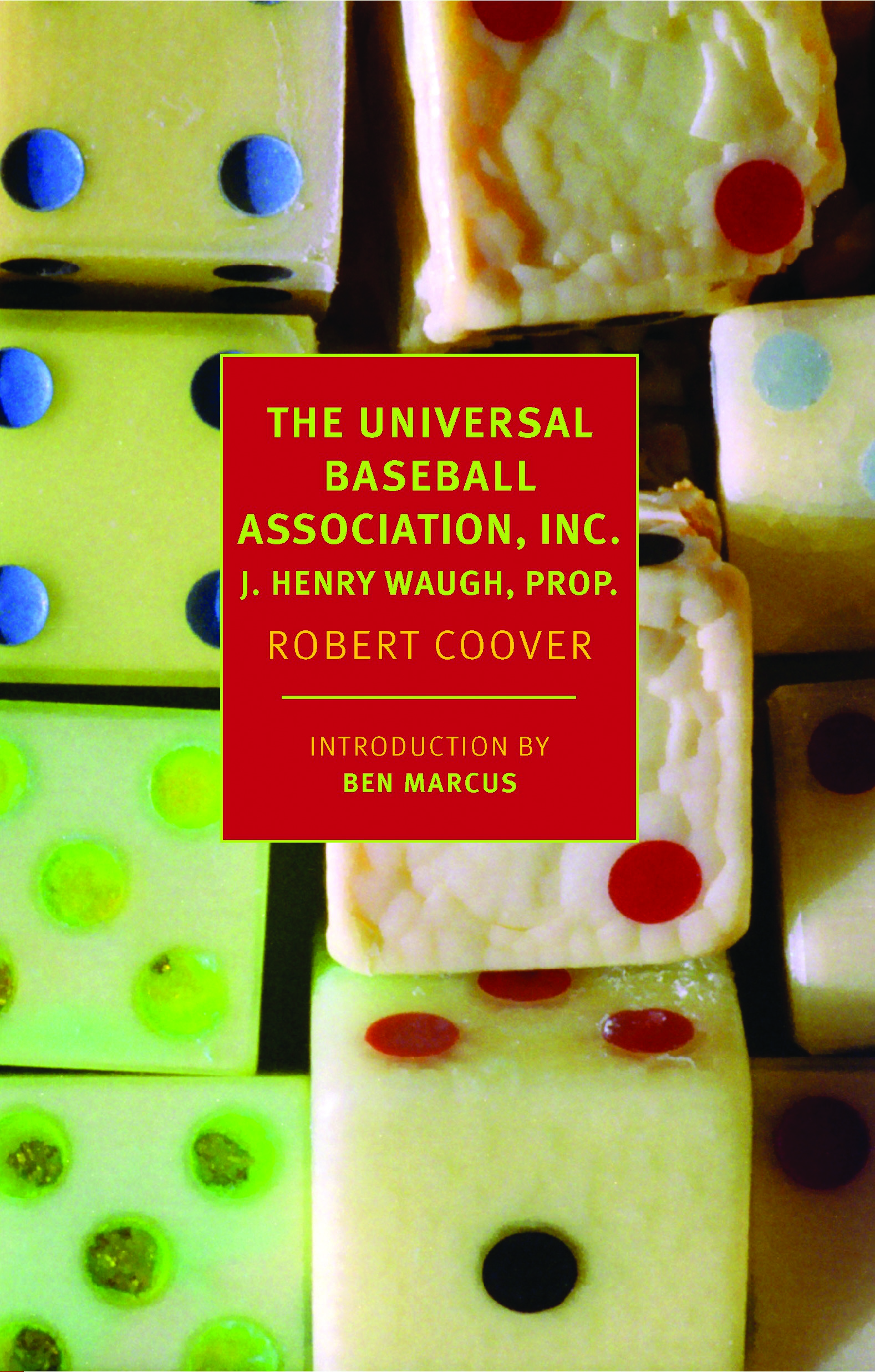
Then there’s Robert Coover’s fever-dream of a simulated league, The Universal Baseball Association, Inc., J. Henry Waugh, Prop. No baseball novel better reflects the paranoias of its moment than this 1968 oddity, which turns the national pastime into a closed system—a paper empire powerful enough to consume its creator. And I can’t think of another baseball novel that features no actual baseball.
Henry Waugh, the novel’s lonely commissioner, is a cross between Harvey Pekar and Walter Mitty. When he isn’t slacking off at the accounting offices of Dunkelmann, Zauber & Zifferblatt, Henry enjoys sipping cognac and listening to country music at Pete’s bar; mostly, though, he spends his nights presiding over the Universal Baseball Association, an imaginary league he administers with the accuracy of a state auditor and the ardor of a minor god. Akin to Strat-O-Matic, Henry’s version runs on dice and data, but what he’s really building is a private universe where statistics ripen into stories, something like Ulysses for drunken baseball nerds.
The novel opens midway through season 56 with a thirteen-page play-by-play of the Pioneers’ rookie pitcher Damon Rutherford throwing a perfect game against the Haymakers. The recap reads uncannily real and ranks among the finest baseball writing ever put to the page. From that opening miracle, Coover widens the lens, crosscutting one week of Henry’s lonely life with the developing drama of season 56 of the UBA. Outside the league, you can count the cast of Henry’s world on one hand. There’s his boss, Horace Zifferblatt, a snakeskin-belted micromanager dubious of Henry’s diminishing productivity. There’s Lou Engel, an earnest colleague who’s permanently winded and impossible to shake. There’s Pete, behind the bar where Henry swills his brandy. And there’s Hettie Irden, a seasoned sex worker whom Henry occasionally escorts home from Pete’s. That’s the lineup. Inside the Universal Baseball Association, however, the population explodes: eight teams, hundreds of players, and decades of lore, all meticulously logged in Henry’s ledger, “the Book,” where “into the Book went the whole UBA, everything from statistics to journalistic dispatches, from seasonal analyses to general baseball theory. Everything, in short, worth keeping.”
Like any good fantasy universe, the UBA begins with the names: Damon Rutherford, the boy with the golden arm, and his Hall of Fame father, Brock Rutherford. Jock Casey, Royce Ingram, Sycamore Flynn, Barney Bancroft, Pappy Rooney, Melbourne Trench, Goodman James, Witness York, among many others. Henry plucks the names from the world around him—billboards, bar talk, newspaper headlines. As Coover puts it, “Everywhere he looked he saw names. His head was full of them. Bus Stop. Whistlestop. Whistlestop Busby, second base. Simple as that.” And again: “The light changed to green and Henry crossed over to his bus stop. Green. Slicker. Cop. Copper Greene. Might try it. Have to jot it down when he got home.” It’s the novelist’s trick in miniature: observation, invention, and revision.
But the association’s fragile order shatters when Jock Casey’s wild pitch crushes Damon Rutherford’s skull during a game between the Knickerbockers and the Pioneers, which forces Henry to face the deadly randomness baked into his imagined world. This is where the novel stops being a crafty baseball book without any real baseball and morphs into a metafictional meditation on creation and control. Once Rutherford dies, Henry inherits the old author’s curse: He must answer for the vast suffering in the world he’s made. Invention is easy to a degree, but living with the consequences of your inventions is another story altogether. How does one atone? If you’re Alfred Nobel, inventor of dynamite, you endow a peace prize; Henry, on the other hand, opts for apocalypse. He gets tuned up on beer, abandons his scrupulous record keeping, and burns through the season’s final forty-nine games in a single drunken Sunday. What gets torched here isn’t just the league’s integrity but Henry’s faith in the fairness of any world, invented or otherwise. Things go from bad to worse. Lou spills beer all over the Book. Henry gets fired from his job. And after a night with Hettie, she refuses his money.
Coover’s darkest flourish comes in the final chapter, when he jumps ahead 101 seasons. The UBA has somehow persisted minus its creator, becoming a self-sustaining symbolic order, complete with rival sects (Damonites and Caseyites), sacred narratives, and ritualized violence, as the players annually reenact the killing of Damon Rutherford on Damonsday. Coover’s closing point remains timely: Once a system accumulates enough story, memory, and stats, it no longer needs its architect. From there, things can get strange fast.
Published in 1968, Coover’s oddball baseball novel now reads like an analog prophecy for our algorithmic age, one about a system that outlives its creator, and about how raw data gets mistaken for myth. Coover knew this dirty secret long ago: Numbers never stay in their lane. Stats become stories; stories become systems, and before long, the damn machine is mowing down its maker.
So yes, football owns the modern American audience, and soccer keeps annexing the future one nil-nil draw at a time, but when it comes to novels, baseball still wears the crown, and Robert Coover’s The Universal Baseball Association, Inc., J. Henry Waugh, Prop. is one of its strangest and shiniest jewels. No other baseball book turns the game so completely inside out and still leaves it feeling truer than the real thing.
Ryan Ridge is the author of New Bad News and the novella American Homes, among other books. Climate Strange, his collaborative collection written with Mel Bosworth, is newly available from Astrophil Press. He lives in Salt Lake City and plays bass for the Snarlin’ Yarns.
