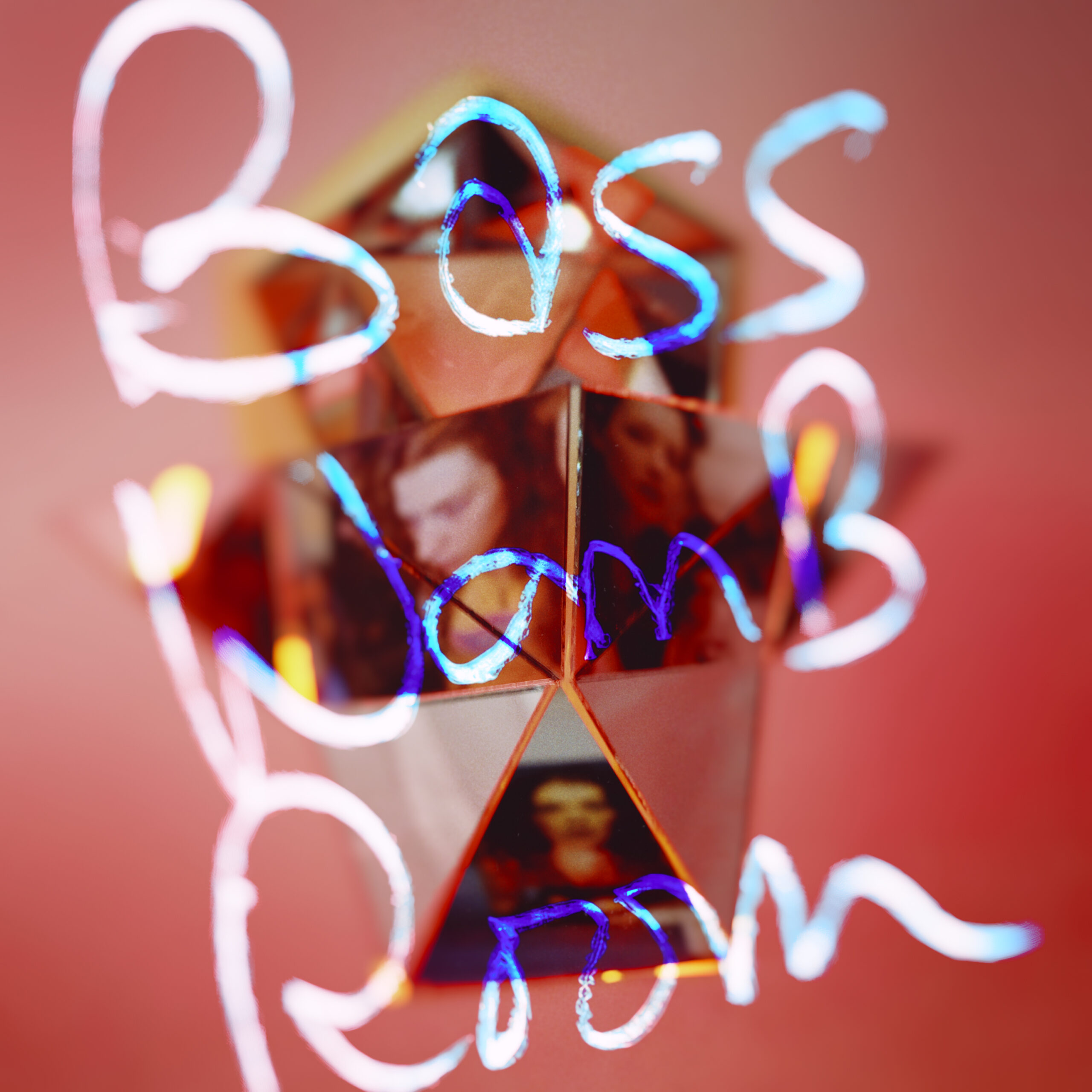
The Guest List is a regular book column that surveys the reading habits of our favorite musicians. In this edition, Elle Nash talks with the former bassist for Hole and Smashing Pumpkins, Melissa Auf der Maur. BASS WOMB ROOM, her first music release in fifteen years, is out September 4 via Envision Records.
Elle Nash: What are you currently reading while on book tour?
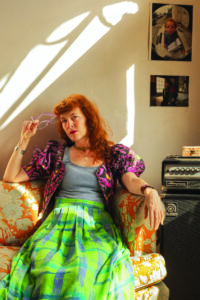
Melissa Auf der Maur: I’ve been doing audiobooks, which is not usually my thing. I’ve been wanting to keep up some reading while lugging from city to city. I’m currently listening to/reading One Day, Everyone Will Have Always Been Against This by Omar El Akkad. He’s an Egyptian Canadian journalist and it’s about Gaza and Palestine. It’s a Middle Eastern Canadian perspective on the history of that dreadful situation, that is I think very hard for most Westerners to wrap their minds around. It’s so many centuries of complex relations. One Day is a very personal way into the subject and the history of his family having to leave Egypt due to an extreme political regime.
What’s oddly personal is the way I even got to it, too. [Omar and myself] along with another hero of mine, whose book I’m also reading, David Suzuki, who is a ninety-year-old lifelong activist [Lessons from a Lifetime: Ninety Years of Inspiration and Activism]—so David Suzuki, Omar El Akkad, me, and Michael Pollan [A World Appears: A Journey into Consciousness] were the top four bestsellers in Canada in the same week. My heart exploded with joy. There I was, this girl telling the story of coming of age, feeling incredibly humbled by the company of lifelong activists who are deeply literary, academic, brilliant.
A lot of my book reflects on the turn of the millennium, specifically around [the transition from] analog to digital and the disgusting corporate tentacles that pulled us out of analog into the monetizing of every human’s minutes. So I was already reading those three books, and I saw myself slipped in there. And it really started making me dream about how artists and women are ambassadors of [these] universal things.
Seeing myself in the company of three men from three different generations: One is a Millennial, one is a Boomer, and the other one is almost like [pre-]Boomer, a ninety-year-old. I was like, “Wow, if I had to keep company with men, these are like the greatest men I could hope to be keeping on a reading list.” I’m very happy to be aligned with beautiful men who need to be celebrated as much as I fight for celebrating women.
EN: Are there any books that you’ve recommended to your daughter as required reading for life?
MAdM: I mean, obviously I would recommend to any teenager Just Kids by Patti Smith, specifically because what was cool about Patti’s short and digestible coming-of-age book is that it made me realize how the ’60s and ’70s were so close to the ’80s and ’90s. Her finding her way to an arts community and her voice, and finding love and complicated relationships—that’s very much the same thing that I experienced. I like that it’s a way in through another generation, to all analog generations. And, because [my daughter] is going to a funny (as in cool) alternative Waldorf School, they don’t do the classics. So one recommendation— even though I’m not a big fiction reader—would be Catcher in the Rye. Even though I cheated on my book report for Catcher in the Rye in high school, and I had a smarter older friend write my book report because I was too busy making music and taking photos. But I would say that book is true to the existential coming-of-age of a teen.
EN: When you were working on your memoir, were there any similar nonfiction books you were reading that inspired you or held a vision in your mind?
MAdM: Most important is that I enrolled in an online writing class with a cohort of twelve women, and we read a memoir a month, so I was reading an insane amount. The book club gave me memoirs of women’s lives that I wouldn’t have otherwise gravitated towards. One of my key inspirations was Hold Still by the photographer Sally Mann. I don’t know if you know, but her work about photographing her children nude was kind of controversial. She also has the most gorgeous memoir where she integrates her photography. Even though I wanted Even the Good Girls Will Cry to be a literary memoir, I didn’t want glossy, ugly inserts—I use my photographic archive and dreamscapes as well as excerpts of my father’s writing. So for me, structuring the book with visual arrangement breaks was very key.
EN: Were there other art books you enjoyed, whether growing up or as you’ve explored photography through your life?
MAdM: I went to art school, so of course I ate art books for food. I mean, that’s all I ever did, was look at them. I have so many books in my house, most of them art books; and the others are nonfiction books that are either esoteric women’s stories, alternative histories of strange countercultures or movements. My interests lie in stacks of books all over my house.
EN: I know, it’s like the knowledge that you want to keep all in one place. I saw you were on a podcast with Pam Grossman as well [The Witch Wave]. I’d love to know if you have any go-to esoteric books that you refer to, whether it’s one particular tarot book or just something that you refer to when you’re like, “All right, we got to do some magic.”
MAdM: What’s funny is that so much of it came early in life, like in college, going to the library and seeking: What is life? How is this working? So for me, it’s really more fundamentals like Carl Jung. I mean, I have The Red Book, but I also have the tiny little Man and His Symbols book. It’s often more about thinking, existentially. It’s about what the lens is from which I’m looking. I was walking down a street in Dublin today and I saw this incredible graffiti drawing of Maureen O’Hara, and I was like, “Oh, that is speaking to me.” That is like, I’m thinking of my heritage, of the myth of Hollywood, and then thinking, how does that tie into warrior goddesses? For me, the magic is everywhere on the streets, and it’s mostly a matter of how I’ve developed seeing the world, believing in signs and in my dreams. A quote I recently read was “The spirit gives meaning to man’s life, but the flesh gives it the warmth without which it would be a mere abstraction.” It’s the idea that we have these spirit things, but they’re just floating in the ether and we rely on our body as a flesh antenna to give meaning, now, here—on the street, in your bedroom, whatever—to that abstract thing called spirit.
I have a cool tarot deck I would love to share—it’s the only deck I use. I’ve been carrying around forever. It’s so beat up, I love it. But it’s very pretty. [Holds up a well-worn tarot card.] She’s the Empress that I pulled for myself a year or two ago. I have a funny thing where I carry an extra deck and pull cards for gifts. I give them to friends to just carry around when I feel like it’s their card, like when I had the opportunity to meet Billie Eilish once and I pulled a card for her.
EN: This year, my partner got me this huge version of The Red Book by Jung. It’s the one that has the facsimile of his illuminated manuscript and has the translation in the back, so I’ve been nerding out on that for the last couple weeks.
MAdM: Oh yeah, of course. I kind of have it just staring at me and then I’m like, “That’s telling me something.” The deck is by this fucking incredible esoteric husband-and-wife team. They’re called Uusi and it’s the all hand-painted “Pagan Otherworlds” tarot. I would recommend it. And it’s supporting an independent husband-and-wife art team that put their visual art practice to good magic.
EN: I’d love to know, were there any literary or bookish influences on your debut solo album or other lyrics?
MAdM: Oh yeah, for sure. Anaïs Nin was a huge one. Again, these are all the formative years when I was in high school and college trying to find myself. Jung and Anaïs Nin are two people that I would just have their books in my pockets and scan them. Her Little Birds erotic one. Also I recently quoted Rilke out of nowhere to an interviewer who was asking me about the secret of relationships. I was like, “Well, Letters to a Young Poet—being the guardians of each other’s solitude.”
EN: I love that you say Anaïs because she’s also a Pisces (like us!).
MAdM: I know, I got it all up here [laughing]. I refer to something in my book that I saw in a really cool interview with her when she was living in LA. I found in the ’90s, on a VHS, a cool black-and-white interview with her that I’ve never found again. I will credit her here because I actually don’t think I credit her in the book, but she talks about the idea of human relationships as constellations. I used that in the book, in the chapter “Trapped in Mythological Webs and Shadows,” and it’s about all of these people, Dave [Grohl], Courtney [Love], Billy [Corgan], all these powerful archetypes that were like these solar systems I was trapped in, and there I was when I was twenty-two, seeing [Anaïs] in some long-lost interview describing how that moment and movement of writers in Paris was. That they were just these people who found themselves in each other’s orbits, and then they learned the power of attraction like that.
EN: When I think of Anaïs Nin as a person that then found herself living in a moment, it wasn’t until years and years later that either she or other people were like, “Wow, that has influence, there’s change that happened there.” And for you coming out of the ’90s and being like, “I’m in a moment” with these archetypes, and thinking about now—sometimes I hear people ask, will there be music or movements like there were in the ’90s, as far as cultural rebellion and what it said about our values? It feels different now the way subculture moves through the world because of social media.
MAdM: I’m excited for you to make that connection because I don’t think I have ever actually connected myself [to Nin] other than I’m a Pisces who was in a cultural moment who kept a diary. So I was like her, chronicling. I photographed every crowd that I ever played to backstage. I photographed everything because I, without realizing it, became an obsessive documentarian of my moment because I could tell we were witnessing something really radical. And I don’t mean just like the music was radical. It was the end of the world as we knew it, the last analog decade. I had to document it because I knew it subconsciously, even when I photographed myself. My first ever show with Hole was at the Reading Festival in front of sixty-five thousand people, which was my seventh concert ever. I went to take a preshow pee and photographed myself sitting on the toilet and I remember very clearly looking through the lens to the future. I was doing this for the future me, the future people, the future you, other generations that would be wondering what happened during that time, not because we were that special, but was that music amazing? Yes. Was it visceral explosion, zeitgeist power? Yes, but it was a movement.
What I’m afraid of in the post-analog world is, how can you create authentic movements? When I’m asked about [what] the power of any art, writing, film, is, it’s the power of local movements. In real-life movements. If you don’t support your local independent bookseller or your local writer or, of course, your local venue and your local cinema and your independent moviemakers, we’re fucked. That’s what we’re losing with the corporate takeover of the digital world. We’re losing the power to have a movement. I know there’s gained communication, but you can’t do it without real-life passion, connection.
As I’ve been telling my fourteen-year-old daughter and her friends. And they now say it as a joke, like, “Melissa, River’s never going to fall in love because she’s on her phone.” I’m like, “It’s true. You can’t fall in love on a phone.” I’m concerned we will forget, in our fractured texting and emailing. Prior to this I was writing in my journal, so I could remember walking down the street in Dublin and seeing a cool piece of graffiti that made me think. I saw this larger-than-life James Joyce quote on the street today, which is “History is a nightmare from which I am trying to awake.”
I hope with all this fractured information that the youth will find long-form culture, movies, not YouTube shorts. Books, not a post on Instagram. Albums, not just singles and a song. Long-form attention, long-form experience and journeys. Deep journeys, not fractured blips.
Melissa Auf der Maur is an acclaimed musician, photographer, curator, and producer, best known as the former bassist of the rock bands Hole and Smashing Pumpkins. In 2010 she cofounded Basilica Hudson, a multidisciplinary art center in Hudson, New York, where she lives with her family and magic cats.
Elle Nash is the author of the novels Deliver Me, Gag Reflex, and Animals Eat Each Other, and the short story collection Nudes. Her fiction has been nominated for Scottish Book of the Year at the Saltire Awards, and her screenwriting has been an official selection in the Torino Film Lab’s NEXT Feature Program. She lives and teaches in Glasgow.
