Majoring in Minor Perspectives
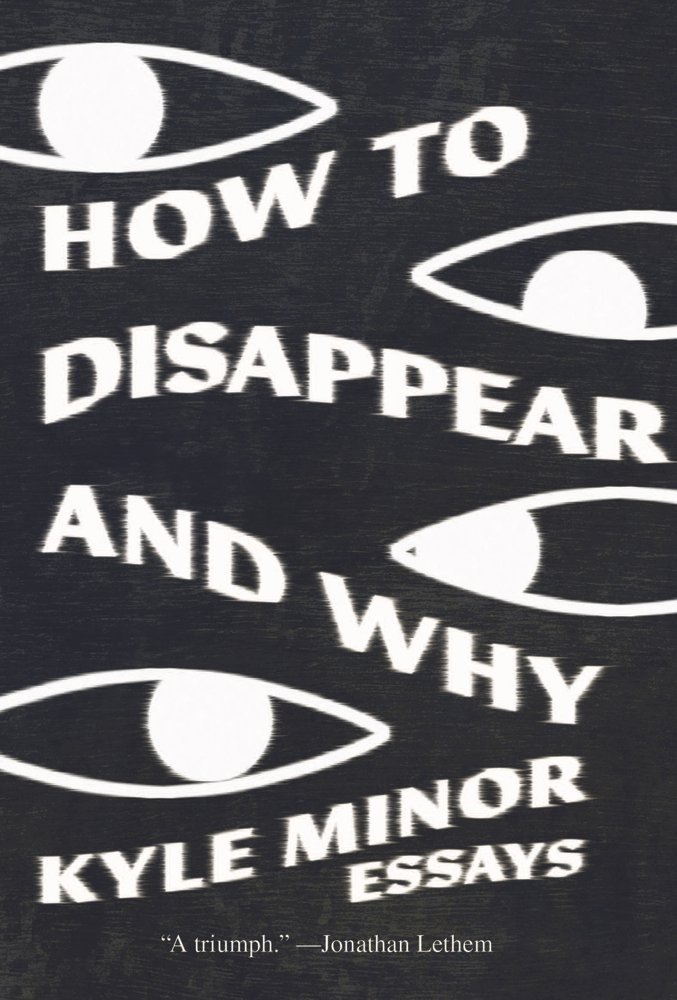
Should this review be scrawled in invisible ink? Should it self-destruct? Will you self-destruct when your “secret life” is uncovered? Like many books of literary substance, the essay collection How to Disappear and Why by Kyle Minor (Sarabande Books, 2026) is a catalog of questions. Which spurs even more questions: Can you ask so many questions that you force your own thoughts to disintegrate? Can you ask yourself into oblivion?
Deftly incorporating lists, letters, strikethrough text, metanotes on previous essays, and other unconventional structures, Minor weaves a scenic cost-benefit analysis of leaving your own life while revealing bits of his own. I must admit, the strikethrough text in this book piqued my curiosity, made me read more closely. He sprinkles in the second person, which, especially with nonfiction, can be a vehicle for immersion, empathy, and attention. Because we, the audience, might not want to hear about it if it’s not about us. Minor knows that, yet his essays from this POV are anything but manipulative or pandering. And there’s definitely that whole gestalt thing happening with the book, even though each essay can and does stand on its own.
In one of the numerous openings of “On the Desire to Reject Narcissism” (an entire essay of openings), Minor clearly lays out our troubles: “I would like to open with the supposition that it’s possible that the origin of suffering lies in the fierce need to be seen.” Attention is a double-edged sword; ask any washed-up child actor. Wanting to disappear stems from both a yearning to go unnoticed and a yearning to be noticed. Maybe there’s a reason wanting and waning are almost the same word. Either way, disappearing is all about you. Ghosts are always hungry. (Seriously, where have all the satiated cowboy ghosts gone?) You disappear because you’re tired of feeling, but in your wake you leave tsunamic waves of emotion for others that hurl them directly into the undertow. There’s a community or a family or a job that would benefit from your presence—even if they would also be irrevocably harmed by your presence—and you are unable or unwilling to give them yourself.
But some disappear because they’ve already made too much of a mark. “No less alive for being dead,” an afterimage remains. The author is clearly and beautifully grieving such a loss in “A Theory of Ghosts.” Disappearing can make people forget about you, or it can make people obsessed with you, depending on your situation. And, perhaps most twisted of all: Some people turn up the spotlight on themselves as a way of disappearing without really disappearing. To control the narrative. To become someone else entirely. “Grab all the control you can, then let go the illusion you have any control.”
Still others (mostly writers) are unintentionally invisible. Their unique ideas, public readings, and published works appear to disintegrate in real time. Minor is willing to delve into both his highs and lows as a writer in his culminating essay, “The Sickness and the Song.” It appears that humans are well past information overload, and a whisper is heard more than a shout. We have to love writing for its own sake or we will perish.
So how can you tell when someone has truly disappeared? If they do it the right way, maybe you wouldn’t even be able to tell at all. Or maybe it would be like the prison escapee Minor mentions who has a $2 million fugitive bounty—the only woman on the FBI’s Most Wanted Terrorists list. This book certainly leaves it to your interpretation.
If Minor is making an argument, it’s that perhaps instead of grasping at disappearance, humankind is grasping at transcendence. For him, as he describes in “Junk Temples,” that means art. Color. Synesthesia. Altruism. Putting oneself in the position to be led into transcendence, but not forcing it or it, too, will fade. Running away from something only really works if you’re running toward something else.
Never are these underlying intentions more artfully juxtaposed as with Jan Karski, the Polish soldier, resistance fighter, and World War II diplomat (featured in “Hiding in Plain Sight”) and Donald Crowhurst, the swindler, con man, and amateur sailor (featured in “The Sickness and the Song”). Because you can disappear, but “you can’t separate the heart from the body.” You can disappear, but you can’t escape your own mind. Which means your own fire escape could be your own trapdoor.
Perhaps Minor’s most noble quest of all is his attempt to face the “monstrosity of unchecked human nature” from a place of understanding. From a place of knowing that, under the right circumstances, it could be him. It could be me. It could be you. There’s a sickness latent in the I, Minor explains. Our ownership of the inner monster is the only factor that can prevent its unleashing. And it’s the one thing we can’t make disappear.
Claire Hopple is the author of seven books and a fiction editor at XRAY. Her stories have appeared in Southwest Review, Wigleaf, Forever Magazine, Little Engines, Cleveland Review of Books, and others. She lives in Asheville, NC. More at clairehopple.com.

More Reviews