A Portrait of a Fuckup as a Young Man
In Robert Earl Keen’s 1993 song “Corpus Christi Bay,” the narrator reflects on a life wasted. He works the oil rigs with his brother, and they raise hell on their time off: “We were bad for one another / But we were good at having fun.” When his brother’s wife leaves him, the brothers take their revenge by dumping her possessions into the water—a mix of casual cruelty and general loser behavior. At the end of the song, it’s revealed that the narrator’s brother moved to Houston, got remarried, and quit drinking, but, on a visit home to Nueces County, still buys the narrator (presumably still a washout) a beer.
The song, one of Keen’s best known, resonates with his fans globally: There are no-hopers everywhere. But this is Texas, where even our fuckups seem bigger.
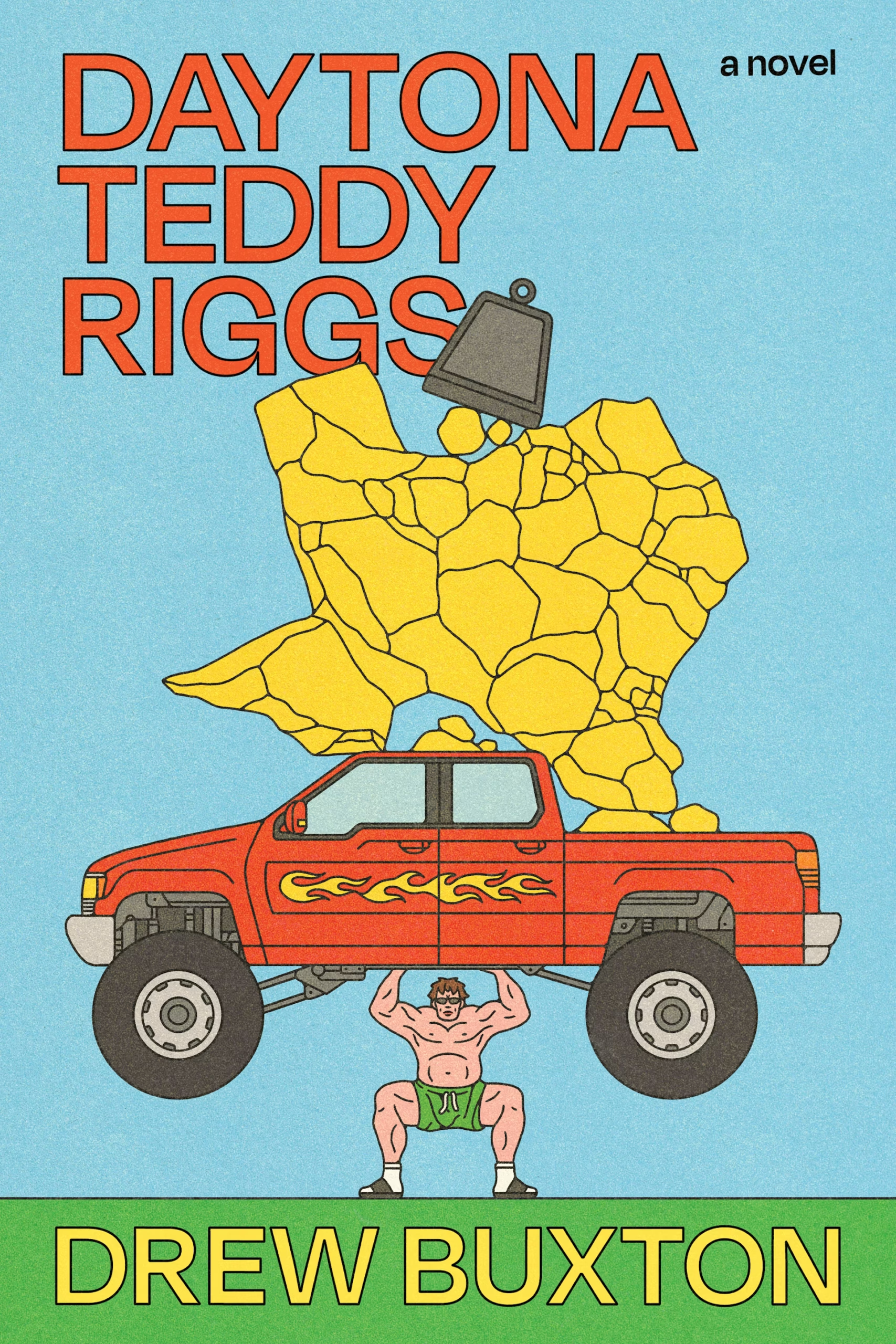
The title character of Drew Buxton’s novel, Daytona Teddy Riggs (Hub City, 2026), isn’t exactly the same brand of loser as Keen’s narrator, though they share a hometown and a penchant for making poor decisions. Teddy’s addiction isn’t alcohol, it’s athletic training—if you can call it that. A former high school football star, he now aspires to win the World’s Strongest Man competition, and his path involves steroids, binge eating, lifting weights, and alienating just about everyone around him.
The novel is set in 1996; as it opens, Teddy (he gets his “Daytona” nickname from being fast for a man his size) is scrimmaging with some middle-school kids playing football; he sees it as an act of generosity, the children’s coach sees it as trespassing. Teddy sacks a young quarterback who feels the hit bad, and Teddy finds himself answering to the police.
We quickly learn Teddy’s backstory. The twenty-four-year-old scion of a wealthy gas company family, he was a standout defensive lineman in high school and played some college ball in Lubbock, but he didn’t last long. “More and more, I get why it didn’t work out at Tech,” a gym owner tells him. “All the talent in the world, but you’re just such an asshole.” Teddy, who slowly reveals himself to be a word-class delusionist, doesn’t see it that way: “I could play in the NFL if I wanted to, but it’s not my calling. The thing with football is you could be the best player God ever put on Earth, but if the man next to you doesn’t do his job, you could still lose. The running back could fumble. The receiver could drop the ball. I don’t wanna rely on anyone but myself.”
But self-reliance is a problem for him too. He depends on his grandmother for housing and food after his parents cut him off following a failed intervention at which they told him they were worried about his lifestyle. His plan to earn a living is twofold: He’ll win the World’s Strongest Man competition, yes, but he’ll also make money off “a business where you call a number and tell them what movie you want to see, and we go and rent it for you and deliver the VHS from Blockbuster. We bring any candy or popcorn you want too.”
He just needs an investor. His parents aren’t interested, however, and he has a habit of burning bridges wherever he goes. He’s banned from the gym he works out at after, in a fit of rage, he hurls a ten-pound weight at someone. He manages to finagle a job as a bouncer, but ghosts it after an attempted hookup proves humiliating. And in a fit of financial desperation, he steals a charity jar intended for St. Jude Children’s Hospital from a supermarket, making no attempt to conceal his identity.
So it’s off to Houston, where the Gulf’s Strongest Man competition is being held, with a fellow weightlifter named Tammy—the woman who has taken his virginity, though she sees him less as a boyfriend than as a kind-at-heart charity case. Teddy has another reason to visit the city: He’s attending a multiday seminar by Pat Dupree, a motivational speaker who Teddy reveres. But Teddy still can’t control his anger, can’t curb his self-destructive impulses, and things, of course, go wrong.
It’s easy to be frustrated by Teddy, who narrates the novel with periodic hints of self-awareness. He knows he fucked up tackling the young quarterback. He knows he fucked up stealing the money. “Fucking dumb, stealing from kids with cancer,” he admits in one of his many self-flagellating moments. But then the delusion of future grandeur kicks in: “I’m gonna pay it back as soon as possible, as soon as I get the Gulf’s Strongest Man prize. I’ll donate it to St. Jude’s. I’ll donate double what I took!” He doesn’t consider the possibility that he’ll fail. “I don’t think that I’m going to win World’s Strongest Man. I don’t hope I win,” he clarifies. “I know every day. The reason I know is because of the work I put in.”
You may think he’s the perfect lab-grown specimen of someone to root against. But it’s not so simple. In Teddy, Buxton has created a character who somehow almost endears himself to the reader. He knows he’s a screwup, knows how keenly he disappoints others, and hates it about himself. At the seminar, he thinks, “We talked about how everyone is lovable, but maybe that’s a bullshit story I’ve been telling myself. Of course not everyone is lovable. There are tons of fucking scumbags out there.” The implication is that he counts himself among their number.
He is a person in immense pain, though he would never put it that way, and Buxton doesn’t set himself up for an easy go of it by choosing to write the novel in first person, handing the microphone to a narrator who initially screams “unreliable.” But at no point does one get the impression that Teddy, flawed in so many other ways, is being dishonest in his narrative. He openly talks about his self-harm via cutting, though he doesn’t know why he does it. His relationship with food is disastrous: In one of the novel’s most heartbreaking scenes, he eats two pizzas in his truck, ashamed to do so in public: “They look at me, and I hear them giggle, or little kids will stare, and it’s embarrassing for everyone. Granny’s the same way, calls me a fat pig. She thinks I actually enjoy force-feeding, like I’m eating just to eat. It’s all about getting as many calories down as fast as possible.”
It’s not easy to maintain this kind of narrative, but Buxton does it expertly, alternating deftly between Teddy’s bursts of confidence and self-hatred, creating a convincing portrait of a young man who doesn’t realize the extent of the crisis he’s in. Buxton’s decision to set the novel in 1996 is a good one—Teddy must reckon with his own toxic masculinity in an era when men’s struggles with mental illness were more stigmatized than they are now, and when incels and “men’s rights activists” weren’t able to poison the culture by flooding the internet as effectively as they are now. A 2026 Teddy might have fallen in the thrall of Tate-adjacent influencers; as it is, Teddy thinks, “Women are just distractions, obstacles standing between me and my goals. I read that somewhere.”
Buxton, crucially, gets South Texas right, nailing the culture and vocal cadences of the region: “Sometimes I think you forget how goddamn big you are,” a police officer tells Teddy. “I remember when y’all were in the district championship, ’88 or ’89, it must’ve been. Fourth down, the QB drops back, and the guy is open. I thought Tuloso [High School] was done, then out of nowhere here comes big ol’ Daytona off the edge to get the sack.” The references to the Cowboys, the Aggies, the Whataburgers and H-E-Bs aren’t just window dressing; Buxton is able to ground the novel in a real place because he knows the culture of the state intimately. The result is one of the best Texas novels to come around in years.
Teddy is an unforgettable character, and a reminder that the epidemic of untreated mental illness was around well before armies of armchair psychologists were on the internet ready to diagnose strangers based on a single social media post. He’s a broken man barreling toward further ruin, unable to get help because he doesn’t know he needs it. Glory days never last, and some people—in Corpus, sure, but everywhere—are good at having fun, until they aren’t.
Michael Schaub is a member of the board of the National Book Critics Circle. He lives in Georgetown, Texas.

More Reviews