Sight Unseen
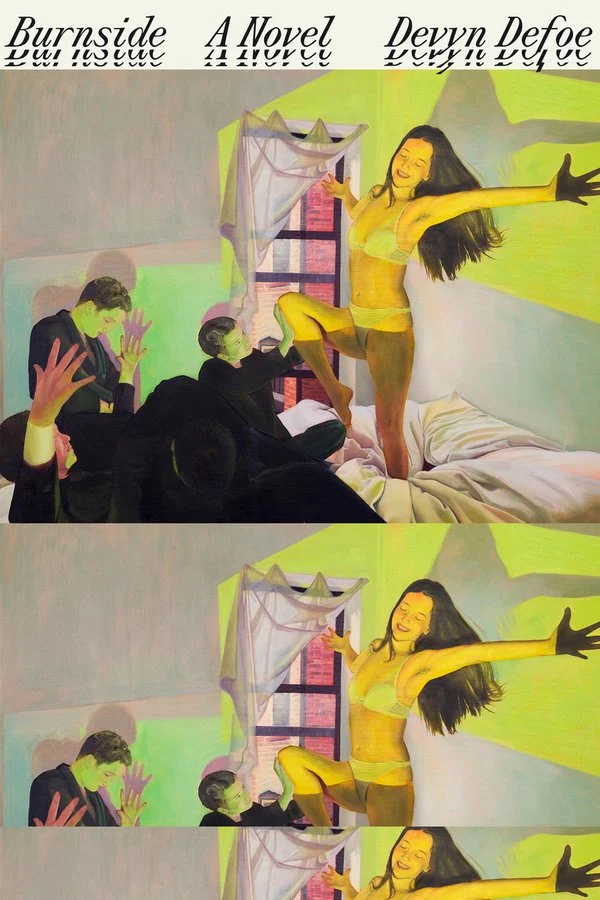
“I want to change my place in the world entirely,” Kafka wrote in his diary, “which actually means that I want to go to another planet; it would be enough if I could exist alongside myself, it would even be enough if I could consider the spot on which I stand as some other spot.” Were he still alive, Kafka might have found solace in the words of Simp Carl from Devyn Defoe’s debut novel, Burnside. “What you have to realize,” Simp Carl says, “is that people are all the same. Or if not the same, at least similar enough to swap out for anyone else.” Kafka could change his place in the world entirely by swapping spots with Simp Carl. It doesn’t matter that Kafka is dead. Simp Carl’s girlfriend, “the cinephile,” is dead. Her body was found washed up on the shore of the river that runs through “the bowl,” a somewhat fictionalized Sacramento where Burnside is set, during wildfire season. Hers belongs to a growing number of “riverside deaths” that worry locals. Simp Carl seeks solace in the knowledge that she “slipped into a dimension that isn’t any more dead than this one. . . . Her death wasn’t her disaster but ours, and our deaths are hers.” At least, that’s the story he tells himself.
Burnside is full of homemade ontologies of the self and other stories characters tell themselves and one another, as sifted and retold by the novel’s unnamed narrator, a self-effacing and rather fatalistic young woman who works at a used bookstore that doubles as an event space to stay in business; few people in the bowl read books. Burnside begins: “The man, September told me at the start of it, was not all there in the head, had a screw loose, a shifty disposition, not unlike the feral children in the outskirts beyond the outskirts who had no grandparents or conception of death.” September is the narrator’s roommate, best friend, and a waitress at a “breastaurant” where she’s named “Girl of the Month” for September. She tells the narrator that the man with a screw loose scratched “three rickety lines across her arm, deep enough in some places to bleed, in others, barely a line.” The man, they find out, is Burnside, a local homeless man who buys books from the used bookstore where the narrator works. Throughout Burnside, September retells the story of her encounter with Burnside to different characters, and each time she does, she tells it differently; the details shift. Eventually, residents of the bowl, specifically Christian baristas who’ve turned Burnside away from their cafes (contrary to Matthew 25, “I was a stranger, and ye took me in”), elect Burnside as their Leviticus 16 scapegoat du jour. When one barista identifies the corpse in a police photo of the most recent river death as the corpse of Burnside, word spreads like the summer wildfires that poison the bowl’s air, and the baristas festively hand out free, day-old pastries (contrary to Proverbs 24:17, “Do not rejoice when your enemy falls”). But the barista is mistaken. The police photo is really of the narrator’s ex, a homeless drifter named Donner. Homeless people’s corpses, if not the same, are at least similar enough to be confused.
That Burnside portrays a man like Burnside makes it an unusual American novel. Homeless people matter to the average North American novelist today as much as servants did to the average English novelist two centuries ago. It would not be unreasonable for a literate alien whose knowledge of the USA derives solely from novels like The Corrections to presume that the issue of homelessness, like free will, is mainly fodder for abstract thought. These novels don’t look away from homeless people. They don’t see them in the first place.
Donner at least had the luxury of owning a car to call home. In his car he read the likes of Baudrillard. Before he disappeared without a word from the narrator’s “rotation of nights,” he told her that reality is a “simulation,” nothing more than “a brain’s useless attempt at distinguishing itself from the exterior wound.” At the time, his words dazzled her. Now she understands that Donner, like other men, desired from women “a surface onto which to project” himself. The last time she saw him was at Simp Carl’s place. Donner was “drooped over the sink in an unlocked bathroom. He looked at me, but he didn’t seem to see me. He had no idea who I was.”
There are about thirty characters in Burnside, if you include relatively minor ones. The narrator pays the most attention to September. The two resemble each other so much that once, before the cinephile died, she got them confused. Yet although Burnside’s many characters resemble and reflect one another in many ways—the novel calls to mind a hall of mirrors—each character is too distinct for readers to confuse. Claudia Thursday, for instance, is a vegan who loves trees more than humans and resents the prevalence of woodworkers. One day, she impulsively marries a stranger who claims he’s a pilot. On their honeymoon he admits he is not, in fact, a pilot, before paying for an old Guinness Book of World Records with a Yu-Gi-Oh! card, as newlyweds do, and then introducing his new wife to six of his seven children, all feral. Another character is “the psychic overrun with sick cats.” She adopts sick cats, studies “veterinary astrology,” believes her “psychic gifts” incur cosmic penalties, and presumably has schizophrenia. Then there is Landlady Dorothy, a serial killer who poisons her tenants and buries them in the yard, evades the police by excusing herself to buy a coffee from Starbucks, lives for a time in a boardinghouse, steals mail from mailboxes, and briefly involves herself “in a new jazz scene in Atwater Village” before a saxophonist recognizes her and calls the cops. Now the district attorney is seeking the death penalty. Sid Julius, in contrast, kills only rabbits. To fish he’s much kinder. At home he keeps his TV on so the fish in his aquarium “don’t get lonely.” He claims their favorite genre is anime. He learned to read late in life because his parents, who homeschooled him, had bigger priorities, namely hot-air ballooning. They came from a proud lineage of “competitive balloonists.” There’s no evidence that Sid Julius reads for pleasure, but if he did, he might enjoy Burnside. Defoe floats from place to place, scene to scene, and character to character, like a hot-air balloon. And her prose would not be a fish out of water in an aquarium: Her long sentences levitate like jellyfish.
Existence, according to Burnside’s narrator, demands “attention and participation” in return for “a flammable sense of personhood.” She excels at paying attention. After polite burglars rob her apartment and steal everything but a few extension cords and similarly undesirable things, she remarks, “It was as if a gust of Martians had lassoed away the moon.” But she’d rather be a fly on the wall than participate. She’d rather be a wall. At a bar peopled by men watching “with robotic interest” an unimportant basketball game on TV, “I was reassured by the way I was absorbed into the room, noticed but ignored as a piece of inaccessible furniture. . . . Strangers looking in my direction sensed a wall that precluded further interest or deflected attention with the thought of efforts more taxing than their worth.” The narrator hates herself in “personal ways” and offers herself in “pieces already detached, discarded, impervious to further destruction.” She’d be a person on whom nothing is lost were she not so opposed to being a person.
Yet even a hawk on the hunt will inevitably eye its own reflection. The narrator can’t entirely avoid eyeing hers and consequently suffering an insight she’d like to unsee. Here she is in a hospital-bound cab beside the psychic, who has miscarried, being (reluctantly) driven past bar patios full of people not wearing masks despite the nearby wildfires: “They seemed to be enjoying a mute quality to the day that didn’t register in the panic of the car, but existed in the outer world shelled off from us by beautiful walls, white-bricked and very high, and if I thought about it more, the walls were the reality of another life versus the reality of mine, an idea that made me so dizzy I had to press it out of my head.” Reality is not a brain’s useless attempt at distinguishing itself from the exterior wound.
An insight the narrator does not try to unsee is that her best friend is a good friend because she is a bad friend:
Did [September] know I was depressed? I knew everything about her life, I had thought then. . . . All the while it didn’t pass my notice that she never asked me questions about my life, as if I ceased to exist when she was not there. Maybe I should have been offended, and sometimes I was, but September’s pathological disregard offered me what no other friendship could, a reprieve from myself, the erasure of the months I’d felt worthless and lonely. I kept all that to myself, and suddenly, in the reflection of someone else, I was not. Instead I was laughing.
Due to these and other epiphanies, welcome or otherwise, Burnside is among other things a bildungsroman.
A few characters in Burnside could be the protagonists of a Künstlerroman, if it were titled something like Small Fish, Small Pond, or A Portrait of a Young Artist Who Is Mediocre at Best, or, for that matter, Give Up. Simp Carl is a “noise musician” who lives in a “dingy hovel.” September’s boyfriend, a bad DJ who wears glasses without lenses, can’t DJ because he broke both arms in a motorcycle accident. The narrator’s “technically homeless” current boyfriend, “the actor,” couch-surfs from gig to gig. The only steady gig he finds is a role in propaganda videos for a “prominent alien cult” that claims humans aren’t humans but “extraterrestrial souls incarnated into a human experience.” The videos are filmed in the desert. The actor’s job is to “convincingly believe in aliens.”
What the narrator likes most about the actor is his ability to consider the spot on which he stands as some other spot, “how easily he could change into a different person.” Otherwise, she doesn’t like him very much. All his ideas are “bad.” Not coincidentally, he’s an optimist. He tells the narrator that famous actors belong to the alien cult, and that “one of these prominent alien souls would watch the videos of him believing in aliens, and discover his singular talents, and this would be the start of his storied career.” One way to look on the bright side is to look well beyond stars. Without NASA technology, this requires furrowing your brow, and there are few things the actor loves more than a furrowed brow. He vaunts “brow theory.” This is the theory that eyebrows are interesting. Eyebrows, he explains, “act as a tool, but also a frame; they define the lines of the face but they’re malleable, they’re the walls with the most flexibility.” He wiggles his brows until the wiggling becomes habitual. “Brows wriggled into all his moods, authentic and put-upon alike. He wiggled them when he asked me about my day. He wiggled them when I caught him up on the major events.” There’s no evidence that the brow-wiggler reads.
The narrator’s job at the used bookstore wouldn’t be a “scam” if people bought books. The few who do tend to prefer “dog books,” meaning books told from the point of view of dogs that accomplish heroic feats humans can’t because humans aren’t dogs. Claudia Thursday’s favorite dog book, for instance, is about a pilot dog, raised by birds, who has a “sixth sense for navigation,” unlike the fake pilot she marries. The narrator reads dog books also, though not for pleasure. She reads them to spite her boss. “When he saw I was reading a book by an Elena or a Nathalie or an Annie or a Clarice or a Marguerite,” the narrator tells us, “his mouth flattened. He’d pretend at interest; he’d ask what’s that about, all the time thinking I’d say something womanly—motherhood or gossip, maybe even menstruation.” Ew. Why read My Brilliant Friend when you could read “Fyodor,” as her boss calls him? (The same publishing house behind Burnside recently published a novel that would make the narrator’s boss yearn for the underground. It’s called The Oldest Bitch Alive.)
Burnside, for his part, reads a faux-leather copy of the King James Bible that he purchases from the narrator’s workplace and carries “as if it wasn’t bound in plastic but the leathered body of Christ himself.” On two other occasions he buys War and Peace and its equal, Zen and the Art of Motorcycle Maintenance. “This is an excellent book about Lucifer,” Burnside says to the narrator upon purchasing the latter; “we can’t outrun Lucifer,” he says, “but I’m learning about him so at least I can stay one step ahead.” But it’s hard to stay one step ahead when you don’t have a place to rest and, as September’s ex-boyfriend, “the thinking man,” thoughtfully explains in one of many moments in Burnside that evoke Twin Peaks, the “very real and not-a-lie devil” is a “restless traveler” who “sees in everyone a passenger for his deeds.” Nonetheless, the thought of murdering Burnside appeals to the thinking man. The narrator doesn’t think he should do it. But what can ya do? She’s just one person. Late in the novel, when the narrator, alongside September, watches the thinking man, Simp Carl, and the DJ cross the street in pursuit of Burnside:
A scream rose in my throat but suffocated upon departure. One by one they surrounded Burnside, stilled in the eye of the storm, who looked first confused and then scared and then, searching for an anchor in the spinning tangle of men, found us girls where we stood in the gloom. When he recognized me, he waved.
She doesn’t wave back.
Gavin Thomson’s fiction, criticism, and interviews have appeared or are forthcoming (in print or online) in Tin House, BOMB, Southwest Review, The Walrus, and the Canadian anthology After Realism: 24 Stories for the 21st Century (Véhicule Press). He is at work on his first novel.

More Reviews