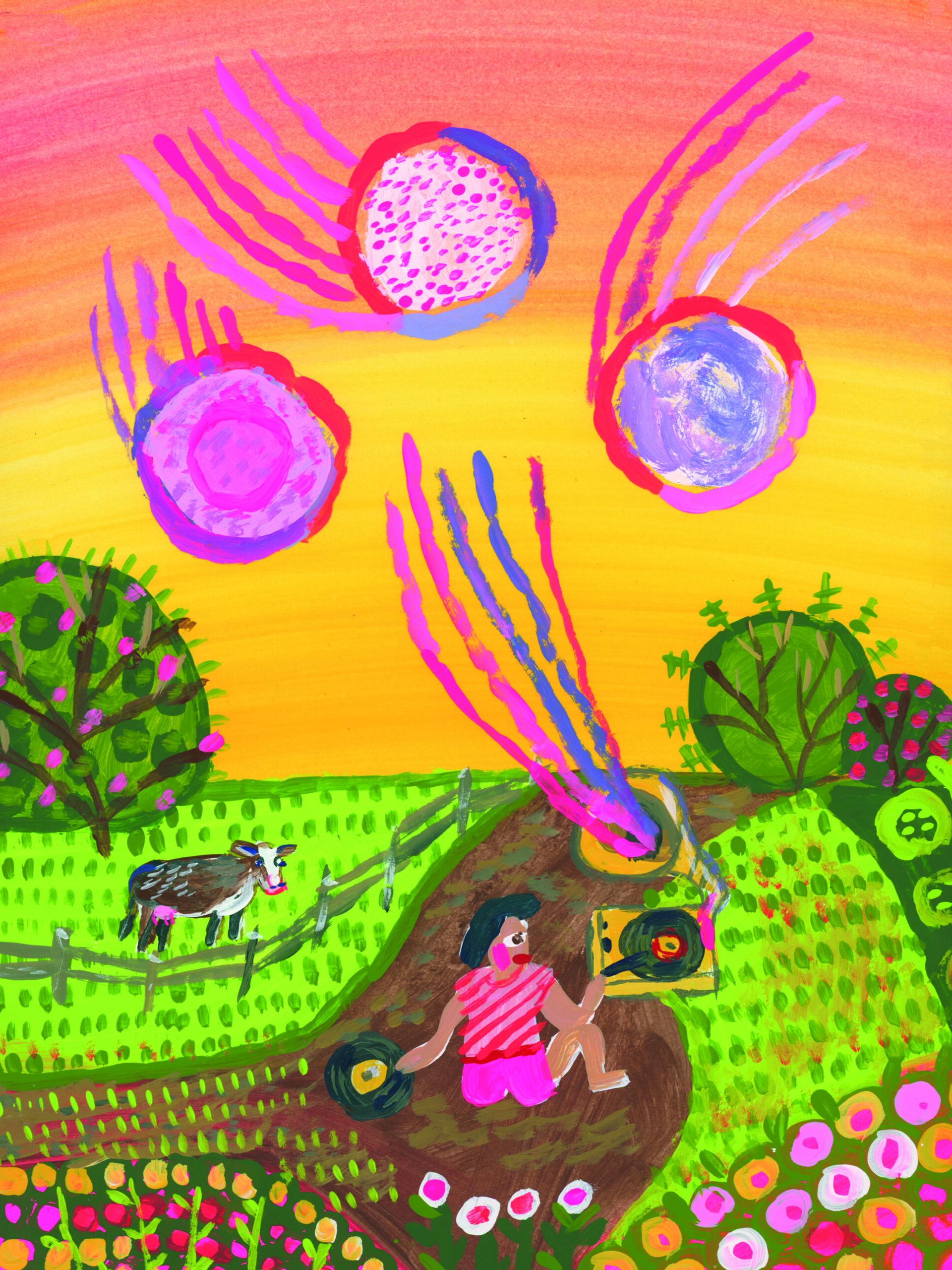
I grant a certain pride of place in my well-stocked inventory of troubled predilections and ill-advised affections for American folk music. Shape-shifting and unstable, filled with tales of the rough-and-tumble life or the road and its crossings; trains, travels, lovers, and the broken promises of God and Devil alike; metal guitar strings and raspy voices and version upon version of the “Battle Hymn of the Republic” and “Black Is the Color of My True Love’s Hair.” I’m not sure why—it’s not my music, not my tradition or even my language—but ever since I can remember, American folk has held me.
Of course, the notion of folk music is itself a fiction. What the so-called folk revival of the 1960s understood as folk took shape in Harry Smith’s 1952 six-LP Anthology of American Folk Music, in magazines, and in the catalogue by the Polish American Jew Moses Asch of Folkways Records, themselves inspired by and built upon decades of anthropology and “comparative musicology” research (and, Pete Seeger claimed, the encouragement of Albert Einstein). Those recordings made in the early decades of the twentieth century had, in part, congealed the lie of America’s complete colonization, of extinct Native Americans ambered in sound and of a vanishing Black sharecropper class in the South.
The folk music I hold most dear is predictably, precisely, that of the folk revival, its biggest stars—Bob Dylan, Joan Baez, Peter, Paul and Mary, John Fahey—more songwriters and artistes than the vagabond, Depression Era troubadours they admired. The music of outraged inheritors buoyed by managers and recording contracts, not W. E. B. Du Bois’s “sorrow songs” or borderlands ballads. What attracts me most is, I think, the romance of an era I don’t remember and that is itself driven by nostalgia. Was a forgotten music being revived, or the lost suburban souls of the cafés searching for meaning?
Both my homeland of Argentina in particular and Latin America in general are also rich with folk music. Its stars—Mercedes Sosa, Violeta Parra, Atahualpa Yupanqui, Víctor Jara—are global icons, even if none earned a Nobel Prize for Literature. Latin America and its nations are, of course, fictions, and much like in the US, folklore largely extracted from Indigenous and Afro-descendant peoples became an engine for their invention. In fact, the two are inseparable, with Latin American folk song central to the development of US folk and the US’s folk revival and its musicologists integral to Latin America’s own. Folkies across the continent were dreaming the ’60s dreams of the counterculture and the new left. Folk music was central to their search for “the people.”
But the new-left project was exterminated across the continent as dictatorships dismantled society’s networks of solidarity and took folk’s thrill with them. But folk’s deep relationship to all genres of contemporary music—from Leoš Janáçek and Stravinsky to Elvis, Alvin Ayler and beyond—grants it enduring power. Numerous contemporary artists have taken inspiration from folk and reconfigured it for our time, reinventing the invention anew. The most notable such case in the past decade, for their originality and depth of reference, may be Los Thuthanaka— siblings Joshua Chuquimia Crampton and Chuquimamani-Condori, members of the Great Pakajaqi Aymara Nation, whose ancestral territory lies in present-day Bolivia. A hypnotically scrambled, strikingly original self-titled debut album, available only on Bandcamp, shot them into critical darlingdom when Pitchfork named it the best LP of 2025. Their sound, somewhere between the ’60s Bolivian folk of Los Kjarkas and the hyperpop of 100 gecs, attests to an apparent contradiction: born in California but rooted in the Bolivian Altiplano, inspired by Luzmila Carpio and Hank Williams Jr., huayno and Timbaland, with a touch of My Bloody Valentine.
We are not living through another folk revival, even if the genre’s delight in supposed authenticity lives on. But the songs of Los Thuthanaka—and the siblings’ solo projects—follow in the decades of travel from the North to the South and vice versa, in the borrowings and love and theft and shared inspiration that fueled those decades. It inherits a long tradition of artists using collective, authorless musics to their own ends, at once a betrayal and an extension of what came before. Then, are Los Thuthanakas making authentically Latin American music, or American music? What’s the difference in our hyperglobal age? Does it matter?

The traditions and musical forms that constitute Latin American folklore, in their vast diversity, precede both individual nations and the idea of Latin America. But those practices have been made into a mythical sine qua non, an origin point for the identity of nations and a region troubled by newness, poverty, and inequality. To invoke indigeneity, in a sense, was to touch the people and, with them, the possibility of stable identity.
In The Invention of Latin American Music, the historian Pablo Palomino situates the notion of a unified or definable Latin America at the turn of the twentieth century. In those years, writers, scholars, and intellectuals like the Cuban revolutionary writer José Martí and the Mexican writer and politician José Vasconcelos described a singular Latin America stood athwart both Europe and North America. The concept of Latin America, developed in the mid-nineteenth century by a Chilean exilee in Paris according to Mauricio Tenorio-Trillo’s Latin America, was opposed to Hispano America, which included the Iberian Peninsula, or Pan America, which included the United States and Canada.
Before the 1930s, musical forms and practices in the continent were transnational and subregional, local and diffuse. Tango, for instance, was not Argentine or Uruguayan but Rioplatense, formulated in the exchange of people and practices between Buenos Aires and Montevideo. Cuban genres like the rumba, son, and danzón traveled the continent to New York, Los Angeles, Colombia, and beyond. Huayno traveled the Andes for centuries. Mass migrations from Europe to the region, from the country to the city and across Latin America accelerated cultural intermingling. Not even national musics had consolidated before the twentieth century, devoid of institutions or commercial circuits comparable to those in the US that could stimulate professional musicianship. Professional musicians were a rare sight outside major cities. The United States, for its part, had developed a vast, wealthy system of music distribution, education, and performance since the 1880s.
In the 1920s, nationalism blossomed in Latin America. Growing states and foreign-educated intelligentsias searched for an authentic music of the people with which to invent their respective nations. Experts privileged the European tradition in which most of them had been trained. “Indigenista” movements, led mostly by city-dwelling elites, began to search for a quasi-mythical national spirit in the very Indigenous cultures the continent’s nation-states had spent the past century exterminating. In Bolivia, the nation-state on whose (appropriated) musical traditions Los Thuthanaka draw, a white, foreign-educated, city-dwelling elite rooted the nation in ill-understood traditions of the Aymara and Quechua peoples during the first half of the twentieth century. Most of the country’s Indigenous people lived in poverty, ignored or actively oppressed by the state that made their struggle into a symbol. The process intensified after the 1932–1935 Chaco War with Paraguay, which Bolivia lost, and especially following the nationalist revolution of 1952, which greatly expanded political rights in the country and nationalized the tin mines (with paradoxical support from the United States once they realized the party leading it wasn’t communist).
But in the 1930s, Latin American music would become a concept that superceded and integrated its national components. Only then did the unity of the region’s hundreds of musical traditions become believable to producers and consumers alike; by then, music had also changed, had evolved into a veritable industrial form with distribution networks, consumer products, and copyright. The founding intellectual proponent of musical Latin Americanism would be, Palomino suggests, the Uruguayan German musicologist Francisco Curt Lange. In 1934, after a decade in the continent spent between Argentina and Uruguay and after classical musical training in Germany, Lange penned the manifesto Americanismo Musical (Musical Americanism), which argues for music’s privileged role in unlocking the unique cultural wealth of Latin America. Palomino quotes Lange’s call for “American music for Americans,” as well as for artists to leave the cities for the authentic (read: Indigenous) interior, the Pampas and the Andes and the Amazon. Lange would soon found the influential Boletín Latino-Americano de Música, the first publication geared toward studying and documenting the music of the entire region.
However, with the Great Depression, an increasingly activist New Deal state began to develop a huge array of cultural policies in the US, among them massive investments in music. Federal programs supported sprawling fieldwork that canvassed the country in search of authentic folk music, and the work was then assembled into the Archive of American Folk Song by Harold Spivacke and John and Alan Lomax. (Notably, the writer and anthropologist Zora Neale Hurston was among the WPA’s song hunters.) The collection included numerous songs in Spanish—recordings of Chicano traditions from what had been Mexico only eighty years earlier. All the recordings would become the bedrock of American folk when the revival, which was brewing, arrived.
At the same time, with Nazism on the rise and FDR looking to solidify the US’s rocky image in the region, the federal Good Neighbor Policy supported cultural initiatives throughout Latin America. In 1938, Lange himself was put in charge of the Inter-American Institute of Musicology, while the Nelson Rockefeller–led Office of the Coordinator of Inter-American Affairs and its Cultural Affairs Division, started that same year, pioneered the notion of American cultural diplomacy. The Pan American Union (PAU), a late-nineteenth organization meant to “provide a framework for the economic expansion of US economic interests over Latin America,” in Palomino’s words, founded its Music Division in 1940. A musicologist sent to travel around Latin America and develop contacts and insights into how to best position the Music Division’s work—how to best support the development of Latin American music—concluded that “a unifying policy from above” was needed.
What followed, Palomino puts succinctly: “Before becoming a political symbol and a commercial brand, ‘Latin American music’ was a tool of the cultural diplomacy of the United States during World War Two.” In charge of PAU’s Music Division was Charles Seeger, a Harvard-educated American composer and musicologist, the Mexico City–born son of a rubber baron. Seeger was one of the country’s first university-educated musicologists, and had worked in the Works Progress Administration to promote national composers and hire unemployed musicians, as well to record the nation’s folk music; he had become a committed folklorist. Under his leadership, the Music Division began publishing a spate of materials documenting the national musics of Latin America, the relationship between US and Latin American music, as well as assembling libraries of scores and other materials for use in music education. Soon, research into folk music in Latin America proliferated, and the region’s music was taught in US schools, while the tremendous influx of US resources expanded the reach of folklore research in Latin America. Composers of those years, like the Brazilian Heitor Villa-Lobos and the Argentine Alberto Ginastera—a student of the American folk-influenced composer Aaron Copland—greatly enriched their sonic palates with folklore as they wrote nationalist, Latin American music. “Pan American music,” as Palomino frames it, was hugely influential, buoyed, too, by a growing corpus of widespread (if not hugely popular in Latin America) “Good Neighbor” films.
By the 1950s, the PAU Music Division’s vision went global, though Seeger was relieved of his post in 1944. The folk revival was to come shortly thereafter, fueled as much by an American tradition rediscovered by Asch and Smith as by an influx of so-called “world music,” particularly from Asia. For Palomino, American “cultural diplomacy” in Latin America, both in general and with music in particular, had been the blueprint. The region, in Greg Grandin’s now-familiar turn of phrase, was a “workshop of empire,” where tactics of cultural diplomacy like those of the Music Division were developed and eventually exported. Meanwhile, Seeger’s children—Pete Seeger, Mike Seeger, and Peggy Seeger—became leading figures of the revival’s early generation as well as militant anti-war activists. Perhaps their father’s work on Latin America’s music influenced their orientation. In any case, the story of the folk revival and of the search for authentic music, authentic expression itself, cannot be written without Latin American music. With its invention, quenas and maracas and kultrún drums, guitars and the charango were no longer expressing the truth of some singular nation and its people, but of the gargantuan, diverse region altogether.
Unifying folklores into a tenuous but marketable singularity gave the music a huge commercial boost. As the folk revival accelerated in the United States, a similar phenomenon transpired in Latin America. In 1950, the scholar Matthew Karush recounts, the Argentine folk singer Antonio Tormo scored a number one hit with a version of “En el rancho e’ la Cambicha,” a song that his label, RCA Victor, suggested to him. In those years, Palomino recounts, Violeta Parra and her sister Hilda began recording Chilean folklore for RCA Victor and performing it in Santiago de Chile and Paris, Buenos Aires and Geneva. By the 1960s, she’d become an inspiration for the Chile-centered Nueva Canción Chilena and an icon of the regional Nueva Canción or Nuevo Cancionero (New song; New songwriter) movement, which, similar to the Chilean movement, offered explicitly militant, left-wing music grounded in folklore and arose partially in the aftermath of the Cuban Revolution. Parra would also become the first Latin American to show her art at the Louvre she “embodied authenticity” itself, according to the scholar Ericka Verba.
The Nueva Canción movement seized on folkloric traditions assembled in decades prior and laden with nationalist, Latin Americanist significance. Other icons of the movement, like Víctor Jara, Silvio Rodríguez, Atahualpa Yupanqui, or Jorge Cafrune, became contestatory political symbols as much as influential musicians. The region’s politics were growing increasingly violent, and some, like Jara and Cafrune, met brutal ends at the hands of military dictatorships because of their political beliefs. Many others, including Parra, were forced into exile.
But the movement’s singers often relied on a troubled relationship with indigeneity. Mercedes Sosa, who became Argentina’s most famous folklore singer, started her career around 1950. Yet she would not experience much success, even as a member of the Nueva Canción movement, until the mid-1960s, when, in Karush’s words, she made herself into “an embodiment of indigeneity” by “drawing on contemporary trends in North American folk music as well as on a tradition forged by earlier Argentine musicians who packaged their art to appeal to the primitivist sensibilities of European audiences.” Her recording deal with Philips, a powerful American company, also helped expand her influence. She was soon a hit in the United States, Europe, and Argentina and the rest of Latin America, where indigeneity remained a prized guarantor of authenticity. Argentina’s military dictatorship forced the seriously radical Sosa into exile in 1979, and she was hailed as the spirit of the nation after she returned as the dictatorship’s power weakened in 1982. Her authenticity, like Parra’s, was itself a kind of product—and the result of movements between Latin America and the United States.
But beyond networks of friendship and knowledge sharing, beyond recording companies and the Rockefeller Foundation, arguably the most notable and celebrated example of contact between American and Latin American folklores (or their manufactured, manicured versions) came late, in 1970. That year, the American folk duo Simon and Garfunkel included the song “El condor pasa (If I Could)” on their hit album Bridge over Troubled Water. That album is, I confess, one of my favorites. My father had a bootleg CD, which he kept in a metallic album in his Volkswagen, and would relate the epic of their awesome simplicity as the music played: two guys, one guitar, and hundreds of thousands of people. I have no doubt that Simon and Garfunkel and their own passionate authenticity are at the origin of my own troubled love of folk.
The song, with its recognizably “authentic” Andean sounds and titular bird, originated in 1913, when the Peruvian composer and musicologist Daniel Alomía Robles wrote the music for a zarzuela—a form of one-act play mixing music and dialogue that originated in Spain—titled El cóndor pasa . . . with a libretto penned by Julio Baudouin (under the pseudonym Julio de La Paz). The music relied on Alomía Robles’s extensive research into, and documentation of, various styles of music from coastal to Andean Peru and beyond, and recent scholarship indicates that he relied on preexisting folk songs. In either case, the zarzuela was a smash hit, an icon of Peru’s indigenista movement and, with it, of Peru’s national identity. Nowadays it’s often described as the country’s second national anthem.
The play is an allegory of the national struggle, the tale of poor Indigenous miners in the Andes exploited by an American corporation. Alomía Robles’s music was also a kind of national allegory, as the scholar Kirstie Dorr has argued, moving from a mournful highland mestizo yaraví, a favorite of eighteenth century criollo elites, to an urban, popular pasacalle—of Spanish origin—and then a huayno, a Quechua and Aymara celebratory dance music. (Some or all of the melodic core may have been taken from an old, traditional yaraví called “Huk urpichatam uywakurqani [I am the dove that the nest lost], which Alomía Robles encountered in his musicological research.) Notably, Alomía Robles’s arrangement does not feature any traditional Andean instruments—no quena, no charango, no sicu. The score thus melds distinct musical traditions associated with different geographies, moments, and peoples in Peru and the Andes into a singular nationalist allegory mediated by the European chamber orchestra. Synthesis was the goal, a recognizable authenticity its effect.
A year after writing “El condor pasa,” Alomía Robles left Peru for New York. In 1930, at the dawn of musical Latin Americanism, the prestigious Goldman Band performed Alomía Robles’ music at New York University. The program, as recounted in a New York Times piece on the performance, did not include “El condor pasa,” although Alomía Robles’ compositions were framed as “based on ancient Inca music,” including one tune allegedly three thousand years old that was dedicated to “Mr. and Mrs. Guggenheim,” presumably his benefactors. (Inca civilization, for what it’s worth, is thought to have likely begun around the thirteenth century CE.) Alomía Robles returned to Peru around 1933—though not before copyrighting El Condor Pasa in the United States—and died a decade later. The score had grown hugely popular in Peru, though Alomía Robles never published the original version. Instead, more commercial, partial rearrangements circulated, taking three of the seven original musical fragments and none of Baudouin’s words.
Frenzied global interest in the tune began in Paris, about a century after the idea of Latin America was born there. In 1958, the Ensemble Achalay, led by Argentine charango player Ricardo Galeazzi, recorded an arrangement using traditional Andean instrumentation, including quenas. Galeazzi had split from the Andean folk group Los Incas, which was formed by Argentines, Uruguayans, and Venezuelans, sans Peruvians or members of Indigenous origin despite the name. Galeazzi’s replacement in Los Incas, the Jewish Argentine classical pianist-cum-charanguist Jorge Milchberg, added two notes and sped up the tempo for the band’s 1963 version. He also copyrighted his version in Argentina, listing himself and Alomía Robles as coauthors.
When Simon heard Los Incas perform in Paris in 1965, he asked about the tune. Milchberg, who knew better, explained that it was a traditional Andean folk song. Dorr recounts how the American duo probably did not think twice about Milchberg’s claim because of the “authenticity” his Latin Americanness conferred, and they paid Los Incas a small fee to record an arrangement. (Simon went on to produce Los Incas’ records and tour with them for some time.) Four years later, in 1970, Simon and Garfunkel’s version—with Los Incas’ arrangement as a backing track—credited Milchberg as arranger and Simon, who wrote the English lyrics, as songwriter.
Simon’s added lyrics were filled with naturalist fantasies of escape (“Away, I’d rather sail away / Like a swan that’s here and gone”; “I’d rather feel the earth beneath my feet”) and domination or escape from oppression: “I’d rather be a hammer than a nail / Yes I would, if I only could, I surely would.” Somehow, perhaps because of his and Alomía Robles’s genius, Simon found the original emotional core of the anti-oppression zarzuela and his American hands recast the nationalist, indigenista tune in a primitivist light. The song was Simon’s first incursion into “world music,” of which he became a major advocate in the coming decades.
Alomía Robles, meanwhile, was a victim of his own aesthetic success as much as of Milchberg’s dishonesty. His name was nowhere to be seen in the credits, though a lawsuit brought by his son against Simon and Garfunkel was quickly settled and credit restored. Credit to Milchberg, however, was not removed. Alomía Robles’s own appropriation of Indigenous musics, an extractive labor of love after decades of musicological research, went largely unremarked. Authenticity—his promise and Milchberg’s alike—became a farce, a category error. It was also big business: “El condor pasa” has become one of the most ubiquitous tunes in the world.
You might be wondering how all this can help us understand Los Thuthanaka. They are by no means part of a folk revival, and the Nueva Canción movement died decades ago along with the revolutionary project that fueled it.
Bolivia, the homeland of the California-born siblings, has lingered in the background of this discussion, its own folklore traditions blurring into the somewhat diffuse concept of the “Andean” that Alomía Robles, Milchberg, and Simon deployed to their own ends. Because of its large Indigenous population and location at the very heart of the Andean plateau, as well as its poverty even compared to Peru or Argentina, Bolivia is often regarded as Latin America’s doubly authentic spiritual center. Their most globally famous folklorists were Los Jairas, a 1960s group in which Violeta Parra’s Swiss ex-husband, Gilbert Favre, played the quena, and which toured the world with great success. Unsurprisingly, their album titles frequently featured the word Bolivia. Los Jairas—like Los Incas—made recognizably, self-evidently Andean and Latin American music. Los Kjarkas, the other major Bolivian folk act, earned great acclaim across the continent and became even better known after a French band plagiarized their most famous song, “Llorando se fue,” in the 1980s. (JLo and Pitbull also sampled them for their beloved 2011 banger “On the Floor.”) Like Sosa and Parra, Yupanqui, and Simon and Garfunkel, Los Jairas and Los Kjarkas trafficked in authenticity, promised something ancient and rare unobtainable elsewhere, some true expression of the transcendental character that the music of Bolivia’s Indigenous peoples allegedly expresses.
Los Thuthanaka also promise authenticity—there’s no denying it. Their song titles are frequently in Aymara. Quenas and charangos abound in the music, and most songs on Los Thuthanaka are framed within a traditional Andean genre: “Ipi saxra” and “Phuju” are huaynos, “Apnaqkaya titi” is a caporal—a relatively recent Afro-Bolivian synthesis of preexisting dances like the saya. Of course, few of these genres are Bolivian; they are rooted in the country’s hundreds of Indigenous traditions and spread across the Andes, where the Aymara people have lived for centuries, from present-day Argentina to Ecuador. The nation-state has merely absorbed and deployed them. For instance, Los Thuthanaka seem disinterested in Spanish, itself a symbol of authentic resistance to Yankee imperialism in Latin American folklore (and the US imagination) but no less colonial a language. In fact, Los Thuthanaka are deeply connected with the music of Los Kjarkas, who were possibly the siblings’ first show (either them or the Smashing Pumpkins), with “Llorando se fue” sampled in Chuquimamani-Condori’s “Eat My Cum,” from the 2023 record DJ E. At the same time, Los Kjarkas remain explicitly invested in their own Bolivianness, in sentimental ideas of the nation-state and Latin America which are foreign to communities of the Bolivian Alto or, for that matter, to Bolivians raised in the United States.
Indeed, Los Thuthanaka glows in repetition—tunes often wind the same melodies, on Joshua’s dreamily intense guitar or sampled from somewhere, into a frenzied intensity. There are no techno-bass drops, no resolutions or Boléro-like crescendos, not even the steady processes and slow movements forward of minimalism and its inheritors. The melodies and beats arrive, repeat with truly minimal variation, and fizzle out, as if disputing the urge toward forward movement altogether. The songs are dense, tones overlap and augment each other. Each track is an atmosphere, a world of its own. Of course, that the genres of Los Thuthanaka are dances, not isolated concert hall musics, many with specific functions. Huayno (huayño is how Los Thuthanakas spell it) is an ancient celebratory circle dance, while the salay is more recent, and associated with Evo Morales, Bolivia’s former president of Aymara origin, whose administration stimulated a new, albeit less aesthetically compelling, folk revival and gave Indigenous people greater power. Repetition is thus not just aesthetic but practical: The music is one part of a larger ceremony or celebration, and in its repetition unfolds something larger. “Q’iwanakax-q’iwsanakax utjxiwa,” the album’s opening song, translates to “The queer people medicines are here.” Theirs is meant to be an “activated ceremonial music,” not just for our listening pleasure.
The Chuquimia siblings have spoken often of how their heritage informs their work. Tunes on the album frequently trace an Aymara notion of nonlinear temporality known as qhipnayra and in which “The future does not lie ahead but is behind us, something we carry,” as Chuquimamani-Condori put it in one interview. They’ve made those connections not just formally or musically, as the critic Joshua Minsoo Kim suggested in his review of Los Thuthanaka for Pitchfork, but also narratively, with frequent explorations of their specific family history. For instance, Chuquimamani-Condori’s 2022 exhibition Across the Policed World: A Transnocturnal Huayño, held in the Centre d’Art Contemporain Genève, was a detailed exploration of the life and death of their grandmother, Flora Tancara Quiñonez Chuquimia, as well as other ancestors. A film, Amaru’s Tongue: Daughter, which Joshua soundtracked with his fuzzy, shoegazy but melodic electric guitars, narrativizes their grandmother’s passing and her journey to heaven. Shot almost entirely in 8-millimeter with some drawings—of Amaru, the serpent who represents rivers and streams, for instance—mixed with grainy images of the Andes and of their grandmother’s home and with a variety of voices: Chuquimamani-Condori’s, their grandmother’s, and several of their aunts’. Flora is played by a faintly Muppet-esque puppet; she encounters a particularly charming Pomeranian, as well as a puppet condor and other Quechúa and Aymara symbols linked to the passage from life.
Thus, their so-called authenticity is not like Parra’s, or that of Los Jairas. Chuquimamani-Condori, under a previous alias, has made mixes that included Justin Bieber, Lil Jon, and Rihanna—not particularly traditional music, even if Bieber is a particular favorite of Latin Americans. Los Thuthanaka features abundant uses of radio callout—“sonido . . . exclusivo” in the deep bass of Latin American FM radio opens the album. I, for one, remember that voice or one just like it as the sound of my parents’ car, of Radio Aspen or Mega in Buenos Aires. Often, even these voices are fuzzed into unrecognizability on Los Thuthanaka. This album sounds manufactured, the work of musicians and artists with a vision who have little interest in hiding, like Milchberg, behind the veil of a not-quite-real ancestrality. Los thuthanaka, as a piece by the Bolivian critic Javier Rodríguez-Camacho reminds us, means “the moths,” nocturnal insects often driven to death by their single-minded love of artificial light. An impish humor undergirds so much of Los Thuthanakas: Even the serious stuff, the critiques of colonialism and policing, the mourning of lost family, the respect for tradition, is part joke, earnest and ironic at once, as if to insist that they not be mistaken for oracles or purveyors of unmediated truth.
Like Pitbull and JLo, whose zillennial classic opens with JLo singing, “It’s a new generation,” Los Thuthanaka take the beauties of another era and revive them, rewire them for a time beyond nations or even regions. Thus, the album opens with the bass of an emcee advertising a “sonido . . . exclusivo,” a reverby wash of chords that grows into oscillating clouds of pentatonic fuzz and atmospheric wobble.
This is not your abu’s folklore.
Latin American but not quite, American but not quite, folklore but not quite, folk but not quite, electronic but not quite: Los Thuthanaka’s is a music of placelessness as much as it is deeply rooted, the music of migration’s unsurpassable distance and history’s ceaseless proximity. The music of two sibling’s roots and their rootlessness. The sound of time passing, and thus standing still.
Federico Perelmuter is an essayist, journalist, and critic from Buenos Aires, Argentina. His writing has appeared in The Baffler, New Left Review, Aeon, and Parapraxis, among others. He is a contributing writer for Southwest Review and is at work on a book about the history of silver extraction in the Americas.
Illustration: Esther Pearl Watson
