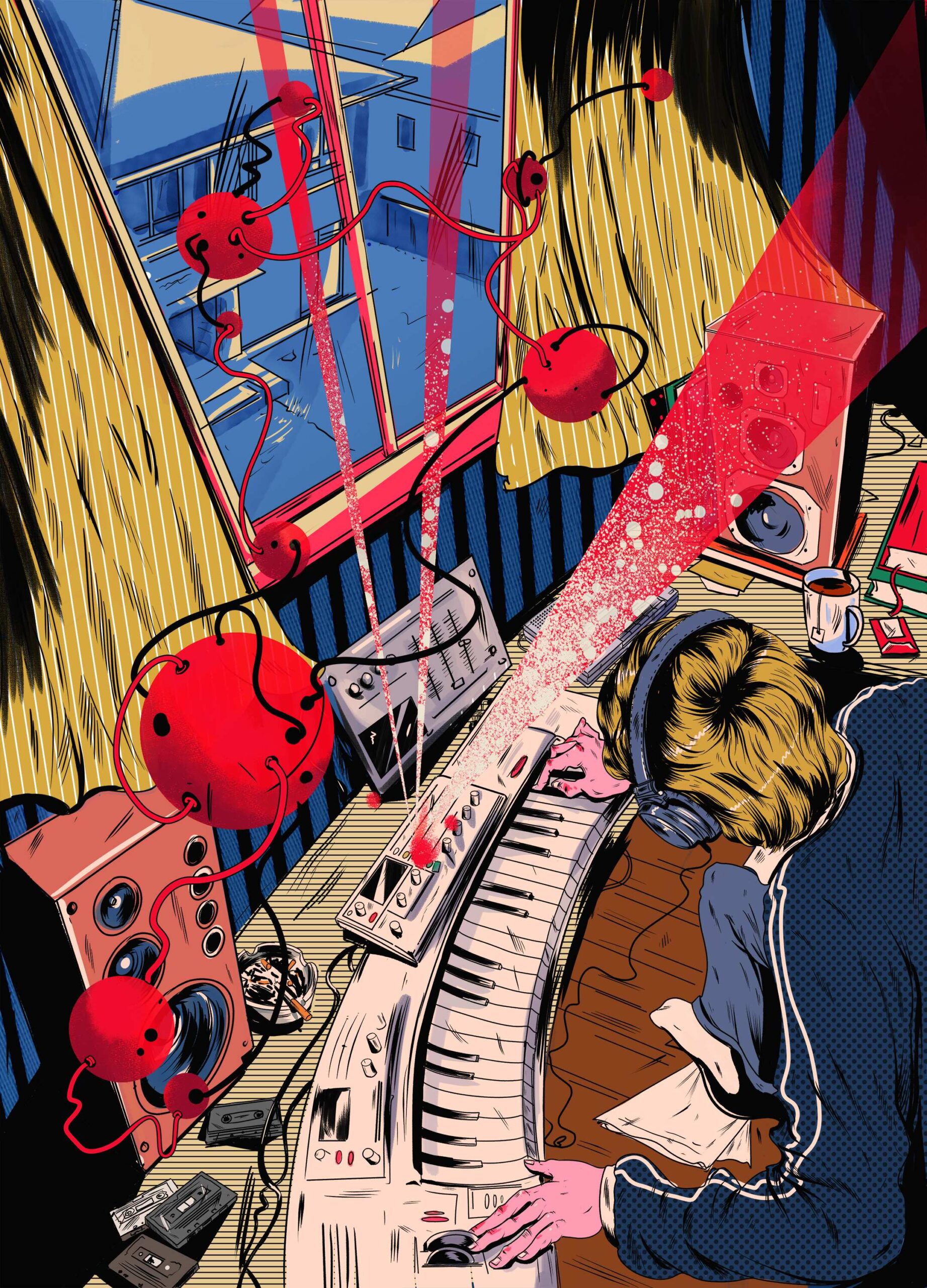
Theo woke up hours early each morning to go to the synthesizer on his desk, a white Waldorf Blofeld he affectionately called Bianca, he liked his time alone with it, liked being intimate with it, liked listening to every slow change in the complex wavetables, he was a tactile learner and sitting with it was the only way he could feel his way around it, he could never remember anything he learned from the video tutorials. Low-frequency oscillators, keytracking, what’s it mean again, I don’t remember, I don’t remember but I put three little stickers red blue green for each color of light in the corner just above the knobs, now for other people to look at when Ada drags me up onstage, just for me. I wish I never had to play out, Theo thought, this is what I like, sitting alone with it in the morning. It was 3:30 a.m. He was working through a file sent to him by a friend from Gainesville who’d tracked billowing streams of drony guitar on top of her reverberant luminous lyricless voice she said she’d recorded in the big abandoned warehouse they’d explored last time he visited. Theo laid his fingers gently on the keys and listened patiently through his black padded headphones, to the slow and subtle sheets of developing sound, kind of sunny-sounding, but dissonant, like gagaku, he stared out the window as he listened and felt nervous about what to add, he recorded a few ideas and listened to them all one by one, always looking out the window, always withholding judgment because of course you cannot know in the moment, and then with panic he realized it was dawning, a line of sunlight beginning to dust the top of the halfway house across from where he lived, it was past time to get ready for work, he threw himself into a ratty purple T-shirt and dashed out the door without even turning the synthesizer off. (He barely slept. To make it all work, he took long naps every afternoon, since nobody ever wanted to hang out before eight anyway.) He was off. It was a short drive, but stressful, on roads too small for their voluminous traffic. He liked his job. He liked the red chairs and the people smoking outside on the patio with their friends or with a book and a notepad or with a computer or just looking vacantly out at the parking lot, waiting for someone, waiting or just watching. He liked arriving just after sunbreak and seeing the morning colors dry up into blue just as the shop started filling with people, as though the people were the colors descended and concretized. He liked receiving flyers from bands he had and hadn’t heard of and arranging them on the metal blackboard, liked watching stickers accumulate on the windows of the skateboard shop next door, liked sneaking free coffee to his friends and acquaintances, even liked, a bit mischievously, the discomfort on the faces of those acquaintances who realized they had to interact with a man they saw at shows in a way that was transactional. He liked watching all of them write poetry, send emails, mix songs, design flyers. He calibrated the espresso machine. He rubbed the sand out of his eyes and thought about how someday he’d have enough money to build a modular synthesizer, he’d even learn how to solder, hell, he could build his own Oramics machine, turn abstract drawings into music, there was so much possibility in multimedia machinery, so much you could do with art in life, it was all so expansive, cosmic, talkative, transcendent . . . he scrolled through Craigslist on his phone. He put it away as the first customer entered the door and hesitated, a man in the mist, asked if they were open. Yes, we’re open. Theo could already tell the day was going to be hot. The man got his coffee and left. Theo wanted to live differently, in a way that was realistic but just barely, realistic in actuality but almost impossible to imagine, the kind of life he could keep asking himself if he was really living, the kind of life difficult to describe to your family but easy to strangers. He could never quite articulate what kind of life it was that he was after, but he knew he would know it when he had it. He got the feeling the world was more like that when he was a kid, that sense of abstract expansive possibility, but of course it was impossible to truly remember. Sometimes it seemed as though Bianca could catch the ghost of it—yes, as though Theo could sense the presence of that life in the sounds of the machine, the machine whose little lights were still twinkling, her power light pulsing red like an exposed plastic artery. Oh, to be alone.
Austyn Wohlers is a writer from Atlanta, currently living in New York. Her debut novel, Hothouse Bloom, was released with Hub City Press in 2025. She is also a musician, playing in the band Tomato Flower and with others.
Illustration: Jackson Arthur Cook
