Grunge was important for a disenfranchised generation, suspicious of the sellout. So sure we would stay in the ’90s forever that computers had hardcoded the 1900s into everything, for decades. The last of the latchkey kids. We had to change the clocks, people said. Everyone said we had to change the clocks. Culture, however, was changing of its own accord. The sound of alternative metal was distorting the further it got from its starting point, like a wave reverberating through time.
Nu metal was politically charged. It was less apathetic; it was angry. Cathartic. Most histories of nu metal online already explore the sound, the specific history—the way it collaged hip-hop and metal, broke away from aggrandizing guitar solos, drop-tuned and brutalizing its way into the mainstream. Chug-a-chug with JNCOs and rattail beards. On the heels of Brad Pitt asking you to punch him as hard as you could, nu metal did punch, and it punched hard.
Back then, music was still, like, tribal. The music you listened to and the aesthetics that followed the established social hierarchy and order in high school. Freshman year and you established yourself as a punk, a juggalo, a metalhead. If you were a metalhead you thought rave music was soulless, and if you were a punk, you despised anyone who wore a Dead Kennedys band T without knowing their greatest hits. Or you were a normie, someone who listened to pop, and you figured anyone wearing black and listening to thrashing, angry music might one day shoot up your school. 9/11 happened then the Iraq War then Hurricane Katrina and you were on the hunt, every day, trying to find out who you were, or running from it.
Before all that, it was 1999. I was eleven years old. My parents had moved house after elementary school. Now I was at the school of the bulldogs. At the beginning of sixth grade they did musician tryouts for the school band. I tried my hand at the flute, the violin, the trumpet. The guy told me I’d be able to play anything, and this made me feel like I was a miraculous talent. That I’d be able to pick up any instrument and just know it already. I wanted to play the piccolo. Somehow I ended up playing the clarinet.
Then our family was moving to another house, one my parents would buy instead of rent. My dad was finally out of the army. I would go to a new middle school. Mountain lions instead of bulldogs. Somehow, the band teacher was the same person. I couldn’t understand that he’d just found a new job, but I liked to think it was because of me. I still played clarinet but I hadn’t learned how to read any of the music and I hated doing parade and orchestra, especially because I couldn’t really play. Could I ever? I have no memory of this. Just memory of needing to take care of my reeds, making sure they didn’t split, my mother tutting about how expensive they were to replace. Also, all the drool. Out of the bottom of the clarinet and on my thumb.
The band teacher was distressed about Columbine. The only detail I can remember is the way he described the shooters hiding long guns beneath their long coats. How the boys swung them out and took aim, almost like cowboys. I can’t swear by it but I think he even mimicked it, did the arm movement, shaping his hands into finger guns. I can almost see the tail of the trench coat swishing behind him. I don’t remember this troubling me. I had liked him. If anything, I felt connected to his sense of grief, had known at some level this event would be important to my life. It was only forty minutes north of us, not that far (and one day, the many other shootings I’d be just minutes away from: the premier of The Dark Knight Rises, just as I was getting back into a relationship I had tried to leave; the one at the grocery store, the one at the gay club I used to frequent in high school, the spree shooting that took place across the city the day I flew out of the country to my new home. The list, for all of us, is far too long).
I remember I’d told my band teacher I’d wanted to quit. He’d had this hand-carved wooden keychain of the old middle school name on his desk in his small closet of an office. I had felt nostalgic for the bulldogs. At eleven, twelve years old, I had made one friend from my neighborhood who was definitely more of the pop music type. She was a new girl, too. I spent one week sitting at the lunch table she’d been invited to. I remember one boy making a joke about a girl at the end of the table: Roses are red, violets are black, sorry your chest is as flat as your back! I was terrified to be next, grappling with the pain of being stuck inside a body I couldn’t control. Nobody at my new school liked me. Band was for losers, and I’d begun receding into online social life, playing high-fantasy multiuser dungeons and talking to strangers on AIM. My band teacher offered to give me the keychain if I stayed in band for one more year. I took it, but on the premise that I’d be allowed to play a different instrument. I picked the xylophone but never showed up to practice.
In gym class I met a different girl, one with long beautiful hair who introduced me to her blue-haired goth friend. Together we felt our middle school experience was a lot like Daria: We fashioned ourselves to be apathetic, artistic weirdos. The show featured of-the-moment alternative music like “We’re in This Together” by NIN, “Ana’s Song” by Silverchair, “Dragula” by Rob Zombie, songs from Cypress Hill and Alice in Chains, Rammstein. Angry, energetic, emotional songs that dotted the background of my adolescence whose lyrics and sound justified the alienation and confusion I felt about why some people just fit in with the popular crowd and some people didn’t. Little hooks reeling me in. And the music had a style that rejected the norm. My first understanding of resistance: You don’t have to dress like everyone else, look like everyone else. You can actually do the opposite. Blessed as I was for my father’s Blockbuster Video addiction—we’d go every Friday to rent VHS tapes, and Daria was gearing up to run its fourth season on MTV. Daria’s crush, Jane’s brother Trent, was in a band called Mystik Spiral (“but we’re thinking of changing the name”), whose sound was influenced by the likes of “Jane’s Addiction, Morrissey, The Doors (the band, not the movie, which sucked), Cocteau Twins, Zappa, NIN, Nirvana, Gregorian Chants, thunder, the Banana Splits,” according to the Daria-universe MTV site Reburb, an undoubted reflection of the contemporary mashed-up aesthetics of nu metal. Daria had been an inoculation for me, and I watched every episode I could. The ever-cool Jane Lane and Trent were effigies of my new longhaired hippie freak of a best friend and her older brother, who introduced me to Korn (and the band they were before Jon Davis, L.A.P.D.).
My new best friend was a broken-home kid. We hung out in her single mom’s unfinished basement and played truth-or-dare with her fourteen-year-old brother. The room was lit in blacklight and they played “Bawitdaba” by Kid Rock, the most ridiculous song I’d ever heard in my life up to that point. I was a kid who’d grown up on her mother’s love of Motown, her father’s love of country music, Pink Floyd, and Yaz (Upstairs at Eric’s remains a nostalgic favorite). I remember there were mice in the house. Her mother would set out glue traps for the mice, and it was awful to see them wriggling to escape. One time I watched her older brothers put a mouse in the microwave. Jane and I would sneak out of the house with both brothers, exploring the dark hallways of the dilapidated apartment complex just across the road. It was chaos, the boys mimicking Korn’s thrashing throat theatrics on walkie-talkies, then screaming at us to run as they set off fireworks in the apartment’s unlocked laundry rooms.
I loved this new band and their stupid names. Munky? Fieldy? Head? Then the epically normcore “Jonathan Davis” attached to this lanky, dreadlocked dead-looking guy wearing Adidas. He’d been a mortician or something—no, a coroner. In ’93 Davis saw Chino Moreno live for the first time, a doppelgänger or evil twin in a tracksuit and dreadlocks; the two, he said in a 2022 interview with Revolver, had circled each other, then became really good friends.
Korn was recording their first studio album in 1994, all of them railing meth, doing cocaine. Early twenties. The inaugural Family Values Tour in 1998 would go on with Davis getting clean of methamphetamine before the tour to sort his life out. Just a few years later, all my friends were dipping into it for the first time. Some were overdosing; one dropped out. We all wanted something real. Nobody wanted to be a poseur. We would self-harm, some of us worse than others. I had started with safety pins, small scratches, showing off to my first girlfriend in sophomore year, seeking attention. It would get me some, but not enough and not from the people I wanted it from. It wasn’t dangerous enough, wasn’t “the real thing.” What was the problem? We wanted to be troubled, to be something interesting, to make a spectacle of the terrible mundanity of our lives. Korn was like the real thing—the music made me feel like I was a problem, part of the spectacle. Davis, in a 1999 interview in Melody Maker: “I wanted to kill myself . . . I didn’t take pills or slit my wrists but I was thinking about it.” And: “I’d get panic attacks. . . . I don’t like medical drugs because I don’t like being doped up. . . . I got schizophrenic and psychotic and I stopped eating. . . . The only time I felt good was when I was onstage.”
I’m surprised to find, as I reread the interview, how surface-level I thought Davis’s words were on first read. Like, rather than truth, my snap judgment was that it was a cliché of damaged youth dressing something up to appear edgy. Maybe I was just judging my younger self, though. The way I wrote stories in high school that were often deemed “attention-seeking” especially by peers; it reinforced a feeling that I wasn’t damaged enough to warrant help. My feelings are real, but yours aren’t. We learned, early on, how to dismiss the feelings of those weaker than us because it was what our parents were doing to us. After school, on weekends. And the teachers, sometimes, too—perhaps the air of post-Columbine hazards on their minds. My archive of high school notes back and forth to crushes, notes from my first high school girlfriend and the fuckboy I lost my virginity to all share a common refrain: “Could you tell me why you like me again, just so I know?” We ached for acceptance.
Davis was addicted to drugs, grieving the death of his grandfather; these are real pains. We were all just kids hurting once, trying to find a way to put language to what we felt. In a 2001 letter to my online pen pal, Never, I tell her I’m going to a concert that weekend, and I write: “I know what you mean, about the cutting . . . I guess [redacted friend] knows it’s not like I’ll ever KILL myself, so maybe it’s not a big deal to her. When my friends ask what happened I just say ‘me.’ And they don’t know what to say to that, so they just change the subject.” Despite writing this, I think I was still trying to cry for help. In an English paper dated around the same time, I was supposed to pick an object and write about how it could be used for good or bad, to help or hurt, so I picked a razor blade and wrote a four-page epic about a suicidal teenager who grows up and enters an abusive, trapped marriage, then dies, and years later someone comes upon the same cursed razor blade and is transported to a white room in which they are doomed to live in solitary confinement, forever, as no matter how much they use the razor blade to slash themselves open, they always heal. My grade was 14 out of 20 for lack of focus. The final remarks from the teacher in orange gel pen: “This is disturbing because there are so many images of someone hurting themselves.” (I wouldn’t be referred to student counseling until two years later, when I’d accidentally left a “pretend” suicide note in a textbook, a letter meant for my father, when he’d grounded me to the basement bedroom for getting a C on my report card.)
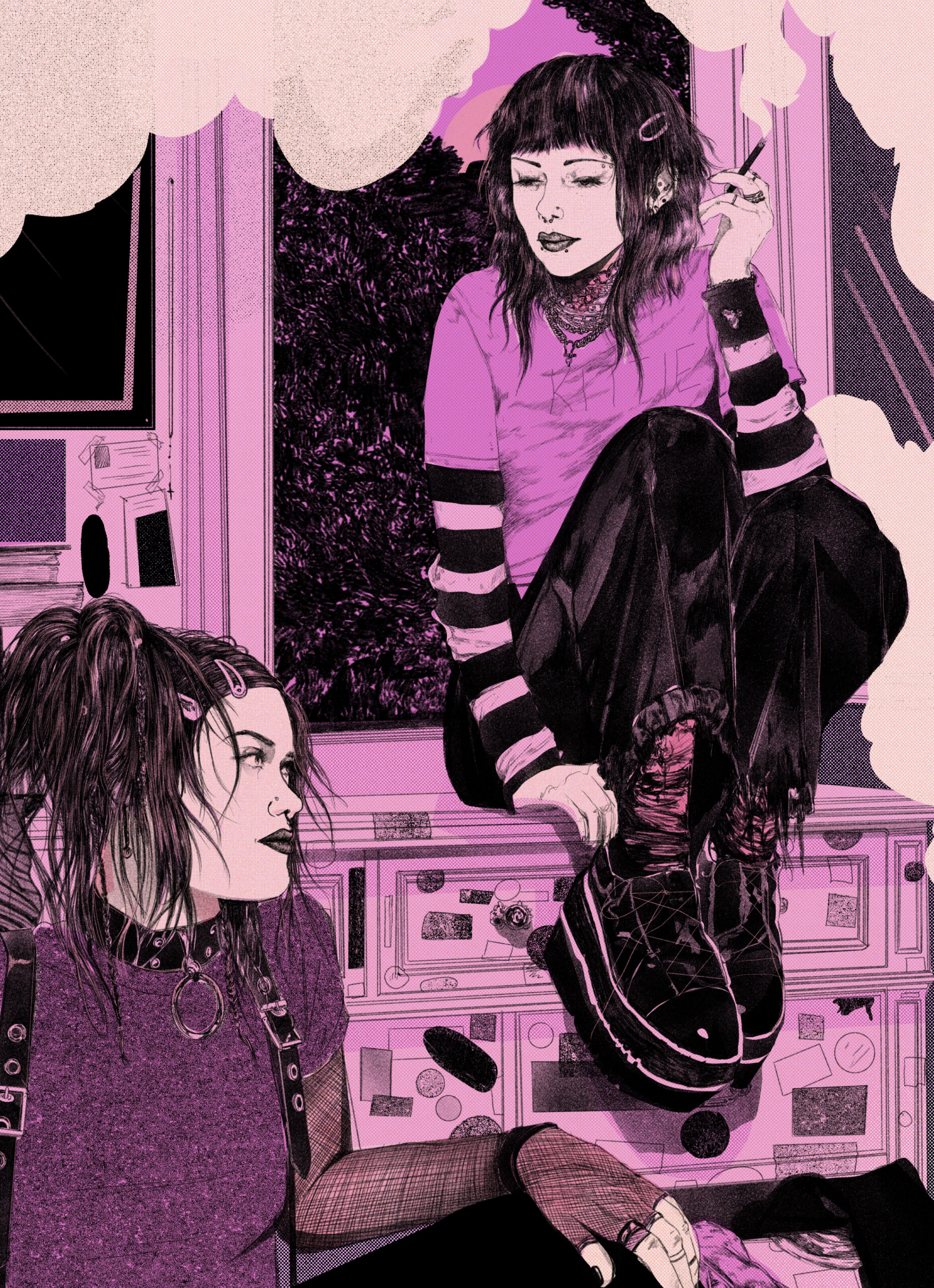
I was fourteen. My longhaired Jane Lane had moved away up north, though we still kept in touch as much as we could. Home life got harder; I was always writing about my parents’ screaming at me, my dad’s alcoholism, my mother’s complete inability to handle it or me (respectfully, she was dealing with a lot). It was that year the blue-haired goth girl and I became closer friends and she played me an album called Spit by an all-female metal band called Kittie. She wore the band’s shirt to school (it belonged to her older sister), along with a pair of black wide-leg jeans with orange flames all up the side. Then I heard “Blood Pigs” by Otep from their debut album Sevas Tra, an anagram of “Art Saves.” Lead singer Otep Shamaya’s performance of pain and anger was so visceral that the band got invited to Ozzfest personally by Sharon Osbourne herself after only their fourth live show. Shamaya’s insistence that “with poetry and suffering / I cannibalised every ounce of my pain” transformed me. By fourteen I had cut my hair short with long pieces in the front, like Morgan from Kittie, and was obsessively writing meager poems into a notebook on the bus every day. I had amassed a group of doppelgängers of my own. A mélange of juggalos, ravers, weirdos: My friends at school wore clothes that seemed to scare everyone else and tied their hair up into dozens of ratty, spiky braids reminiscent of the grotesque crash-dummy mask that Slipknot frontman Corey Taylor wore during their self-titled era. It felt like taping a sign to your back that said “Do not fuck with me.” Though it probably did the opposite. Sometimes, they ran around in the dark in neighborhoods pretending to suck each other’s blood as an excuse to touch each other, to hurt each other, to bite and leave bruises. Evidence they were worthy of being desired.
The late sociologist Karen Bettez Halnon describes the aesthetics of nu metal as a “heavy metal carnival [that] breaks through the noise of commercial culture by raising the transgression ante to the extreme and challeng[es] nearly every conceivable social rule governing taste, authority, morality, propriety, the sacred, and some might say, civility itself.” Halnon’s intentional use of framing nu metal as carnivalesque is interesting in two ways. First is that she based her research on the work of Mikhail Bakhtin, who applied the concept of “liminality” to the medieval carnival. Liminality is loosely defined as inhabiting a state of transition—being between one place and a new one—during which carnival is a “time to vent, release, resist, hector, parody, and rebel.” She implies that nu metal is distinctly a culture of liminality, playing and warping the rules in an attempt to destroy the old world and reinvent the new one as we pass from this time into the next.
The millennium had occupied so much of the American psyche; I don’t think it was just being a teenager that made me feel caught in the midst of some great change. Between Columbine in spring of 1999 and the attacks of September 11, 2001, nu metal skyrocketed in underground popularity and spread like it was slashing and burning the fields to make room for new growth.
It was like a uniform. Band T-shirts featuring Coal Chamber, Slipknot, Taproot, Mudvayne. Black fishnet arm warmers, Tripp NYC pants. Occasionally someone would get suspended from school for violating the dress code on grounds of “obscenity.” Despite its association with disaffected, angry youth, nu metal and alternative culture seemed to pull us all toward each other, fighting the alienation instead. I wrote a letter to the school newspaper, and the journalism teacher told me the suspensions for wearing “occult clothing,” as the principal had called it, were violations of free speech, that it was bullshit. Halnon describes the self-identified fan community of nu metal (like Slipknot’s “maggots”) as “among the most transgressive aspects of heavy metal carnival, for it grates against a society that places primacy on autonomy, self-interest and individualism.” I was starting to feel like I was part of something. My friends and I met up before school at “Smoker’s Corner,” the patch of sidewalk just off of school grounds where we could chat and smoke cigarettes without getting caught by school security.
My diary, October 2002: “Today was good for me. Instead of wanting out of this painted box, I secretly wanted in. I wanted to be with those people, give or take a few, laughing at anything. Not caring about the cold stinging our fingers and noses. But then the school bell rang and I suddenly felt trapped, like a moth in a bulb.”
Mercedes Lander and Fallon Bowman of Kittie had met in gym class, like me and my Jane Lane. They’d shot to success in their teens, somehow managing schoolwork between the recording studio, but had cages of their own to contend with. In the 2017 documentary Kittie: Origins/Evolutions, Bowman describes watching the men in the crowd stop thrashing in the pit and cross their arms, just staring them down on the stage. This, of course, would never stop: old forums of men doubting their musical ability, claiming they were playing off tracks, that they had men secretly playing their instruments for them in the wings.
Morgan Lander, Mercedes’s sister, said “Brackish” took them three years to write, starting when they were just twelve or thirteen. Full of spite and hurt, Louder reports that the story behind the lyrics is about a close friend in a relationship with a controlling older man. From Kittie: Origins/Evolutions: someone from behind the camera recording Morgan in the studio sometime in 1999, her hair cropped just above her chin, metal barrettes at her temples, an eyebrow piercing. “Brackish, what’s that about?” they ask. “That’s not about anything at all,” Morgan says, avoidant and laughing. “Just wrote down some words, doesn’t make any sense.” Later, her in a hallway, Hatebreed on her shirt. Then she burps.
The band had finally finished the song when they were what, fifteen, seventeen. A track with vocals inspired by Static-X, they paid a DJ with a case of beer to make a backing track, and it became the first single on their debut self-titled album. It wasn’t even supposed to be on the album, but it helped them move almost nine thousand albums in its first week.
Kittie spent three hours signing records for fans and after a show in Connecticut with an audience of twenty-thousand, Mercedes said “Tanya [Candler, bassist] afterwards told us she didn’t want to be in the band anymore. And everyone kind of brushed it off like, okay . . .” Years later, Candler says it was too much; she was struggling with drugs, her eating disorder, and she had no idea how to bring that struggle to her friends about how the pressure of success made it all worse. “I didn’t tell any of the girls any of that,” Candler said. She was just sixteen. Candler was airbrushed out of a publicity photo shoot just after the first album was signed, and they brought in a guitarist who’d never played bass before, Talena Atfield, to work the tour and star in the “Brackish” music video in 1999. By 2000, Kittie had played on Conan O’Brien, headlined at Ozzfest with Slipknot. Spit had hit gold. But barely.
Sometime in 2003 or 2004, emo arrived right as I was becoming a senior in high school. Skinny jeans were coming into style, which I rejected outright as a form of popular culture trying to get me to conform. But it was a sign that alternative music (or the market, at least) was shifting again. Kittie was reeling after the pressure to put out their second album, Oracle, in 2001; Bowman had left by then, too. Garth Richardson, their producer, and Rob Nation, their audio engineer, both thought Kittie’s push into being too metal was a mistake. The Landers sisters rotated through band members until they brought on Lisa Marx as guitarist and put out their third album, Until the End. It was 2004. Nothing could scratch the itch like their debut had; they’d never replicate the same success. A 2025 video essay by @TheRealLordofEmeralds on YouTube about Spit being one of the greatest nu metal albums of all time echoes a common refrain that the “only one really truly unfortunate thing about this record” is that “it’s the only Kittie record that sounds the way it does.”
“Heavy metal carnival is a politics of dissatisfaction and a demand for difference from the commercialized mainstream,” Halnon writes, noting, however, the complication that even dissent becomes commodified in Debordian fashion once its subcultures are able to sufficiently be mined. By 2002, Daria aired its last season and published a pilot script of a never-aired spin-off about Mystik Spiral. In the script, the band is criticized for not putting enough “raw pain” into their music. Trent and his bandmate Nick discuss the possibility that “post-alterna-grunge” was over, that letting the band die might be for the best.
By 2003, my blue-haired goth friend, the girl who had become my daily rock, had officially dropped out of school. She was holed up with the guy who used to sell us cocaine, who taught her how to freebase. When Fallon Bowman growled, “Take so much away from inside you / Makes no sense, you know he can’t guide you” in “Brackish,” it now took on deeper meaning. Jane Lane and I would call each other on the phone and cry about how much we were worried about her; her notes and letters became more distant; and soon we stopped hearing from her at all. It felt like she’d abandoned us both, but that couldn’t be further from the truth. She was young, struggling, desperate for help. It was crazy what life was becoming for us. It had all started small. Like the scratches with safety pins that didn’t bleed. Then it became something worse. Scratches engorged into rivulets cut by razors, then glass. How it went from smoking catnip and rolled-up paper and getting caught because we set off the fire alarm. Thirteen, watching MTV, the guitarist of System of a Down curving his whole body over his guitar like a fucking coat-hanger hook, bashing his head into the air. Stealing Jane’s mom’s weed and making our own pop-bottle bong. Industrious little fuckers, if it meant finding a way to get high or get attention. And somehow me and this blue-haired girl ended up at some big-ass house on the outskirts of town because these guys in a band had picked us up in their car before their show. These guys with guitars in their late teens, early twenties; it seemed innocent; we couldn’t fathom the danger. And it had snowballed into a world where we were snorting almost anything we could crush. I remember my dad had bought me the Limp Bizkit albums for Christmas the year I turned thirteen, heard me listening to them, and then took them away. Haha. Like that would stop it.
The Kittie: Origins/Evolutions documentary says it was made to show how precarious life as a mid-list band is, twenty years after Kittie was formed. By 2004, Morgan and Mercedes were the only people left in the band. No record deal. They launched a clothing line, then a record label called Kiss of Infamy. They got sued by Gene Simmons and changed the “Kiss” to “X.” Nu metal was on the backswing; the system had taken all they needed from bands like Kittie, the cycle complete, on the prowl for the next rebellion to commercialize.
Despite this, it’s kind of unbelievable that, in 2019, the only bands that had more top-ten album debuts than Korn were the Rolling Stones, the Beatles, the Dave Matthews Band, and fucking Santana. Where had I been all this time? Certainly not paying attention. I had abandoned much of myself for a man, starting in 2010, the same year Korn released their ninth studio album, Korn III: Remember Who You Are.
Whenever I listen to nu metal, it gives me this strange, conflicting experience of coming back to myself. When I was young, it was like the music was co-creating me. Now that I’m older, it’s like I have to remember a part of me I thought was gone. All the childhood pain and cringe teenage lore that I’ve come to outgrow. I always think it’s died, but in the music, this person I used to be rises out of the substrate like some weird little zombie. Halnon says that the carnival quality of nu metal plays with concepts of death and rebirth, both by directly challenging the “everyday, taken-for-granted reality” and “celebrat[ing] body-world connectedness.” It dissolves the boundary between the self we have to hold out to the world and the one we hold inside, the one that hurts (I’m reminded of “Duality,” by Slipknot). In the throng, you access the self that used to be uninhibited and spontaneous. A moment that provides short reprieve from the self that lives amid “the immense socio-psychological clutter of commercial culture.” To me, this hints at the recent string of video essays and cultural pieces over the last couple years that nu metal is coming back (and I can’t help but think of my favorite Simpsons reference: This time, “in pog form!”).
Our digital and ever-present offline lives are now a genuine hoarder’s den of commercial clutter; now that I’ve begun to reject so much of digital life, a major anxiety is that AI progress seems to threaten IRL life with more and more pervasive hypercommercialism. Recent gig-work apps like RentAHuman bring the online into the offline, a horrific inversion of surfing the web, where now the web is surfing us. Nevertheless, nu-metal and its transgressive aesthetics remains, like most of our beloved subcultures, to release its fans from the oppressive mundanity of late-capitalist life. “Brackish,” for just three minutes and three sweet seconds, allows me to feel separate from the spectacle and part of something real.
So come back with me here. It’s 1999. I’m eleven years old. That year, America has its first pro-wrestling political leader in Jesse Ventura. Bill Clinton’s sex-pest allegations are acquitted by the Senate. The best and worst television shows of all time, The Sopranos and Family Guy, debut, respectively. Enron begins megawatt laundering. Bryan Cranston is Malcolm’s father, not yet the one who knocks. Kubrick dies.
We learn it takes nineteen days to get across the world in a hot-air balloon and Ricky Martin goes solo and hits number one. We ask ourselves what it means that there is no spoon. And then, at 11:19 a.m. on April 20, an event changes how teachers view leather trench coats forever.
SpongeBob premieres, which I watch diligently. Everyone at school speculates that SpongeBob is gay. The Jenny Jones Show is found liable for the murder of Scott Amedure, when they brought his friend Jonathan Schmitz onto the show and revealed that Amedure had romantic feelings for Schmitz; the family claimed Schmitz was afflicted by “‘ambush’ tactics” that made the show culpable. A month later, TV causes the death of another man, when Jim Ross and Jerry Lawler announce the passing of Owen Hart.
In June, the birth of Napster. (Of course, within a couple of years, Metallica begins its end with a lawsuit.)
Woodstock ’99 brightens the summer and a riot ensues when Fred Durst screams “Break Stuff” into a mic.
Lance Armstrong makes bicycles interesting to Americans, and Tony Hawk makes Activision rich when he breaks a world record for whatever that twisty thing is that he does with his skateboard. The Blair Witch Project opens in August, and then The Sixth Sense. We begin fumigating suburban neighborhoods with pesticides to kill all the mosquitos.
Putin becomes prime minister of Russia.
The late, great Mitch Hedberg makes the 280-character quip popular before Twitter is a cum stain in its mother’s underwear, and the more lame version of Woodstock ’99 happens for the first time: Coachella. The players are Beck, Morrissey, Tool, and A Perfect Circle, which is just Diet Tool. There is no riot.
Elián González is rescued on the coast of Florida and six months later, over 130 US federal agents raid his Miami relative’s house and return him to his father in Cuba, forever answering the question of how many federal agents it takes to pick up a baby.
Coasts are battered by hurricanes, always. And Earth hits six billion people.
On the last day of the twentieth century, Napster is still legal. The World Trade Center is in the headlines because people are protesting in front of the one in Seattle against the World Trade Organization conference. My parents use a paper map if they need to drive to a new place, and my dad has quit Blockbuster for Netflix, where he gets three DVDs mailed to him once a week. Heroin is free of fentanyl, though the era of grunge is undeniably over.
But for me, life is just beginning.
Elle Nash is the author of Deliver Me, Gag Reflex, Animals Eat Each Other, and Nudes. Her fiction has been nominated for Fiction Book of the Year at the Saltire Awards, and her screenwriting has been an official selection in the TorinoFilmLab NEXT—Feature Film program. She lives and teaches in Glasgow.
Illustration: Nicole Rifkin
