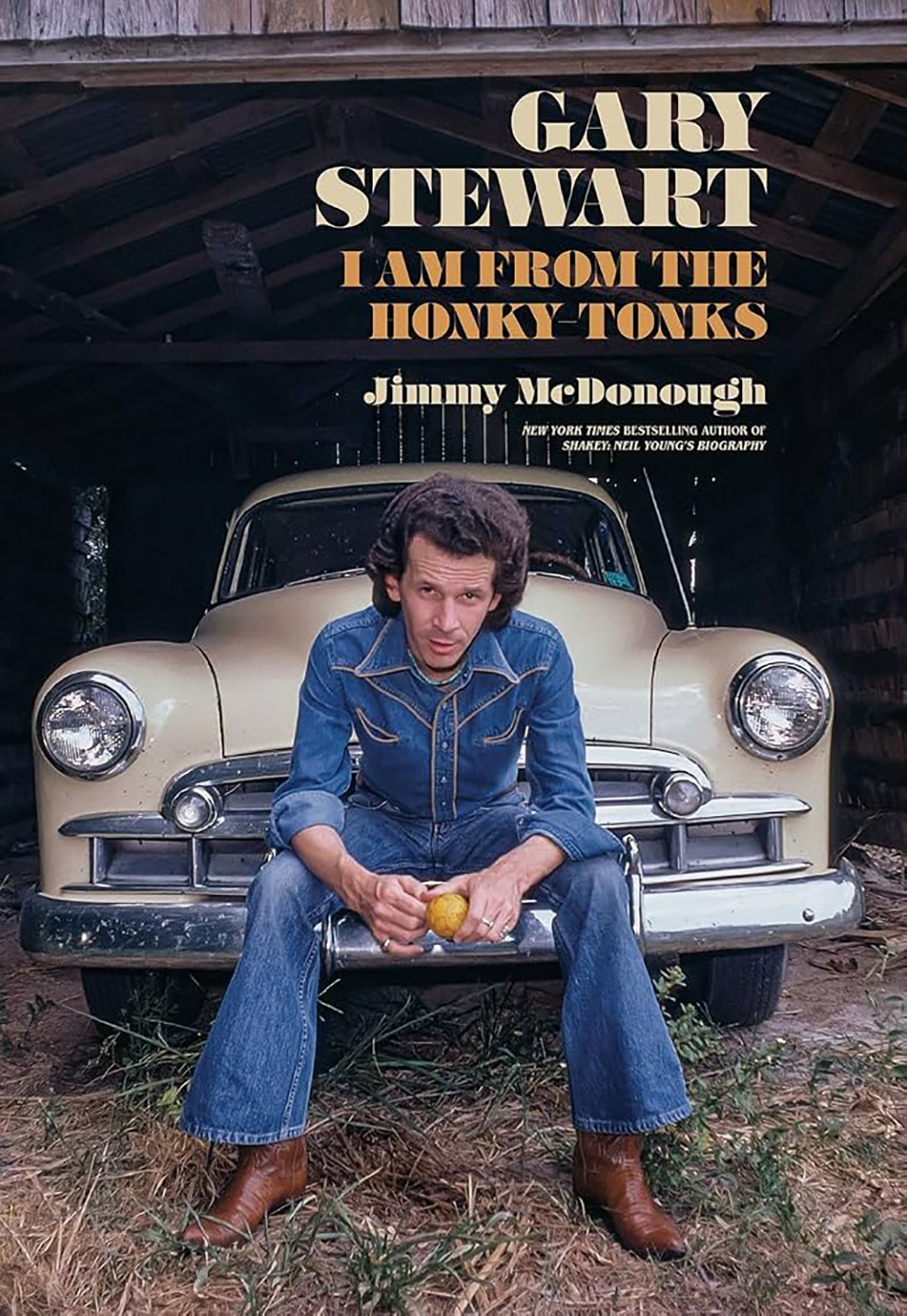
Biographies of tragic figures are generally not funny. You could read Jimmy McDonough’s chronicle (a grand one) of the Kentucky country singer Gary Stewart and emerging from the task absolutely unmoved if you’re (a) humorless, (b) not from the American South, or (c) uninterested in the region’s oral traditions—and the (d) here being: you simply don’t know who Gary Stewart is. Safe to say, a lot of people don’t.
In McDonough’s hands, (d) almost doesn’t matter, and (b) pretty much doesn’t matter. Yet (a) and (c) matter a great deal. Oral tradition is the register in which McDonough—author of biographies on Neil Young, Tammy Wynette, and the sexploitation auteur Russ Meyer (Big Bosoms and Square Jaws), among others—recounts Stewart’s history. Gary Stewart was born in a holler in Eastern Kentucky, “raised on a mother’s love, soup beans, corn bread and taters.” These are Gary’s own words, chicken-scratched on record-label stationery and discovered among his ephemera, of which McDonough largely eschews in favor of real talk: Gary Stewart: I Am from the Honky-Tonks (Wolf+Salmon, 2026) is polyphonic collage. A summoning of voices.
This is why McDonough’s book achieves what few biographies can: entertain somebody with only a passing interest in its subject—in outlaw country music, and perhaps much less so in Stewart, whose legacy hasn’t endured like his peers’ have. Willie and Waylon and the boys and so forth. Stewart was his own thing, more country rock than his contemporaries, more boogie-woogie, more swinging-and-drooping-rockabilly-tear-in-my-beer mash-up. A honky-tonk man, but for real. Stewart’s bandmate and buddy Richard McCroan called it “Texas dance hall music.” (Entering Gary’s life in the 1990s, McCroan became—hard ridden by then as Gary was—as much of a personal assistant as anything, “hooked on helping Stewart,” writes McDonough, “driving Gary to gigs, running his many errands, pressing his clothes, and even, upon occasion, washing his back.”) Anyway, you’d guess “Kentucky dance hall music” just doesn’t have the same heft to it.
In his best years, Stewart possessed this high, quavering howl somewhere between Jerry Lee Lewis and Magic Sam. Not gruff or plaintive enough to be part of the standard outlaw pantheon, and still not mournful enough to be romanticized by a generation fawning and weeping over Townes Van Zandt. Not that TVZ’s legacy isn’t well deserved—much like Gary, Townes failed to make hay in Nashville and retreated into some measure of squalor.
Gary Stewart’s rattling wail was an instrument over which he held utter control, a gift tantamount to that of George Jones, Merle Haggard, Roy Orbison. A good prerequisite to reading McDonough’s biography would be a drive through some pretty countryside dotted with Dollar Generals and title loan shops. Put on Stewart’s 1976 record Steppin’ Out, starting with the fantastically titled “Flat Natural Born Good Timin’ Man” and all the way down to the album’s final note. Or start with “Trudy,” good as almost any ripper on Exile on Main St. Among breaknecks and ballads, Stewart’s voice is high and lonesome and rapturous and trembling—is he possessed, is he really fixing to cry?—and you will understand, before opening the book, that everything McDonough says about Gary’s best music is true.
Talk to country fans whose curiosity expands well beyond the basics of 1970s outlaw- cosmic country—some Young, Poco, the Byrds’ Sweetheart of the Rodeo, the Burritos, and solo Parsons (not to give Parsons too much credit), Van Zandt, your Steve Earles, your Guy Clarks and your Lucindas and on through the alt-country of the 1990s No Depression–era—and Gary still doesn’t get his due.
This, as McDonough reveals, was by design. “Gary didn’t give a shit,” said Stewart’s drummer, Robert “Cotton” Payne. Gary did not like “doing those big arenas,” which surely annoyed his label, RCA. “He’d say, ‘Robert, I just want to play music, make my money, and go home. Is that so much?’” For much of Stewart’s life, after his brief 1970s ascent toward country stardom had faded, he stayed, as McDonough puts it, “locked away from the world in a double-wide.”
Jimmy McDonough’s chief aim is to right this wrong, to give Gary his due. Above all else, McDonough—an accomplished and thorough, albeit stylish and wacky, biographer—was a friend to Stewart, and obviously a bit of a superfan. The first time Jimmy went to one of Gary’s shows, “nothing prepared [him] for the roar that came next,” having “expected some pompadoured song salesman in a Nudie suit to waltz onstage and replicate his hits.” McDonough continues:
It was like entering a Presbyterian church to discover that Pentecostal snake-handlers had seized the pulpit. . . . Gary looked like he’d just slid out of the back seat of Uncle Elmo’s moonshine hauler, ready to steal your chickens the minute you turned your head.
In much of the book’s middle section, recounting Gary’s studio sessions, McDonough describes Stewart’s “outrageous vocal” while recording 1977’s “Your Place or Mine,” a voice that “stretches, elongates, and practically bounces off walls like Plastic Man in a Jack Cole panel.” Some readers, if not already unfamiliar with Stewart, will be even less so with Uncle Elmo, the Plastic Man, or Jack Cole and his panels. But this is how McDonough writes, and through five hundred pages of oral history laced with straight-up dialogue montages—as though you’re reading a play whose cast is all of Stewart’s rowdy kith and kin—Jimmy McDonough juices his prose with a voice not out of step with his many subjects: Gary himself, Robert “Cotton” Payne, “Boogie” Bob, members of the Allman Brothers Band, and fellow Stewarts with names like Grandal Stewart, Candy Stewart, and Trampas Stewart; Gary’s dear wife, Mary Lou; and Gary’s mother, Georgia—herself a member of Stewart’s outlaw entourage, as well as a pill dealer, a professional wrestling aficionado, and evidently tight with a dollar. In Grandal’s words, Georgia Stewart could “take a damn buffalo nickel and make it piss before she turned it loose. I’m serious!”
Daniel Boone also makes an appearance.
I Am from the Honky-Tonks is, beyond biography, a carnivalesque history of a fading Kentucky, a honky-tonkin’ outlaw way of life often pantomimed by bullshitting former shorthairs (Willie and Waylon and the boys, again!). McDonough’s voice, his telling, and other voices he conjures through kinship and candid barroom conferences . . . likewise enters the carnivalesque. The berserk. This is a book for people who love language.
McDonough’s voice simply suits his material. It’s a refreshing biography, an experience akin to reading a novel (some readers may find this perturbing). But Jimmy McDonough shoots straight. Higher than his esteem for Stewart is a love and an impeccable ear for music, good country music, and McDonough chronicles Stewart’s artistic downfall with the clear-eyed, unsentimental hand possessed by all great music critics, beginning with “periods in the studio where [Stewart] was less than great,” when “Gary’s weirdness oozed out and he became erratic, unreliable,” recording music that was, in McDonough’s own words, “truly execrable” (hard to find a nastier word hurled at somebody’s music than execrable)—and then a “trainload of drugs intensif[ying] everything” that wound up going wrong. In the words of Gary’s sound engineer, Steve Cureton, “Stewart was just one of those downward-mobility guys.”
Of Gary’s oozing weirdness, McDonough shares a ceaseless torrent of amusing tales. Here’s a quick one:
Surely the most unusual appearance Gary Stewart ever made as a guest star was on an acoustic blues medley [Dickey] Betts [of the Allman Brothers Band] recorded in 1991 with Warren Haynes . . . called “Willie and Poor Bob.” There are no vocals save for some distant whooping and hollering. “Gary did the moanin’, like a train about twenty miles away,” said Betts. Stewart is credited with “field hollers.”
One look at Jimmy’s silver rockabilly pompadour and, upon further plumbing, his reluctance to speak openly about his own history—and a single look at one of his rockabilly sentences—explains why those in Gary Stewart’s orbit welcomed him throughout so many years, speaking to him as you would an old friend over a six-pack and liter of George Dickel, as though McDonough had weathered the hard years along with his biographical muse. And, in many ways, he did. The book’s very first line: “Gary Stewart, king of the honky-tonks, has just thrown a knife at my head.”
McDonough worked on the book for forty years (so he claims, but you have to believe him), starting with trips down to Florida in the late ’80s, to Gary’s double-wide and its blacked-out windows. McDonough had “[barged] into his life,” eventually befriending Stewart (despite events like the knife throwing), thinking he could “save him from going to hell in a handbag.” Gary had been “abandoned by Nashville”—largely his own doing—and “had fallen off the charts, wasn’t recording, and was barely playing live shows[,] having retreated to a pill-fueled existence.” As McDonough says,
The trailer was Stewart’s kingdom, filled with a carefully curated collection of antiques, Western memorabilia, and albums of every vintage. “I got my own little world, see,” he told me. “I built this.”
It’s almost a sick thing to delight in the scenes and dialogues gathered here by McDonough. There is much despair in these pages, yet this despair is often buoyed by the sheer outrageousness of Gary Stewart. As Stewart continued to “ingest massive amounts of drugs—Somas, Xanax, painkillers, coke, speed, and whatever else got slipped to him by fans,” he started “wearing a T-shirt with ‘WHERE’S MY FUCKIN’ MEDICATION?’ emblazoned across it.” McDonough describes an overdose in 1996 in which Stewart is found at the house of Randy Woolery (one of his drummers), “laying in [Randy’s] bed, shaking and foaming at the fucking mouth,” a fire truck and police car and ambulance out front of the house. He was “slobbering, with his fucking eyes all rolled back in his head. It scared the emergency people.”
All of this surely took a toll on a biographer who’s had a long career and yet has now crafted his signature work. It’s difficult to fathom the degrees of sincerity—and pain—behind the colossal effort put into I Am from the Honky-Tonks, and you’d imagine that many, many biographers who are worth a damn still couldn’t fathom it either. Shannon, Gary’s daughter, played a tremendous role in helping Jimmy get the facts straight, to round up the choir—to fashion a story that’s often rip-roaring but honest, all the way down the line while things kept getting worse and worse: the fates of Gary of his wife of over forty years, Mary Lou—both, like many Americans in the early aughts, seized by opioids and despair in their final hours—and then Shannon’s own troubles.
Gary and [Mary] Lou were fierce, incandescent souls, flawed like the rest of us, caught up in something they felt they couldn’t escape. It could happen to you. Or me. Late some restless nights I turn to [a] haunting demo of “Williamson County” few have heard, with its ghostly guitars and Gary howling bloody murder. And I wonder—did he know way back at the beginning what the end would be?
Does it even ever end? If McDonough thought so, he wouldn’t have written the thing.
Not a book just for people who love language, then, but for those who care to peer down at the water’s surface and see themselves all broken up. To peer into a life not much different from their own, if you think about it too much. The long ride, its many gifts, and the increasing rain of horrors. Good to see McDonough has invited us into the room, the one in which he wakes up gasping, under the howl of blood and the ghosts in the dark and their strumming. And the laughter too—there’s always that.
Brett Puryear is a writer from East Tennessee. His debut novel, Nightburner, is forthcoming from Minotaur Books in 2027. His work appears in The Iowa Review, Wildsam magazine, CutBank, Writer’s Foundry Review, and other venues, and he writes the newsletter Pedal Steel. He lives in Missoula, Montana, with his family.
