A Life Guided by the Arts
I could tell it was getting bad when tech guys started talking about their “stacks.” They had sleep stacks, workout stacks, nutrition stacks, self-improvement stacks . . . if you could load up a bunch of helpful tasks or goals in a way that felt connected, then you could “stack” it. All in the name of optimization. Live longer. Live smarter. Live better. Forget to live while you’re planning to live.
The appeal was less in the actual carrying out of the tasks contained within these stacks, but in the planning of them. Perfection isn’t possible, so optimization toward perfection that is just out of reach can quickly become a quixotic lifestyle.
It got worse when they started making “inspiration stacks”—usually a stack of books, spines out, usually nonfiction books that would have in another time been classified as “self-help.” When this idea trickled down from the successful lords of technology to the wannabes, I knew we were in real trouble.
The idea that you can will the best version of yourself into being through focused learning is basically fine—being intelligent is a noble goal. But it’s a fool’s errand to do it by loading up on books written by quacks, conspiracy theorists, aphoristic love hucksters, scammers, grifters, and, inexplicably, Dostoevsky (if you run into me on the street, ask me about how I think the inclusion of Russian classics in these otherwise subliterate stacks has something to do with the trade dress of the current editions). Also: It’s embarrassing enough that this has turned me off all aphoristic writing—do we really need more short, (hopefully) insightful bursts of thought? Wasn’t there a whole app for that that may or may not have contributed to the slow-rolling, still-in-process downfall of America?
Am I saying that relentless self-optimization is causing the collapse of American society? Well, not exactly, but I’m not not saying that either. My disgust, it turns out, was directed at something deeper than the tech-bro stacks: When improvement of the self is homogenized, it stops being about your self, and more about submitting to the hive mind’s idea of the self. I’d submit that this is one of the many reasons we’re seeing people move away from digital spaces in favor of real-life communion.
From afar, it seems like the guitarist, writer, and therapist Matt Baldwin is living right on the edge of real life. He’s not a Luddite, but he’s not embracing technology with abandon either. When he makes music, his playing is spidery and circuitous, prone to discursive spirals and a sort of dubby smallness, like he’s playing each note in a continuous echo. It’s music of patterns, unbeholden to any rules except the rules of the composition itself.
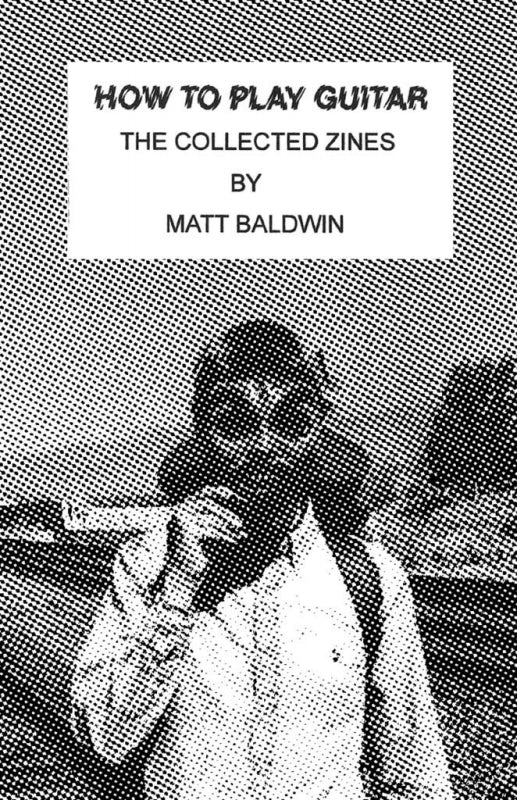
This is an obtuse way of describing a listening experience that is, at heart, messy, human art. While writing this piece, I listened to the bulk of Baldwin’s catalog. There are patterns there—familiar moments and, at times, a dedication to repetition—but there’s also an appealing sloppiness. This goes a long way toward explaining why How to Play Guitar, the collection of Baldwin’s eponymous zines, resonated with me.
Before we go further: Don’t be put off by the title. Matt Baldwin is not going to teach you to play guitar. He’s not even going to sort of do it. No stuffy discussion of scales and chords here! This book—this collection of zines—is actually about how to be an artist, and I think it’s safe to assume that we’re all coming into this with the point of view that making a guide to how to be an artist, despite it being a robust cottage industry, is totally ridiculous. It’s too individual. So Baldwin is not quite doing that either. Instead, he’s (mostly) using aphorisms as a form to clearly and directly transmit his own learnings.
It’s useful to imagine these aphorisms as coming from an older brother who has Really Seen Some Shit. There’ve been fuckups along the way, and more than a few bad decisions, but those mistakes became fuel for a full life worth being proud of, and now that older brother is guiding us through the existential question of what it means—what it really looks like—to live a life guided by the arts.
In the first installment, Baldwin writes about artistic vision and the undeniable way it tends to present itself. How it feels almost channeled by the artist, as opposed to created by them; how it can sound or look sort of like a million other things, but some ineffable quality makes it more impactful, somehow better. There’s no real way to categorize this type of artist, and no real way to describe what this type of art is doing and how it is doing it, but Baldwin gets closer than anyone I’ve ever read.
In a single paragraph he connects the dots between John Fahey, Alice Coltrane, Ellen Fullman, Burial, JJ Cale, Roedelius, Jon Hassell, and a whole host of other names. The theory Baldwin’s working with is that the thing that uniting all these musicians is a “secret thread” tying them together. “There has only ever been one song,” he writes, implying that they, across time and space, were all, in a sense, making the same song. What he means by this is that the animating force was not a single note, but a way of being that is forever infused into their music. All these artists are united by the notion that they’ve made that kind of connection with listeners before. That the act of seeking out art that moves us or creating art that moves others means we’ll eventually find what we’re looking for. He’s right, but more important, he guarantees it— “If you spend your life looking for it you will find it,” Baldwin writes. That, friends, is one of the only guarantees worth anything in the arts.
Maybe I’m an easy mark or I’m just desperate for people to care about art as much as they used to, in the same way they used to, but it feels good to read something like that. It feels possible. It makes an intangible idea somewhat tangible, giving voice to the unsatisfied thing inside us, craving connection as we consume relentlessly. And that’s really what Baldwin does so well: He’s giving direction to the directionless, or purpose for the purposeless (however you want to define it), but by being casual, by subverting the intensity of aphoristic language in favor of a funny and true writing style, he builds goodwill. Reading How to Play Guitar is not dissimilar to reading a one-panel Far Side comic that illuminates an ineffable truth, or waking up to one of those Jack Handey Deep Thoughts they used to drop in the middle of Saturday Night Live and realizing it was actually kinda true. Also: Baldwin is not forcing a “method” of creation down our throats, he’s just providing guideposts that reveal themselves only when they’re needed.
At other points, he diverges from aphorisms. Part 6 is titled “Drug Slang Code Words,” which is exactly what it sounds like. Page upon page of drug-slang terms, categorized by the drug they’re associated with. At first glance it reads like a pre-internet missive from a countercultural sage, doling out tips on how to talk (or not talk) about drugs in front of narcs and pigs. Baldwin’s actual use for this chapter, though, is to offer up interesting words and phrases that could in some way become part of a band name. Is there a band called White Horizon yet? If so, they might be really into PCP.
Baldwin also devotes a little over a page to talking about psychotherapy and the pitfalls of abusing the language and ideas behind it. If you’ve spent any time in modern America, you’ve no doubt encountered this; therapeutic language is so frequently weaponized that it loses all meaning, even when it shows up in the correct context. Baldwin’s solution is to cut to the core, And in doing so, he offers up more concrete solutions than you might expect, including my favorite: “Self pity, the inverse of gratitude, is a form of black magic.” This manages to get at the ugly truth of self-pity, especially self-pity that comes from working in the arts or making art. You will always feel self-pity about your standing in your chosen creative field, and there’s dangerous power there. Rely on it as your creative driver for too long, and, well . . . as Baldwin writes later, “Some people just want to complain.”
Am I saying this is a self-help book you don’t have to feel bad about reading? Sort of. Except there’s no self to help—just the communal thread we’re all tapping into in search of the truest truth.
Sam Hockley-Smith is a writer, editor, and radio host based in Los Angeles. His work has appeared in the New York Times Magazine, the FADER, Pitchfork, NPR, SSENSE, Bandcamp, Vulture, and more. His radio show, New Environments, airs monthly on Dublab. He spends his spare time reading.

More Reviews