A Zone of Indistinction
Life can feel overwhelming when you’re a teenager. Your physique is changing dramatically while at the same time your emotions are being bombarded by surging hormones and your brain is undergoing its last big developmental phase, a combination that can make it difficult to imagine that anything will ever be more exciting, more tragic, more intense, or more consequential than what you’re going through at That Very Moment. Becoming an adult often helps put things in perspective, since new challenges and milestones provide an opportunity to reflect and realize that maybe those adolescent experiences didn’t always merit the level of distress, melodrama, or obsession that you devoted to them.
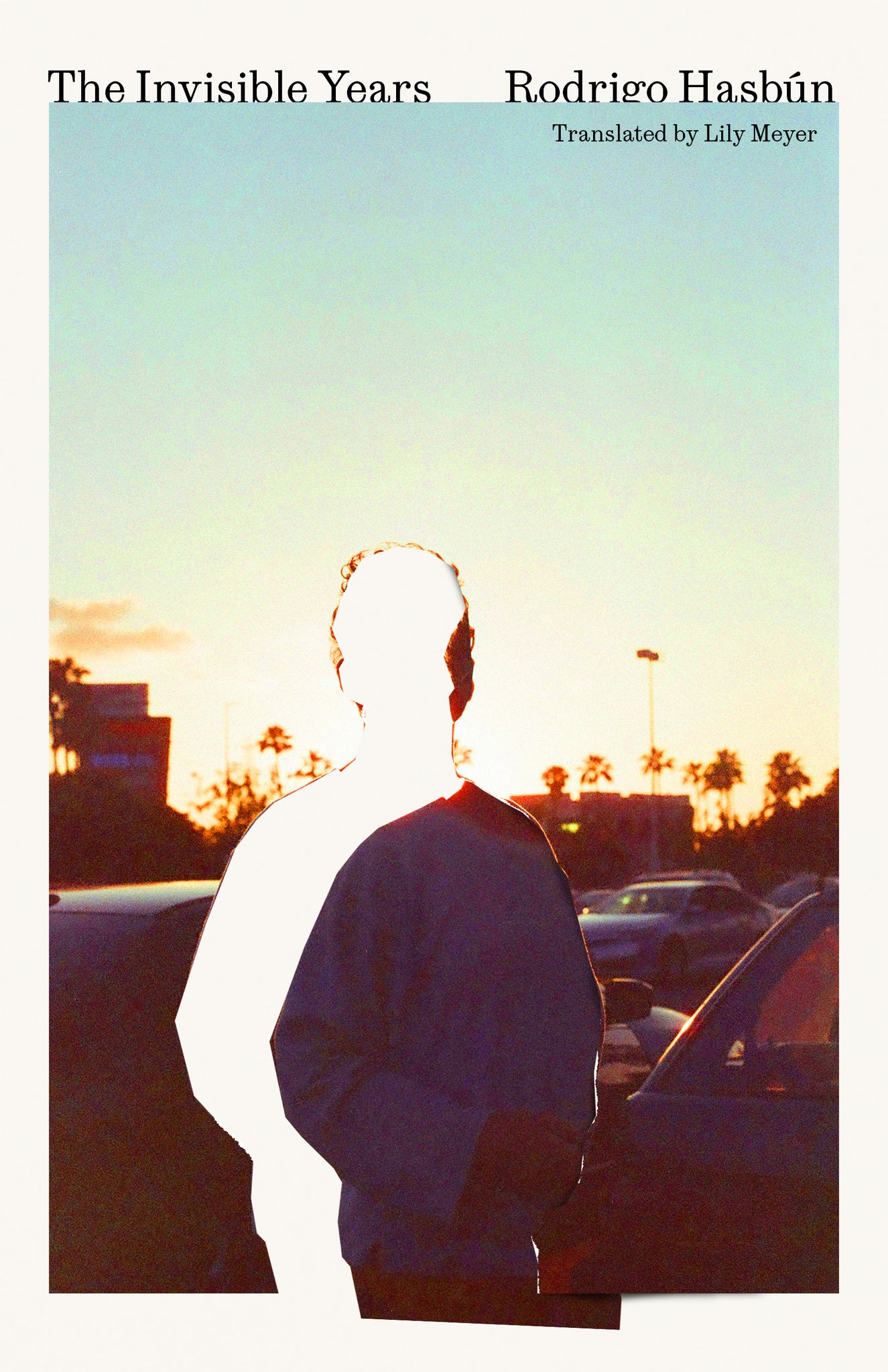
Except that sometimes they did. Sometimes those teenage experiences prove impossible to move past because they were, in fact, so exciting, so tragic, so intense, or so consequential that they continue to shape, haunt, or oppress you for the rest of your life. Bolivian author Rodrigo Hasbún’s 2019 novel Los años invisibles braids together heightened versions of two such stories, both of which are staples of coming-of-age fiction: a student-teacher relationship and a teenager having an abortion. I hesitate to describe Lily Meyer’s thoughtful new English-language translation of the novel, titled The Invisible Years (Deep Vellum, 2026), as enjoyable due to the book’s harrowing conclusion, but it does make for an engaging, provocative read that provides further evidence of the creatively uninhibited approach to narrative that Hasbún displayed in his 2017 English-language debut, Affections.
Both adolescent threads in The Invisible Years are set in Hasbún’s hometown of Cochabamba, Bolivia, in March 1997. In the first, sixteen-year-old Ladislao falls into a sexual relationship with his English teacher, Joan, an American gringa who’s twice his age; in the second, Ladi’s classmate Andrea chooses to have an abortion rather than give birth to an unwanted child fathered by Humbertito, her aggressive boyfriend of eleven months. The two stories collide in the book’s final chapter, wherein the events during a party at Andrea’s house further upend her world as well as those of her classmates, her family, and her entire community. Or as she succinctly puts it: “Our lives would’ve been completely different without that party.” These narratives are further entwined by a metafictional third thread set in Hasbún’s current home of Houston, Texas, over a single night in 2018. In that timeline, Hasbún’s authorial avatar, Julián, who is the childhood best friend of the fictional Ladislao and the real-life best friend of the inspiration for Ladislao, interviews the real-life inspiration for Andrea. Throughout these chapters, Hasbún refers to the real-life models for his fictional characters as “the woman I’m calling Andrea,” “the man I’m calling Ladislao,” etc. (For concision, I will use quotation marks around the 2018 versions of the fictional characters, so “Andrea” is the real person who inspired the character Andrea, etc.)
Much like the adolescent experiences that Ladislao and Andrea have been weighted down by for two decades, the twin narratives about them are stories that Hasbún himself has been carrying for years. Ladislao’s tale is an expansion of several autobiographical short stories included in Hasbún’s untranslated 2011 collection Los días más felices, and Andrea’s narrative was first written in 2004 as an ultimately unrealized screenplay by Hasbún and his friend Martín Boulocq, a Bolivian filmmaker. That Hasbún should continue to revisit these deeply personal stories is intriguing both with respect to the novel’s larger theme about the unshakable persistence of our past, and in light of a moment when “Julián” tells “Andrea” that he doesn’t think you can “narrow the gap” between life and literature until you have turned forty. While plenty of successful authors would disagree, it’s worth pointing out that Hasbún was just thirty-eight years old when Los años invisibles was published, meaning he still might not be done with these stories.
By inserting a version of himself into the novel, Hasbún also centers the nuts-and-bolts mechanisms of fiction and, perhaps more importantly, grants himself permission to appropriate “Andrea”’s story, to use the parlance of that third rail of contemporary literary discourse. In order to facilitate this blessing, “Julián” has sent a draft of his novel to “Andrea,” which prompted her to request the meeting recounted in The Invisible Years. At first, “Andrea” asserts that she’s finally gotten past what happened at the party, telling “Julián” that she’s “single and loving it” and has conquered her demons after several visits to rehab. It’s all an act, however, as she continues to drink heavily throughout the night, and eventually asks about how they might score some cocaine. The truth, as “Julián” observes, is that “Andrea” is someone “who’s never learned to set her suffering down, who doesn’t think she deserves to let it go.” The accuracy of this impression is confirmed later in the night, when “Andrea” says, “If it were up to me, humans wouldn’t have memories.” Yet despite her continued trauma, she does not object to what “Julián” has written, partly because she doesn’t really “have much in common” with “Julián”’s version of Andrea, telling him that “it was all more chaotic and complicated than in your version.”
We meet Andrea in that fictional version immediately after she finds out she’s pregnant, though her mind is already made up. She doesn’t tell her parents, who are testing the boundaries of their newly opened marriage on separate vacations for the duration of the novel. She doesn’t tell Rigo, the longtime nanny who raised both her and her fourteen-year-old sister. And she doesn’t tell Humbertito, who comes over after school to have sex, which he does over Andrea’s objections, leading her to break up with him soon after. Instead she goes straight to Dr. Angulo, an “old family friend.” In the original novel, the closeness of the relationship is made clear when Andrea tells him, “Necesito hablar contigo,” but since English does not have formal and informal versions of address, Meyer emphasizes Andrea’s comfort level and desperation by adding a line to her translation: “‘I need to talk to you.’ She calls him ‘tú,’ not the more formal ‘usted.’” It’s a simple, effective way that a skilled human translator can keep her readers informed of nuances that will inevitably get lost in a brute-force AI translation.
Dr. Angulo agrees to help Andrea on the weekend when his clinic is closed because abortion is illegal in Bolivia, a point that Hasbún implies by having Andrea mention that “hundreds of women a year [in Bolivia] die gruesomely after running sharp wires up their vaginas.” Another, less extreme option that Andrea mulls over in case Angulo doesn’t agree to help is asking Rigo to “brew some concoction” for her, which is what “Andrea” tells “Julian” actually happened in real life since there was no Dr. Angulo for her. Everything in 1997 goes smoothly enough that when Andrea’s old BFF Laura visits just days after the procedure, the girls go target shooting prior to setting up for the big party, which allows Chekhov’s gun to burst onto the scene when Andrea tells her sister, “Don’t forget to put the gun away.”
Ladislao’s story is much more detailed, perhaps owning to “Julián”’s personal ties to the character and particularly their interactions in March 1997, when Ladi makes a music video for Julián’s grunge band, which will later play at Andrea’s party. Ladi is an aspiring filmmaker, though he has some pretentious thoughts on the art form, dismissing both Spielberg and Kubrick as “not cinema” because they—unlike his preferred practitioners Cassavetes, Jarmusch, and the avant-garde Lithuanian director Jonas Mekas—make films for money instead of just “for art or fun.” Such idealistic notions echo Hasbún’s own from fifteen years ago, an indication either of their shared dreams growing up or simply that the author imparted some of his own sentiments to the fictional version of his longtime friend.
During their first out-of-class conversation, Ladi tells Joan that Cochabamba is a destination solely for “people who had to flee something awful.” And indeed, the teacher, who is just seven years younger than Ladi’s mom, is portrayed as running away from her past traumas, including the deaths of her father and brother and the persistent emptiness years after her college boyfriend dumped her. True to his protagonist’s cinematic aspirations, Hasbún uses the novelistic equivalent of montage sequences to deliver exposition about both Joan’s and Ladi’s backstories, passages that are introduced via sentences like “From here, they launch into an unstoppable inventory of themselves.” We learn that Joan is cosmopolitan, from San Francisco, in contrast to Ladi, who has never left home. She introduces him to pot smoking and the films of Wong Kar-wai, through his painfully tragic love story Happy Together. She teaches him how to have sex and even how to go down on her, precipitating one of the more jarringly discordant moments in the novel when she asks, “Are you happy now that you’re eating your teacher’s pussy?”—a line so tonally at odds with everything else in the book that it’s laughable.
Along with trying to shape Ladi in the bedroom, Joan also endeavors to influence him as a man, starting by pointing out that he and his friends should acknowledge their privilege: “You’re rich kids who live in a bubble and don’t understand how hard life is or how your own country works.” She also cautions him that his video should not simply repeat “men’s ideas of how women are supposed to be”—advice that he ultimately ignores, and that Joan herself is guilty of flouting by taking on the conventionally male role of an abuser. In fact, the only character to point out the pernicious nature of what Joan is doing is “Andrea,” who tells “Julián” that “the gringa abused the man you’re calling Ladislao. Just because he thought he was in control, or felt like a big man, doesn’t mean he wasn’t a victim.”
Meyer adds several textual indications that show Joan is not fluent in Spanish and that Ladislao is unwilling to correct her since he wants her to like him. These instances can be as straightforward as noting that Joan sometimes changes languages when she speaks: “‘Why are you still in your uniform?,’ she asks, switching to English halfway through the sentence.” Or they can require more-nuanced intervention by Meyer. At one point in the original, Joan says, “Qué linda palabra, huir,” an exoticization of Spanish that Meyer perfectly captures by rendering the phrase: “Such a beautiful word, ‘huir.’ It’s so much better in Spanish than English.” Later Joan mentions that she started drinking yerba mate in Argentina. In the original, she says, “¿Se puede decir adicto? Me volví adicto . . . en Argentina.” Even though Ladi ignores the error, he surely notes that adicto should be adicta, since Joan is a woman, but with no way to carry this over into English, Meyer wisely gives Ladi an additional line: “I got—is the word ‘adicto?’—in Argentina.” He doesn’t tell her she should say ‘adicta.’ Instead, he asks, “Did you live there?”
Another time, Joan doesn’t understand Ladi’s usage of the Spanish verb apedrar when he says, “Hace unas semanas, después de una rave en el campo, apedreó a una vaca.” Meyer efficiently makes clear to English speakers what is going on by again adding elucidation to her translation:
“A couple weeks ago, after a rave way outside the city, he stoned a cow.”
“He—what was that word? ‘Apedreó?’’
“Threw rocks at it.”
Hasbún highlights Ladislao’s infatuation with Joan via lines like “When will he tell her he’s never been so happy in his life?” and “It’s the beginning of the unknown, and he can’t turn back from it.” Lengthy series of questions also effectively convey the boy’s angst and his occasional sophomoric slide into adolescent introspection: “Does listening to the same songs over and over serve a purpose?”; “What about continuing to turn over ideas for the video instead of giving up and accepting defeat once and for all?”; “Does his constant questioning mean he’s on his way somewhere?” As genuine as this portrayal can feel, it’s also likely somewhat divorced from what really went on in “Ladislao”’s head. We can never know, however, because “Julián” reports that eight months after he began writing the novel that becomes The Invisible Years, “Ladislao” dies by suicide.
While Hasbún’s decision to incorporate both Ladislao’s and Andrea’s stories into one novel makes sense logistically and thematically, it can be hard to buy into at a couple moments. Without discussing specific plot points at the end of the novel, and hopefully without sounding too insensitive, I will just say that what happens to Andrea at the party is an almost incomprehensible nightmare, while what happens to Ladislao is that he gets his heart broken after a weeks-long infatuation. The reader knows that twenty years later Ladislao will die by suicide, seemingly still haunted by that heartbreak, but his reaction in the moment feels melodramatic and false given everything else that happens around him, particularly in lines like “Even in the face of violence and death, all he feels is the void created by what he wishes he didn’t know.”
Ladislao’s story is unquestionably tragic, particularly since “Julián” says his friend never got over Joan, that her leaving remained “one of the greatest agonies of his life.” I wish that “Ladislao” could have gotten help trying to process everything he experienced as a teen, even if it was just meeting up with “Andrea,” because despite the burden she continues to carry, she also has the best grasp on life’s insoluble complexity: “We don’t get better with age. That’s a lie. But it’s also a lie to think that our best days are behind us. Not one, not the other.” It’s an astute, if noncommittal, encapsulation of the disparity between the novel’s narratives. And even though “Andrea” says it during her conversation with “Julián,” it feels like the clearest example of Hasbún the author trying to comfort himself as well, trying to finally shed the weight of these memories he’s been carrying for so many years.
Cory Oldweiler is an itinerant writer who focuses on literature in translation. In 2022, he served on the long-list committee for the National Book Critics Circle’s inaugural Barrios Book in Translation Prize. His work has appeared in the Boston Globe, Star Tribune, Los Angeles Review of Books, Washington Post, and other publications.

More Reviews