Abel Ferrara’s Back Pages
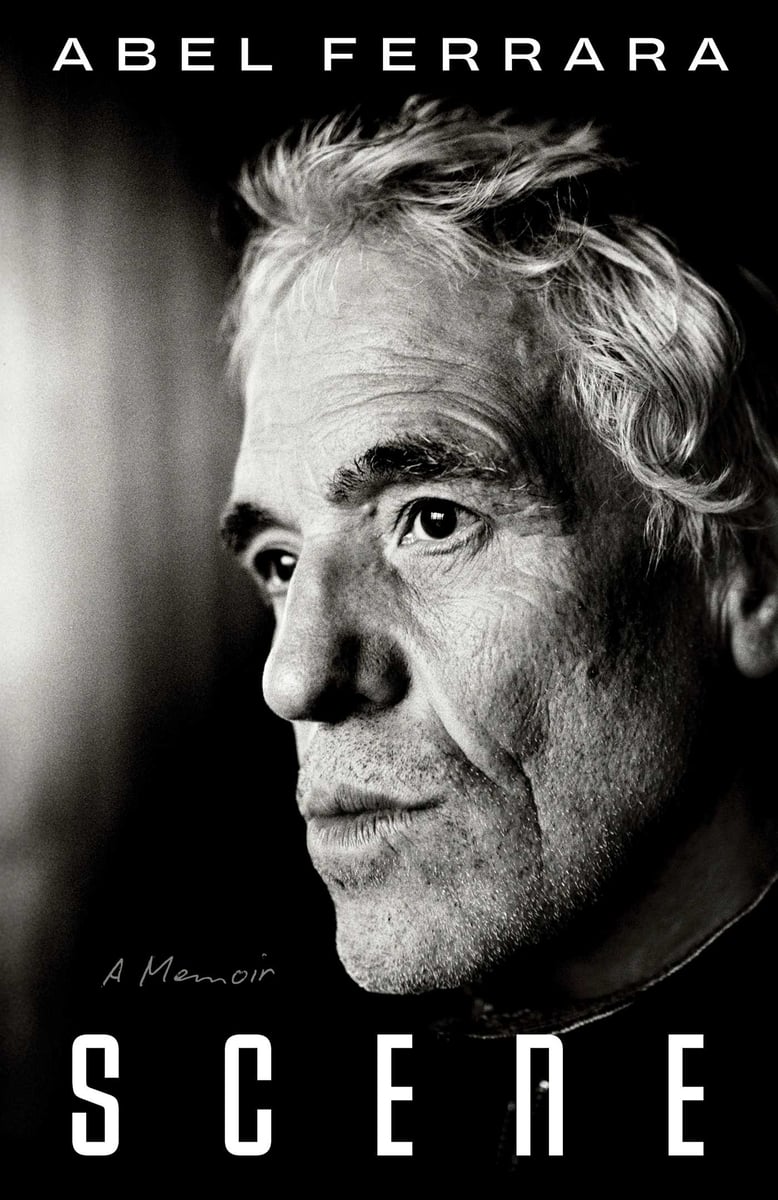
In the final chapter of his new memoir, Scene (Simon & Schuster, 2025), Abel Ferrara relates an anecdote about a fan coming up to him before the premiere of a recent film of his to tell him that The Driller Killer was one of his favorite movies and that “as a twelve-year-old boy he went to the video store and had to rent a bunch of G-rated movies and stick the X-rated Driller Killer in the middle.” The fan “went home, waited for his mother to fall asleep, then snuck downstairs to lie on the floor a foot from the TV and watch it with the sound barely on,” reporting that he’s still talking about the experience twenty-five years later.
That wasn’t literally me, but it could very well be. I remember pulling a similar trick at Wolfman’s Video around the same age with King of New York. When Bad Lieutenant came out on VHS, I had just started high school, and I still felt the need to watch it on the sly, away from the prying eyes of my mom and grandparents (in our heavily Italian American Catholic household, they would’ve certainly disapproved of Bad Lieutenant). Growing up, something always felt dangerous and desperate about Ferrara’s films. They were different from a lot of the other stuff I was seeing, tonally and otherwise. Watching a Ferrara film always felt like dancing close to the third rail. He was cut from the same cloth as heroes like Lou Reed and Jim Carroll, who toed a similar line. The images on the screen, the voices, the soundtrack, everything—there was real blood there. It’s no surprise, then, that Scene has a similar energy and vitality, a lifetime’s worth of stories condensed into an elliptical, gravel-voiced confession. It’s electric, absolutely, but it could probably be frustrating—in the same way as Bob Dylan’s Chronicles—to a reader who expects behind-the-scenes insights and gossip. This is not that book, thankfully.
Chronicles, in fact, is a perfect point of reference. While reading Scene, I’d suspected it was a major influence on Ferrara’s approach, and he confirms that in this interview with Evan Louison for Filmmaker. Instead of taking on the whole of his life and career, Dylan simply dropped into various moments across three decades in a nonlinear fashion. Ferrara doesn’t duplicate Dylan’s structure, but he does drop into moments and focus on various people and experiences in vignettes that span from childhood to the present day. Some of his most riveting and personal films (Dangerous Game, for instance) barely get mentioned, if at all. Ferrara refers to his approach as a sort of “emotional recall.” Like the Dylan book, there are moments when you might want or expect more from Ferrara, but there’s never any disappointment in whatever turn or pivot he takes. The withholding and the elusiveness are part of the joy of reading Scene.
In the final chapter, Ferrara also writes about his philosophy of art. A typical approach in filmmaking insists that a director should focus on giving the audience what they want, something tried and true. Ferrara’s response to that: “But I still don’t know what I want, and I don’t go to a theater or a museum or a concert for what I want, I go to be blown away by what you got.” A powerful rebuttal to approaching art in the most boring way possible, no doubt. One thing you can say about Ferrara throughout his career—from his earliest films to his TV work to his most recent films and this memoir—is that he always gives you what he’s got, all he’s got. He dispenses with expectations. He’s a singular artist who sees the world a certain way and reflects it back to us.
This is a book about Ferrara’s career as a filmmaker, to be sure, but it’s also about his love of literature and writing. Ferrara has a reverence for writers that’s noteworthy. As someone who is unafraid to talk shit (and there’s plenty of shit-talking in Scene), he saves his highest praise for novelists whose work he adapted or tried to adapt with varying levels of success, including Elmore Leonard (Ferrara was and is clearly in awe of Leonard, though he regrets losing control of Cat Chaser), Edwin Torres (Ferrara was originally slated to direct Carlito’s Way), William Gibson (whose short story was the basis for New Rose Hotel), and Jack Finney (Body Snatchers is an adaptation of Finney’s novel The Body Snatchers). Two of his most profound relationships and collaborations are with his childhood friend and longtime screenwriter Nicholas St. John and with actress/writer Zoë Lund. Ferrara writes tenderly and beautifully about them both. St. John penned ten scripts for Ferrara from 1976 to 1996, including many of his best pictures (The Driller Killer, Ms. 45, King of New York, Dangerous Game, Body Snatchers, The Addiction, The Funeral—I should probably just list them all, ha); and Lund starred in Ms. 45 and got cowriting credit on Bad Lieutenant with Ferrara, though she claimed to have written it by herself.
One of the more heart-rending chapters in the book has to do with the dissolution of Ferrara and St. John’s personal and professional relationship—St. John, it seemed, yearned for a quiet family life, while Ferrara drifted toward excess. And Lund is, as she was in life before her early tragic death, a star here. Probably my favorite section has to do with the script that Ferrara and Christopher Walken commissioned from her on the life of the porn star John Holmes, getting back a massive script with wall-to-wall margins, overflowing with descriptions. Walken found it unreadable, but Ferrara marveled at Lund’s genius. The movie was never made. “The films you don’t make only exist in your dreams,” Ferrara writes. The chapter where Walken and Ferrara visit Lund, a heroin addict with pet rats, to discuss the Holmes project is unforgettable.
Speaking of heroin, Scene is a chronicle of addiction, tracing Ferrara’s long journey to sobriety. The son of an alcoholic, booze factors into his life from an early age. In his teens, he discovers weed. He gets into crack and heroin later, and gets in deep. He somehow writes about drugs in a way that makes you immediately and simultaneously want to get high and never ever go near the stuff. He has a lot of regrets rooted in his addictions, especially when it comes to his family. He portrays his struggles in raw, spare prose. In that same Filmmaker interview with Louison, he notes that Scene “[is] a book about change.” It is. In terms of his craft, Ferrara has always been and will always be uncompromising, but that doesn’t fly in the face of his ability to grow and change. Think of that classic Dylan line from “My Back Pages”: “Ah, but I was so much older then / I’m younger than that now.” That’s the feeling you’re left with at the end of Scene. At seventy-four, Abel Ferrara might just be getting started.
A couple of postscripts: (1) I read a galley of Scene several months ago. When I revisited it in the lead-up to writing this review, I was encouraged to listen to the audiobook, which I did. I don’t listen to a ton of audiobooks and rarely prefer encountering a book that way first. I like to listen to books I’ve already read several times and, of course, so much depends on the narrator. Ferrara reads Scene himself, and it might be the perfect way to experience the book and might be the best time I’ve ever had listening to an audiobook. That voice. In any case, definitely read and listen.
(2) I’ve listened to Marc Maron’s WTF podcast for a long time and—like a lot of folks—I was sad to see it come to an end. The final episode with President Barack Obama was fine (though the second-to-last episode with Maron solo was far more emotional), but I’d held out hope that Ferrara would be Maron’s last guest. I don’t know why. I can’t recall Maron ever discussing Ferrara’s films, though it seems likely they’re up his alley. But the timing with the release of Scene would’ve been perfect, and I think they could’ve and would’ve had a compelling conversation about making art, sobriety, change, and more. In any case, like the films that don’t get made, the conversations that never happen exist only in dreams. Here’s to hoping I hear that conversation in a dream somewhere down the line.
William Boyle is the author of the novels Gravesend, The Lonely Witness, A Friend Is a Gift You Give Yourself, City of Margins, Shoot the Moonlight Out, and Saint of the Narrows Street. His novella Everything Is Broken was published in Southwest Review Volume 104, numbers 1–4, and he co-edited (with Claudia Piñeiro and Frances Riddle) the noir issue (Volume 108, number 3).

More Reviews