Blessed Are the Composers | Rereading Frank Stanford in the Light of Truth
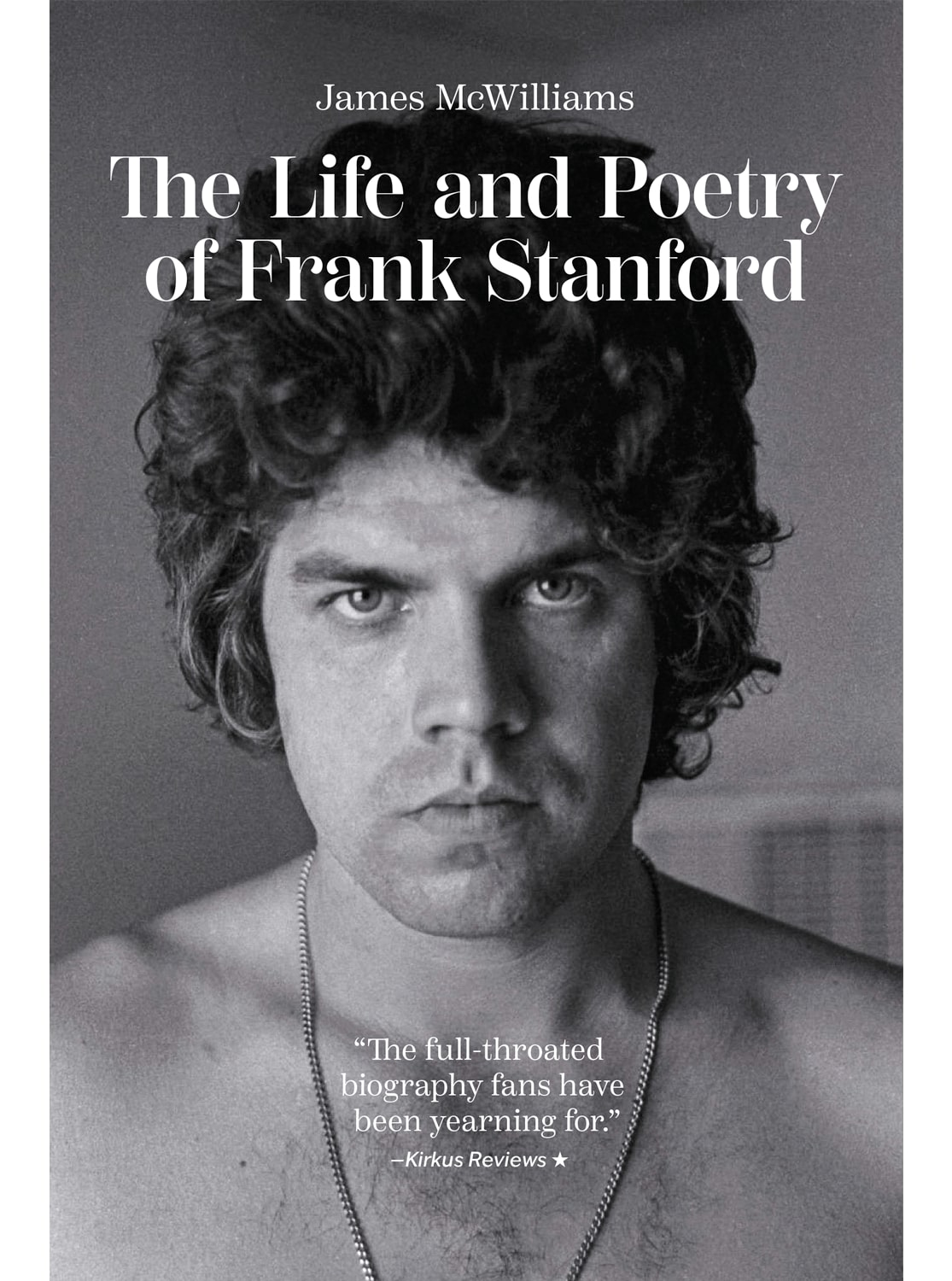
More than ten years ago, as I was researching the life of the beloved but obscure poet Frank Stanford, Sam Gwynn told me, “No one will know the absolute facts of Frank’s early childhood, but it’s pretty clear from his poetry that he felt he was anointed in some obscure way.” Gwynn, one of Stanford’s fellow graduate workshop members at the University of Arkansas in Fayetteville, was mostly correct. In truth, no one had yet been able to puzzle together an authoritative gospel of any stage of Stanford’s life. This has shifted in the past couple decades: first with several terrific essays about him and his work published in high-profile journals and magazines, then the publication of What About This: Collected Poems of Frank Stanford, and now with James McWilliams’s The Life and Poetry of Frank Stanford (University of Arkansas Press, 2025). McWilliams’s deeply sourced biography strips the mythic cladding from the poet’s life and replaces it with something elaborate yet simple—arguably more human. Stanford’s life was marked by contradictions, brilliance, obsession, and ethical murkiness. McWilliams does a wonderful job recontextualizing Stanford’s poetic output as not simply “surreal,” Southern gothic, or dreamlike, but as a layered act of revision, translation, self-invention, and cultural critique. In The Life and Poetry of Frank Stanford, the poet is no longer relegated to being—as Lorenzo Thomas once called him—the Poet of Death. Instead, Frank Stanford lives and breathes on every page.
If you’re unfamiliar with Stanford, you should know there’s a verifiable (occasionally certifiable) cult celebrating his life and work. His fans, gripped by his unique style, mythic story, and untimely death by suicide at the age of twenty-nine, are often enchanted the first time they encounter a few lines from him. I know this from experience, because that happened to me, once, long ago, in an undergraduate poetry workshop. This is not to say that Frank Stanford is a famous poet. Despite this (growing) number of followers, and publications about him, he’s still not widely read by English majors and grad students across the country—and therefore unheard of outside the world of poetry. Though his poetry is truly unique—and often transformational for writers stumbling across him—the other, unspoken draw to Stanford has always been the cultural one-upmanship, the anti-mainstream signaling he yields to those looking to wield it. His is the book one might place into a friend’s hand and say, “You’ve probably never heard of him.” The Frank Stanford myth is one of a rugged male poet, unwilling to sacrifice his artistic lodestar in the name of his art and independence. To some, this conception of the man is undeniably attractive.
McWilliams carefully frames why Stanford has been neglected by mainstream readership and rarely anthologized in comparison to his contemporaries. As McWilliams writes, the neglect of Stanford’s work “reminds us how and why exceptional art can slip through the cracks and languish as oblong pieces hard to fit into boxes made by well-connected tastemakers, relegated to obscurity by forces and factors the gatekeepers notice but for whatever reason shut out.” What follows in The Life and Poetry of Frank Stanford is a book-long explanation of how the poet self-subverted his career by refusing to bend to the will of the elite tastemakers of his time and running away from the fashionable and influential. Inversely, he proves without question that Stanford often maneuvered, hustled, lied, and did his best to flatter those who could advance his legend. You see, in almost every aspect of his life, Frank Stanford—an ambitious writer of ungodly talent not only burned the bridges he crossed but then set the rivers beneath him ablaze for good measure—lived in paradox.
Readers will have to wrestle with what this biography presents, and what that might mean for the legend they have built inside their heads and hearts. Stanford’s narrative has been successfully controlled by his version of events and by those closest to him—his habit of lying, obscuring his age, and even fabricating submissions (hilariously, Seventeen published him under the assumed name Francis Gildart). For me, the value of this book is its clarity; how it helps us to see through the artifice by showing us the way things truly happened. Often, the truth is right there in the poems. When speaking of Stanford’s epic poem The Battlefield Where the Moon Says I Love You (perhaps the longest American poem ever written), McWilliams says, “we can infer that the poem is deeply autobiographical. But it is not an autobiography.” This is a nice way of saying much of that poem comes from a true place, but that it likewise serves as a revisionist biography of the poet’s Southern upbringing. Yes, Stanford and his sister were adopted and not formally told about it until later in life. Yes, his adoptive father Albert Franklin Stanford was a civil engineer who was responsible for the system of levees that held back the Mississippi River. Yes, in the summertime, Frank Stanford lived in those same levee camps deep in the Delta (most notably Snow Lake, Arkansas). Yes, with only a few exceptions, the Stanfords were some of the only white folks in the camps, and Frank played almost exclusively with his sister and the Black children of the laborers. Yes, O.Z., Tangle Eye, Born In The Camp With Six Toes, Baby Gauge, Ray Baby, and Jimmy were real people with real histories and futures, all of whom this book covers in great detail. Yes, Stanford attended Subiaco Academy where he studied classic literature with priests and monks. Yes, as an undergraduate at the University of Arkansas in Fayetteville, he was noticed by Jim Whitehead and invited to participate in the storied MFA program’s poetry workshop. Yes, he was married to painter Ginny Crouch Stanford in Missouri while also living with his lover then-graduate-poetry- student C.D. Wright in Arkansas. Yes, he did die by suicide after shooting himself three times in the chest with a target pistol. These elements, all true and part of the Stanford lore, are covered well in The Life and Poetry of Frank Stanford. It’s McWilliams’s inclusion of so much information between these cracks that makes this biography the most complete account of Stanford’s life to date.
Another central preoccupation in McWilliams’s biography is his exploration of how Stanford’s work (especially The Battlefield Where the Moon Says I Love You), serves as a self-modified biography of Stanford’s coming of age in the South. He also explores, deeply, how Stanford wrote about race, and interacted with and confronted the realities of the privileged first half of his life. As McWilliams writes: “Understanding the nature of Stanford’s revisionism lends rare insight into the adult Stanford’s changed perspective on race and the cultural cost of young Frank’s privilege as a boy growing up in Memphis, a city with rare opportunities to cross racial lines that, at the time, he rarely crossed.” Stanford had grown up playing with the Black children of the levee workers employed by his father each summer and virtually idolized the family’s Black chauffeur driver Charlie B. Lemon (who became a character in multiple Stanford poems). This was the same Stanford who, while at Subiaco Academy, sometimes donned a rebel cap and hung the Confederate battle flag in his room. McWilliams provides some clarity when he writes about how age and maturity changed Stanford:
As [Stanford] was conditioned to do, he experienced race without knowing he was experiencing it. But the older Frank, as he revised The Battlefield, was a different person requiring a different past, one that reflected his awakening to a new language, a new manner of understanding and experiencing race, culture, and justice. Frank Stanford thus wrote about Memphis as a grown man aware of the deeply implicit racial assumptions that shaped his upbringing. Hindsight, which unifies all the history we need unified, allowed this.
Frank Stanford had to do some reckoning with the realities of life in the South, and with his grasp on race as he aged. “To blame a child for not recognizing this reality would be unfair. To marvel at the way that child, when he became a man, returned to it and critiqued it in a way no American poet had is to acknowledge a voice that we still need to hear,” says McWilliams, poignantly.
McWilliams’s detailed examination of Stanford’s poetry is occasionally dazzling, and on this particular subject, he shines. He writes later in the book, “The Battlefield Where the Moon Says I Love You offers a kind of shadow biography of Frank Stanford’s life in Memphis. Stanford is showing us the history of what he missed and later, as a poet looking back, found.” It wasn’t until he moved to Fayetteville as an undergrad at the University of Arkansas that he began to escape his early oblivion and retrospectively critique both his stance on race and how he would confront, through what he wrote and how he revised for the rest of his life, what he now saw as despicable. Because of this unique blend of history and Stanford’s delight, similar to Whitman’s, in finding the voice of the common man in his poetry, he has been accused of appropriation. McWilliams—and those who best knew Stanford—argue that it should instead be called witness.
Such paradoxes make this new biography eminently readable and revelatory. I am certain a whole host of scholars once thought they would undertake a project such as McWilliams’s, but gave up when they realized how it would overwhelm them. How does one write a book about a man who lived such a complicated, opaque life? As McWilliams tells us, “In 1997, [C.D. Wright] wrote a letter to a potential early biographer of Frank Stanford, warning him that Stanford, while “funny, profound, mythic, sexual,” was also a liar. “At lying, as well as writing,” she warned, “he knew no match.” Wright, winner of a National Book Critics Circle Award, and Stanford’s lover and protégé while he was married to Ginny Crouch Stanford, his second wife, would know a bit about Stanford’s capacity for deceit. The book casts doubt on both women’s long-held assertion that neither knew the extent of Stanford’s relationship with the other (he told Ginny that C.D. was a lesbian and a business partner, and told C.D. that Ginny and he were married in title only). Poet Leon Stokesbury, sometimes-rival and close friend to Frank Stanford once told me when I was doing my research for a graduate school thesis:
There is no one that I have ever met who was as completely into self-mythologizing as Frank was. And no one who was as successful at it. His great gift was verisimilitude, as much as any poet I know. But remember, that does not mean what he wrote, or said, about himself was an accurate reflection of the real world. This preoccupation with his past, a rewriting of his history, an attempt to define who he is, or rather invent a history for himself because he did not feel like he knew who he was is at the center of his work. He was a wonderful poet and a unique and special man, but he was the biggest liar I ever met.
Thankfully, McWilliams spent years in the darkroom, sifting through all the many negatives of Stanford’s (and countless others’) lives. I imagine him now, dipping each paper into the three trays, agitating them as he waits for each full picture to clarify to show how the moments happened—how they developed. And then, with care, how he would have to hang them on the line and decide how he might best tell the baffling, convoluted story, and how to order it.
Because of the nature of McWilliams’s research—which seems to include every available thing: letters, journals, notebooks, receipts, ledgers, down to an interview with a woman whose son mowed Stanford’s lawn—we become privy to how Frank Stanford moved through life. Much of it might break your heart. Stanford was a man who, as McWilliams puts it, possessed a “periodic self-absorption and habit of reducing people to functionaries serving his interests.” In a letter to poet Alan Dugan, Stanford once wrote, “I’ll never be faithful to one person.” This was true to the end, and it was true, especially with the women in his life. And there were many. This biography fixates on Stanford’s extensive life of love and lust. This unbridled sensuality and its unbreakable bond to the poet’s art is a major component of what made his myth. Stanford, we’re told, at times was sleeping with five, ten, twelve women. Some of them married, some of them underage, and all but two of them were not his wives. During a one-month trip to New York to visit an ex-lover named Cheryl, he had six different lovers. In one section of a letter he sent to his longtime friend Bill Willett, Stanford wrote, “I seek out the mystery of all women. With some it takes seconds, others years. Like a priest, I transubstantiate the body + spirit one into the other. Once this is done, whenever I look into one woman’s eyes, I see yet another woman.” McWilliams writes:
He treated these women poorly in many ways, and his mistreatment of them created considerable personal distress, an emotion often evident in [his] poems. Bill Willett observed that, when it came to women, “Frank imagined himself the hunter when he may have been the prey.” This comment suggests not only that women went after Frank as much as Frank went after women but also that when he caught them, or they caught him, everybody ended up wounded.
With every disturbing impulse Stanford succumbed to, whether it was alcohol or adultery, whatever small lie that became a bigger lie and separated him from friends and loved ones, whatever it could be attributed to—including his mental health—Stanford’s story as narrated by McWilliams, makes one want to both admonish him and celebrate him at once.
Even the most dedicated Stanford scholar will learn much from McWilliams’s book. For instance, I’ve held a theory for as long as I’ve read the poet, that Stanford not only knew about and understood prosody and syllabics, but wielded that knowledge in beautiful and surprising ways. Though his workshop mates mostly brushed this off in my conversations with them (chalking it up, understandably, to his preternaturally “perfect pitch”), McWilliams verified it by looking at undergraduate essays Stanford wrote for Jim Whitehead in the program at Fayetteville. For example, in one of those essays (on James Dickey’s Buckdancer’s Choice), Stanford—at twenty years old—discusses the complexity of the verse including swift anapestic moves, how they align with the “doggerel of fifteenth-century English poetry,” and how Dickey bucks against contemporary poetry’s “successions of unstressed syllables” by writing in unpredictable rhythms “with images that claw.” This is one example, but Stanford absolutely knew how prosody worked, how it could couple with image to make meaning, and he was putting it all together as an undergraduate who started college as a business major to make his mother happy.
A few years later, when Stanford was interested in translations, he wrote several poems that included the signpost “after” below the title (e.g., “after Jean Follain”). This move, usually reserved for homage, signals that a poet is in conversation with another work. Stanford wrote that his poem “The Intruder” was “after” Follain. Upon closer examination, “The Intruder”—one of my favorite Stanford poems—is a recreation of Follain’s “Exile.” It’s noted as an “after” poem, but it’s an almost direct translation (with Stanfordian settings and objects placed carefully throughout). McWilliams notes that this is similar to what Robert Lowell was doing at the time with his period imitations, “seeking something between a translation and a tribute.” If I’m honest, for me, this strips a bit of the beauty and mystery from “The Intruder.”
Because of this newly illuminated glut of information and backstory, readers must reckon with what I believe is the central tension of this book: Does it demystify or deepen the Stanford legend? In some ways, for better and for worse it does both. After I read The Life and Poetry of Frank Stanford, I went back to The Singing Knives, Stanford’s first book. Then Ladies from Hell and Field Talk. Then Shade and Arkansas Bench Stone. What once felt otherworldly—these poems that had made me feel as if I were living in a black and white film as a samurai floating down a river on a raft—were now grounded in the well-researched reality McWilliams presents. Stanford’s poems were reframed—in my eyes—not as mystical visions, but as re-imagined memory and reportage. Though this commonly occurs when studying a poet’s life and then reading his or her work, in the case of Stanford, I could orientate myself in a way I’d only partially been able to do before. His lines rattled me less. The speaker in Stanford’s poem “The Mind Reader” proclaims, “blessed are the composers nobody will listen to.” In all my days reading biographies and long-form essays about artists, their work, and their often fascinating lives, McWilliams’s important new book is near the top of the list of the very best of them. It belongs on your bookshelf, and its meticulous attention to every detail astonishes. I hope McWilliams’s long-necessary biography will persuade readers to experience Frank Stanford for the first time or convince those who have read him to return to him and listen. While many readers will likely enjoy using this biography to gain a more solid footing in Stanford’s poems, I recommend reading the Collected Poems before ever opening McWilliams’s book. Then, read The Life and Poetry of Frank Stanford—the best, most exhaustive, and exhausting biographical source on the poet—and decide for yourself whether James McWilliams has slayed Stanford’s myth or clarified it.
Elijah Burrell is the author of the poetry collections Skies of Blur (EastOver Press, 2024), TROUBLER (Aldrich Press, 2018), and The Skin of the River (Aldrich Press, 2014). His work has appeared in publications such as AGNI, The Hopkins Review, North American Review, Crab Orchard Review, The Rumpus, Sugar House Review, and Measure, and has been featured on the Slowdown podcast. Since 2012, he has taught creative writing and literature at Lincoln University, where he serves as Professor of English and received the 2023 Missouri Governor’s Award for Excellence in Education.

More Reviews