Breaking the Silence
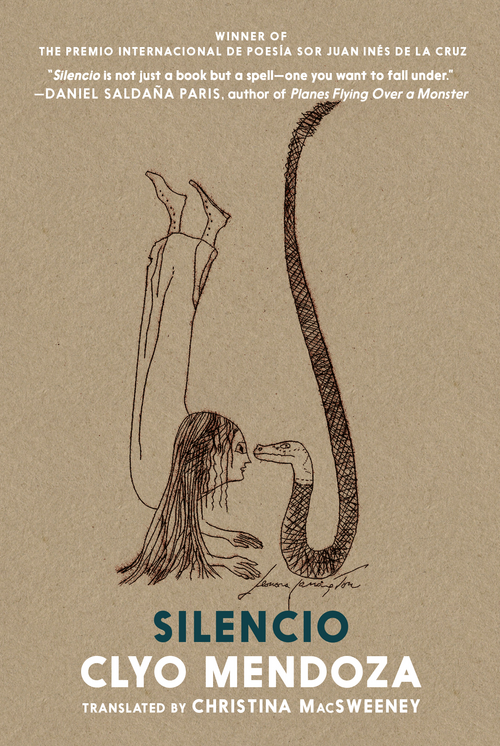
Mexican author Clyo Mendoza’s 2018 book Silencio begins with a young woman poisoning herself, a death undertaken in—and greeted by—silence. The dying woman, we are told in Christina MacSweeney’s excellent new English-language translation of the book, which retains its original Spanish title, is seeking “a hiding place,” an escape from a country and a world where “thirst and hunger have become a weapon.” The word silence appears more than two dozen times in the slim book, usually to describe an atmosphere, as with the silence accompanying the woman’s death. But the first time the word appears, in an epigrammatic introductory scene, it carries a threat of violence, the woman’s daughter wordlessly pleading with her mother to weep noiselessly, to “be silent or he’ll come to silence you.”
Silencio is a collage of poetry, prose, fiction, and nonfiction, recounting the stories of Indigenous people, mainly women and girls, from Oaxaca, where Mendoza grew up. The book’s title and the recurrence of “silence” in its first two chapters makes clear that Mendoza wants her readers aware of, focused on, and sitting with the silence, unfamiliar and perhaps uncomfortable to her readers, that attends the lives of these women and girls, women and girls who live and die in silence and in fear, women and girls for whom silence is not only a condition, but a necessity, of life. An omniscient narrator relates the book’s primary story, about Águeda, the adolescent daughter of the woman whose death by suicide opens Silencio. Both the girl and her dead mother add their individual perspectives throughout the book, as do some of the animals around them and the literal stones beneath their feet and in the adobe walls of their homes. The stories of these lives are supplemented with excerpts from a military-training manual, testimonials of Indigenous women who have sought refuge in foreign countries, and a first-person epilogue from Mendoza that alludes to her ties to all that preceded it.
The book’s original text includes characters speaking not only Mexican Spanish but the endangered and vanishing languages of Zapotec, Isthmus Zapotec, and Tacuate, all languages that the Catholic Church historically played a role in suppressing as part of its efforts to convert Indigenous populations. In Silencio, the church assures that the mother, who grew up speaking Zapotec, will not be buried in the cemetery due to the nature of her death. Zapotec, “the language of steel and grass,” was once among the most commonly spoken languages in Oaxaca, but it has become one “of secrets and disobedience.” God speaks the language of the church, a language where “suicide doesn’t deserve hallowed ground,” while in “the language of steel and grass,” death is not hierarchical, and it doesn’t “involve eternal flames or the supreme clarity of a God in clothing.”
Mendoza’s sparing usage of these Indigenous languages in Silencio is not a “grandiloquent gesture” aimed at “saving” them, MacSweeney writes in a translator’s note, but more of a recognition that their speakers “both in Mexico and the diaspora in the United States” would take pleasure in seeing them appear in print. MacSweeney could have treated these passages like the bulk of the novel and just rendered them in English, a path that she admits “might perhaps have been simpler.” Instead, she retains them—an immeasurably beneficial decision for her readers. Even better, she provides English translations of these passages, most of which are brief dialogues or songs, in parallel or sequential text as might be seen in a dual-language book of poetry. This is an especially effective solution that makes the English and Indigenous languages appear almost in conversation with each other.
MacSweeney is a prolific and skilled translator whose work is always a pleasure to read, and Silencio abounds with great writing, as in this deliciously eerie sentence: “Her belly has niches for the fish, and the dark fish of ocean trenches grow in her feet.” (The choice to translate fosas as “trenches” picks up all the consonants in “niches,” which is a small thing but the kind of small thing that is critical with a writer so attuned to language.) Mendoza’s prose is intensely poetic, laden with imagery and rhetoric, especially repetition that draws readers into the world she is depicting, as with a pendulum swinging back and forth or a metronome. She leans on anaphora, as with the variations on “There are houses . . .” that open parallel pairs of observations in the third chapter. And other phrases are introduced early then echoed late in the book, including “sibilant descent,” a reference to the whiteness of a back tooth, and the memorable sentiment “how wearisome it was to carry one’s blood everywhere.”
Violence is a constant for the women in Silencio. The mother, whose anonymity imparts a universality to her life and death, was just thirteen years old on her wedding day. She recalls having to wash her “bloodied hands” in a puddle after slaughtering her pet goat to feed her new husband. Marriage hopefully brings financial security but not physical safety, and the mother explains that the risk of dying in childbirth is so great that women start sewing their death shrouds as soon as they marry, shrouds that they embroider together in the afternoons while sitting “in silence, always in silence.” And the abuse, physical and psychological, begins long before marriage. Coincident with her mother’s death, Águeda’s father marries a fourteen-year-old he has impregnated. Águeda acts out at the wedding and her father flogs and beats her—her “skull thundered like horses’ hooves galloping over all things”—before tossing her into a half-completed house he is building for his lover.
Águeda is imprisoned in the house for “a year that would never return.” She is fed beans, tortillas, and hot sauce once a day; because there are no mirrors in the house, she “pisses on the floor to remember her face.” The mistreatment by her father feels almost inextricable from his vocation as a marijuana (and possibly opium, given a reference to the “hidden fields of red plants”) grower for narcos in the North, a location where he has slept with hookers and “learned how to decapitate.” But the girl also recalls similar abuse from her mother, abuse she mentions with an almost blasé equanimity: “I remember the blows, the raised fists, the taste of her bread, home-baked in the adobe oven.” And at another moment: “My mother would lock me in a room when she caught me crying. My mother was beautiful.” True comfort for Águeda comes from her memories of Pedro, a boy she knew before her imprisonment. In imagined letters, she vows, “When I get out of here, I’ll find a place for us to be together.” She keeps her vow, in a way, and the two have a brief, passionate romance. However, Águeda’s father has other plans for his daughter, having promised her to a man in the North. The situation doesn’t play out as nightmarishly as it could for the girl, but it’s deeply tragic, before Mendoza offers the most ephemeral glimmer of hope.
While Silencio emphasizes that the lives it documents are precious, they are also, like all human life, insignificant in the broader scope of history and the geological scale of the planet. The afterlife for Águeda’s mother is portrayed as the sea, or at least “what she dreamed was the sea, because during the twenty-nine years of her life, she had only known the sea by imagining it in the clouds of the barren, rocky sierra sky.” This metaphor allows for a cyclical, ongoing conception of life, death returning the body to the elements, to the earth, to the amniotic fluid of conception. It also provides some of the book’s most beautiful imagery, as with a description of the moment of the mother’s death:
Her body falls into a torrent, or she is a garden stream.
She is rain or blood.
She is the surging flood that uproots trees and drowns the horses drinking on the banks, the water in which a child is bathed, and the small puddle reflecting the night.
For Águeda, however, her mother persists in another element, fire, her spirit and voice consumed by flames due to the Church having hammered home its message about hell, resulting in Águeda only being able to picture her mother on a burning pyre.
Mendoza also uses the earth itself to impress just how transient a human lifetime truly is. Early on, the broken stones used to make the adobe walls of the mother’s home attest to the dying woman’s fragility: “So many years here, wearing down, watching, so much time needed to convert a mountain into this small rock that scrapes off a piece of the woman’s skin when she falls.” Silencio offers other examples of lives shortened, altered, or ended, some of which are specific and some of which seem (at least to this American reader) more allegorical. An orphan, known only as the “child who never closed his eyes,” is killed by a soldier who enlisted to make his mother proud. An activist—“we might be hungry, but we still have tongues”—is murdered. An enigmatic bird, introduced as “piece of sky that enters through the eyes,” alludes to what are perhaps specific moments from Mexican history, including a massacre of children by military troops and the killing of the last of the Tacuate people. And three women, identified by their first names, offer brief statements about their lives in the United States. One of them, María, who “is in flight from a neighboring country we know nothing about,” seems to be speaking to Mendoza at some sort of detention center. She concludes her story with a harrowing observation about the conditions into which she has escaped: “That man raped me hundreds of times during the journey and now he sleeps here, under your protection, we eat the same food in the shelter, we are equals here.”
The book returns to the focus on silence near its conclusion, presenting an example of life beginning in silence much the same as the mother’s life had ended. The mother laments that people are “so easily broken” but knows that, whether broken or dead, she must not let her existence be erased, her memory be forgotten: “The more witnesses, the more shared silence, the more muted anger.” Mendoza’s epilogue makes clear that she found a way out of the area (if not necessarily the exact situations) she has written about in Silencio. Regardless of those specifics, by attesting to the lives she observed, Mendoza adds her voice to those of Mexican writers like Valeria Luiselli, Cristina Rivera Garza, and Fernanda Melchor who have also made clear to varying degrees that their fiction is at least partly fueled by anger, aimed at documentation, dedicated to preservation, committed to memorialization. Having borne witness, they feel compelled to speak up. Having borne witness, they cannot sit in silence.
Cory Oldweiler is an itinerant writer who focuses on literature in translation. In 2022, he served on the long-list committee for the National Book Critics Circle’s inaugural Barrios Book in Translation Prize. His work has appeared in the Boston Globe, Star Tribune, Los Angeles Review of Books, Washington Post, and other publications.

More Reviews