Call It Ithaca
My quiet, recondite corner of the city of Buenos Aires was known as Ciudad Feliz, literally happy city, when its territories were auctioned off in 1906. Villa del Parque, as this rather secret neighborhood is now known, lies behind the Chacarita cemetery and Agronomía, the park (and agronomy college) that gave this territory its current name when the railroad station was inaugurated in 1907. Only one train line passes through here, starting to the north of the city, southwards and then into the northern reaches of our endless, mysterious suburbs, our lifeblood.
Villa del Parque is rather suburban, with low, split-roof English-style houses and narrow streets, and no subway. It was once a rich man’s literal villa and farm—the great house, since demolished, was on my block, where a minor location of a state-owned bank now rises between a shoe repair store and a cheese-and-cold-cuts store. The neighborhood is known for its short blocks, product of its (now underground) streams, which once flooded often. Julio Cortázar grew up here, as did Osvaldo and Leónidas Lamborghini. In nearby Paternal lies Argentinos Juniors, the club where Diego Maradona rose to fame. “Ah, Villa del Parque . . . those parts of the city one never visits,” a would-be employer once told me.
We live atop what was my grandfather’s pharmacy for around forty years, starting in 1960 or so until he died in early 2005. He was not from residential, petit bourgeois Villa del Parque, but raised by his immigrant, factory-worker, Jewish parents in the working-class industrial suburb of Avellaneda before making it into the University of Buenos Aires, where Perón’s cops once cracked his head open. He was, at some point, a socialist, and the only intellectual in my family, though he died too early for me to much remember him. Among his books I found Lenin’s Imperialism, Kafka’s The Trial, and Bolaño’s Nocturno de Chile. Israel was his name; in Hebrew, it is also my own. His mother called him Zrule, in Yiddish, and the goyim at school called him “frule” because the sounds were unnatural in Spanish. He met my grandmother in this pharmacy—she was born and raised on this very block, in the apartment above her father’s clothing store, which is now a chain coffee shop. My father was raised in this area, though not in this house. My girlfriend and I have lived here for a couple years, and though I often insist that this neighborhood is “not for me,” it has become mine.
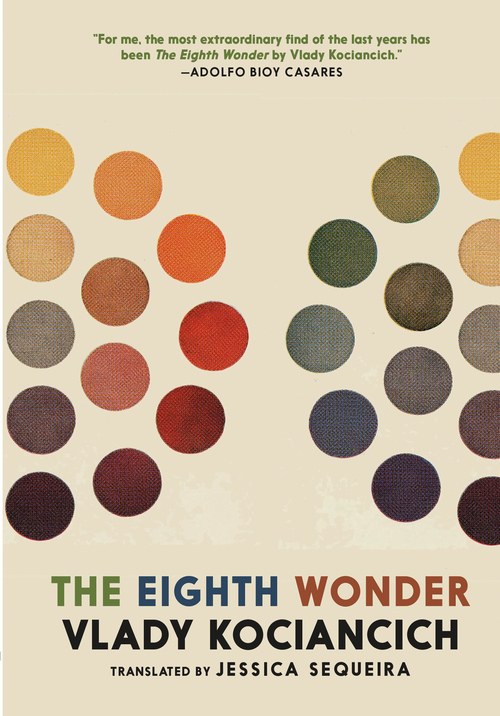
Though the reason lies beyond me, the fact remains that Villa del Parque is both forgettable and pulsating with nostalgia. The neighborhood has rather eluded fictionalization, but among its most notable portrayers is Argentine novelist, short story writer, translator, and essayist Vlady Kociancich, whose The Eighth Wonder was translated by Jessica Sequeira and published this year. The novel is set largely between Villa del Parque, in whose train station—the ordinary, late-Britannic shacks with which that country’s engineers peppered the nation—the novel opens, and Berlin, where its story reaches its climax. Its protagonist is a feckless nostalgist and liar, Alberto Paradella, born and raised in Villa del Parque before marrying the neighborhood beauty and moving downtown to Monserrat and joining a legal practice. A short way away from graduating, realizing he no longer wishes to become a lawyer but hoping to spare his uneducated parents and proud wife the embarrassment, he stumbles onto a perfect ruse and announces his intent to become a writer. He does not, however, write, though he keeps up the deception for years.
Kociancich, who died in 2022, is often memorialized as one of Jorge Luis Borges’s children. Like other writers of her generation, young enough to grow up in his shadow but old enough to have spent meaningful time with him, she studied with Borges at the University of Buenos Aires, where he taught English Literature for decades. She also studied Old English with him privately once he’d gone blind, when he asked pupils to read the tomes aloud for him. In fact, her first book, a collection of stories titled Coraje [courage], was published in 1971 at Borges’s recommendation; he also chose the name. In fact, Borges gave Kociancich (part of) her pen name, suggesting she exchange Vladi for Vlady to soften the harshness of abbreviation. Kociancich was also friends with Adolfo Bioy Casares, Borges’s closest friend and an eminent writer in his own right, who prefaced the first edition of The Eighth Wonder, her debut novel, upon its publication in 1982, during Argentina’s last civic-military dictatorship.
Paradella’s story begins and ends in Villa del Parque, at the train station on Cuenca facing the church, but also in its avenues and intersections and the family home—“a single-story building, shaped like a cube. It had a flat façade without whitewash and a patio in back covered by the obligatory vine.” We hear of its children’s society from eight decades prior—though the novel’s historicity is not specific, Paradella’s childhood seems to transpire roughly in the 1940s. Children similar to those play in the neighborhood square as I write, while a clarinetist busks Carlos Gardel’s “Por una cabeza”:
I was a child like any other in Villa del Parque, with its well-nourished, correctly-dressed, state-educated offspring of immigrant families, Spanish and Italian for the most part. The only difference I recall—my condition of being an only child—was counterbalanced with irritating exaggeration by my large number of cousins, horrible little creatures who invaded my house on Jonte Street. My friends had too many siblings, but I had too many relatives.
This idealized childhood extends to Argentinos Juniors, the neighborhood club that Paradella frequents and where he meets his closest friend, the incongruously named Paco Stein. (“I don’t know through what crevice that name—which was actually Boris, as I found out, or he told me when we no longer lived in Villa del Parque—filtered into a family as strictly Jewish as his.”) On the day that Stein “voluntarily expelled” himself from the institution by throwing the new president’s library into the “just inaugurated swimming pool,” Paradella also met Victoria, who Stein was trying to seduce but who eventually became Paradella’s wife. At the dinner commemorating his law school graduation, he announces: “I am writing.” Everyone is duly impressed and, when the young couple leave Villa del Parque for Monserrat, Paradella builds a study in which to lock himself. He acquires a Remington typewriter and, to sustain the fiction and his isolation, loudly clacks away at a transcription of a Spanish dictionary of proverbs. Victoria, for her part, maintains a lively social calendar with family and friends, respectful of her husband’s solitude.
The fiction of Paradella’s life—the fiction of fiction, of writing, upon which it rests—soon unwinds. An obsession with Anastasia Brodsky, a friend of Victoria’s, combines with the realization that his wife has been having an affair with Paco Stein the entire time. Stein, meanwhile, has slowly ceded to Paradella his job at a tourism magazine, for which he becomes if not a “writer,” then a journalist, circumnavigating the globe from one tourism convention to another. Villa del Parque is never far from his mind: the married woman from across the street with whom he lost his virginity, the drowned library of Argentinos Juniors, the Spanish waiter at the neighborhood café—he is Stephen Dedalus, Villa del Parque his Dublin.
Berlin soon enamors Paradella. In one visit, he befriends a Soviet travel agent based there, who invites him to lunch with his wife and daughter. He also begins to translate Joseph Conrad’s novella The End of the Tether. Kociancich herself worked at a tourism magazine during the 1970s, and published a translation of that Conrad text, snippets of which appear in The Eighth Wonder. She also contributed to the writing of and was briefly featured in a documentary film about Borges, Borges para millones. Paradella finds himself in a similar role: He meets Juan Pablo Miller, a Europe-based Argentine film director, at an airport, and the two later run into each other at a run-down Italian restaurant in Berlin. Miller, we learn, needs someone to write the book for his film about an Indigenous Nicaraguan poet, Francisco Uriaga, canonized globally and rather unwillingly by those institutions that make their bread from the production of novelties from the margins. The film mostly consists of a shot of Uriaga, who is almost 100 years old and insisted on being brought to Paris from Nicaragua “in a leather cot,” “a high-backed chair, baroque and gold.” Francisco Uriaga bears an ironic echo of Borges himself—impossibly ancient, immobile (in Borges’s case blind), canonized around the world rather late in life and insistently, obsessively anti-identitarian despite his readers’ insistence otherwise.
Francisco, one might add, was the name of Borges’s Uruguayan paternal grandfather, a prominent, nineteenth-century military man to whom he dedicated the poem “Alusión a la muerte del coronel Francisco Borges (1833–74).” Its final verses—“Alto lo dejo en su épico universe / y casi no tocado por el verso” [“High it left him in his epic universe / and almost untouched by verse”]—remind one of Uriaga himself, his seeming disinterest in poetry, at least as his Western audience understands it. Borges’s poem evokes a famous incident in which, seeing his forces defeated, Francisco Borges charged at a firing line by himself—an unwritten, uncelebrated epic hero in Borges’s telling, a foolhardy Odysseus of the Pampas. Francisco Uriaga, on the other hand, acceded to every condition and demand made by diplomats and cultural agents in service of his global success.
The one exception he made was leaving his chair—though Sequeira’s translation is rather inexact on this point, degrading the Rioplatense verb “transar,” which means to deal or negotiate, into “defraud.” That Miller’s recordings turn out not to have working sound, so that the man’s poems cannot in fact be heard even as his mouth is seen moving, only adds to the irony.
As we learn in the novel’s first page, the film wins the top prize at Cannes nevertheless, and Paradella’s name is nowhere on it. The fake writer who briefly wrote the words of another writer with an equally troubled relationship to writing is nevertheless erased, unmade once again. And when all is taken away, broken or unmade or shattered, what remains are Villa del Parque’s shady streets, the Ciudad Feliz’s familiar smells. Paradella calls it Ithaca—and returns.
Federico Perelmuter is an essayist, journalist, and critic from Buenos Aires, Argentina. His writing has appeared in The Baffler, New Left Review, Aeon, and Parapraxis, among others. He is a contributing writer for Southwest Review and is at work on a book about the history of silver extraction in the Americas.

More Reviews