Cultivating Emptiness
In 1932, in the depths of the Depression, Adele Crockett, a thirty-year-old museum worker, decided to move back to her family’s apple orchard, in Ipswich, Massachusetts, and see if she could make a living off the fruits of the land. Her father, a doctor in Boston, had recently died, leaving a pile of unpaid bills. Crockett’s mother and two brothers discouraged her from the endeavor; better, they said, to let the bank foreclose on the property. The family couldn’t afford to throw good money after bad. But Crockett, known as Kitty, was too stubborn and sentimental to give in—plus, she had a little bit of cash she could put toward the effort. She had grown up on the farm, and it was the site of many beloved family memories: “I could not imagine life without it: no center for the existence of the family, no link with the past. It was in the feeling, I think, that somehow I could keep the past alive and save something of the old happy days that I urged and argued until the family agreed to let me try to keep the farm from foreclosure.”
Decades later, Crockett described her experiences on the farm in a memoir, which was unfinished and unpublished at the time of her death. After Crockett’s daughter discovered the manuscript, it was published as The Orchard by Metropolitan Books in 1995. I read the book years ago on the recommendation of a friend, and I have never forgotten it. It is harrowing and inspiring, a window into an era of mass deprivation and a portrait of good old-fashioned New England perseverance. Armed with little knowledge of agriculture beyond what she had witnessed working alongside her father as a child, and living alone but for a Great Dane named Freya, Kitty dives headfirst into the exhausting, all-consuming labor of running an apple orchard: repairing equipment, hiring help, negotiating with buyers, and, of course, harvesting fruit. The fate of the apples, as delicate and precious as infants, emerges as a source of suspense, as every blight, freeze, or thunderstorm threatens to dash Kitty’s dreams of self-sufficiency. As a writer Crockett is vivid, precise, and tender, and she is as adept at distilling the economic facts of her situation as she is as at rendering the regular beauty of working in the orchard. While Kitty does live alone on the property, she is hardly isolated, and the people the book immortalizes—including neighbors, farmhands, and the various purchasers of her apple crop—vibrate with a materiality in the same way that the eyes of subjects staring out of an old photograph seem to speak to you directly: I was real. I was here. In the end, The Orchard is as much a portrait of a community as of a single plot of land.
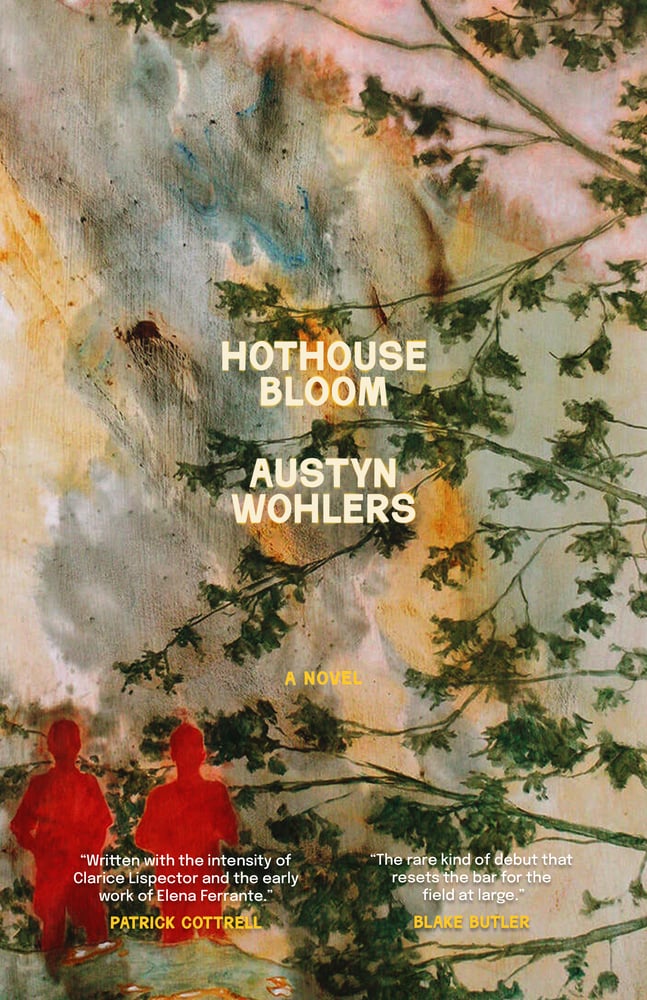
I have been thinking a lot about The Orchard since reading Austyn Wohlers’s new novel, Hothouse Bloom (Hub City, 2025), in which a naive protagonist takes on the immense challenge of apple farming. I have no idea if Wohlers was familiar with Crockett’s memoir before composing her novel, although I doubt it, given the The Orchard’s continuing—and undue—obscurity. But whether it is a conscious homage or not, Hothouse Bloom says as much about our relationship to agriculture today as The Orchard does about farming during the Depression.
Like Kitty in The Orchard, Anna in Hothouse Bloom comes into her orchard through a family connection, inheriting a plot of eight acres, including a few hundred apple trees, from her grandfather. Also like Kitty, Anna’s relatives view her decision to farm as pitiably quixotic. Calling to check on her, Anna’s mother signs off with, “Call me once you’re done dallying. We’ll get it on the market and you can come back to your life.” But Anna is not so easily discouraged, and, once again like Kitty, she is determined to make it work.
The similarities end there. Anna is not sentimental, and she is not engaged in a project of familial reclamation. In fact, she has no prior emotional attachment to the land, having barely known the grandfather who passed it to down to her. A lapsed painter who has grown disillusioned with her urban existence, Anna is looking for something far loftier and more abstract than mere survival. She seems to desire a kind of unity with the land in which all the troublesome annoyances of human life fall away. At the beginning of the novel, as she drives toward the orchard, she fantasizes about what existence there will look like: “The unblemished life, life free from human error. . . . I will no longer be paralyzed, things will flow freely into me, I will live the existence I have yearned for.”
After meeting a pair of curious neighbors (a couple of sheep farmers named Gil and Tamara, friends of her late grandfather), Anna settles into her new life of isolation and work. It’s spring—the time for fertilizing, pruning, perfecting irrigation strategies. The specific details of what Anna is doing, however, are far less important to her, and to the novel, than what she is thinking. The book is dominated by long, dense passages that trace the meanderings of Anna’s mind. Planting a new tree, for example, leads to a contemplation of something like a spiritual singularity:
She was trying to collapse everything into one thing. Quivering she was struggling to arrive at her position as a priestess. Meditating she understood the questions of fate and intention to be vanishing, the past erasing itself finally, the future blank and beautiful: how the present with its harsh wind and binding light dominates the future and the past. Things were happening plainly in front of her. The gentleness. Cutting the rootstock and the scion identically with her knife she felt as though she were cutting herself loose from something. . . . The love she was trying to summon subsumed the image of the little tree, the little mutt in the dirt. The little twig: easy, traitorous, serene.
As with the work of Clarice Lispector, an obvious influence on Hothouse Bloom, these moments are often exhilarating and beautiful; Wohlers is unafraid of chasing philosophical abstractions down one rabbit hole after another, to the point where the absolute definitions of words are less important than their poetic resonance. But they can also be frustrating, if one tries too hard to extract clear meanings. The best way to read these passages, as with Lispector, is to understand them as purposefully vague and purposefully contradictory, reflections of Anna’s fluid, developing perspective.
Much of Anna’s thoughts have to do with time—being able to step outside of time, or stop time, or stretch time, in order to become fully “present.” In the first chapter, as she drives toward the orchard, Anna imagines being able to “prolong time by entering a world of timelessness, or at least one where time passed on a different scale.” Later, she thinks, with some satisfaction, that “every day the world recedes and I live more in the perfect present.” This focus on the here and now as opposed to the past or the future is underscored by the fact that we know little of Anna’s backstory. Just as Anna wants to exist solely in the present while working in the orchard, the reader likewise is only allowed to see her in her current incarnation. We wonder about her past relationships, her childhood, her education—in sum, her life before the orchard.
Wohlers, as if on cue, introduces a potential means of answering these questions about a quarter of the way into the novel, with the introduction of Anna’s friend Jan. Jan is a nomadic writer who knows Anna from her artist days. He’s working on a manuscript—maybe an essay, maybe a book-length work of nonfiction, he isn’t sure yet—about the artist Charles Burchfield and is looking for a place for a crash. Anna initially declines Jan’s offer to help her with the orchard in exchange for room and board, but she eventually acquiesces. Her reasoning for letting Jan into her secret garden is characteristically elaborate and opaque at the same time: She wants to see if she can sway him toward her view of the world, to “show him how to live divinely.” But she also sees his presence as a kind of test of her strength and solitude.
As one might expect, Jan turns out to be a poor choice for these goals. He’s chatty, excessively curious, and eager to get Anna back into painting. He’s not interested in her new way of looking at things, in her attempts to live outside of time. He’s full of ideas about making cider and offering tours of the orchard. He befriends Gil and the other farmhands, increasing Anna’s isolation. Meanwhile, Anna’s dream of constructing a “world of timelessness” starts to fall apart. Financial pressures intrude. She wants to kick Jan out but can’t summon the gumption. All this turmoil registers as nausea and vomiting. She begins to fall apart, mentally and physically.
It’s a testament to Wohlers’s abilities as a novelist that she never reveals whether she believes Anna’s project is a noble or a foolish one (although the title of the book could be a giveaway). I imagine some readers will find the protagonist admirable, while others will see her as frustratingly naive. By the end of the book I found myself tending toward the latter interpretation. Maybe it’s because I’m biased toward the kind of apple farmer memorialized by Kitty Crockett in her book—curious about humanity, conscious of history, courageous in the face of adversity—but I just couldn’t forgive Anna for her constant attempts to wash the world of all its impurities. At one point late in the novel, Anna meditates on her vision of a “perfect apple”: “To her a perfect apple was a red halo rotating, solidifying. A halo of red light. A perfect apple held no history, no genealogy, no ecology, no symbolism. It wasn’t a product and it didn’t appear in poems. It was simply extant. The temperature of the air around it.” If anything typifies Anna’s naivety and hints at her coming breakdown, it is this. An apple without a genealogy is not an apple at all. To attempt to separate agriculture from the business of capitalism, or envision an orchard as distinct from its environmental context, or ignore the deep cultural connotations of the forbidden fruit, is to set yourself up for the cruelest of failures. Put it another way: a farm is a place where every new day lodges as a step in a specific cycle, a notch in a clock that never stops ticking. It’s not a great place to go if you’re looking to escape time.
Wilson McBee lives in Highland Park, Illinois, and is currently at work on a novel.

More Reviews