Deeper Than Cool
Toward the end of his last novel, 2017’s The Sarah Book, Scott McClanahan reads to his children from a Sesame Street book. This is a book the author remembers from his own childhood, and in it, Grover begs the reader to stop turning the pages, warning them that there awaits a monster at the end. Grover builds walls and sets fires and does all sorts of crazy things to stop them from turning the pages, but naturally, the reader does it anyway. “The best thing about books is you can turn back and start all over,” McClanahan says to his children. “You can turn back to page five and the people will still be here inside of the pages.” But then the author remembers that life is not a book. “I could see right then that I was just like Grover and I wanted everyone to stop turning the page.” The twist is that the monster who is waiting on the last page is no one but the Muppet himself.
I laughed when I first read this—the author is like Grover?!—but then I turned the page and wasn’t laughing anymore. Something had accrued between the spaces on the pages and the occasional odd picture floating within the text—an energy that I could now see had been building, chapter by chapter, toward the ecstatic, sad catharsis that is McClanahan’s trademark. Life, the book suggests, is the process by which a person loses everything—first their youth, then everyone they ever loved, and then themselves. But outside that are books, which are these enchanted objects whose sentences can destroy time and bring dead people back to life. Or maybe not the sentences, but what’s between the sentences, or how they accumulate and take on a certain glow.
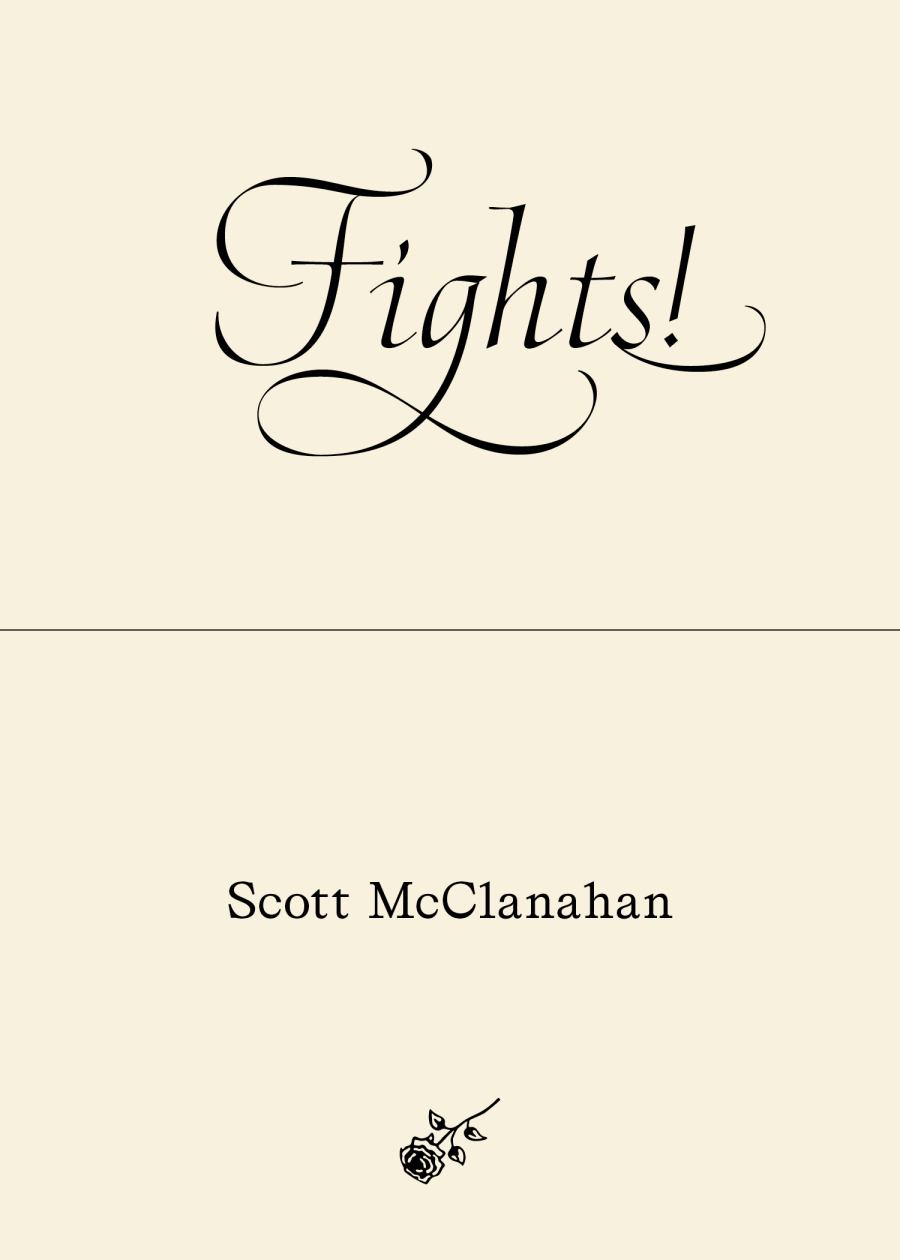
Halfway through McClanahan’s latest book, Fights! (Rose Books), the author turns the page to discover that the book he has been writing has changed. He’s in the midst of telling two loosely entwined stories—a history of funny fights with his wife, Juliet, and a history of sadder fights with his editor Gian, to whom McClanahan has not spoken in a year after a blowout over his manuscript in a West Virginia bar. We, the readers, are aware Gian is dead; probably we knew this before the novel began, having witnessed the rise and fall of Tyrant Books—this century’s most influential independent publisher—and its founder, Giancarlo DiTrapano, who died in 2021. But we are inside the book and so Gian is still alive, until McClanahan breaks the fourth wall to tell us something’s wrong. He is writing this years later when he hears Gian inside his head, editing the pages just like he used to do. “I asked Gian if he liked my new book Fights! so far, and he breathed heavy and said, ‘I don’t know, man. It kind of fucking sucks,’” McClanahan writes. Then, a moment later: “His ghost voice said, ‘I dunno man, maybe you should just start over.’” We turn to see another title page, another dedication, and suddenly, like magic, the book begins again.
DiTrapano’s death at the age of forty-seven marked the end of Tyrant’s run as the 2010s’ leading arbiter of literary cool. From his Hell’s Kitchen apartment and later an Italian villa, DiTrapano coaxed modern classics out of untested writers—books about sex, drugs, abjection, and the internet, existing in defiance of the MFA industrial complex. Back then, I schlepped my groceries in a black Tyrant Books tote bag that alerted fellow shoppers to a badass in their midst. “DOUBLE SUICIDE OR IT WASN’T LOVE,” its message read, the kind of performative darkness that resonated in my twenties. DiTrapano’s own myth is shaded by this darkness; “I like smoking because it lets people know I’m into death,” he repeats throughout the story, a joke that grows a bit less funny every time it’s told. And so it is an act of love when McClanahan, in the novel’s second half, offers up a countermyth, an account of DiTrapano that goes deeper than cool.
Up until now, McClanahan’s books have taken place exclusively in West Virginia, but in Fights! the rising author parachutes into New York City, where his role in the indie-lit scene is something between revivalist preacher and traveling-circus magician. It is here in the big city in the early 2010s that McClanahan meets Juliet Escoria, his second wife, as well as DiTrapano, who will go on to publish Hill William and The Sarah Book to critical acclaim. But read between the lines of those books and you might start to get the idea that geography is fate. Though by then DiTrapano had become an avatar of downtown, he, like McClanahan, was a boy from West Virginia, born among some of the oldest rivers and mountains on this earth. It is McClanahan’s accent that catches the editor’s attention, and it is in West Virginia where their brotherhood evolves. It’s where DiTrapano shows McClanahan the grave of his brother; where the two hug each other for the last time; and where they have their worst fight at a redneck bar in Charleston, where DiTrapano tells McClanahan that his writing started sucking around the time that he got sober. “He placed his palms together in a prayer and told me he’d spent a long time trying to make me look cool, but this book wasn’t cool,” McClanahan writes. His character responds: “I told Gian I was sick of him and all his cool kid shit. I told him I didn’t want to be cool. I wanted to be warm.”
The two friends go on fighting about writing: Is it the sentences that matter most, or what’s between them? Their arguments get mean, and they clash on certain details, but the fight itself implies that they agree on what’s important—that the books we make will still exist long after we are gone. And so the author returns to this scene many years later, to this bar in West Virginia where he and Gian are still fighting. “We’re still fighting about what makes something real,” McClanahan writes. “We’re still arguing about what makes something beautiful.”
After the book begins again and the friends’ big fight is over, DiTrapano asks McClanahan, how’s life in West Virginia? As it turns out, not so good. “It was 2016,” the author says, “and it felt like the whole world had been broken, and a great plague was upon us, and some would not survive.” At the college where he teaches, a student who works as a paramedic writes about going to the same house for four overdoses in one day. A few houses over from where the author and his wife live, a man is arrested for locking another guy in a dog cage over a drug debt. The couple go get donuts, but the donut shop has closed, so they drive past tweaker gas stations, fake-limb stores, empty buildings. “I told Juliet that when I was a boy this place was full of businesses,” McClanahan writes. “I said, ‘It might look like a wasteland, but it was beautiful once because people had been there.’” The line breaks. “And now it was gone.”
And so the state of West Virginia joins the people who are dead now, but who might still live forever inside McClanahan’s books. That same year, 2016, a flood ran through the author’s hometown and swept away the places he remembered growing up. But then there’s the ancient river flowing past the boys’ childhood bedrooms, and the country’s oldest mountains looming in the background as DiTrapano and McClanahan say their last goodbye. Hanging off the page is a question from 2013’s Hill William—the first book that the two friends made together—where McClanahan stands in the mountains and hears his mother call him home. “I asked myself whether the mountains were just graves full of dead skeletons,” he wrote then, “or whether they were pregnant bellies popping full of life.” Then the years pass, and we see that books are just like mountains. We see that books are what we turn into after our bones are gone.
The other half of the story fades briefly into the background—sweet, silly, crazy fights between husband and wife. Then comes the final scene, which could be seen as uncool: They sit on the couch and grow old together and watch the years pass by. “But sometimes,” McClanahan writes, “we still fight like demons. And it’s like the old days when we were young and first in love.” When two people are fighting, they agree that something matters. As long as they’re fighting, it means they’re alive.
Meaghan Garvey is a writer from Chicago, living on the shores of Lake Michigan. Her first book, Midwestern Death Trip, was published in 2026 by Panamerica Books.

More Reviews