Enough to Be Noticed
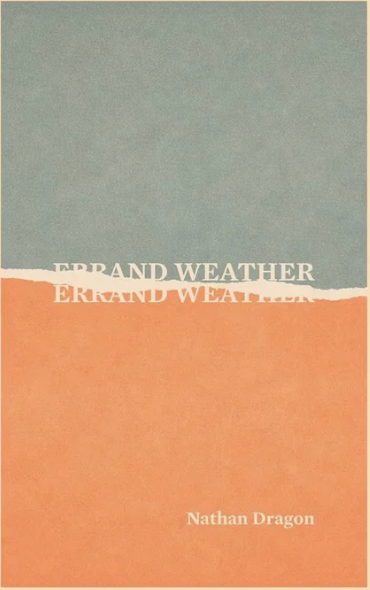
Errand Weather, Nathan Dragon’s second book, purports to be two linked novellas. The first section, titled Fug, spans ninety-five pages and is composed of prose poems. Ranging from one line to one and a half pages, each piece has its own title and narrates a thought, provides an image, or offers a brief glimpse into a scene. The second section, The Marine Biologist, is forty-five pages and similar, content-wise, to Fug, though it lacks titles and its fragments run longer. The thoughts and circumstances of both unnamed narrators are similar enough to assume they comprise the same consciousness, though The Marine Biologist has one notable addition: a romantic partner named Swimmer. Together, the two sections read less like separate novellas than like two seasons with similar weather.
The title could not be more apt. Atmospherically, the book is a Sunday afternoon. The world of Errand Weather is populated by woodpeckers, Lynchian cameos, dead bees, grocery store coupons, surgeonfish, and patches of clover. In a vignette entitled “Scene,” Dragon writes:
Deflated heart balloon tied to a mailbox.
Smell of a newly lit cig and mulch, warm on the breeze.
Getting the chance to drive with the windows down.
Nothing asks to be resolved; it only asks to be noticed. Dragon navigates quiet, small-town life with all its momentary miracles and mundanity. Thoughts pass through the narrators’ minds like clouds. In one rather meta moment, Dragon writes: “What the fuck is a slice of life?”
Dragon’s book is self-aware. The first epigraph, written by Thomas Merton, reads: “If we strive to be happy by filling all the silences of life with sound, productive by turning all life’s leisure into work, and real by turning all our being into doing, we will only succeed in producing a hell on earth.” Several vignettes throughout illustrate this point. In The Marine Biologist, the narrator panics at the silence following Swimmer’s gift of peaches and cream, anxiously blurting, then later regretting it, that he prefers nectarines. In “One-Upping,” the narrator contemplates the ideology that enables road rage:
He thinks, Why am I like this? Biological explanation? Like competition within species, like a survival-of-the-fittest-pecking-order kind of thing? An American thing? Like it’s impossible to chill out, live and let live, impossible to is what it is. Like a capitalist thing? ’Cause I gotta get there first. But what’s that do in this situation?
Permeating Errand Weather is the desire to slow down, to savor life’s brief flashes as they come. Or as Dragon writes: “A slow life like it’s low tide. It’s enough, isn’t it?” In the book’s last vignette, the narrator, Swimmer, walks a dog along a stony shore. They find torn pieces of photographs strewn about and take time to collect them so they can patch them together, see what it all means. It’s a fitting final image for a book of fragments gathered patiently, of meaning arrived at only in the piecing-together, if it arrives at all.
Throughout The Marine Biologist, the narrator stresses over the need to work on his “big project.” While not explicit, one can infer, because of the narrator’s need for time to sit alone at a desk, that the project involves writing. The narrator-author procrastinating the writing of a book—while we of course are reading what the narrator-author has in fact written—brings to mind Jordan Castro’s The Novelist. Both texts explore interiority and the mounting pressure of desired productivity, all the while winking at their readers. In this case the wink never curdles into cleverness though; it stays gentle, almost apologetic, the way a friend might admit to overthinking something out loud.
At several points while reading Errand Weather, I laughed, and at a few, I almost cried. Take the wordplay and humor in “Semiotics” for example:
Heart-shaped stones.
Why are they stones and not rocks?
Saying heart-shaped rocks, he thinks. A pop culture
pun.
There are absurdist elements too, like in “Gone Fishin’” when the narrator envisions going on a “comeback tour” to all the businesses whose signs told him to “come back later.” But then in “Breakfast for Dinner,” Dragon writes: “Life feels like watching a disappointing stand-up special—you only seriously laugh once. And then spend the rest of the time trying to force another.” Later, in The Marine Biologist, we get: “The word thoughtful has always been a perfect word to him, a beagle on a hill.” Lines like these are where Dragon’s gift is most visible: the ability to land on a striking image that shouldn’t make sense but somehow does.
At times the tone can feel monotonous, though I suspect this is Dragon’s intention. Life isn’t a montage of action-movie cliches, and books shouldn’t have to be either. In the current climate of traditional Big Five publishers, editors demand plot. They want a page-turner, something readers can quickly consume. What makes Errand Weather genuinely radical is its refusal to stoop to the level of industry. Instead, Dragon insists, again and again, that simply living is more than enough.
Shy Watson is a PhD candidate in Creative Writing and Literature at the University of Southern California. Her short stories can be found in Joyland Magazine, Southwest Review, Volume 0, and elsewhere.

More Reviews