Hello, Stranger
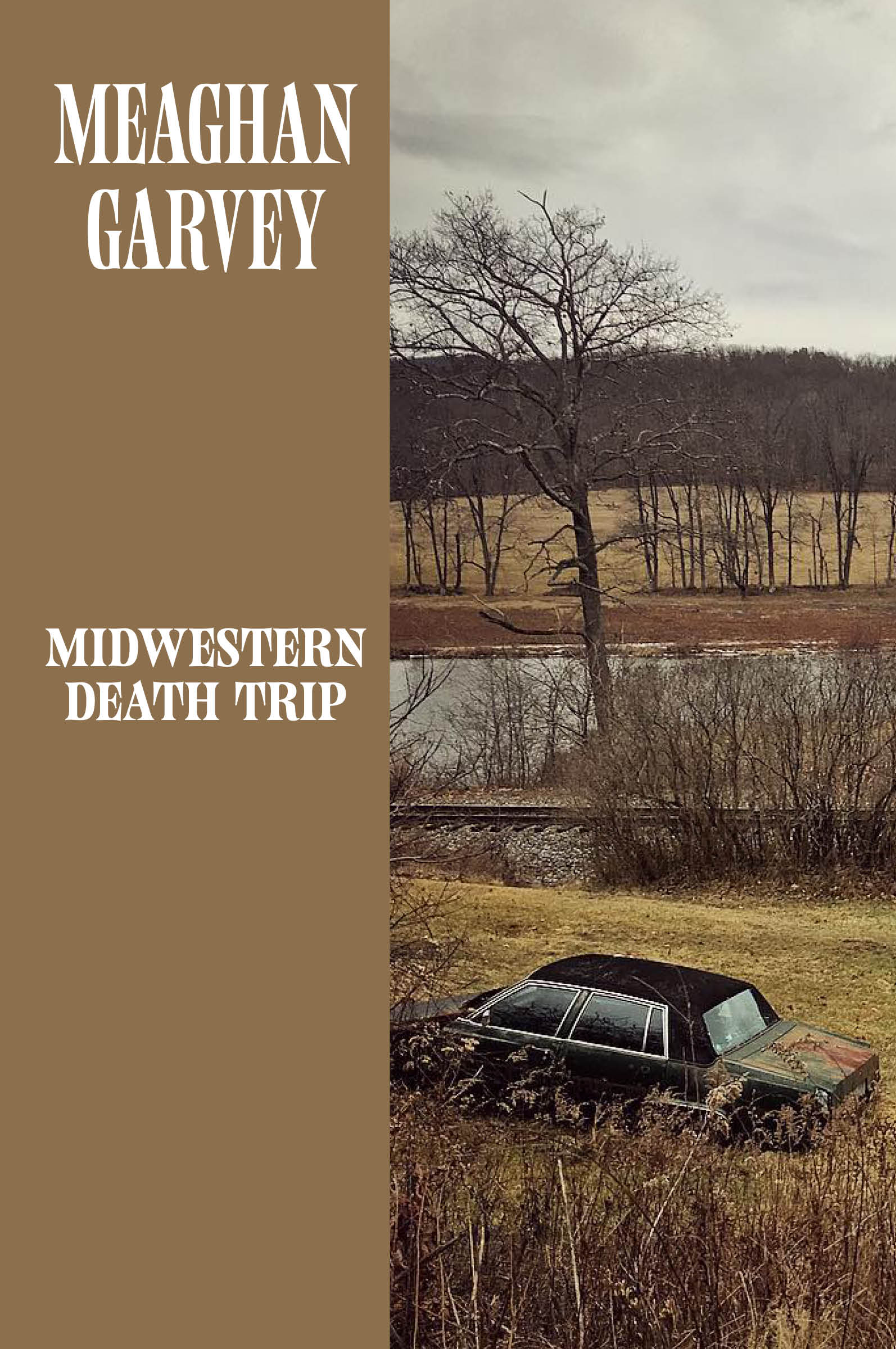
There is a particular kind of American nonfiction that frontloads arrival. It announces itself breathlessly from the jacket copy outward—urgent, necessary, unflinching—and then spends its pages in a careful, anxious crouch, nudging the reader toward a superficial lesson prepared in advance. It knows what it wants you to gain from the reading experience. It wants you to know that it knows. Meaghan Garvey’s debut, Midwestern Death Trip (Panamerica, 2026), is not that book.
The catalyst is Michael Lesy’s Wisconsin Death Trip (1973), the urtext of Midwestern macabre: a collage of found newspaper clippings, glass plate photographs, and institutional records from fin de siècle Black River Falls, Wisconsin, a small town populated by “forebears of the indigenous American berserk.” Garvey’s introduction reconstructs Lesy’s book and its disquieting subjects, including pyromaniacal women, arsenic drinkers, ghost-haunted farmers, lake monsters, men driven insane by perpetual motion machines, as entry points to something unseen but felt, the catalyst for her search for . . . what, exactly?
We don’t know what we’re looking for, but we’re about to find it.
What follows is a road trip, though “road trip” flattens this odyssey the way “coming-of-age story” flattens the lived experience of growing up. Garvey gets her driver’s license at nearly forty, secures a 1993 bloodred Cadillac Coupe de Ville from a Polish felon on Craigslist, and proceeds to drive it from here to everywhere, five hours for dinner one way, three hours for a drink another. She visits supper clubs and roadside attractions, national lakeshores and Driftless valleys and the historically strange House on the Rock, reporting on each with the eye of someone who has been watching and listening her whole life.
The regulars told better stories than the young novelists and critics whose works were sold as urgent, necessary reflections of our time. As if ‘our time’ wasn’t precisely what I had been avoiding, whiling away the days and weeks not answering my emails, drinking Old Styles with divorced boomers who were losing their teeth.
The book is organized in loose sections, each named for a geographic landmark or roadside mythology, shifting between Garvey’s present-day reporting and a life story that accretes in fragments: the drama surrounding her adoption as an infant, the well of pain beneath her mother’s death of breast cancer when Garvey was twenty-one. The narrative moves ahead, but not always forward. There are revelations, but no lessons. Only people and places and objects and their networks of connective threads, followed and illuminated by the narrative’s porous I.
There are ghosts everywhere. Garvey visits the Apostle Islands and the Driftless and the Wisconsin River valley and the absurdly named supper clubs on county highways in places you probably haven’t been and are unlikely to go (although now, after reading, I have made it my goal to visit at least one), and at each of these she manages to locate the permanent underneath the passing: love and grief playing out in real time, the past that remains “a living, breathing thing.” Indigenous history taken and buried under tourism and mythology, Catholic grottos in cornfields built by German immigrants, a lake that drained overnight the morning her mother died. All sequenced intentionally, but Garvey doesn’t connect these dots for us. She trusts us to feel the pattern out.
The great structural freedom of Midwestern Death Trip—its organizing principle of drifting, of detours, of a radical willingness to just go and see what happens—is a sheer joy to experience. Garvey’s commitment to specifics, to precise, felt descriptions, especially when it comes to nature and food and drink (I’ve lived in the Rust Belt for most of my life and had no idea how unregulated Midwestern old-fashioneds can be, “garnished sensibly with a cherry or outlandishly with a pickled mushroom or Brussels sprout”), is a master class in vibes, and it makes you wonder why more writers don’t do it. Tunnel deep into curiosity and build a world in that hole.
The closest I’ve come to a beach read this summer, Midwestern Death Trip was consumed on a dilapidated lounge chair at a pool we were supposed to have paid for but didn’t, watching my son and his best friend do underwater handstands from my perch in the shade amidst a pile of wet towels and crinkled snack bags, a White Claw Zero at my feet. Seven days alcohol-free at the time of reading, I got more than a few chest pangs from Garvey’s descriptions of red-lit bars and demented cocktails and even Helen Morgan’s alcoholic unraveling, all tied to another aspect of the book I found refreshing: lots of drinking, lots of drugs, mercifully zero moralistic reckoning.
Is this groundbreaking? Maybe. In an era of performative and aggressive self-optimization, where “creepy little Gen Z people who are so nihilistic and yet so risk averse” seem to have concluded that the correct response to being alive is to eliminate all friction and track their sleep, there is something quasi-political about a book that treats intoxication with neutrality, as a feature of human experience rather than a shameful variable to be controlled. Midwestern Death Trip is, among other things, an antidote to the sanitized redemption memoir, the kind that preclears its author’s choices and frames every bad decision as a step on a ladder toward insight. Garvey is only mildly self-conscious about her position as a writer and observer, taking brief, obligatory detours to call out the inherent silliness of creative pursuits, but she does not dwell there. She offers excerpts of her mother’s found journal entries, which show a different side of the self-assured, capable woman she knew: a woman at a private existential crossroads, who always wanted to write but never took the risk. Garvey has to take it.
Among the book’s most unnerving passages, stunning in its simplicity, is the account of Garvey’s pandemic-era boyfriend who decided, somewhere in Hayward, Wisconsin, that she was possessed by Satan and suggested drowning her in the frozen lake. Here, her Midwestern practicality rolls up its sleeves: she triages the situation, assesses the likelihood of successful escape, then settles on a course of action that includes feeding him molly, singing along to “Lake Marie,” John Prine’s double-murder love song, and stopping at the world’s largest Culver’s while counting down the minutes to Chicago. Life continues.
Life continues, amid water demons and courthouse weddings and spiritualist camps and sorrow. Garvey does not arrive, by the book’s end, at a grand resolution. The dead are still dead. The Midwest is still the Midwest, misunderstood, underestimated. But she has been, and seen, and heard, and written it down with considerable grace and no bullshit, passing the notebook with the keys to the Caddy on her way out to smoke. Hello, stranger.
Mila Jaroniec is the author of Plastic Vodka Bottle Sleepover and the creator and editor of Black Lipstick. Her work has appeared in Allure, Playboy, Playgirl, Joyland, Ninth Letter, PANK, Vol. 1 Brooklyn, The Millions, NYLON and Teen Vogue, among others. She earned her MFA from The New School and is represented by Annie DeWitt at Enliven Endeavors.

More Reviews