I Wake Up Streaming | July 2025

In this edition of “I Wake Up Streaming,” novelist William Boyle rounds up his top streaming picks for the month of July. The column’s name is a play on the 1941 film I Wake Up Screaming, starring Betty Grable, Victor Mature, and Carole Landis. While the film’s title hits a pleasing note of terror and despair, changing that one letter speaks to the joy of discovering new films and rediscovering old favorites, as well as the panic that comes with being overwhelmed by options.
Army of One (YouTube)

I never saw the theatrical version of Army of One back when it came out—I guess I’d heard that it got taken away from Larry Charles and that both he and Nicolas Cage had disowned it. It came to my attention recently that Charles has put his two-hour-and-forty-minute Director’s Cut up on YouTube. He also provides a short intro, detailing how the studio chopped it up and ruined it. Like I said, I haven’t seen the ninety-two-minute version, and I don’t anticipate watching it, given Charles’s description. But the Director’s Cut is a goddamn revelation. One of Cage’s most batshit genius performances, which is saying a lot. Be sure to stay for the long “end credits” sequence where you get to hear the real guy that Cage’s character is based on talk his wild talk and see what exactly Cage is drawing from and riffing on. Magic. Anyhow, in short, Cage plays Gary Faulkner (“not Fuckner”), a stoner handyman from Colorado who goes to Pakistan on a mission from God (Russell Brand, ugh) to capture Osama bin Laden (Amar Chadha-Patel). Armed with a samurai sword, he keeps failing and keeps trying, drawing the attention of a couple of CIA agents (Denis O’Hare and Rainn Wilson). Back home in Colorado, Gary (“the G,” aka “the Donkey King”) has a burgeoning relationship with Marci (a luminous turn by Wendi McLendon-Covey) and her daughter and occasionally hangs out with his pals Pickles (Paul Scheer) and Roy (Will Sasso). I laughed so much—the movie is shaggy and weird and off the rails in all the best ways. Despite the insane runtime, it really moves. The ninety-two-minute version got butchered into “a happy-go-lucky fable about the goodness and innocence of America,” according to Charles, while he intended it as “a blackly comic metaphor about the meddling, imperialistic, ignorant, greedy, theocratic, delusional, violent America that we all recognize, America the hero in its own mind.” Again, make sure you watch the Director’s Cut. The picture quality on YouTube isn’t great, unfortunately, but it’s well worth it.
Fresh Kills (Hulu)
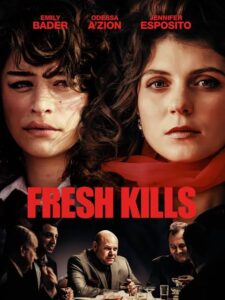 I went in wanting to love Fresh Kills when I first saw it last year but was prepared to be a little disappointed—I’m often let down by Italian American NYC stories. Post-Sopranos especially, there have been some real turds. Despite my Irish-sounding last name (it’s Scottish, actually), I grew up with the Italian side of my family in Brooklyn in the ’80s and ’90s—it’s the world I write about. Early on, I was fascinated by mob lore and mob history. After my dad split and before my mom got remarried, we lived in an apartment on the border of Bensonhurst and Gravesend whose previous tenant had been Anthony “Gaspipe” Casso. Fresh Kills is also set in the ’80s and ’90s, across the bridge on Staten Island (which is where my old man moved after he left us, so I spent many weekends in that borough, the smell of the dumps heavy in the air). It’s very much up my alley in how it approaches the story it tells. Rose Larusso is young when we meet her in 1987—I’m not sure how old exactly, maybe eleven, twelve. She doesn’t talk much. Her sister is Connie, far more extroverted. They worship Madonna (as in Madonna Louise Ciccone). Her father, Joe (Domenick Lombardozzi) has just brought the family to Staten Island from Brooklyn—he’s obviously a mobster, but we only see him from the girls’ POVs. They’re piecing together this strange and dangerous world they’ve been born into. Men in tracksuits hauling around mysterious boxes, guns on their hips. Half-whispered conversations. Codes they don’t understand. Their mother, Francine (the great Jennifer Esposito, who also wrote and directed), and Aunt Christine (hall-of-famer Annabella Sciorra) are the central figures in their lives. I won’t give away the whole plot, but something shocking and tragic happens at the end of the 1987 segment and then we move ahead to 1993, the girls grown up, their world a hothouse of late teenage feelings. The movie makes a couple more little time jumps throughout the ’90s. One of the things I admired most about it was how it moved through time and its restraint—Esposito doesn’t tell too much, she simply shows, not dumbing anything down for the audience, letting the story simmer under the surface. A lesser writer/director would’ve relied on voiceover to explain everything. Esposito lets it unfold naturally, and the power of Fresh Kills derives from that choice and from the focus on the women’s perspectives. We’ve seen many mob movies and shows before, both bullshit ones and great ones, but the stories are generally told from the POVs of the mobsters themselves—we see the violence play out, and the narrative is built around their crimes. There are exceptions, of course. Edie Falco’s Carmela and Jamie-Lynn Sigler’s Meadow on The Sopranos are notable ones (and no doubt major influences here). Esposito stays with the women in cars and kitchens and churches, and we only see the world of the story that way. The violence committed by the men stays offscreen, and we only witness violent acts when they intrude specifically into the lives of Connie and Rose. It’s effective, tense, and claustrophobic. They’re observers, Rose especially. We can feel the pressure of not knowing, the uncertainty, the fear, the sense that they’re part of something they can’t name. In the ’90s segments, Rose is played by Emily Bader—a moving and quiet performance—and Connie is played Odessa A’zion in an utterly electric turn. Esposito’s supporting performance—all the hidden pain she transmits through what Francine says and doesn’t say, through her expressions—feels like the beating heart of the picture, and Lombardozzi and Sciorra are terrific. Fresh Kills winds up being a great place story precisely because it doesn’t try to do too much with its setting—often, when someone doesn’t have authority over a place, they’ll try to get across their supposed bonafides in horseshit ways. Esposito knows this place. She simply lets the story feel like Staten Island. Rose wants to escape, and the borough is tightening around her. Esposito uses period details effectively without overdoing it, and there are details beyond that—their house, their possessions—which bring the world of the family to life. I love movies where people scream at each other, and there’s some good screaming here. I also love the subtextual narrative of what the girls are being fed about what it means to be a woman—the terrible talk shows on TV (that largely seem to be about young girls dressing like “tramps”), the persistent beauty ads, the models they have in their own lives of what it is to be a wife and mother and sister. It feels so right that Rose is searching for a dream and the only dream she can think of is to be a guest host on The Sally Jessy Raphael Show or to become a beautician. The final act brings everything together in a way that’s deeply satisfying.
A House in the Hills (Tubi)
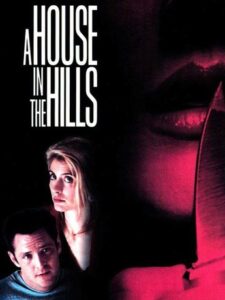 RIP Michael Madsen. I’m not sure why this is the first thing I watched after hearing he died (I did, however, rewatch and write about Kill Me Again just recently), but I’m glad I did. I vaguely remember seeing it way back when. It’s a lot of fun. Helen Slater plays Alex, an actress (she’s just auditioned for a soap opera reminiscent of Twin Peaks’s Invitation to Love) and waitress who takes a gig housesitting for a rich couple in the Hollywood Hills. Her main task is to spend time with the husband’s prize roses in his greenhouse. What she doesn’t know is that there has recently been a murder next door. After the couple leaves for the weekend to go out on their boat, Alex plays dress-up in the wife’s clothes. When an exterminator, Madsen’s Mickey, comes knocking, she pretends to be the lady of the house. Madsen, of course, isn’t an exterminator, and he believes her to be who she says she is. Fear not: this isn’t some stressful home invasion deal. Mickey’s a thief, but he’s a likeable guy seeking vengeance for a wrong committed against him and his brother. Soon enough, he discovers Alex’s real identity, and it winds up being a meet-cute situation—two people on the ropes brought together by fate. The whole thing is ridiculous as hell, sure, but it goes to some unexpected places. Essentially, it’s a mashup of a ’90s B erotic thriller (some definite nods to Brian De Palma) and an offbeat romcom. Madsen’s charming—he brings the same swagger and cool that he always seemed to bring in his best roles (Reservoir Dogs, Kill Bill, The Hateful Eight, Thelma and Louise, Donnie Brasco, Kill Me Again, Trouble Bound, Mulholland Falls), his worst, and everything in between. He and Slater have terrific chemistry (this made me remember how in love with her I was when I was a kid), and Jeffrey Tambor chews some scenery in his very John Lithgowesque supporting turn.
Baja (Tubi)
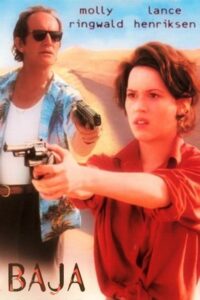 I’ve been on a Kurt Voss kick lately—I was mostly familiar with his collaborations with the great Allison Anders before, but I’ve been digging into his ’90s B neo-noirs, which all have interesting casts and often hit unique beats while working with familiar tropes. I recently watched this one for the first time. A thought: Is there a similarity between what Voss was doing in the ’90s and what Edgar G. Ulmer was doing in the ’40s? I’m not saying that any of Voss’s B neo-noirs are as good as Detour, Bluebeard, Strange Illusion, and Ruthless, but his movies feel like what Ulmer would’ve been doing in the ’90s if he’d been around. They have in common an ability to work well with constraints and there’s an intelligence and dark humor at work behind the more clichéd elements. In any case, this is a solid little desert B neo-noir worth watching just for Lance Henriksen, who is absolutely golden as a hit man named Burns fast on the heels of Donal Logue’s Alex and Molly Ringwald’s Bebe, who have lammed it to Mexico from California after a drug deal gone bad. Also in pursuit is Bebe’s estranged husband, Michael, played by Michael A. Nickles. Logue is pretty hard to take in this (Alex is an annoying character), and Ringwald and Nickles are both flat, but Henriksen makes the whole thing sing with life. Here’s my pitch, fucko: I’ve never made a movie, but I’ve always wanted to, and I’d like to do a remake of this with Sydney Sweeney as Bebe, Kyle Gallner as Alex, Joe Keery as Michael, and Nicolas Cage as Burns. Come on, let me goddamn do it.
William Boyle is the author of the novels Gravesend, The Lonely Witness, A Friend Is a Gift You Give Yourself, City of Margins, Shoot the Moonlight Out, and Saint of the Narrows Street. His novella Everything Is Broken was published in Southwest Review Volume 104, numbers 1–4, and he co-edited (with Claudia Piñeiro and Frances Riddle) the noir issue (Volume 108, number 3).
Illustration: Jess Rotter
