Needle Drops | Peter Gabriel’s “Blood of Eden”
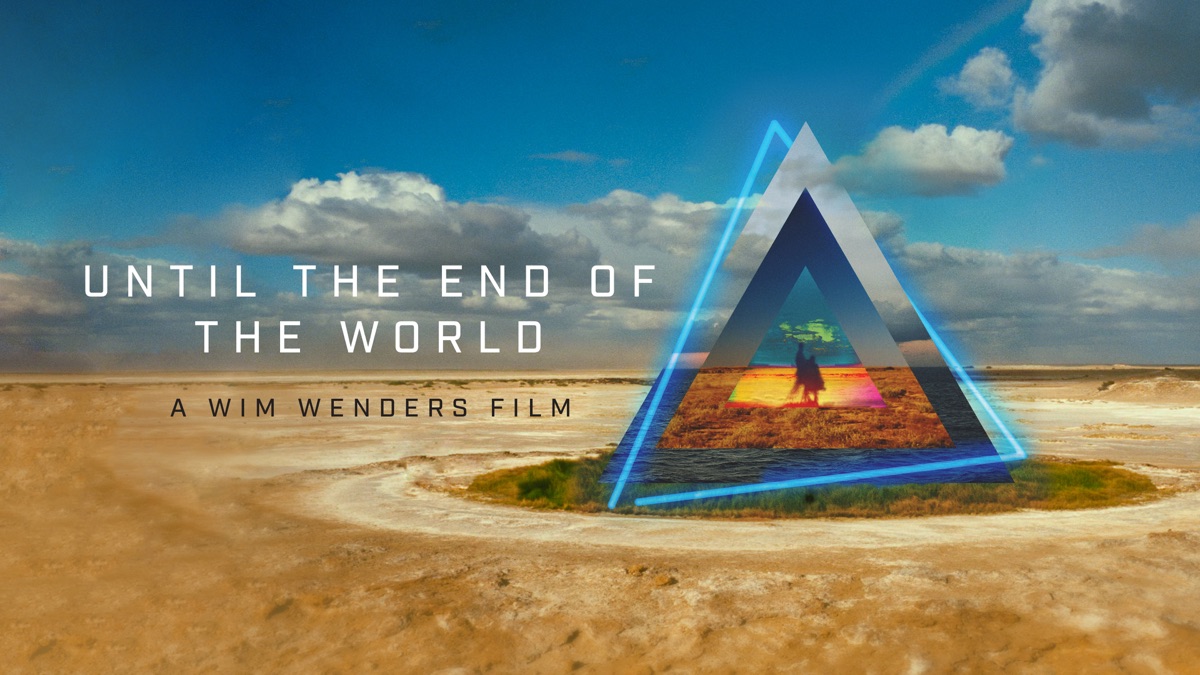
Needle Drops is a column that asks writers about—you guessed it—their all-time favorite needle drop in a film. In this edition, Jason P. Woodbury explores Peter Gabriel’s “Blood of Eden” from Wim Wenders’s Until the End of the World (1991).
Music courses through all of Wim Wenders’s movies, tying together the German film director’s musical and cinematic language. Ry Cooder’s proto–Ambient Americana score for 1984’s Paris, Texas immediately conjures the sunbaked expanses of the American Southwest. Or consider the scene-stealing appearance of Nick Cave and the Bad Seeds in 1987’s Wings of Desire, interjecting a charge of fleshiness to the elegiac and existentialist story of an angel exchanging heaven for our ordinary world. Or the deep-hued joyful musical vérité of the 1999 Cuban documentary Buena Vista Social Club. But few of the director’s many projects so closely marry the musical and the cinematic as his apocalyptic 1991 masterpiece, Until the End of the World.
Envisioned as “the ultimate road movie,” Until the End of the World is an ambitious, nearly five-hour epic filmed across eleven continents, a brilliant collage of romance, classic crime noir, tech-dread dystopianism, oneiric science fiction, a meditation on art, music, writing, and the Aboriginal concept of “Dreamtime.”
For the soundtrack, Wenders approached his favorite bands and performers like U2, Depeche Mode, R.E.M., Patti Smith, Lou Reed, Talking Heads, and the Kosmische Musik pioneers CAN, the latter of whom even reunited to contribute. With plenty of screen time to allow these contributions to sprawl, Wenders lets the songs soundtrack long passages of the dreamlike film.
At the box office, Until the End of the World enjoyed a less than stellar reception; due to its expensive production, it was a massive flop. Critics and viewers alike didn’t know what to make of the 158-minute theatrical cut, which was hacked from Wenders’s nearly five-hour cut, which was itself pared down from something like a twenty-hour cut. This disjointed presentation prompted the critic Roger Ebert to describe the movie as “a film that was photographed before it was written, and edited before it was completed.”
But unlike the film, the soundtrack was something of a hit—a rare soundtrack that took on a cachet somewhat removed from its artistic root, functioning as an expertly curated progressive pop playlist, optimized for the compact disc format, complete with ambient cues from the score (by the excellent, unsung Graeme Revell) factored in as musical connective tissue. Thanks to the soundtrack, at least some of Wenders’s vision shines through.
If only it wasn’t missing one of the film’s key songs, one that lays its mythical and spiritual bedrock bare, a stripped-back, dubby mix of Peter Gabriel’s spectral Biblical reverie, “Blood of Eden.” This, his lonesome deconstructed take, opens up a mythic and spiritual skeleton key into Wenders’s miraculous though maligned cinematic statement.
It took our own apocalypse for me to feel like I had enough time to watch the early five-hour director’s cut of Until the End of the World, which was reissued by Criterion Collection in December 2019 along with record label Run Out Groove’s vinyl reissue of the soundtrack. I picked up the two-disc Blu-ray in early 2020, when I didn’t feel like social calendars permitted a viewing of such a long movie—that is, until the COVID-19 pandemic obliterated said calendar. In those days, movies and music took on heightened, almost superhuman power.
“Blood of Eden” drops just about squarely in the middle of the movie (or, in physical-media parlance, just after you put the second disc of the Blu-ray in ). Until the End of the World is set during a global incident in which an orbiting Indian nuclear satellite begins spiraling toward Earth, resulting in worldwide uncertainty and brinkmanship, all of which plays in the background of most of the film’s action.
But what has served as a source of ambient dread for most of the movie manifests into physical reality as our heroes, Claire (Solveig Dommartin, who also cowrote the film with Wenders ) and Sam (William Hurt), are hit by an EMP wave that disables their small craft plane, flying above the Aboriginal outback. Soaring, held aloft not by engine power but by simple air currents, Sam and Claire course along, suspended in air. “They shot down the satellite,” Claire whispers. “It’s the end of the world.”
What comes after the end of the world? As “Blood of Eden” creeps into the mix, Claire and Sam navigate what comes next. There are always pressing concerns in an apocalypse. The world may have ended, but they still need to land the plane.
That turns out to be the least of their worries, as once they do, they begin an arduous trek through the desert to Sam’s father’s laboratory. As they wander, Gabriel intones over the stately drums and bass, both betraying the dub-wise influence of the producer Daniel Lanois: “I saw the signs of my undoing / They had been there from the start.”
Wenders had asked artists to write music for the future, but tellingly, Gabriel reached for the past with his contribution, going back to the first couple of creation for his song. A more polished version appears on Gabriel’s 1992 divorce rock classic Us, featuring a tremendous duet with Sinéad O’Connor, and a live version from the Secret World tour finds Paula Cole adding a similar touch of the divine feminine. Here, though, Gabriel appears alone.
It’s a shame that the Wim Wenders mix, like a proper version of Until the End of the World itself, was unavailable for so many years. For whatever licensing negotiating reasons, it was omitted from the official soundtrack release. But in 2019, it, too, found an official home on the Gabriel B-sides collection, Flotsam and Jetsam.
The lack of lilt makes the song so much lonelier, as if perhaps sung by an omniscient God watching the banished Adam and Eve, who Sam and Claire bear no small resemblance to, as they are cast out from the garden.
While they make their way through the harsh terrain—a blown-off door from the airplane is handcuffed to Claire’s wrist, in a foreshadowing of both characters’ eventual screen-addled tech addiction, which forces them apart and steals away their reality—Gabriel sings of the “union of the woman, the woman and the man.” In that moment, Claire and Sam are bonded together, united in spirit, and in love, but also by the necessity of survival, which is called into question as they drink the last of their water.
Nestled at the center of this singular movie, the “Blood of Eden” needle drop serves as one of the movie’s best musical moments—no small feat, given the tracklist. Elsewhere in the movie, Sam Neill’s Eugene Fitzpatrick describes the music of the postapocalypse as a prayer, and that’s what Gabriel’s hushed and holy version provides. And that’s ultimately what the movie/music hybrid is too, a prayer. Describing his work with Dommartin, Wenders said, “We thought that we only had the right to enter into such a sacred area like a person’s dreams if we would bring something into the work that was sacred to ourselves.” What song will you sing after the end of the world? Whatever it is, make it a sacred one.
Jason P. Woodbury is a writer, podcaster, musician, and producer. He is an editor for Los Angeles online music magazine Aquarium Drunkard, where he hosts the lauded Transmissions podcast. He also serves as the creative director of WASTOIDS, the audio/video network from Hello Merch. He lives in the Sonoran desert.
