No Body Left Behind
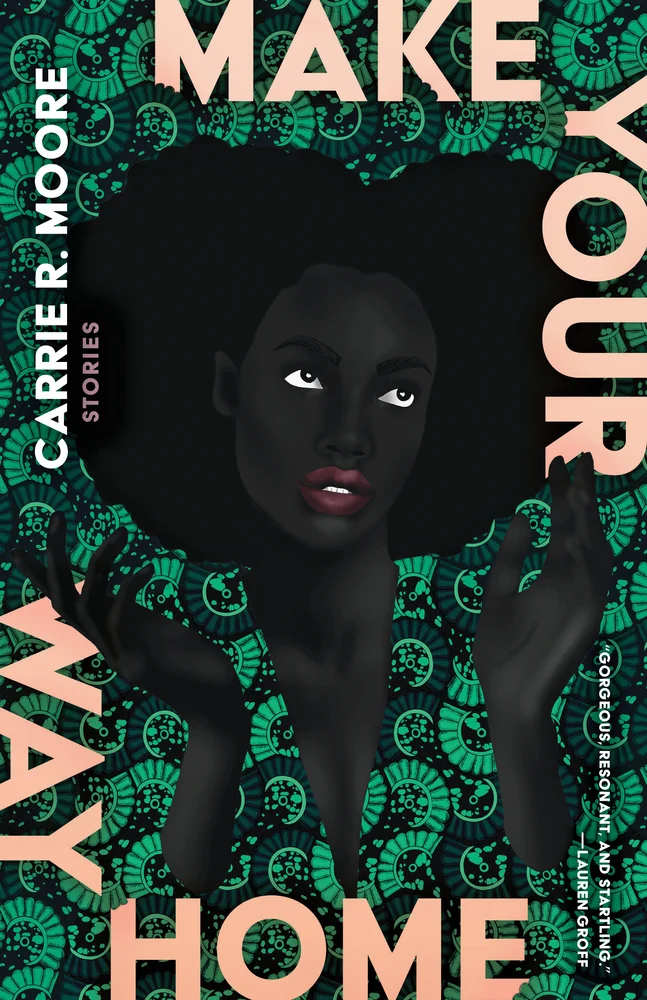
Carrie R. Moore’s debut story collection, Make Your Way Home (Tin House Books, 2025), closes with a piece set sometime in the near future titled “Till It and Keep It.” East Texas sisters Brie and Harper are road-tripping north, seeking refuge from the endless summers, floods reaching ever deeper inland, and dwindling federal support. This is “Low America,” where the land has gone dry, the people live in large encampments, and fortress-like cities have strict health inspections designed to keep out strangers carrying deadly viruses. Throughout the story, Moore alludes to something terrible that happened to the sisters in Texas. Near the end, Brie is finally ready to talk.
She remembers the call to evacuate. Her family’s decision to stay and hunker down. Waking to rising water. A scramble to the roof of their government-issued disaster housing, where emergency lifeboats are chained for just this purpose. Her mother vanishing as the water swallows the building whole.
“Till It and Keep It” is an elegant choice to close out a collection that’s devoted to exploring what our bodies know, what we’ve buried inside them, what they’re straining to tell us. Moore intends to offer a portal to life after climate collapse, but the echoes of survivor accounts from this summer’s flash flooding in Texas confirm what I felt in my body while reading the story: This future is not nearly as distant as I’d wish.
Moore’s main characters include Black men, women, and children from across the rural and metropolitan South. The stories are set mainly in the very recent past, with radio shows and snippets of passing conversation suggesting where and when. While each piece is a complete world unto itself, Moore also offers up common threads that hint at a collective Black Southern experience—reflexively looking for the other Black people in a room; grappling with the presence of ghosts, real and imagined; feeling the magnetic pull of home, whether that place wants you or not—while taking care never to make sweeping conclusions.
Moore’s youngest characters are especially well drawn. The children in these pages intuitively know things the adults around them have learned to forget. In “Cottonmouths,” a preteen named Twyla is pregnant at the same time as her mother. There’s a sweet intimacy to the two of them holed up together in the Florida marshlands; there’s also a disturbing dissonance to Twyla’s mother preparing her child to have a child, step into premature adulthood, and leave their home. But when a cottonmouth makes its way into the house, stranding her mother on a chair, Twyla refuses to get help. Instead, she sizes up the snake: The snake “lowers her head, and I think, Oh. She’s tired. She’s much more worn out than you’d guess at first glance.” Twyla understands more about survival than meets the eye. Across one long, tense scene, she coaxes the snake through the front door. Then she turns to her mother and declares that she won’t be leaving their home as planned: “I’m not going. . . . I’m just not.”
In “Naturale,” a Charleston hairdresser named Cherie learns she’s pregnant after her husband confesses to cheating with a colleague. Unlike Cherie—who was raised by an uncle to be “amiable,” to endure discomfort with a smile, to be the kind of “woman you’d want to marry twice”—her unborn daughter is “pushy and particular.” When someone makes a snide remark at Cherie’s expense, she can feel the baby looking up, “as if to say, Oh Momma, if you have to smile, go on.” Her daughter has not yet learned to smile back and say nothing. Maybe she never will.
In “Gather Here Again,” Damonia is out in the garden while her grandchildren are supposedly sleeping inside. It’s Halloween night in Charlottesville, Virginia, just months after the 2017 White supremacist rally. The children come downstairs to talk to her through the screen door. “They gon’ get you, you keep staying out there,” the eight-year-old Howie says, referring to the men in white polos with torches. “With the way his voice has gone quiet,” Damonia thinks, “he does not seem eight, but much, much older, as if someone from another century has loaned him a voice.”
While the children are in tune with their bodies, their heritage, and their homes—their raw intuition not yet corrupted by convention or expectation—the adults are often unaware of how their bodies are straining to be heard. Moore writes these moments into her dialogue; it feels almost like the characters’ bodies are whispering to each other.
In “Surfacing,” Grace and Dev are a married couple struggling to reconnect after Dev discovers that, for years, Grace has been experiencing pain when they have sex. They go to Grace’s childhood home on St. Simons Island in Georgia, where Grace hopes to heal her body and her marriage. While observing the teenage girl next door running across her lawn, Grace envies the girl’s ease in her own body. “What’s on your mind?” Dev asks. “When she turns, he’s inches from her face again, his own soft and open. ‘Nothing,’ she says.”
In “How Does Your Garden Grow?” Claire is haunted by her mother’s death from complications of uterine fibroids (presumably cancer), which Claire suspects could have been prevented with better medical care. Now Claire is dealing with painful fibroids herself, planning to have an elective hysterectomy. She’s keeping her friends and ex-fiancé, Holm, in the dark (an ex-fiancé because of Claire’s inability to share any of her interior life). She and Holm eventually reunite, and Claire considers telling him about her mother’s death: “My mother, she began inwardly, and against her back, he shifted, his arm around her waist.” When he asks what’s going on, she shakes her head. “Nothing. I missed you like you wouldn’t believe.”
And then there are the bodies that do know how to connect. When Claire returns home to Mississippi, she and her aunt don’t talk about their estrangement since her mother’s death—at least, not out loud: “There was so much that face held in,” Claire thinks, looking at her aunt, “the long nights that year, the valerian root that did nothing to help them sleep, their first Christmas apart. . . . Oh, Auntie’s face said now. You’re so different.”
In “Morning by Morning,” a deaconess in New Orleans named Sariah meets Jay during an evening prayer circle. “Welcome, she nodded at him, hoping her body could speak. . . . He raised an eyebrow: Like this? His hand adjusted its grip on hers.” The women in particular are struggling against internalized expectations that they should control their bodies, that they should never say what they want, or act on their desires. That they must be quiet and always contained.
Cherie’s and Claire’s stories of learning to put down what they’re carrying, and coming back home to themselves, are particularly satisfying. Cherie’s inner monologue in “Naturale” is almost entirely about control. The first insight that Moore gives us into this character is that, right up until her daughter’s birth, Cherie had spent “all that time practicing being warm and willing to carry just about anything.”
Moore draws a fascinating parallel between Cherie’s habit of carrying too much and the women who came before her. Cherie’s husband is an archeologist working at dig sites on old plantations outside Charleston. “That plantation ground littered with ceramic fragments,” Cherie says, “traces of vessels enslaved women had spent hours coiling from clay, wall after thick wall to hold water, rice, whatever needed containing.”
Moore again invokes these women from past generations who carried too much in “How Does Your Garden Grow?” After an upsetting racist incident with the local police, Claire confides in her two White friends. They try to soothe her feelings by offering different interpretations, suggesting that she misunderstood what happened. “Telling them was like attempting to hand over an ancient, painfully heavy object,” Claire thinks. “They gave it right back.”
Returning to Cherie, when she looks back on videos from her vow-renewal ceremony with her husband following his cheating revelation, she notes, “I smiled hard as I could. Repeated mostly what I’d said the first time. Because I’d done what I said I would.” When she’s at her husband’s work party: “I laughed at their colleagues’ jokes, especially the ones that weren’t funny. I shook hands and nibbled on hors d’oeuvres and stood like the type of woman who’d never shouted a day in her life.” Wisdom such as this is rare in a first collection. Reading Make Your Way Home, I often found myself nodding along the way.
Kate Preziosi is a New York-based writer and editor. Her reviews have appeared in Literary Hub, The Rumpus, and The Brooklyn Rail, among others.

More Reviews