Scrapbook of a Rio Neighborhood
Brazilian director Kleber Mendonça Filho has devoted much of his still-young career to a thoughtful exploration of the many ways that cities, and by extension urban societies, are shaped and abraded over the years by political and economic forces. This interest in the vanished past—at times academic, at times nostalgic—is a recurring theme in his filmography, from his earliest features, Neighboring Sounds (2012) and Aquarius (2016), to his 2025 breakout hit, The Secret Agent, in which the full relevance of the theme is not revealed until the final scene, when viewers are shown one last example of how the evidence of lost lives can be either eradicated or preserved.
Following a New York City screening of The Secret Agent in November 2025, Mendonça said that the “emotional basis” for the film emerged rather organically out of his prior project, the 2023 documentary Pictures of Ghosts. Both films are set in the director’s hometown of Recife, on Brazil’s easternmost coast, where nearly all his stories take place. The documentary, which he likened to “a scrapbook, a family album of the city itself,” tracks the changing landscape of Recife through, among other things, the evolution of Mendonça’s longtime family home and the disappearance of the city’s once-numerous movie theaters. The processes he employed researching Pictures of Ghosts were not necessarily anything new to him—his mother was a historian and he was a journalist before turning to moviemaking—but spending almost seven years in public archives gathering material for the documentary was revelatory: “That’s probably the closest you can get to traveling in time, because you see how facts were, how stories were told, the photographs, words that have been retired by society because of how society has evolved.”
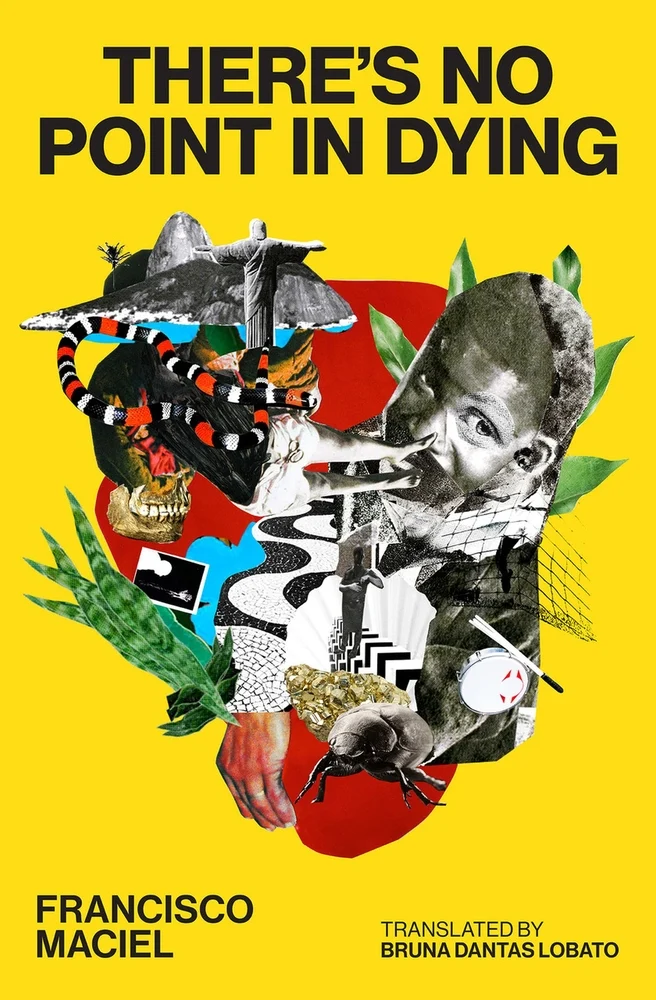
I often thought of Mendonça’s many attempts to capture the changing life of his hometown while reading There’s No Point in Dying, a 2026 novel by Francisco Maciel, another Brazilian who turned away from journalism and toward the arts. Like much of Mendonça’s work, Maciel’s novel also reads like a scrapbook or family album of a Brazilian city, in this case Rio de Janeiro. Originally published in 2017 as Não adianta morrer and now available from New Vessel in Bruna Dantas Lobato’s English-language translation, There’s No Point in Dying is strictly set in the teeming Brazilian capital but gains an almost small-town feel by focusing on life—and death—in the city’s Estácio neighborhood. Estácio is a neighborhood of “screw-ups, starving, one foot in jail,” where everyone is “a lame horse,” ready to be put down, put out of their misery. A neighborhood where everyone “gets to be a slave again.” A neighborhood of gang members and sex workers, dreamers and drinkers. A neighborhood where the poor are moved out so “progress” can be made at their expense, where homes and businesses are torn down to build things like a helipad that the locals will never access unless they’re showing up for a work shift. A neighborhood where teenagers have confirmed kills under their belts but immigrants fleeing a civil war across the Atlantic still settle in the hopes of finding safety. A neighborhood echoing with the pagode variation of samba music that originated there, a neighborhood where residents wile away their days in bars known only by their proprietors’s first names: Luiz’s bar, Raimundo’s bar, Nelson’s bar, Assis’s, Kadhafi’s, Euclides’s, Maradona’s, Dona Zilda’s, Maria’s, and Tiãozinho’s, which is “the last refuge for the sleepwalkers who can’t go home before the sun’s up.” A neighborhood where life persists “in the city of stray bullets, in the land of lost opportunities, on the planet of wars for peace.”
There’s No Point in Dying is sprawling and occasionally disorienting, featuring a cast of more than three dozen characters, many of whom are first-person narrators at some point and many of whom appear in only a single brief episode. The scale is not in itself overwhelming, though it can be unwieldy because the identity of the current narrator or the stage in the novel’s amorphous timeline is often unclear. People die only to show up alive and kicking some pages later, and at least one character turns out to be a ghost. As Sandrinha puts it during her lone fleeting turn at the narrative controls: “There are a lot of people here who are still alive despite not knowing how to be alive, not knowing how to live, dead but still walking, breathing, fucking up.”
While the novel does have a satisfying and concrete conclusion, I don’t know that my comprehension of the story would have been changed much by rearranging the chapters preceding the final 30 pages or so. Despite the lack of a conventional or linear plot, once you settle into Maciel’s freeform style, an image of Estácio and its residents, its rhythms and rituals, emerges via agglomeration, becoming clearer with the application of every layer, every vignette. Mirtes loses one of her 17 children, Dafé, to gun violence at the start of the novel, then later sees another son, Xande, pulled off the “bad path” by his boyfriend, whom he moves in with after a one-night stand. Octogenarian Seu Nonô plays cards all day while his 50-year-old wife “fucks everyone but” him. Another octogenarian, who goes by My Dear (the phrase he uses to address everyone he speaks with), retells his story of being “kidnapped by a flying saucer in rural Goiás [in the central part of Brazil] and left in a bush by a landfill in Rio.”
Blond-haired, blue-eyed Ruth spends her time running up bar tabs all over town ever since the “average Black man” she left her husband for was killed by a bank guard who erroneously believed he was robbing them. Paulo also gets shot during a bank robbery, but because he was actually a perpetrator of the crime, he and his lover Olivia get compensated by Pará, who dies fleeing the cops when he jumps off the wrong side of a bridge and lands on concrete instead of in the water. Pará is member of Manaus’s gang, most of whom get beheaded during a police ambush, a set piece that played out on a much larger scale at the end of 2025 when a real-life raid in the name of public safety turned into a bloodbath. One of the only ones to escape the raid in the novel is Beleco, a kid “from the streets, from the chaos” with three confirmed kills by the age of 14, a horrifying legacy of violence that becomes tragically ironic once we learn that he has survived being held hostage and starved by his own grieving mother who wanted to protect him from Estácio’s violent streets.
There are episodes that flesh out Brazil’s troubled past, including one where the Baron, who claims his great-grandfather’s slaves “thought abolition was a bad idea,” must take responsibility for the deaths of six Black boys in one of the chalets on his property. And there are cautions about Brazil’s precarious future, specifically due to climate change, the consequences of which are laid out during a cameo from Emanuel Terra, “another madman” who repeatedly proclaims that “we are at the end” because of melting glaciers, deforestation, and “murdering the plankton.” We briefly meet the Comadres, a quintet of women who hit the bars on Friday and drink all weekend, ending in a “Sunday afternoon [that] stretches out over everything like a huge dirty sheet”; and their male counterparts, the Four Mandelas, the “living four-volume encyclopedia of old-fashioned trickery and deceit.” Even the neighborhood dogs—Amarelinho, Edmundo, Targa, and Caveirinha—get a chance to expound on their own class system, most easily observed at the public vaccination clinic, where they recognize how some “patients” lead “much nicer lives.”
The only constants among this parade of personalities are Guile Xangô and Vovô de Crime, two men who “argue all the time, like God and the Devil, shouting then sitting in uncomfortable silence, hugging then giving each other the finger.” Guile was a king in his first life, a tiger in his third, and now has “decided to carry the world on his shoulders.” He goes by many nicknames: “Professor, Pastor, Doctor, Poet, Nutcase, Life, Janjo (Janjo!), Xaxango.” And he’s a bit of a physical chameleon as well, known to have blue or green eyes, to be tall or thin or fat, to appear White or Black. Though some disparage him as “all talk and no pussy,” a beautiful woman takes him back to her room to celebrate the victory of the local football team. Meanwhile, Vovô do Crime (literally “Criminal Grandpa”) leads the unelaborated-upon “Movement” by lurking in the background, chiming in with advice or admonishments, and—like most effective leaders—never getting his hands dirty.
Dantas Lobato, who won the 2023 National Book Award for Translated Literature for her translation of Stênio Gardel’s The Words That Remain, has a couple remarkable moments of wordplay that leap out from this assemblage of lives. In one anecdote, an orangutan who likes oranges is identified as an “orange-utan,” which is an all-time pun and surely wholly original, as those words in Portuguese don’t seem to lend themselves to anything similar. And at another point, characters are ordering shots in a bar when one of them remarks: “You’ll need one too—not one, two,” which, again, feels so tailored to the English homonyms that it’s hard to imagine the phrase working in another language.
As the novel nears its conclusion, Guile is having a conversation with a cabbie named Pedrão, in whose home the beheadings take place, during which he introduces the concept of “Laplace’s demon,” a being who knows everything about the current state of the universe and therefore can foresee everything about the future. In a sense, such a creature is a lot like an artist who takes great pains to depict their fictional world with enough detail that a narrative reveals itself, one that the artist then conveys to their audience. Maciel nods to this correlation by ending his novel with Guile screening a film he has made in an attempt to “exorcise” another violent event that takes place concurrent with the attack on Manaus’s gang. The power of art in the face of tragedy is an evergreen theme, and while a novel or a film can never turn back the clock or resurrect the dead, it can provide a source of comfort, amusement, and even catharsis, not by showing definitive proof that there’s no point in dying, but making a compelling argument that there’s reason to live on.
Cory Oldweiler is an itinerant writer who focuses on literature in translation. In 2022, he served on the long-list committee for the National Book Critics Circle’s inaugural Barrios Book in Translation Prize. His work has appeared in the Boston Globe, Star Tribune, Los Angeles Review of Books, Washington Post, and other publications.

More Reviews